|
|
When the beginning portion
of Samantha Power's first chapter (of her book, "A Problem from
Hell") was featured in Power's publisher's site, her level of
scholarship needed to be examined. The resulting page, which may be accessed here, was meant to be a
"quickie."
However, one of her sources seemed so ridiculous, the original book needed to
be consulted. Naturally, once the book was looked at, it cried for further
analysis.
Once again, we will be looking at Samantha Power's "ethics" as a
scholar, dissecting the rest of her "Armenian Genocide" chapter.
(Entitled "Race Murder.") But we're also going to focus on (below) the genocide industry's poster boy, Raphael Lemkin...
treated so reverentially by Power's unscrupulous industry. Lastly, we'll take
a look (also below) at Power's choice and handling of
the other "genocides" in her book.
The book's cover blares: "Nothing less than a masterwork of
contemporary journalism... an angry, brilliant, fiercely useful, absolutely
essential book." (The New Republic.)
Whew! Do you get the idea The New Republic's reviewer was sold on
Power's book?
The first few pages are filled with similarly gushing testimonials.
"Agonizingly persuasive," wrote Brian Urquhart, of New York
Review of Books. "...(P)articularly good at bringing alive various
people who were eyewitnesses to these catastrophes as they were
happening," offered Adam Hochschild of The Washington Post. One
such "eyewitness" might have been the non-witness Ambassador Henry
Morgenthau, whom Power cited extensively in her Armenian chapter.
 |
|
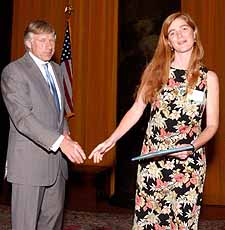
Columbia
Univ. President Lee C. Bollinger
(a member of the Pulitzer
Prize board)
presents Samantha Power with the 2003
Pulitzer Prize in General Non-Fiction, a
"distinguished" book "not eligible for
consideration in any other category." She
received $7,500, and the jurors were
Richard Bernstein, New York Times
book critic, Diane Ackerman, and
Patricia Limerick, a "professor of history." |
It does not even occur to professional
and fair journalists to look over the shoulders of agenda-ridden
"genocide scholars" such as Samantha Power. Because people like
Power are anti-genocide, they must automatically be considered
"good." Historians, too; "This is a serious and compelling
work," beamed Yale University's Professor of History, Paul M.
Kennedy. (Not to be confused with Stanford University's David M. Kennedy,
another historian and professor, who served on the Pulitzer board that awarded
Power's prize, along with eighteen others. Dr. David also won a Pulitzer
Prize... but now we know how much these are worth.) It does not even occur to
these people to scrutinize the value of the sources involved, because they are
all on an "anti-genocide" mission. Thus, it becomes a breeze for a
propagandistic book such as "A Problem from Hell" to win a
Pulitzer Prize. (Prof. Paul Kennedy tarnished his reputation by co-editing the
propaganda book, "America and the Armenian Genocide of 1915 ," along
with Yale colleague, Jay Winter.)
Many of us have lived through the reportage of such modern genocides as the
ones in Bosnia and Rwanda. (Along with many others that might be classified as
"genocide," stressing what Power likes to stress, the "in
part" part of the 1948 U.N. Convention... but which were not politically
worthwhile to dwell upon, in the hypocritical Western world.)
I remember my own outrage while these events were transpiring, particularly in
Bosnia. The point of Power's book is that America dragged her feet before
doing anything, and that we must all be on greater guard, in order to prevent
genocides in the making. That's all very noble, but is it realistic?
Of course it is not. All countries have their own problems, even a great one
as the United States, and it will always take time before a country decides to
sacrifice their resources, sons and daughters in pursuit of a hazardous cause.
So this contention is very idealistic, but with all idealism, carries great
naiveté. It was awful for the USA to wait as long as it did before
intervening in Bosnia. (In Rwanda's case, the USA totally ignored the mess,
with disastrous memories of Somalia fresh in mind.) As Power's book reminds
us, the USA even went beyond its awfulness, by closing the doors on the
Bosnians to acquire weaponry. That last decision was inexcusable, but the fact
that no country is going to unselfishly jump in to fight injustice is to be
expected.
(A related question was raised for Raphael Lemkin by the New York Times'
A. M. Rosenthal, on p. 55 of Power's book... regarding whether a genocide
convention would actually prevent a Hitler or Stalin from committing mass
murder. Lemkin's reasoning was that if a law is on the books, perpetrators
will think twice, in time: "Only man has law. Law must be built, do you
understand me? You must build the law!")
Another problem lying directly at the root of the genocide industry is what
constitutes a genocide? Genocides have become a political animal. People not
in favor are free to be demonized, and people who have taken pains to be
looked upon sympathetically, or have great political power, sit prettily.
For example, there are terrible, terrible events happening in Darfur, at the
time of this writing. Technically, though, is it a "genocide"?
Naturally, those who feel they hold the moral high ground can quickly brand an
example of inhumanity a "genocide." But even with the broadly
written 1948 U.N. Convention, there are rules. The words may be interpreted
differently by different people. Facts get thrown by the wayside;
agenda-ridden folks or propagandists hope to get mileage out of the emotional
value of the word "genocide," cashing in on the Nazi-Jewish
prototype.
At the time of this writing, Israel has unleashed massive violence on a
segment of the Lebanese populace because (as the surface explanation has it)
terrorist groups have captured two Israeli soldiers. Of course, this isn't
really genocide. Yet "genocide scholars" are often quick to label
other examples where thousands of innocent civilians suffer via the aggressive
actions of a state as "genocide."
But Israel is not on the list of "villains," so they get a pass.
"Israel has a right to defend itself," we are told. Yet when PKK
terrorists cause havoc in Turkey (for example, they have acquired the
technology to now kill officers deep inland by remote control, which is far
worse than being captured), and Kurds get killed when Turkey responds, we are
sometimes told that Turkey is committing a "genocide" on the Kurds.
Turkey is prominently on the list of the genocide industry's list of
"villains."
It is this vicious double standard that exposes the "genocide
scholars" to be the agenda-ridden hypocrites that they are. Those such as
Samantha Power are accepted as serving the forces of "good." In
fact, by designating the victims and villains, and by frequently distorting
the facts, the genocide crowd serves the forces of evil.
They perpetrate racism and hatred against the people they tell you are not
worthy. And they turn a blind eye to the ills of the people they tell you are
worthier.
|
|
|
| Continuing
with Samantha Power's "Armenian Genocide" Distortions |
We're picking up where we left off with Power's first chapter of "Race
Murder," so please consult "Part I" of this series, the link for which
is at the top of this page.
Samantha Power makes sure to tell us later in her book that the U.N. Convention is not
retroactive. it would have only been fair for her to have paid attention only to what may
be called genocides, appearing after the Holocaust.
She ignores a number of other "modern" episodes, such as British actions in the
1950s against the Mau Mau, or East Timor. Yet, she singles out the "Armenian
Genocide." She does not say anything about the countless other examples of "Man's Inhumanity Against Man,"
transpiring throughout history before the Holocaust.
Samantha Power evidently has a beef against Turks.
In fact, as she explores "modern" genocides in her later chapters, she
repeatedly brings up the example of the Turks.
She enjoys regarding herself as a "human rights" champion. Yet, by constantly
reinforcing the Turks as monsters (to the extent of comparing modern Turks with Nazis, as
she essentially did in PBS's "The Armenian Genocide"), we can see her motives are political. In her
view, Turks are not equal human beings, and do not deserve consideration during times the Turks have suffered "genocidally."
What can be said about a person who hides behind the veneer of championing human rights,
when the person regards some humans to be worthier than others?
|
Here
We Go!
|
"Part I" of this study encompassed basically the first three pages of
Power's first chapter. If we devote the same degree of attention for the rest of
Power's book, we'll soon be sinking in quicksand, because practically every word she
has written comes straight from the annals of Armenian propaganda. So we'll make an
effort to shoot for the highlights. (Or lowlights.)
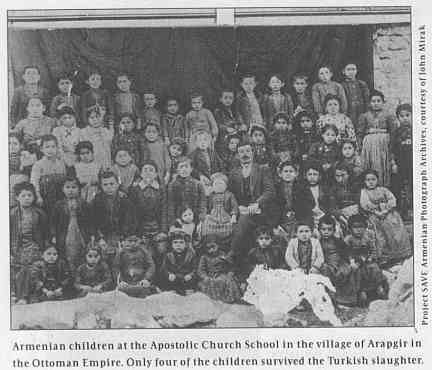
The photo of Armenian children above
is featured on p. 4 of Power's book, and Power has written: "Only four of the
children survived the Turkish slaughter." Could it have been John Mirak,
credited with the photo, who simply made such a claim? Whomever made this claim
that would be so exceptionally difficult to verify, is it not awfully
irresponsible of our "genocide scholar" to simply accept some
agenda-ridden propagandist's "word"? It's highly unethical and
disgraceful to make a charge of "slaughter" if there is no proof.
Furthermore, is it not just as awful for reviewers and "historians" who
have lauded this book to not have their alarm bells go off when they read a
caption such as this ? The first question that should have entered the mind of any
responsible party would have been, "How do you know?" And yet, they
were all accepting of the dubious sources Power has presented... so their
unprofessional lack of questioning is hardly surprising.
Power:
Britain and France were at war with the Ottoman Empire and
publicized the atrocities. The British Foreign Office dug up photographs of the
massacre victims and the Armenian refugees in flight. An aggressive, London-based,
pro-Armenian lobby helped spur the British press to cover the savagery.9
Footnote 9: "The Friends of Armenia, the Anglo-Armenian
Association, and the British Armenia Committee secured meetings with senior
British policymakers. Just beginning his scholarly career, British historian Arnold Toynbee joined the British
Armenia Committee's propaganda subcommittee and published a pamphlet in 1915 that
accused the Ottomans of planning 'nothing less than the extermination of the whole
Christian population within the Ottoman frontiers.' Arnold Toynbee, Armenian
Atrocities: The Murder of a Nation (London: Hodder & Stoughton, 1915), p.
27." (Holdwater: Power also cites the murderously
propagandistic "The Treatment of Armenians in the Ottoman Empire,
1915-16"; the propaganda subcommittee Power refers to above was only in
operation in 1920; see Nassibian,
p. 49. Power was referring to Wellington House, the propaganda division of his
country, erroneously crediting this private pro-Armenian group instead.)
"Britain and France were at war with the Ottoman
Empire," which means Britain and France had every reason to show the
Ottomans to be wicked beasts, given that Britain and France, along with Russia,
were planning to gobble up the
Ottoman Empire. This means the last people we want to listen to in order to get at
the truth would be "Britain and France." Arnold Toynbee's
"scholarly career" took a great unscholarly detour when he agreed to
serve as Wellington House war propagandist, which emphasized demonization of the
enemy. Toynbee was not proud of this chapter of his career, denouncing the work as
"war propaganda." (Pg. 50 of 1922's “The Western Question in Greece
and Turkey.”)
Arnold Toynbee, as editor of The Bryce Report, the Blue Book of the British (F.O.
371/3404/162647, p. 2), in a memorandum dated 26 September 1919, wrote the
following, when the British propaganda services were alarmed about newspaper
accounts mentioning the treachery of the Armenians: "To lessen the credit
of Armenians is to weaken the anti-Turkish action. It was difficult to eradicate
the conviction that the Turk is a noble being always in trouble. This situation
will revive this conviction and will harm the prestige not only of Armenians, but
of Zionists and Arabs as well. The treatment of Armenians by the Turks is the
biggest asset of his Majesty’s Government, to solve the Turkish problem in a
radical manner, and to have it accepted by the public."
Now where in the world could Britain have "dug up
photographs of the massacre victims," since the British were no longer
present on Ottoman soil? We keep seeing the same unverified photos of dead people
in Armenian genocide web sites, some so underhanded they actually have used
verified photos of massacred Turks, in the hands of Armenians. (But what do we
expect from our "human rights" champion who writes that only four
children from the above photo were "slaughtered," when she has no way of
proving it?) Pictures of "Armenian refugees in flight" would be more
believable, but are shots of people in wartime panic or suffering supposed to
serve as proof that there was a systematic plan to eliminate them?
By pointing to enemies of Turkish people to "prove" her claims, what
Samantha Power the Irishwoman is doing is no different than if someone else with
an ax to grind against the Irish would do to show how "bad" the Irish
are. There are plenty of examples of English sources throughout history who spoke
disparagingly of the Irish, particularly during times of conflict. Let's say an
agenda-ridden party refers solely to examples of Irish-committed atrocities after
1916, in Ireland's guerilla struggle, and documented by the English. Would it be
ethical of anyone to compile a list of such biased sources to demonstrate that the
Irish are simply no good? Samantha Power would hate that, but look at what she is
doing. The sources she uses to prove her case are nothing less than a travesty.
But some had trouble believing the tales. British foreign
secretary Sir Edward Grey, for one, cautioned that Britain lacked "direct
knowledge" of massacres. He urged that "the massacres were not all on
one side" and warned that denunciation would likely be futile.
Footnote 10: Sir Edward Grey to Sir Francis Bertie, British
ambassador to France, May 11, 1915, cited in Gary Jonathan Bass, Stay the Hand
of Vengeance: The Politics of War Crimes Tribunals (Princeton: Princeton
University Press, 2000), pp. 115, 348-349.
So here we have a British man of integrity, brave enough to allow honor to
supersede his duty to his country's wartime propaganda, similar to C. F. Dixon-Johnson. But his opinion
was shared by only a mere handful; the British Press would insure that almost all
the people in Great Britain would accept the savagery of the Terrible Turk as a fact.
(Note Grey's message was dated before the relocation, or "genocide,"
began.) The irony here, of course, is that Grey's information that the Armenians
had conducted massacres are presented as a point of ridicule by the agenda-ridden
Samantha Power. (Understandable, as she has made not one reference to crimes of
Armenians.)
After informing us of the May
24 Entente declaration, Power tells us the Allies were too busy trying to win
the war (p. 5), to do much about helping the Armenians... who happened to be
revolting against their country at the behest of the Allies. "At
the same time the Turks were waging their campaign against the Armenian minority,
the German army was using poison gas against the Allies in Belgium. In May 1915
the German army had torpedoed the Lusitania passenger liner, killing 1,200
(including 190 Americans)."12
Footnote 12. Jay Winter, "Under Cover of War: Genocide in
the Context of Total War," paper presented at the National Holocaust
Museum, Washington, D.C., September 28, 2000. Her "May
24" source was The New York Times, and Power elaborated: "Most
Europeans identified with the Armenians' suffering because they were fellow
Christians. But when the Russians suggested condemning 'crimes against
Christianity,' it seemed too parochial, and the phrase 'crimes against humanity
and civilization' was chosen instead." Perhaps Russia chose to specify
"Christianity" as a means to let Russia off the hook for Russia's crimes against "Judaism"
that the hypocritical Allies chose to ignore. One of the reasons to demonize Turks
stemmed from the Allies' wish to take the heat off Russia, heat that threatened to
steer the USA away from joining the Allies. No mention in Power's book, by the
way, of Russia's WWI crimes.
Jay Winter is a full-fledged member of the profitable genocide industry who
presided over the propagandistic PBS show, "The Great War." (Even though in that show's book version,
Winter contradicted himself, writing the relocation program was "not genocide.")
Regardless of how Winter depicted the actions of WWI Germany, it is unconscionable
of Power the anti-scholar to present only the view that helps with her
agenda. Here, she seems determined, for some odd reason, to show the
"Hun" was a beast in its own right. (Perhaps this is her way of getting
back at Germany, as she began the "Recognition" part of her chapter with
Germany's covering up "Talaat's campaign." Power was wrong on this count, as well.)
 |
|
Could
Power have imagined
she was in the hairy arms of
"The Hun"? |
Indeed, there were times Germany behaved
miserably during the war, as all nations have a tendency to do during war, but it
appears Power is still fully in line with the British propaganda of the period.
Germany was using gas, but so were the Allies. (The British reportedly used
chemical weapons against the Turks, in the Gallipoli invasion.) Some accounts have
it that Germany torpedoed ships with warning at the outset, and changed policy
only after the Allies torpedoed without warning. As for the Lusitania, Germany
issued a traveller's warning in America that "vessels flying the flag of
Great Britain or any of her allies are liable to destruction." One torpedo
was fired, but there were two explosions, probably the result of a secret cargo of
heavy munitions on the ship. The rules of warfare required that civilian ships
were not to carry ammunition. (Britain claimed the second explosion was caused by
coal dust igniting.)
 |
|
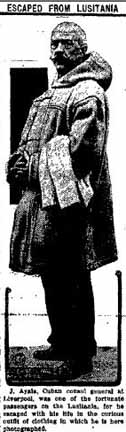
"Escaped
From
Lusitania" — J. Ayala,
Cuban consul general
of Liverpool, was one
of the fortunate
passengers on the
Lusitania, for he
escaped with his life in
the curious outfit of
clothing in which he is
here photographed."
(The Pinedale
Roundup, Wyoming,
1915) |
(The Daily Kennebec Journal, on May
28, 1915, offered what must have been the prevailing thought on the warning
loophole: "Rattlesnake Gives Warning. [Bath Times] The rattlesnake
gives warning too, but he is not regarded as a highly desirable citizen. That is
the way the New York World sums up in 15 words all there is to be said about the
sinking of the Lusitania.")
.Howard Zinn ("A People's History of the United States," 1980):
"It was unrealistic to expect that the Germans should treat the United States
as neutral in the war when the U.S. had been shipping great amounts of war
materials to Germany's enemies...The United States claimed the Lusitania carried
an innocent cargo, and therefore the torpedoing was a monstrous German atrocity.
Actually, the Lusitania was heavily armed: it carried 1,248 cases of 3-inch
shells, 4,927 boxes of cartridges (1,000 rounds in each box), and 2,000 more cases
of small-arms ammunition. Her manifests were falsified to hide this fact, and the
British and American governments lied about the cargo."
At least Power did not insist the Germans had bayoneted Belgian babies. (Although
she will actually try to legitimize anti-German propaganda later
in her book.) Such claims were so awfully invented by British war propagandists,
the British apologized to Germany in 1936 for the fabrications in their Blue
Books. Since Turks are low men on the totem pole, no similar apology to the Turks
was issued for similar lies. In this day and age, propagandists like Samantha
Power are still citing British Blue Book references, as Power has done with
Toynbee's The Treatment of Armenians in the Ottoman Empire.
Power next tells us that Wilson had not joined the Entente's May 24 declaration to
maintain the neutrality of the USA (does Power have evidence that the USA was even
asked to join this declaration?), yet Amb. Henry Morgenthau would emerge as a sort
of America's conscience:
In January and February 1915, Morgenthau had begun receiving
graphic but fragmentary intelligence from his ten American consuls posted
throughout the Ottoman Empire. At first he did not recognize that the atrocities
against the Armenians were of a different nature than the wartime violence. He was
taken in by Talaat's assurances that uncontrolled elements had simply embarked
upon "mob violence" that would soon be contained.13
Footnote 13: The 2000 reprint of "Ambassador Morgenthau's
Story," mysteriously requiring the services of "Editor" Peter
Balakian.
If Talat Pasha explained the violence against Armenians was coming from
uncontrolled elements, Talat Pasha was being 100% truthful. If the idea was
extermination, after all, the majority of Armenians could not have survived. Power
agrees a million survived. The
original pre-war population hovered around 1.5 million, and the bulk of those who
lost their lives died of famine and disease, the same causes claiming the lives of
"thousands" of Turks daily, as Morgenthau had written in his "Story" book. Morgenthau is also on
record, as quoted by Vahan Cardashian in an early 1916 letter to Lord Bryce, for
agreeing that the "genocide
had all but run its course," as even Vahakn Dadrian had put it. [The
Armenian Review, Winter 1957, p. 107.] If the idea was "Race
Murder," why stop in early 1916, when the majority was still alive and
kicking? Morgenthau was also aware
central command was weak. When a federal government is not fully in control,
the odds for "uncontrolled elements" increase. The odds of a "Final
Solution" plan carried out by the central government similarly decrease.
Talat Pasha, in fact, sent a "cease and desist" "deportation"
directive in August 1915, but needed to keep re-issuing similar orders until
1916... since locals had different ideas, illustrating the weakness of central
command. (Guenter Lewy, "The Ottoman Massacres in Ottoman Turkey: A
Disputed Genocide.")
Morgenthau had various reasons for wanting the USA to hop aboard the war train.
His English-speaking Armenian secretaries had his ear, and Morgenthau developed a racist distaste for
matters Turkish. Knocking out the Turks would also quicken the path to a Jewish homeland. (The
Zionist Rabbi Stephen Wise was a close friend.) The fabrications Morgenthau
presented in his "Story" book were at odds with his personal communications. For example, the
"intelligence" he received made him fully aware that Armenians were, in
fact, rebelling in great
numbers. He didn't report the full story, because Morgenthau had an agenda.
Morgenthau was not an honest
man.
...[B]y July 1915 the ambassador had come around. He had
received too many visits from desperate Armenia and trusted missionary sources to
remain skeptical. They had sat in his office with tears streaming down their
faces, regaling him with terrifying tales. When he compared this testimony to
the strikingly similar horrors relayed in the rerouted consular cables, Morgenthau
came to an astonishing conclusion. What he called "race murder" was
under way.
BINGO! There you have it, ladies and gentlemen, the sources for not only
Morgenthau but for his gang of consuls. (Among whom, apparently only Leslie Davis took the trouble to have
a personal look-see.) Who in their right minds would trust missionaries, whose Godly duty, as
evidenced in their prayers, was to vilify the Turks? And it wasn't as though the
missionaries served as "eyewitnesses" for massacres. Mostly, they
observed suffering people. The missionaries were generally swayed because they
listened to teary-eyed Armenians. Too many Armenians , then and now, observe the
Dashnak "end justifies the means" principle. Missionaries and Armenians
have agendas, and do not serve as valid sources.
Westerners, particularly bigoted Christian westerners, and especially Americans,
having grown to be the most hostile thanks to relentless propaganda, were easy
prey to "terrifying tales," told by people with "tears streaming
down their faces." This is the kind of "evidence" that has
condemned an entire nation of "Race Murder": the hearsay of terrifying
tales.
 |
|
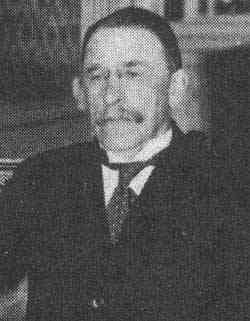
The
unethical Henry Morgenthau |
Power made certain to reproduce Morgenthau's
horribly prejudiced "July 10 cable" that he based on the hearsay of
Armenians and missionaries with tears streaming down their faces. It is the
professional duty of ambassadors to provide factual, honest, and unbiased
reporting about the countries where they serve. Morgenthau, however, had his own
agenda and prejudices. An Armenian representative had told Morgenthau half a
million resettled Armenians were doing relatively well, but that kind of tidbit
would only surface in his private entries. As Prof. Lowry summed up, "All
comments in Ambassador Morgenthau's Story notwithstanding, as late as September
1915, Morgenthau had not firmly concluded that the Armenians were the subject
of an attempted 'extermination' by the Young Turk leadership."
Local witnesses urged him to invoke the moral power of the
United States. Otherwise, he was told, "the whole Armenian nation would
disappear."15 The ambassador did what he could, continuing to send blistering
cables back to Washington and raising the matter at virtually every meeting he
held with Talaat. He found his exchanges with the interior minister infuriating.
Again and again, Silly Samantha Power demonstrates what an anti-scholar she
is. Heath Lowry's excellent research, "The Story Behind Ambassador
Morgenthau's Story," was available (see last link above) by the time
Power prepared her propaganda book. Lowry scoured Morgenthau's own diary and
letters, and Morgenthau's privately written words served to sink many of his
"Story" claims. In actuality, Morgenthau enjoyed a relatively good
relationship with Talat and Enver. When Morgenthau said good-bye, in fact, Talat
was kind enough to state how sorry he was to see him go, adding, "We feel
almost as though you were one of us." (Morgenthau changed the line to a meaner tone, upon the advice
of his ex-boss, Secretary of State Robert Lansing.)
Now why would Power present the idea that there was tension between Morgenthau and
Talaat, when the ambassador's letters and diaries stated otherwise? Either she did
not read the Lowry report, or more likely ignored what she had read, because the
truth did not fit in with her propagandistic agenda. She demonstrates
anti-scholarship also by referring to "Ambassador Morgenthau's Story"
(e.g., her footnote 15, above; of 49 total "Race Murder" footnotes, a
whopping one-seventh refers to the Story book) as though it were real history.
(George Schreiner, perhaps the only American correspondent who travelled into the
Ottoman interior in 1915 (see below) and concluded "no
genocide," was incensed at
Morgenthau's dishonesty, and wrote in his preface to “The Craft Sinister,”
"It is to be hoped that the future historian will not give too much heed
to the drivel one finds in the books of diplomatist-authors.” (That lets
Power off the hook somewhat, as she certainly is no "historian.")
|
What can be said of scholars working on the Armenian 'genocide,' who, in
publication after publication, over the past decades quote the outright lies and
half truths which permeate Morgenthau's 'Story' without ever questioning even
the most blatant of the inconsistencies?
Dr. Heath Lowry
"The Story Behind Ambassador
Morgenthau's Story" |
Talaat believed in collective guilt. It was legitimate to
punish all Armenians even if only a few refused to disarm or harbored seditious
thoughts. "We have been reproached for making no distinction between the
innocent Armenians and the guilty," Talaat told a German reporter. "But
that was utterly impossible, in view of the fact that those who were innocent today
might be guilty tomorrow."17
The fact is, the Armenian community as a whole was disloyal, thanks to fanatical
Dashnaks and Hunchaks' successful poisoning of relations. The loyal Armenians were
often made fatal examples of,
and by this time Armenians were "belligerents
de facto, since they indignantly refused to side with Turkey," as Boghos
Nubar put it in his 1919 letter to the Times of London. Leon Surmelian outlined how there was nary a loyal
Ottoman-Armenian to be found; captured Russian POWs would even be applauded at times
in the streets! The situation wasn't like Japanese-Americans
or French Alsatians "deported" in WWII; these groups were completely
innocent. By contrast, the terrorist committee men could expect local Armenian
villages to feed and otherwise take care of them. The situation was most dire for
the Ottoman Empire, attacked by superpowers on multiple fronts. Tolerating thousands
of armed Armenian traitors from behind-the-lines would not have been an option for
any nation; the traitors needed to be moved out. (It fact, self-defense is the duty
of a nation. No less a historian than the Armenian, Borian, reminded us in 1929: "It
is obvious that when a mass of ten thousand people revolt against the state behind
the military front, the idea of state entails the state rule and statesmen to take
responsible precautions to necessary defense.”)
Although Power is pointing to Talat's statement (Power's source for footnote 17: Ambassador
Morgenthau's Story) as words an obvious criminal would make, the grim
circumstances demanded no other recourse. Enver used similar reasoning in Power's
favorite historical source. Check out the sensibility.)
Power makes propaganda with her statement that "all" Armenians were
punished, but she is blowing her usual hot air:
|
The Armenians
of Istanbul, and the Armenians in the sanjak of Kutahya and the province of Aydin had
not been required to emigrate. The Armenians who at the present time are in the
sanjak of Izmit and in Bursa, Kastamonu, Ankara, and Konya, are those who had
emigrated from these areas, and who have returned. There are many Armenians in the
sanjak of Kaiseri, and in Sivas, Kharput, Diyarbekir, and especially in Cicilia and in
Istanbul, who have returned, but who are unable to go to their villages. The rest of
the Armenians of Erzurum and Bitlis are in Cilicia.
The Armenian Patrirch, elaborating after the late 1918 decree permitting Armenians to
return; British Archives, F.O. 371/6556/E.2730/800/44 |
Instead of hiding his achievements, as later
perpetrators would do, Talaat boasted of them. According to Morgenthau, he liked to tell
friends,"! have accomplished more toward solving the Armenian problem in three months
than Abdul Hamid accomplished in thirty years!"18 (The Turkish sultan Abdul Hamid had
killed some 200,000 Armenians in 1895-1896.) Talaat once asked Morgenthau whether the
United States could get the New York Life Insurance Company and Equitable Life of New
York, which for years had done business with the Armenians, to send a complete list of the
Armenian policyholders to the Turkish authorities. "They are practically all dead now
and have left no heirs,"Talaat said. "The Government is the beneficiary
now."'9 Morgenthau was incensed at the request and stormed out of Talaat's office.
Armenians rebelled in the mid-1890s, and it is the duty of any nation's leader to put down
rebellions. "The Turkish sultan Abdul Hamid had killed some 200,000
Armenians..." Samantha Power tells us, as if these events existed in a vacuum. Did
Abdul Hamid commit a "genocide"? An Armenophile of the period, Richard Davey, served as character witness:
It is impossible to withhold sympathy and respect
for a Sultan of such blameless private life as Abdul Ahmed, who works incessantly at what
he believes to be the welfare of his people. To accuse him, as I have seen lately, even in
respectable English papers, of being a sort of Tackleton who delights in tormenting his
Armenian subjects as that worthy did in scrunching crickets, is not only unjust but in
preposterously bad taste. In the first place, the Sultan is so free from the spirit oi
cruelty which disgraced some of his ancestors, that it is difficult to get him to sign
even the death-warrant of a murderer.
And did Silly Samantha Power "preposterously" indulge in further "bad
taste" by repeating the propagandistic figure of 200,000? The mortality of the
Armenians was more likely one-tenth
of that, and no one speaks — as usual — of the thousands of Turks killed by Armenians
during the same period. One rebel, Aghasi (or Aghassi), boasted in his diary of killing
20,000 Turks in one battle alone.
Regarding the above Power passage, the lady needs to bow her head in shame. Both anecdotes
are from her favorite historical source, Morgenthau's Story book, with invented words
placed between quotation marks. If Talat actually stated the first remark (a strange boast that he would make,
or that his "friends" would repeat, before the Armenian-friendly American
ambassador), about doing more in three months than Abdul Hamid's thirty years, he was not
referring to the concept of "extermination," but to distributing Armenians
around the empire, in order to reduce their tendency to rebel. (ADDENDUM,
Nov. 2006: Cover story from a newspaper
in Indiana, The Fort Wayne News, Oct. 7, 1915: "ENVER PASHA'S BOAST OF BLOODY
BUTCHERY; Glories in His Ruthless Slaughter of Helpless Christians. EMILY C. WHEELER Makes
a Sensational Statement Concerning the Atrocities of the Turks. NEW YORK, Oct.7.— 'It is
Enver Pasha's boast that he killed more Armenians in thirty days, than Abdul Hamid did in
thirty years. And Abdul Hamid was known as the "great butcher" and the "red
sultan".' This statement was made today by Miss Emily C. Wheeler, secretary of the
National Armenia and India Relief association, an organization which since 1895 has been
active in mission work in Turkish Armenia. Information on which her statement was based
was given her by a missionary, an Armenian physician just returned from Turkey.")
The worst crime Power commits,
however, is in her reproduction of the insurance anecdote. Prof. Lowry has shown that the
exchange was pure fiction, the reality being the opposite of what Morgenthau tried to
convey.
The New York Times gave the Turkish horrors
steady coverage, publishing 145 stories in 1915. It helped that Morgenthau and Times
publisher Adolph Ochs were old friends. Beginning in March 1915, the paper spoke of
Turkish "massacres," "slaughter," and "atrocities" against
the Armenians, relaying accounts by missionaries, Red Cross officials, local religious
authorities, and survivors of mass executions.
Such was an awful stain on the reputation of
perhaps America's most prestigious newspaper, a stain that the pro-genocide publication
carries to this day. Note the sources relied upon: bigoted religious fanatics, and Armenians. Both groups pursued the policy of
showing the Turks to be monsters.
On October 7, 1915, a Times headline blared, "800,000 ARMENIANS
COUNTED DESTROYED." The article reported Bryce's testimony before the House of
Lords... By December the paper's headline read, "MILLION ARMENIANS KILLED OR IN
EXILE."25 The number of victims were estimates, as the bodies were impossible to
count. Nevertheless, governmental and nongovernmental officials
were sure that the atrocities were "unparalleled in modern times" and that the
Turks had set out to achieve "nothing more or less than the annihilation of a whole
people."26
Footnote 26: "500,000 Armenians Said to Have
Perished. Washington Asked to Stop Slaughter of Christians by Turks and Kurds,"
NewYork Times, September 24, 1915, p. 2; "Says Extinction Menaces Armenia; Dr.
Gabriel Tells of More Than 450,000 Killed in Recent Massacres," New York Times,
September 25, 1915, p. 3. Gabriel was the Armenian (real name:
Gabrielian. See Armenian Review, 10:2, summer 1957, p. 66) president of an Armenian
organization, and was living in New York City at the time, a
propagandist who created numbers (a main source of his was Boghos Nubar, who referred to
atrocities that were "without precedent" in his "Nation's
Martyrology"; "450,000 Armenians Reported Massacred," Dallas News,
8-25-15. Must have been an example of one of Power's "officials"), unaware that
propagandists a century on would still be using him as a valid source.
Samantha Power is demonstrating her lack of morality by
showcasing what were purely propagandistic reports. (It was bad enough these hateful
fabrications were accepted wholesale in more "innocent" days, but Power is
helping them find a whole new audience.) She softens the blow by describing the figures as
"estimates," but that is not what the American reader thought, especially when
sources included the most trusted Briton in the USA, former Ambassador Bryce. (Bryce headed the Ottoman division of Wellington House, Britain's war propaganda office.) We can see
exactly how correct those officials were, with their deduction that the Turks were out for
"annihilation."
Witnesses to the terror knew that American readers would have
difficulty processing such gruesome horrors, so they scoured history for parallels to
events that they believed had already been processed in the public mind. One report said,
"The nature and scale of the atrocities dwarf anything perpetrated. . . under Abdul
Hamid, whose exploits in this direction now assume an aspect of moderation compared with
those of the present Governors of Turkey." Before Adolf Hitler, the standard for
European brutality had been set by Abdul Hamid and the Belgian king Leopold, who pillaged
the Congo for rubber in the late nineteenth and early twentieth centuries.27
Footnote 27: "Armenian Officials Murdered by Turks. Confirmation from
Cairo of the Wholesale Atrocities That von Bernstorff Belittles," New York Times,
September 30, 1915, p. 2.
There were no "witnesses to the terror." People were being
relocated, and many were suffering from famine and disease, similar to the 2.5 million
other Ottomans racist "human rights" champions prefer to remain invisible. The
occasional massacres left few witnesses. The genuine and rare witness took the form of this man.
It is bitterly laugh-provoking for Power to cite only two examples of "genocide"
before 1915, and one of them is, naturally, Turkish. One that occurred three years before
1915 took place in Europe proper, when murderous Greeks, Serbs, Bulgarians and
Montenegrins chased away 1.5 million Balkan Turks, totaling roughly the entire pre-war Armenian population,
and killing 600,000, paralleling the entire Armenian mortality who died mainly from
non-violent reasons. Only in the few years prior, we had Albanians (1912-13) getting
knocked off by Serbs, Hereros by Germans (1904-07), and Filipinos by Americans (early
1900s). All examples of "European brutality" were set by Europeans, not just
Belgium's Leopold. Name a genocide
throughout history, you'll find a European nation (or their descendants in America)
behind it. How utterly despicable of Samantha Power to make it appear as though the
Turks she hates basically "invented" genocide... even when there is no
factual evidence proving Turks ever committed a genocide.
Not incidentally, in her continuation of Footnote 27, Power instructs that even though
"the Congo population was cut 'by at least half' between 1880 and 1920," and
that "some 10 million people died as a result of Leopold's presence," Leopold
was still not as bad as Abdul Hamid, because the Belgian king was not aiming at
"wiping out one particular ethnic group." You've heard it here, folks; Silly
Samantha Power is actually telling us the aim of Abdul Hamid was to exterminate all of the
Armenians. Incredible!
Because the Turks continued to block access to
the caravans, reporters often speculated on whether their sources were reliable. "The
Turkish Government has succeeded in throwing an impenetrable veil over its actions toward
all Armenians," a frustrated Associated Press correspondent noted.
"Constantinople has for weeks had its daily crop of Armenian rumors. . . . What has
happened... is still an unwritten chapter. No newspapermen are allowed to visit the
affected districts and reports from these are altogether unreliable. The reticence of
the Turkish Government cannot be looked upon as a good sign, however."28
28. "Pleas for Armenia by Germany Futile," New York Times,
October 10, 1915. sec. 2,p. 19.
By this time in her chapter, Power has shifted from her reliance
upon Morgenthau to citing numerous New York Times reports. And yet she is admitting
here that the newspaper reportage was based upon rumors. She is providing what a
journalist reported as "altogether unreliable" to substitute for actual history.
Is that not absolutely incredible?
The fact appears to be, based on Co-Editor Jay Winter's propaganda book, "America
and the Armenian Genocide of 1915," journalists preferred to cover the more
glamorous Gallipoli chapter of the war, instead of trekking into the threatening Ottoman
interior. There was only one journalist who braved these waters and genuinely eyewitnessed
events firsthand, George Schreiner, and his verdict was "no genocide."
(He blamed the goings-on not on
"intentional brutality," but on "ineptitude.") Furthermore, not all
foreigners were barred from accompanying the caravans. Missionary Mary Graffam was permitted to go along on
one, which would have been ridiculous if the "intent" was to exterminate.
Graffam's verdict at the time of the events (although she sang a different tune in her
1919 memoirs): "no genocide." ("I am not in any way criticizing
the government. Most of the higher officials are at their wits end to stop these abuses
and carry out the orders which they have received, but this is a flood and it carries all
before it.")
Turkish representatives in the United States predictably blurred the
picture with denials and defenses. The Turkish consul, Djelal Munif Bey, told the New York
Times, "All those who have been killed were of that rebellious element who were
caught red-handed or while otherwise committing traitorous acts against the Turkish
Government, and not women and children, as some of these fabricated reports would have the
Americans believe." But the same representative added that if innocent lives had in
fact been lost, that was because in wartime "discrimination is utterly impossible,
and it is not alone the offender who suffers the penalty of his act, but also the innocent
whom he drags with him. . . . The Armenians have only themselves to blame."29
Footnote 29. "Turkish Official Denies Atrocities," New York
Times, October 15,1915, p. 4.
Sorry, Samantha Power. Everything claimed above conforms 100% to the
actual history of what went on; Djelal Bey's "all killed were rebels" was
referring to those killed directly by government forces. Armenian women and children who
were massacred died at the hands of "uncontrolled elements," as Talat Pasha put
it above. If the idea was for the government to kill all Armenians, the
"genocide" would not have "all but run its course" in 1916, as
Dadrian himself vouched for, and the majority of Armenians could not have survived. If
there is proof that the Ottoman government was involved, such proof has yet to be found.
(Silly Samantha certainly has produced no evidence, simply offering the drivel of
Ambassador Morgenthau and the "altogether unreliable" New York Times,
based on "rumors.") And were the Armenians to blame? If they Fired the First Shot, they surely were
culpable.
"The culpability of Armenians leaves no doubt."
Philippe de Zara, Mustapha
Kemal, Dictateur (Paris, 1936)
|
"Do you believe that
any massacres would have taken place if no Armenian revolutionaries had come into the
country and incited the Armenian population to rebellion?' I asked Mr. Graves. (British
consul, Erzurum.)
'Certainly not,' he replied. 'I do not believe that a single Armenian would have
been killed.'"
Sydney Whitman, Turkish Memories (1914), p. 94. The above exchange took place
during the mid-1890s (the period where Power dumbly points a finger at Abdul Hamid for
intentional extermination), as was a similar account from 1895, entitled "The Armenian Troubles
and Where The Responsibility Lies." The same principles apply to the
"1915" period. Whomever begins the violence must accept the responsibility
for the repercussions. The Turkish consul was entirely correct in concluding, "The
Armenians have only themselves to blame." No less an authority than the
Armenian Republic's first prime minister practically said as much, in 1923.
|
The Turks, who had attempted to conduct the massacres
secretly, were unhappy about the attention they were getting. In November 1915
Talaat advised the authorities in Aleppo that Morgenthau knew far too much. "It
is important that foreigners who are in those parts shall be persuaded that the
expulsion of the Armenians is in truth only deportation," Talaat wrote.
"It is important that, to save appearances, a show of gentle dealing shall be
made for a time, and the usual measures be taken in suitable places." A month
later, angry that foreigners had obtained photographs of corpses along the road,
Talaat recommended that these corpses be "buried at once," or at least
hidden from view.30
In the first part of this look at Samantha Power's Hell Problem, I wondered about a
fishy quote Power had utilized. There was, after all, a practical industry of
unscrupulous characters, from Morgenthau on down, who put words into Talat Pasha's
mouth. Getting the source of that quote (a stupid article written by the
genocide-obsessed Julia Pascal) is what made me finally dig up a copy of Power's
"Pulitzer Prize winning" book. At the time, I wondered whether the
suspicious quote was an Andonian forgery,
perhaps?
Well, Samantha Power has done it. She truly has proven herself to be "an
idiot."
Her source here is "30. George R. Montgomery...'Why Talaat Pasha's Assassin Was
Acquitted,' Current History, July 1921, p. 554," the brunt of which may be
accessed at bottom of TAT's "Soghoman
Tehlirian's Trial" page. George R. Montgomery was the highly propagandistic
director of the Armenian-America Society, not exactly what a genuine scholar would
accept as a trustworthy source. Talat's orders to Aleppo were fabricated by Aram
Andonian. Indeed, even the 1921 Berlin kangaroo court rejected the Andonian
forgeries, but that did not stop the immoral George R. Montgomery from using them in
his article for the equally immoral New York Times, which published the
article without question.
 |
|
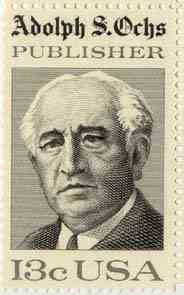
Morgenthau's
pal, Adolph Ochs,
honored on a U.S. postage stamp. |
On one hand, we can almost excuse both
Montgomery and the New York Times (as Power reported earlier,
the Times' publisher, Adolph Ochs, was a close chum of Henry Morgenthau),
since they were products of viciously anti-Turkish times, but in our new and
enlightened age of Samantha Power's "Human Rights," by what justification
can Samantha Power perpetuate these awful lies? Is she really that stupid,
being unaware of these discredited documents? Or is she being unethically clever,
and using false documentation knowingly, as does Vahakn Dadrian? (For whom the
validation of the Andonian documents serves as his greatest embarrassment, assuming Dadrian is capable of
embarrassment.) Since Samantha Power is no scholar, we can't explain why she would
stoop so low... given the validity of the racist sources she has used as a whole, it
is possible she is that dim-witted. Suffice it to say, those who point to the
Andonian work operate on the same level as the anti-Semite who points to the
Protocol of the Elders of Zion, to demonstrate how "evil" the Jews are.
(To further illustrate the falseness of Talat's words that Samantha Power would ask
you to accept as genuine, the reader may look at the diary of a resettled Armenian teen-ager, who was present in
Aleppo. See if you can find evidence of Talat's "usual measures.")
Power next touches on the money Morgenthau and others were able to raise for the
Armenian cause, and recruits the powerful voice of one of America's greatest
presidents, Theodore Roosevelt, who "wondered how anyone
could possibly advise neutrality 'between despairing and hunted people, people whose
little children are murdered and their women raped, and the victorious and evil
wrongdoers.'"
Roosevelt actually serves as an excellent example to offset Samantha Power's
"moral" position, the theme of her book, that we must act fast in order to
prevent genocides. The problem of jumping in without knowing the real facts can be a
worse crime than not jumping in at all, akin to lynching a man on the spot, on the
say-so of the town's mob. The Ottoman Turks did not commit a state-sponsored
genocide. All the factual evidence points to the contrary, and all the "evidence" Power is
supplying, as can readily be seen, derive from corrupt and conflicted sources. Okay,
Roosevelt was a swashbuckling adventurer and "Rough Rider" in his day, a
romantic image to be sure, but if his desire to "smash" (as he wrote that
he would love to do with both Spain and Turkey; he had his chance to
"bully" the former power that was similarly on last legs) was based on his
own prejudices, then why should we heed the opinion
of Theodore Roosevelt? (Roosevelt was an advocate of the "whites are
superior" notion, prevalent during his time period.)
|
| |
Morgenthau tried to work around America's determined
neutrality. In September 1915 he offered to raise $1 million to transport to the
United States the Armenians who had escaped the massacres. "Since May,"
Morgenthau said, "350,000 Armenians have been slaughtered or have died of
starvation. There are 550,000 Armenians who could now be sent to America, and we
need help to save them." Turkey accepted the proposal, and Morgenthau called
upon each of the states in the western United States to raise funds to equip a ship
to transport and care for Armenian refugees. He appealed to American self-interest,
arguing, "The Armenians are a moral, hard working race, and would make good
citizens to settle the less thickly populated parts of the Western States."36
He knew he had to preemptively rebut those who expected Armenian freeloaders. But
the Turks, insincere even about helping Armenians leave, blocked the exit of
refugees. Morgenthau's plan went nowhere.37
This one is really a dilly. Once again, Samantha Power demonstrates herself to be an
"idiot."
 |
|
The
Oct. 3, 1915 Dallas News report |
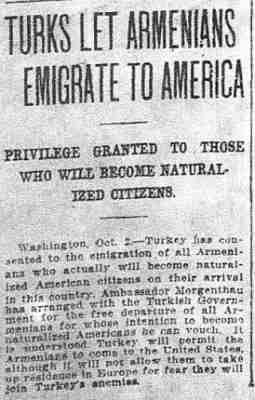
Here is where the reader can tune in, to get a better idea
of Morgenthau's million dollar plan. The episode actually serves to demonstrate there
could have been no genocide.
At right is a clipping from the Dallas News (thanks to reader Cihan) from
Oct. 3, 1915. "TURKS LET ARMENIANS EMIGRATE TO AMERICA
— Privilege Granted to Those Who will Become Naturalized Citizens." (A
grand policy continued in the USA,
even when it comes to convicted Armenian terrorists.)
Washington, Oct. 2 — Turkey has consented to the emigration
of all Armenians who actually will become naturalized American citizens on their
arrival in this country. Ambassador Morgenthau has arranged with the Turkish
government for the free departure of all Armenians for whose intention to become
naturalized Americans he can vouch. It is understood Turkey will permit the
Armenians to come to the United States, although it will not allow them to take up
residence in Europe for fear they will join Turkey's enemies."
(As if coming to America, ballooning the Armenian population to a huge one million
or so in less than a century, would have prevented the Armenians from becoming
"Turkey's enemies.")
Here is an example among so many others demonstrating the good heart of the Turks.
Did this plan move ahead? If not, there could have been reasons... perhaps the
required money was not raised. (In the article linked above, we learn Morgenthau
really needed $5 million.) (ADDENDUM: Or perhaps the U.S. government, heeding
immigration law, balked at admitting such a large number of "professional
beggars" — to borrow the phrase of Col. William Haskell — as in an earlier period.) Whatever happened,
however, Samantha Power cruelly informs us, "But the
Turks, insincere even about helping Armenians leave, blocked the exit of refugees.
Morgenthau's plan went nowhere." Even when the Turks do good, Power must
show they are bad.
But here's the clincher: Power's source, footnote 37, "Turkey
Bars Red Cross," New York Times, October 19,1915, p. 4."
The reader may access this article online at a popular Armenian propaganda site. We
can see the topic has nothing to do with Morgenthau's $1 million plan. The article,
as the headline sums up, is all about how the Red Cross would not be permitted to
travel into the Ottoman Empire, in order to help the Armenians. There is nothing
about Armenian immigration to the USA. There is one reference to Morgenthau by
article's end: "We find it also difficult at present,
almost impossible, in fact, to send supplies to Turkey, everything is in such a
fearful condition in Europe. We have notified those that desire to send
contributions for Armenian relief that we would transmit them through the American
Ambassador at Constantinople, as this seems to be the only method at present of
aiding the Armenian population."
The above was written by "Miss Mabel Boardman of the executive staff of the
American Red Cross." It was a private letter written to "Dr. M.
Simbad Gabriel ... the President of the Armenian General Progressive
Association." The latter (an Armenian, as covered above)
simply made these private communications available to the New York Times
reporter, once again demonstrating how all of these anti-Turkish forces were working
together. In the article's conclusion, Dr. Gabriel somehow tied in Miss Boardman's
"We can't go" message with proof "in the eyes of all prejudiced
persons" (!) of "convincing evidence
of the truthfulness of the terrible stories that are coming out of Turkey regarding
the persecution, murder, and torturing of the Armenian people." Quite a
leap!
 |
|
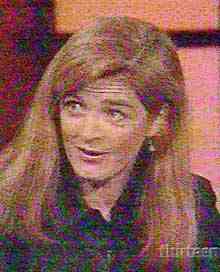
Bimbo
Scholar: Samantha Power. |
Can you imagine that Samantha Power pointed not
only to a bare-faced piece of propaganda, but one that had nothing to do with her
topic... offered as proof that "insincere" Turks "blocked the exit of
refugees"? Does our little "Human Rights" champion have any
scruples?
In point of fact, let's take a look at the time the Turks performed the reverse of
what this "Red Cross" article told us:
When the USA declared war on Germany, the USA became the nominal enemy of the
Ottoman Empire as well. Years beforehand, the missionaries and the more recently
arrived members of the Near East Relief could not have been more vicious toward the
Turks. In spite of these realities, Talat Pasha promised Ambassador Elkus that he
would let these Turk-hostile Christians stay and take care of the Armenians.
Perhaps this was the only time in history that a combatant country had given
permission to the citizens of another country fighting against its side to stay,
feed, clothe, treat, educate and give moral support to the people which it was
accused of exterminating. Turkish people, at this time, were starving to death
(thousands dying daily from famine, as Morgenthau told us in his "Story"
book), but Talat Pasha didn't even lay the condition that the Turks needed to be
taken care of, as well. This Turkish leader, whom Samantha Power is blackening the
reputation of as another Hitler, demonstrated in this instance that he was an
amazing humanitarian. (See Story of Near East Relief: 1915-1930, James L.
Barton, 1930).
Not all Red Cross personnel were adherents of propaganda, by the way:
America should feed the half million Turks whose
hinterland was willfully demolished by the retreating Greeks, instead of aiding the
Greeks and Armenians who are sitting around waiting for America to give them their
next meal. The stories of Turk atrocities circulated among American churches are a
mess of lies. I believe that the Greeks and not the Turks are barbarians.”
Colonel William Haskell, the American Red
Cross; returning from a tour of investigation in the Near East. Source: The Turkish Myth, 1923. Here is what the
colonel thought of the
Armenians, according to Dr. Richard Hovannisian.
|
| |
Lansing... expressed understanding for Turkey's security concerns."I
could see that [the Armenians'] well-known disloyalty to the Ottoman Government and the
fact that the territory which they inhabited was within the zone of military operations
constituted grounds more or less justifiable for compelling them to depart their
homes," Secretary Lansing wrote in November 1916.41 Morgenthau examined the facts
and saw a cold-blooded campaign of annihilation; Lansing processed many of those same
facts and saw an unfortunate but understandable effort to quell an internal security
threat.
[Secretary of State Robert Lansing to President Woodrow Wilson, November
21, 1916, in Papers Relating to the Foreign Relations of the United States: The Lansing
Papers, 1914-1920, vol. 1 (Washington, D.C.: GPO, 1939), p. 42.]
Samantha Power adds in her footnote that "Lansing was aware of the savagery of that
deportation." Yes, it was bad. The nation was bankrupt, and did not have sufficient
manpower and resources to do the job adequately. (The USA had plenty of both when
resettling their Japanese during WWII, and at least there were no massacres. Otherwise,
how much more humane were the Americans?) The
point is, however, that there was no "intent" for "genocide" on the
part of the Ottomans. So of these two perspectives, Morgenthau vs. Lansing, who was
correct? Morgenthau was affected by hugely biased Armenians and missionaries, and by his
own bigotry. Lansing could see the truth from a distance, with a cooler head. All the
factual evidence points to Lansing being right on the money: "an unfortunate but
understandable effort to quell an internal security threat." What a pity that
Samantha Power, like the rest of her "genocide scholar" ilk, has no use for
factual evidence.
More than 1 million Armenians had
been killed on Morgenthau's watch. Morgenthau, who had earned a reputation as a loose
cannon, did not receive another appointment in the Wilson administration.
Yet on the first page of her chapter, Power had written:
In 1915 Talaat had presided over the killing by firing squad,
bayoneting, bludgeoning, and starvation of nearly 1 million Armenians.
Looks like I owe Samantha Power an apology. In "Part I," I had written that she contradicted herself by writing
"nearly one million" in her book, and "more than one million" in the
joint New York Times letter she had written with Peter Balakian. Now it appears her
"nearly" figure related solely to the massacres in 1915.
(But wait a minute. Since Morgenthau scooted away in January 1916, what Power just told us
is that "more than one million" died in 1915, whereas before she had written
"nearly" for the same year. Unless the difference of "nearly" and
"more" transpired in that portion of 1916's January — which could
not have been the case — she contradicted herself after all. I now reckon if she adds
the Armenians who died in 1916-1923, her total for the "killed" might be three
or four million.)
Her Footnote 2:. "Estimates of the number of Armenians who died
in 1915-1916 vary widely. Some Turkish historians claim just 200,000 Armenians were
killed, mainly in the legitimate suppression of rebellion. See, for example, Stanford J.
Shaw and Ezel Kural Shaw, History of the Ottoman Empire and Modern Turkey, vol. 2
(Cambridge: Cambridge University Press, 1977), pp. 315-316. Armenian sources often place
the figure at more than 1.5 million; see Ronald Grigor Suny, Looking Toward Ararat:
Armenia in Modem History (Bloomington: Indiana University Press, 1993), p. 114; Robert
F. Melson, Revolution and Genocide: On the Origins of the Armenian Genocide and the
Holocaust (Chicago: University of Chicago Press, 1992), p. 147. British historian
Martin Gilbert estimates that some 600,000 Armenians were killed in massacres committed in
Anatolia and an additional 400,000 died as a result of the brutalities and starvation
inflicted upon them during the forced deportations from Anatolia into the deserts of Syria
and Mesopotamia; some 200,000 Armenians were forcibly converted to Islam. See Martin
Gilbert, The First World War: A Complete History (New York: Henry Holt, 1994), p.
167."
Let's say it once again: the pre-war population of the Ottoman-Armenians hovered around
1.5 million. Samantha Power agrees one
million died. 1.5 million minus one million cannot possibly equal "more than one
million." The only way such a sum could be possible is if one takes the propagandist
pre-war figure of the Armenian Patriarch, 2.1 million. But even the Patriarch offered a
different number (1.85 million) elsewhere, and broke
down his bloated 2.1 million figure as such: 1,260,000 survivors, 840,000 dead.
Even the propagandistic Armenian Patriarch did not go into the stratosphere, regarding the
Armenian dead, as has the even more propagandistic Samantha Power.
 |
|
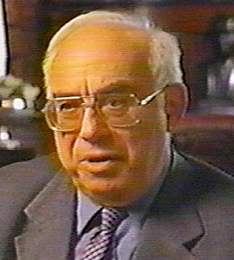
Prof.
Stanford Shaw from the documentary,
THE DESPERATE HOURS. Shaw was
forced to retire from UCLA after constant
harassment by Armenians, directed in large
part by his colleague, Richard Hovannisian. |
Stanford J. Shaw is not a "Turkish" historian, as
ethics-challenged Silly Sammy states above. Most Turkish and pro-Turkish (i.e.,
pro-"Truth," in the case of non-Turks) historians agree the mortality ranged
between 300,000 to 600,000, so it is misleading for Power to have given
"200,000" as the standard example. Kamuran Gurun provided compelling reasons as
to why the figure could have approached 300,000.
The scholar who went straight down the middle of what both sides had to offer, Prof.
Guenter Lewy, settled on slightly over 600,000. When asked as to why these estimates can
go as high as 1.5 million, Lewy replied: "Unfortunately
many Western scholars and parliamentary bodies simply repeat the Armenian allegations
without critical examination as to their veracity."
(ADDENDUM, 4-07: "200,000"
as the total Armenian mortality was a figure not restricted solely to "Turkish
historians." The Armenians themselves said "more than 200,000" at the 1919
Preliminary Peace Conference, in Paris.)
Here I figured Suny was a little more "reasonable" Armenian propagandist.... did
he actually go as high as "more than 1.5 million"? (Wow.) Melson is not to be taken seriously, and
neither is Martin Gilbert. ("...[S]ome 200,000 Armenians were forcibly converted to Islam."
Brother! It's likely Gilbert's source was Christopher J. Walker's Armenia: The Survival
of a Nation. The way Armenian propaganda manages to multiply, not a few cockroaches
must be envious.)
(By the way: it is a near certainty that Power, our sorry scholar, did not go anywhere
near the work of the Shaws. Allergic as she is to any information opposing her dogma, she
simply must have picked up that tidbit as reference provided in a paper by Vahakn Dadrian,
or another pro-Armenian propagandist. In a report written by Yuksel Oktay — see link,
page bottom — Power claimed at a book signing that she read Shaw's book along with
others offering the same perspective, and that her book was
the result of seven years of research. If this is the case, she has no excuse for writing
the biased and untruthful book she has written.)
|
|
In early 1919 the British, who
still occupied Turkey with some 320,000 soldiers, pressured the cooperative sultan
to arrest a number of Turkish executioners. Of the eight Ottoman leaders who led
Turkey to war against the Allies, five were apprehended. In April 1919 the Turks set
up a tribunal in Constantinople that convicted two senior district officials for
deporting Armenians and acting "against humanity and civilization."
It is not ethical to call anyone an "executioner" unless the charge has
been proven, particularly if the accuser has studied law in an Ivy League
university.
This is Samantha's cue to get into the 1919-20 puppet Ottoman kangaroo courts, the
findings of which even the British
rejected as a travesty of justice. Imagine an occupying power holding a gun to
the head of the vanquished, and ordering the vanquished to... let's allow Vahakn Dadrian to tell you what the Allies
demanded: "Unless you prosecute and punish the authors of Armenian
deportations and massacres, the conditions of the impending peace will be very
severe and harsh."
Conscious of his place in history, Talaat had begun writing
his memoirs. In them he downplayed the scale of the violence and argued that any
abuses (referred to mainly in the passive voice) were fairly typical if
"regrettable" features of war, carried out by "uncontrolled
elements."
In other words, Power is implying Talat was guilty and the only reason he made sure
to write his memoirs was to, in a manner of speaking, "cover his ass."
Forget about how natural it is for figures who have played an important historical
role to want to make a record of what transpired. Even insignificant megalomaniacs
as Henry Morgenthau have been known to write memoirs. Here is a taste of those Talat memoirs.
Frankly, his words come across as refreshingly honest. Power provides some of them:
"I confess," he wrote, "that the deportation
was not carried out lawfully everywhere. . . . Some of the officials abused their
authority, and in many places people took the preventive measures into their own
hands and innocent people were molested." Acknowledging it was the government's
duty to prevent and punish "these abuses and atrocities," he explained
that doing so would have aroused great popular "discontent," and Turkey
could not afford to be divided during war. "We did all we could," he
claimed, "but we preferred to postpone the solution of our internal
difficulties until after the defeat of our external enemies." Although other
countries at war also enacted harsh "preventive measures," he wrote,
"the regrettable results were passed over in silence," whereas "the
echo of our acts was heard the world over, because everybody's eyes were upon
us." Even as Talaat attempted to burnish his image, he could not help but blame
the Armenians for their own fate. "I admit that we deported many Armenians from
our eastern provinces," he wrote, but "the responsibility for these acts
falls first of all upon the deported people themselves."47
There is nothing written in the above that does not conform 100% with historical
accuracy or common logic. Take for example, his statement that it is the
government's duty to prevent and punish abuses and atrocities. That's absolutely
true, and one strong piece of evidence that there could have been no genocide
is that the Ottoman authorities did punish those committing crimes against Armenians, over 1,600
such cases, some punished by execution. (A writer for a not-friendly German
newspaper was impressed during a
"genocide conference" that was avoided by Samantha Power's hypocritical
genocide club, although renegade club member Hilmar Kaiser participated.) Naturally,
however, during wartime especially, no matter how honorable a government is to
"go by the book," there will always be other factors to consider. For
example, only one American soldier was tried for the massacre of hundreds of
Vietnamese civilians at My Lai, and his (Lt. Calley's) punishment, before a period
of house arrest, was only three days' imprisonment. As a more recent example,
when the Abu Ghraib prison scandal in Iraq erupted, only a few scapegoat soldiers
were made examples of. Why? Because if the USA had gone all out to prosecute all of
its soldiers responsible for "abuses and atrocities," that would be very
bad for morale at home. There is still a war that is being fought. (And the war that
the Ottomans were fighting was not the kind that Americans are used to, safely away
from the homeland. WWI was a war that would determine either life or death for the
empire. It finally brought death.)
|
| |
To avoid further unrest, the Turkish authorities began releasing low-level suspects. The
British had grown frustrated by the incompetence and politicization of what they called
the "farcical" Turkish judicial system. Fearing none of the suspects in Turkish
custody would ever be tried, the British occupation forces shipped many of the arrested
war crimes suspects from Turkey to Malta and Mudros, a port on the Aegean island of
Lemnos, for eventual international trials. But support for this, too, evaporated.
"Incompetence"? Why, these are the very courts that Vahakn Dadrian loves to tell us were conducted so
professionally. The real reason why the British took over is because they decided to
conduct the trials in an honorable fashion; there was great pressure from their Muslim
subjects in India to do so.
It's unfortunate Power did not footnote the British gentleman who opined these trials were
"farcical." These trials were indeed farcical, but not for the reason Power
presents. The Ottoman lackeys of the British did all they could to condemn the accused
Turks. The reason why these trials were "farcical" is because they were
conducted under the directive of an occupying power, without due process in kangaroo court
fashion, and were illegal.
Samantha Power provides the usual Armenian propagandistic hogwash regarding why Malta fell
apart. (The anti-scholar predictably gets her facts wrong: "In November 1921 Kemal put an end to the promise of an international
tribunal by negotiating a prisoner swap." By November 1921, Malta was already
over.) The fact is, proven by no less a source than the British archives themselves, that
the British were still hard at work trying to dig up the judicial evidence to convict the
Turks, even after "Kemal seized twenty-nine British soldiers
whose immediate fates Britain privileged above all else," as Power explains as
to why Malta was doomed.
The one and only reason why Malta was called off was because the British could not find any real evidence. If the
British failed to find the evidence... the British, who were the masterminds behind the
Treaty of Sèvres (which Power complains was "denounced as treasonous" by
Mustafa Kemal, as if the charge were a frivolous one. This treaty pronounced the death sentence upon the Turkish nation,
and when the puppet Ottomans signed it, the act was nothing less than treasonous)... when
all the evidence was at their fingertips, including the Ottoman archives which the British
had appointed an Armenian to conduct research in, then honorable people can reach only one
conclusion: There was no genocide.
Power offers sparse footnotes to support the conclusion of her chapter's "Malta"
topic; here is the main thrust (Footnote 48):
Near the close of the twentieth century, the Serb perpetrators of
genocide in Bosnia would also evade international sanction by seizing European
peacekeepers as hostages in order to stave off NATO air strikes.
Is this woman actually equating the seizure of "neutral" European peacekeepers
to Kemal's seizure of actual enemy soldiers who were occupying his country? In retaliation
for the wrongful imprisonment of innocent men (naturally, pro-Armenians would choose to
regard the Malta detainees as "guilty" [or perhaps as "executioners,"
as Power herself helpfully put it a few paragraphs ago], but there is a little legal
concept required in the form of evidence. Otherwise, it's accepted the accused are
innocent until proven guilty. Perhaps Samantha Power was distracted, doodling Swastikas on
pictures of Turks, the day they covered that principle at Harvard Law School), Ottoman
personnel who were kept in a far-away prison in little better circumstances than those of
Guantanamo Bay, Kemal acted justly in giving the British a taste of their own medicine. We
can't expect such a partisan as Samantha Power to look at the picture fairly, of course.
And if our anti-scholar had made the effort to conduct responsible research, she
would have learned if the British considered anyone as "hostages," it wasn't the
British prisoners held by the Turks... but rather, the Turkish prisoners held by the British, in Malta.
|
Role Model
for the Genocide Scholar:
RAPHAEL LEMKIN
|
It was my intention to cover the rest of the book in more detail, but since I got
into exposing Power's lack of scholarship in the chapter regarding the
"Armenian Genocide," Samantha Power has tired me to the point of my
needing to take a powder. Let's touch on a few highlights.
Given Power's abysmal scholarly methodology, one would have rocks in the head to
accept whatever else she has to say at face value. You can simply call me Rockhead
now, as I'm going to accept her factoids on Raphael Lemkin. This is the first time
I'm learning about Lemkin in detail (Peter Balakian offered a Lemkin statement that
frankly, made Lemkin out to be a fool. See Footnote 23 on this page) and I'm not
that interested in conducting genuine research concerning the man's life. However,
you can be assured Lemkin is like a God in the genocide world, and Power was not
going to say anything "bad" about Lemkin. If anything, we are dealing with
a whitewashed look, the polar opposite of how Samantha Power has chosen to portray
Turks, as the embodiments of evil.
Lemkin is a "twenty-one-year-old Polish Jew studying linguistics at the
University of Lvov" (in descriptions of Lemkin, we must always be told that he
was a "Polish Jew"), and he engaged a professor in the topic of the
"Armenian Genocide."
Lemkin asked why the Armenians did not have Talaat arrested
for the massacre. The professor said there was no law under which he could be
arrested. "Consider the case of a farmer who owns a flock of chickens," he
said. "He kills them and this is his business. If you interfere, you are
trespassing." "It is a crime for Tehlirian to kill a man, but it is not a
crime for his oppressor to kill more than a million men?" Lemkin asked.
"This is most inconsistent."'
Irony of ironies! While Lemkin had an excellent point in the case of a despot who
deliberately murdered multitudes, the fact is, Talat can only be judged as having
killed "more than a million" if that annoying little matter as
"evidence" can be shown. We don't point to Andonian forgeries as
"evidence," as Silly Samantha Power has done. In this regard, we learn
that Raphael Lemkin was no different than Samantha Power.
(Lemkin had more of an excuse. He was living in a "Christian" country that
mainly provided Armenian propaganda as real history. The biased
"Christian" West never bothered to hear the side of the Turks. If one
hears only one side, it's very easy to come up with genocides. The situation is
little different today, alas, as anti-Turkish prejudice rages on, but in our modern
times, Samantha Power had easy access to much more information while Lemkin's
chances for perusal were limited. On an ethical level, then, although Lemkin will be
getting the criticism he well deserves — for allowing his prejudices to take
precedence — we can't compare his lack of ethics with those of our "Human
Rights" champion, Samantha Power.)
(And by the way; sadly, history has demonstrated that it was no crime at all for
"Tehlirian to kill a man." His example would be demonstrated time and time
again, in most trials of the rare Armenian terrorists who would get caught in future years. The degree of
anti-Turkish prejudice in the West is simply staggering.)
Lemkin was torn about how to judge Tehlirian's act. On the one
hand, Lemkin credited the Armenian with upholding the "moral order of
mankind" and drawing the world's attention to the Turkish slaughter.
Tehlirian's case had quickly turned into an informal trial of the deceased Talaat
for his crimes against the Armenians; the witnesses and written evidence introduced
in Tehlirian's defense brought the Ottoman horrors to their fullest light to date.
The New York Times wrote that the documents introduced in the trial
"established once and for all the fact that the purpose of the Turkish
authorities was not deportation but annihilation."3 But Lemkin was
uncomfortable that Tehlirian, who had been acquitted on the grounds of what today
would be called "temporary insanity," had acted as the
"self-appointed legal officer for the conscience of mankind."4 Passion, he
knew, would often make a travesty of justice. Impunity for mass murderers like
Talaat had to end; retribution had to be legalized.
Footnote 3. George R. Montgomery, "Why Talaat's Assassin Was
Acquitted," Current History, July 1921, pp. 551-555. Tehlirian lived out his
days in California.
Footnote 4. Several years later, in 1926, Lemkin learned that Scholom Schwarzbart, a
Jewish tailor orphaned in a pogrom in Ukraine in 1918, shot the Ukrainian minister
of war Semion Petliure in Paris. As in the Tehlirian case, the jury found it
difficult to acquit or condemn the bereaved assassin. They declared him
"insane" and then freed him. After the Schwarzbart trial, Lemkin wrote an
article describing the man's act as a "beautiful crime" and deploring the
absence of a law banning the destruction of national, racial, and religious groups.
Power has finally provided truth, with her statement: Tehlirian's
case had quickly turned into an informal trial of the deceased Talaat for his crimes.
The cursory two-day mockery of a trial offered (with the exception of Talat's wife)
only witnesses for the defense. Intense partisans having nothing to do with the
murder trial, such as Johannes Lepsius and Bishop Balakian, were asked to the
witness stand. As for Power's critical declaration, "The New
York Times wrote that the documents introduced in the trial 'established once
and for all the fact that the purpose of the Turkish authorities was not deportation
but annihilation,'" note the "George Montgomery" source. These
documents were not only not introduced in the trial, but they were the
Andonian forgeries. Shame, shame on Samantha Power, for perpetuating these
lies.
And isn't Footnote 4 revealing, as far as Lemkin's character, calling the murder of
a man "beautiful." I don't know how guilty this Semion Petliure was, but
even if he was responsible for the murder of every Jew who died in that pogrom, it's
not comforting for Lemkin to have condoned murder. And it does not say much about
his respect for law to have only been "uncomfortable" about vigilantism
substituting for legal convictions; he should have been outraged that murderers were
allowed to get off scot-free, regardless of the alleged criminality of their
victims. It was Lemkin's great prejudice and ignorance regarding the Armenian matter
(and at least prejudice regarding the Jewish one) that likely allowed him to be very
pleased with these acquittals. We expect honorable professionals to rise above their
human emotions, but he evidently entertained a kind of hero-worship Power displayed
toward Soghoman Tehlirian. (See "Part I," link page top.) Incidentally,
Power's words in Footnote 4 do not ring true. The juries in both cases did not find
it "difficult to acquit or condemn." They wholeheartedly chose to acquit,
and used "temporary insanity" as a loophole.
Lemkin had prepared a law that would prohibit the destruction
of nations, races, and religious groups. The law hinged on what he called
"universal repression," a precursor to what today is called
"universal jurisdiction": The instigators and perpetrators of these acts
should be punished wherever they were caught, regardless of where the crime was
committed, or the criminals' nationality or official status.6 The attempt to wipe
out national, ethnic, or religious groups like the Armenians would become an
international crime that could be punished anywhere, like slavery and piracy. The
threat of punishment, Lemkin argued, would yield a change in practice.
Did you know that slavery and piracy could be punished anywhere? Maybe piracy, but
slavery? Looks like the USA and many other nations have much to answer for. (Since
"Nullum Crimen" is
not a concept acceptable to genocide and human rights moralists, at least in
selective cases.)
What's above has good intentions on the surface, but like the good intentions of
communism as Karl Marx had originally envisioned, plays a different hand in the
world of reality. (1) "The threat of punishment" has served as no
deterrent in genocidal examples since 1948. If a murderer is set on murdering, no
law or morals will detract such a criminal. (2) Genocide is a political tool for
those who are in power. For example, there was no "attempt
to wipe out national, ethnic, or religious groups like the Armenians."
Only partisans with axes to grind have made such conclusions for political gain.
What a great excuse for those who don't like the accused: "You committed a
genocide," they declare without paying attention to proof, and then genocide
becomes a tool, in the hands of what may justly be termed forces of evil. (Daunting
as well are those making the accusations having no less blood on their hands. For
example, the Armenians are far guiltier,
as far as extermination campaigns conducted over the years. When such villains have
the sympathy of sanctimonious "do-gooders" as Samantha Power, those such
as Power are not going to dare criticize them. Even "good guy" nations
such as the United States — the nation Power is impugning for not moving fast
enough against genocide — is not innocent of war crimes, some to the extent of
Power's definition of "genocide.")
Although Lemkin was Jewish, many of his neighbors were
Christian. He was aghast that Nero could feed Christians to the lions and [learned
from his mother]... that once the state became determined to wipe out an ethnic or
religious group, the police and the citizenry became the accomplices and not the
guardians of human life. As a boy, Lemkin often grilled his mother for details on
historical cases of mass slaughter, learning about the sacking of Carthage, the
Mongol invasions, and the targeting of the French Huguenots.
Would the Mongols' crimes fall into the category of "genocide"? Or would
slaughters committed during invasions be considered a "war crime"? In
addition, was Nero such a zero? For example, we've all heard Nero was maniacally
playing his fiddle while Rome burned. New evidence indicates Nero was actually
pitching in with his fire department to put out the blazes. And the Christians were
likely responsible for starting the fire. (Because Christians were writing this
history, Nero was perhaps made to look like a murderous madman.) Roman methods of
execution such as feeding people to lions or crucifixions were ghastly, but in
fairness, we must evaluate these methods with the context of the times. There are
always two sides to a story, and it does not say much for Lemkin to have made
blanket condemnations based on surface explanations.
The subject of slaughter had an unfortunate personal relevance
for him growing up in the Bialystok region of Poland: In 1906 some seventy Jews were
murdered and ninety gravely injured in local pogroms. Lemkin had heard that mobs
opened the stomachs of their victims and stuffed them with feathers from pillows and
comforters in grotesque mutilation rituals. He feared that the myth that Jews liked
to grind young Christian boys into matzoh would lead to more killings. Lemkin saw
what he later described as "a line of blood" leading from the massacre of
the Christians in Rome to the massacre of Jews nearby.7
All the more reason why Lemkin should have been deeply ashamed for simple-mindedly
having accused the Turks. Christian anti-Semitism through the ages is a matter of
record. The Jews escaped to the tolerant Ottoman Empire as a haven. The Ottoman
Empire and Turkey have probably been the greatest historical defenders of Judaism,
before the USA took over that role, for less pure-hearted reasons.
He went to work as a local prosecutor and in 1929 began
moonlighting on drafting an international law that would commit his government and
others to stopping the targeted destruction of ethnic, national, and religious
groups. It was this law that the cocksure Lemkin presented to his European legal
colleagues in Madrid in 1933. Lemkin felt that both the physical and the cultural
existence of groups had to be preserved.
We are getting the picture that "genocide" was becoming an obsession for
Raphael Lemkin. Very commendable on the surface — who after all, would argue
against it — but how was he to predict that unscrupulous forces would misuse the
purity behind the idea, for their own evil ends.
...In August 1939, Hitler met with his military chiefs and
delivered a notorious tutorial on a central lesson of the recent past: Victors write
the history books. He declared: It was knowingly and lightheartedly that Genghis
Khan sent thousands of women and children to their deaths. History sees in him only
the founder of a state. . . . The aim of war is not to reach definite lines but to
annihilate the enemy physically. It is by this means that we shall obtain the vital
living space that we need. Who today still speaks of the massacre of the
Armenians?'16 A week later, on September 1, 1939, the Nazis invaded Poland. In
1942 Hitler restored Talaat's ashes to Turkey....
Did "Hitler the Historian" really make that comment about Genghis Khan?
(Genghis Khan, of course, never gets a break in Western history, perceived
one-dimensionally as a ruthless killer of multitudes and no one cares about whatever
functions he served as a "founder of a state." Everything Genghis Khan did
was "bad." Kind of like Turkey.) We don't really know what Hitler said in
that speech, since only a few people took notes by hand. But we can be almost
certain the "Armenians" part was added later for political purposes, and we should not be
surprised our anti-scholar should present that statement as though it were a
fact. (And what kind of a goofy connection is that, the "Hitler Armenian
Quote," followed by sending Talat's remains to Turkey? Is that Power's way of
telling us modern Turks are so much like the Nazis, as she blabbered on PBS's
"Armenian Genocide" show?)
Lemkin arrives in the USA after suffering hardship as a refugee; "Thanks to a professor at Duke University with whom he had once
translated the Polish criminal code into English, Lemkin secured an appointment to
the Duke faculty to teach international law... he landed [in the USA] on April
18,1941." Connections are important, like Samantha Power, Peter
Balakian, Gail Winston, HarperCollins...
Lemkin next tried to approach President Roosevelt directly. An
aide urged him to summarize his proposal in a one-page memo. Lemkin was aghast that
he had to "compress the pain of millions, the fear of nations, the hopes for
salvation from death" in one page. But he managed, suggesting that the United
States adopt a treaty banning barbarity and urging that the Allies declare the
protection of Europe's minorities a central war aim. Several weeks later a courier
relayed a message from the president. Roosevelt said he recognized the danger to
groups but saw difficulties adopting such a law at the present. He assured Lemkin
that the United States would issue a warning to the Nazis and urged patience. Lemkin
was livid. "'Patience' is a good word to be used when one expects an
appointment, a budgetary allocation or the building of a road," he noted.
"But when the rope is already around the neck of the victim and strangulation
is imminent, isn't the word 'patience' an insult to reason and nature?"29
On one hand, all too true. I remember feeling the same sentiments during the events
in Bosnia. On the other hand, what was he expecting? For the USA to be the world's
policeman whenever something goes wrong? There are many considerations involved with
the priorities of a nation... it isn't easy to commit to costly and dangerous wars,
at the drop of a hat. How many of us individually rush to the needs of desperate
others? In future years, had Lemkin lived long enough, would Lemkin have stopped and
saved every homeless person he would have seen on the streets of New York City,
lying in the cold, and in danger of freezing? This line of thinking is idealistic,
which is great, but it's simply not realistic.
He believed a "double murder" was being committed—one
by the Nazis against the Jews and the second by the Allies, who knew about Hitler's
extermination campaign but refused to publicize or denounce it.
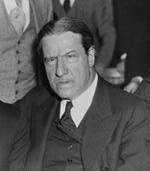 |
|
Rabbi
Stephen Wise |
We don't need to get into the politics of what
was involved at the time... there were Jewish groups that also turned a blind eye to
Holocaust happenings. (One who was a hero, according to Power, was Rabbi Stephen
Wise, who stated publicly that two million Jews had been murdered. This was in Nov.
1942, when the USA was already at war, and the USA was already underway in efforts
to do the Nazis in. Wise was Morgenthau's Zionist chum who championed the Armenians,
in order to hasten the Ottomans' death, paving a quicker path to a Jewish homeland
in Palestine.) Let's not forget the Holocaust was not steeped in fact while
occurring, and the reports were construed as rumors. Thinking with the benefit of
hindsight is not a privilege for those experiencing events in real time. (Power
elaborates on the "plentiful" intelligence [p. 34], and of course there
were powerful clues. Disbelief and anti-Semitism were reasons for ignoring the evil
deeds, as Power correctly writes further. However, Power's motif is in admonishing
governments and common people for not acting sooner, as genocides are developing or
are already in the works. In order to act, the reliable facts need to be in.
"Intelligence" is not always reliable, as we were painfully reminded not
long ago when we were asked to believe Iraq possessed weapons of mass destruction.)
Moreover, is the above where Peter Balakian latched onto the notion of "double killing"?
(Just wondering; never mind.)
During the Turkish campaign against the
Armenians this same propensity for incredulity was evident, but it was even more
pronounced in the 1940s because of a backlash against the hyped-up "Belgian
atrocities" of World War I. During that war, journalists had faithfully relayed
tales of bloodthirsty "Huns" mutilating and raping nuns and dismembering
Belgian babies. Indeed, they reported claims that the Germans had erected a
"corpse-conversion factory where they bioiled human fat and bones into
lubricants and glycerine. In the 1920s and 1930s, the press had debunked many of the
Allies' wartime reports of German savagery, yielding a "hangover of
skepticism." Although many of these stories were confirmed years later, they
were still being discredited at the outbreak of World War II.
The above works on so many levels of irony. Note how Power slyly weaves in the
"Armenian Genocide," as she will constantly do throughout the book, giving
the idea that the Armenian matter was not just any genocide, but perhaps the mold
genocides were made from, even in the case of the Holocaust. But if there is any
"incredulity" with her opening statement, it concerns the statement
itself. Is she out of her mind? The Western world simply ate up sensational stories
from the Orient. Readers were weaned on tales of barbaric Turks slicing open
innocent Christians, and readily accepted the preposterous claims. Such is the
reason why propagandists as Power feel free to repeat these ugly lies this very day,
as anti-Turkish prejudice is still very much alive and well.
As Cyrus Hamlin so correctly opined
on anti-Turkish propaganda in the late 19th century, "(This) one-sided and
unreliable information (about any people) after a long period of unchallenged time,
would create hostility and hatred that would not be easily overcome.” Truly,
how awfully disingenuous of Samantha Power to give the idea that most Westerners did
not swallow the tall Armenian tales!
Then she pulls a fast one, letting us know that World War I propaganda against the
Germans did actually fall within the realm of her selective knowledge base. While
reading these sentences, my mind immediately travelled to, "You idiot!
If you are aware that journalists made up such horror stories about the Germans, why
are you accepting 'New York Times' reports on the Armenians as the gospel
truth?" As if on cue, Samantha Power then sort of replied to my question by
giving the impression that all of those anti-WWI German tales were true, after
all..!
Yes, ladies and gentlemen, she points to a 2001 book called German Atrocities
1914: A History of Denial, by Horne and Kramer, to confirm that the WWI German
horror stories "were confirmed years later."
Maybe this is an excellent book and the authors have stumbled onto ground-breaking
new evidence (although my alarm bells are already up from the choice of the
"Denial" word in the title), but I would not be surprised if this was not
a "politically selective" book, much like Power's own "A Problem
From Hell." It would serve Power's purpose to affirm the German horror
stories, because she must be aware of how vulnerable her claims are regarding the
"Armenian Genocide." Simply to affirm her beloved Armenian Genocide, one
cannot put it past Power to stamp her approval on any and every claim showing the
WWI German horror tales to be true.
|
In fact Bryce and Toynbee
together had written a very similar but shorter book about so-called German Atrocities
in Belgium. That book contained the same sort of thing seen in the Armenian Blue Book:
"X, Y, and Z" and unknown and fraudulent sources. After the war, the
Belgians investigated and found that the book was almost completely lies. The Belgians
had wanted it to be true, but they reported their findings accurately. Yet no one has
looked into the propaganda directed against the Turks. After all these years, no one
has decried this propaganda. If one reads the basic books on the British Propaganda
Ministry, and there are quite a few books on the subject, they never discuss the
campaign against the Turks, only the Germans. I believe the reason that no one has
researched the topic and uncovered the lies told of the Turks is that no one cared.
They were just Turks.
Prof Justin McCarthy's Jan. 19, 2001 presentation on British Propaganda. The key to focus on is that the
Belgians themselves investigated after the war, and the Belgians had two
advantages over the authors of the 2001 book that Power chose to put her entire faith
in: The events were fresh enough to have allowed for a proper investigation, and the
Belgians were the last people to have covered up for the Germans. Power elaborates
that her "Denial" book documents the "brutal German campaign"
resulting in "6,500 Belgian and French civilians," challenging "the
assumption held for most of the twentieth century that the World War I atrocity
reports were hyped." It sounds to me like what the authors did was "hype
up" the civilian deaths that come with any war. Sure, the Germans were not
angels, and they were furious with the Belgians for fighting back. When Belgian
civilians would fire at the Germans, the Germans would hit back, killing innocents as
well. These possible "genocide partisans" who wrote the book probably
pointed to these civilian deaths and made them out to be "atrocities."
(Although it sounds like Power is going farther, lending credence to the atrocity
stories about nuns & babies, and the one about making humans into soap.) If this
is the case, it is spectacularly awful of Power to attempt to erase the misdeeds of
British war propagandists on the basis of one agenda-ridden book. |
Melchior Palyi reviewed a 1944 book Lemkin had written entitled Axis Rule over
Occupied Europe, and produced a line that resonates with truth: "...The Nazis shamelessly displayed their intentionally
planned misdeeds, while the western Allies stumble into illegal practices and cover
them with humanitarian or other formula." Brr! What a cutting
analogy with the sanctimonious "genocide scholar" who sometimes produces
greater evil than the presumed evil-doer on the genocide scholar's holy crusade.
(We'll be touching on this powerful point, as we wind up this page.) Palyi went on
to write that Lemkin had written a "prosecutor's brief" rather than an
"impartial" inquiry. Once again, an on-the-nose observation about the genocide scholar! (Lemkin
appears to have made the mold with his dogma.) Power doesn't seem to care for Palyi
much, dismissing his words as "false equivalency" (p. 39).
Lemkin was somewhat conflicted about the roots of
responsibility and the relative role of individual and collective guilt, theories of
accountability that continue to compete today. On the one hand, Lemkin urged the
punishment of those individuals responsible for Nazi horrors. On the other, he
espoused an early version of the theory, put forth again recently by Daniel Jonah
Goldhagen in his book Hitler's
Willing Executioners, that ascribed guilt not only to the perpetrators of the
crimes but to their fellow citizens who failed to stop them and often appeared
actively supportive.
I've got the feeling Power is a fan of the latter "theory of
accountability." Maybe this is why she appears to hate Turks; she is so
strongly a believer of the "Armenian Genocide," to the extent of
presenting one false fact after another in a pathetic pursuit of affirmation, she
feels that all Turks must be cut from the same Nazi cloth. (As she strongly alluded
in the PBS show.) Looks like her hero Lemkin could have been her role model on this
count; another reviewer of Lemkin's book (p. 40) "faulted Lemkin's sweeping
ascription of blame." By finding "innate viciousness" in the German
people, Lemkin was feeding "nazism-in-reverse." This is what we would call
the genocide scholar's tendency for racism, folks.
On p. 44, Power allows readers to conclude that 1,765,000 Jews (as believed in Dec.
1944) were gassed and cremated in Auschwitz between April 1942 and April 1944. Yet a
former director of Washington’s Holocaust Museum (in response to former Auschwitz
commandant Rudolf Hoess' signed assertion for killing some 2.5 million), Jeshajahu
Weinberg, is on record for explaining: “Today historians believe that the total
number of inmates who perished in Auschwitz was a million and a half, or even
less." (The Holocaust Museum in Washington, 2002, p. 153.) So why is
genocide scholar Samantha Power not bothering to correct the higher number, at least
with a footnote? In her book, she also refers to the total Jewish mortality as six
million, when the Holocaust Museum has settled for a median of 5.25 million.
Shouldn't professional "genocide scholars" be aware of these revised
figures? Or can it be that they really don't care about the facts? (Perhaps they are
afraid of being called "revisionists.")
In 1946, Lemkin showed up in Nuremberg as a (as Power puts in parentheses)
"lobbyist" to get "genocide" spotlighted. Roaming in the
corridors, a lawyer described Lemkin as "a man in pain." Learning of the
death of his parents, he went into "overdrive," bugging the personnel. One
lawyer remembers Lemkin as a "disheveled, disoriented refugee less concerned
with hanging the Nazi war criminals than with getting genocide included in the
tribunal's list of punishable crimes." Power continues: "Most of the
prosecutors tried to avoid him, seeing him as a nag or, in Yiddish, a nudnik."
Setting the "holier-than-thou" agenda-driven genocide scholar prototype
beautifully. No wonder genocide scholars worship this man.
He then decided to infiltrate the U.N. in late 1946 (emphasis Holdwater's):
"Security guards were willing to look the other way when the unaccredited, somewhat
fanatical lawyer would turn any empty UN office into his home for the day —
'like a hermit crab.'" Two New York Times reporters "recall the horror of
many a correspondent and diplomat when the wild-eyed professor with steel-rimmed
glasses and a relentless appetite for rejection began sprinting after them in the
corridors saying, 'You and I, we must change the world.'"
"He was always there like a shadow, a presence, floating through the halls
and constantly pulling scraps of paper out of his pockets. He was not loved because
he was known as a time consumer. If he managed to nab you, you were trapped.
Correspondents on deadline used to run from him like mad. But he would run after
them, tie flopping in the air, genocide story at the ready."
"Most of the correspondents who bothered to notice Lemkin wondered how he
made ends meet... In his rush to persuade delegates to support him, he frequently
fainted from hunger. Completely alone in the world and perennially sleepless, he
often wandered the streets at night." (p. 52)
I suppose passages of the above were presented to show how charming Lemkin was on
one hand, and his dogged persistence was rightly highlighted, as persistence brings
results. And so, Lemkin finally succeeded in getting the United Nations to adopt the
genocide convention as law. However, the above also displays the role model for
genocide scholars to follow, and it's all there: the dogma, the single-mindedness,
the sanctimony... it's actually pretty scary.
|
ADDENDUM, 8-07:
While Lemkin gets the credit for coining the word "genocide," another source
claims the Greek word has been around for a very long time. (YENOKHTONIA; albeit, its
meaning may not have been quite the same.) If this is the case, Lemkin's credit lies
in Anglicizing the word, not inventing it.
|
Power examines what the Convention's critical "in part" part signifies. A
U.S. senator asked (p. 66), "Let us assume there is a group of 200,000. Would that
have to mean that you would have to murder 100,001 before a major part would come under
the definition?" Lemkin stressed that partial destruction obviously had to be "of
such substantial nature that it affects the existence of the group as a group."
Looks like the ICTJ's requirement that
the perpetrator would need to kill only one person is shown for the absurdity that it is.
(The ICTJ, a body of lawyers, agreed there was an "Armenian Genocide" by
consulting Armenian propaganda sources, just as Samantha Power.)
One danger for this genocide law to be used for purposes of evil rests with exactly this:
lawyers can argue all they desire regarding these fine points, but the layman will always
regard a genocide as a "Final Solution," in the Nazi-Jewish mold. This is when
the doors are opened to hatred and demonization. Nobody likes to be compared with the
Nazis. And Samantha Power, to provide a very handy example (and using the Turks as the
perpetrators), is the first to make this Nazi-Turkish juxtaposition. Such a comparison
becomes particularly insidious when the case is built politically, with no concern for
genuine historical facts.
U.S. lawmakers were concerned that ratification would license critics
of the USA to investigate the Indians, segregation in the South, and other matters. Power
assures the reader, however, that "Reckoning with American brutality against native
peoples was long overdue, but the convention, which was not retroactive, could not
be used to press the matter." (p. 67.) Let's keep this thought alive, folks, as we'll
be returning to it.
Lemkin himself pooh-poohed the segregation issue: "In the Negro problem the intent
is to preserve the group on a different level of existence, but not to destroy it."
How do you like that! Lemkin himself just threw a monkey wrench into his own
"Armenian Genocide" thesis. If we turn to Ambassador Morgenthau, Samantha
Power's favorite source other than the New York Times, we learn from Morgenthau's
Aug. 8, 1915 diary entry that
"[Talat] said they want to treat the Armenians like we treat the negroes."
In other words, what Talat had in mind for the traitorous Armenians was
"segregation." (Morgenthau wondered whether Talat meant the "Indians,"
which is one reason why Power loves Morgenthau so much. They both think so genocidally!)
On p. 68, Power notes that Lemkin, in reference to congressional opposition to his
convention, remarked: "If somebody does not like mustard, he will always find a
reason why he doesn't like it, after you have convinced him that the previous reason has
no validity." Why, shut my mouth! Doesn't that describe perfectly the lack of
rationality for pro-genocide people..! Just substitute "the fact that the Turks
did not commit genocide" for "mustard." (And if that is too hard
to follow, simply substitute "Turks.")
Then we get into the fear of the Soviets; "Because Lemkin recognized that
including political groups would split the Legal Committee and doom the law, he, too, had
lobbied for their exclusion." (The footnote tells us he also did away with the
requirement for "cultural genocide," basically in order to "save a
ship.") Power comments that "the exclusion of political groups from the
convention made it much harder in the late 1970s to demonstrate that the Khmer Rouge were
committing genocide in Cambodia..."
Lemkin did not care for a new 1951 Human Rights Commission chaired by
Eleanor Roosevelt, for fear that it would dilute his genocide convention. "As he
attacked the human rights treaty and its sponsors, Lemkin found himself mouthing the same
arguments as notorious human rights abusers." (P. 74.) Roosevelt herself became a
target. As Footnote 39 explains, "In December 1951 she forever earned Lemkin's
disdain when a reporter asked her to comment on the charges lodged by the East European
expatriate and exile groups in the United States that the Soviet Union was committing
genocide. Roosevelt replied casually: 'How could you prove it? I'm not sure you can prove
that. Unless you can prove it, there's no use bringing it up.' ... Although Roosevelt had
been a frequent critic of Soviet human rights abuses, Lemkin heard her skepticism as a
familiar form of denial."
 |
|
Eleanor
Roosevelt, neo-Nazi genocide denier, honored
on a stamp. In 1940 she had written, ""Hate and force
cannot be in just a part of the world without having
an effect on the rest of it"... Words that will go over
the heads of hatred-spreading genocide scholars. |
It's kind of funny that not only would Lemkin butt heads with the
cause of "human rights" that lay at the heart of his genocide convention, he
would actually think of Eleanor Roosevelt.... Eleanor Roosevelt!... as a
"denier." Once again, the intolerant and sanctimonious way of the "my way
or the highway" genocide scholar.
Power writes that women were attracted to Lemkin but he made no time for them, saying,
"I can't afford to fall in love." His genocide agenda superseded all. Reminds me
of when Taner Akcam was asked whether he would write his memoirs during a radio interview, and Akcam replied, "I don’t have time. I think working on the Genocide is more important..."
Lemkin hoped to write a genocide book, but publishers rejected him, thinking no one would
want to read such a work. How times have changed. These days, a non-scholar can write a
genocide book, basing one chapter 100% on propaganda, and the book can go on to win a
Pulitzer Prize.
|
Power's
Choice of Genocides
|
As Humphrey Bogart kind of said in CASABLANCA, "Of all the gin-ocides in all
the towns in all the world, she walks into mine." Let's see what grabbed
Samantha Power's attention:
1) The "Armenian Genocide"
2) Cambodia
3) Iraqi Kurds
4) Bosnia
5) Rwanda
6) Srebrenica
7) Kosovo
It may be argued that the last two are subsets of "Bosnia," definitely in
the case of "Srebrenica," as the perpetrator was the same. So, really,
Power looked into four genocides that followed her favorite one that began the book.
Of these four: Rwanda. A genocide, without question.
(ADDENDUM, 9-08: Or... was
it? That is, did Rwanda fulfill the U.N. Convention's
requirements, in particular the exclusion of political groups?
It is easy to make genocide conclusions when we've been
exclusively fed one politically-motivated version of events, and
we don't bother to investigate in cases we are not emotionally
involved. Read "Genocide Inflation is the Real Human Rights Threat.")
Is Cambodia really a genocide? Not in the sense that the Khmer Rouge behaved so
horrifyingly; it was definitely a "genocide" in the pure and non-technical
sense of the word. But other than the bothersome "political" catch (ones
who were killed basically couldn't conform well to the mindless new order; Power
explained above that the exclusion of political groups made this example difficult
to define, but I'm not quite sure how this exclusion was dealt with), what we had
was Cambodian vs. Cambodian. Article 2 of the Convention specifies that the victims
need to belong to either a national, ethnical, racial or religious group that is
presumably different than the corresponding identity of the perpetrator. In that
sense, what we have cannot technically be called a "genocide." An Israeli
quoted in Power's chapter describes Cambodia as "auto-genocide," and that
is precisely what Cambodia boils down to. But in the end, how does the Cambodian
example conform to the UN Convention?
If it does not conform, what is Cambodia doing in Power's list? The idea here is not
that Cambodia wasn't a genocide... it most certainly was one of the worst cases of
systematic and government-directed slaughter in the 20th century. The idea is to
emphasize that people can make a "genocide" out of anything, even in the
rare clear-cut case that does not abide by the technical definition. Imagine how
cases that are far foggier could also be manipulated.
This is the worst thing about "genocide." If someone wants to make a
genocide out of a conflict for political gain, it is not so difficult to do. By
doing so, one commits a greater wrong, in a sense, by saddling the accused with the
charge of a ruinous crime. Given how irrational and dogmatic and faith-based and
uncaring-of-historical- facts that "genocide scholars" are, woe to the
accused who "denies" the charge. The genocide scholar is holier than the
rest of us, and if members of their club decree an event as a "genocide,"
their conclusion must be accepted as law.
Another Danger of Genocide Politics:
...[W]e must focus solely on... an ideological basis for further
"humanitarian intervention" in the future — the Pol Pot atrocities
were explicitly used to justify US intervention in Central America in the
'80s, leaving hundreds of thousands of corpses and endless destruction.
Noam Chomsky, "Atrocities in
Cambodia," ChomskyChat Forum
|
|
| Iraqi
Kurds |
The Kurds are the darlings of the West, especially because the West hates Turkey, and what
a wonderful opportunity to weaken the Turks, by heaping "human rights" abuses.
Exactly as Western imperialists did with the Ottoman Empire, by taking the side of the
Christian minorities. The idea was to cause the break-up of the Ottoman Empire. Today, by
insisting on a "Kurdistan," what a great way to break up Turkey. Never mind that
the PKK is a terrorist organization; when Turkey responds to PKK attacks, the West must
condemn Turkey for being brutal with the Kurds, at
times even charging a "genocide" against Kurds.
Samantha Power's duty appears to be to cause harm to Turkey. It would help to create
sympathy for Kurds as "genocide victims."
Now, how many among us thought of what happened to Iraqi Kurds as a "genocide"?
You can bet few of us have. Given the broad stipulations of the convention, Power can
rightly point to the "in part" part and cry genocide. (Even though she would be
ignoring hero Lemkin's own rule; "in part" must be substantial enough to
endanger the existence of the group, as you have read above, and the still-to-be-confirmed
intentional deaths of hundreds by no means threatened the existence of the Iraqi Kurds.)
This kind of manipulation, however, further makes the word meaningless. We can point to
many conflicts that have occurred in the latter part of the 20th century, and come up with
genocides... including the carpet bombing actions of the USA in the Vietnam War, and
Soviet actions in their invasion of Afghanistan. We can even cite the invasion of Iraq by
the USA.
The reason why Samantha Power has spotlighted the Kurds is political in nature.
There are still legitimate questions pertaining to whether Saddam used chemical weapons.
Trust me, I'm not defending a brutal tyrant like Saddam. He was certainly "bad."
Yet it's easier to attribute a bad act to a bad man, without being as demanding of proof.
Power keeps going back and forth in her chapter, with examples of whether the people were
hit by the poison or not. Her agenda, of course, is to make it seem as though the chemical
attacks were a deliberate certainty. With genocide scholars, their conclusions must always
be foregone.
The Federation
of American Scientists tells us that chemical weapons were used by the Iraqis to counter
Iranian human-wave assaults. It was a horrible war crime as far as I'm concerned. But one
might argue, wasn't Iran also committing a "genocide" (that is, an
"auto-genocide") when it sent waves of their defenseless soldiers to certain
death?
"The first chemical attacks by Saddam Hussein against civilian populations included
attacks launched by Iraqi aircraft against 20 small villages in 1987. Saddam Hussein's
forces reportedly killed hundreds of Iraqi Kurds with chemical agents in the Kurdish town
of Halabja in March 1988. The poison gas attack on Halabja was the largest-scale chemical
weapons (CW) attack against a civilian population in modern times. Halabja had a
population of about 80,000 people who was predominantly Kurdish and had sympathised with
Iran during the Iran-Iraq war in the 1980s. Troops from the Kurdish Patriotic Union of
Kurdistan (PUK) entered Halabja on 15th March 1988, accompanied by Iranian revolutionary
guards."
As with the Armenians of the Ottoman Empire, Iraqi Kurds were collaborating with the
enemy. (An enemy, as with Russia in the Ottoman example, who didn't care for the
well-being of the Kurds, and was only using them.) Already, there is a political alliance
in play, excluded by the Genocide Convention.
With the above, we get the idea chemical weapons were used in Kurdish villages while the
Kurds were with the enemy (Iranian revolutionary guards). This was not "nice" of
that nogoodnik Saddam Hussein, but I don't know if it constitutes "genocide."
A Jude Wanniski in a site called What Really Happened (in response to Sandy Berger, who asserted the
genocidal gassing on a TV news show) reasonably tells us that using such weapons in
wartime is not nearly as serious as "gassing his own people." Wanniski also
claims the US Army War College came up empty, regarding real proof.
In a letter to Jesse Helms:
What disturbs me even now, Jesse, is that these meetings occurred after the Senate
Foreign Relations committee had accused Iraq of using poison gas against its own people,
i.e., the Kurds. Like all other Americans, in recent years I had assumed that what I read
in the papers was true about Iraq gassing its own people. Once the war drums again began
beating last November, I decided to read up on the history, and found Iraq denied having
used gas against its own people. Furthermore, I heard that a Pentagon investigation at the
time had also turned up no hard evidence of Saddam gassing his own people.
This is serious stuff, because the US Army War College tells us that
1.4 million Iraqi civilians have died as a result of the sanctions, which is 3,000 times
more than the number of Kurds who supposedly died of gassing at the hands of Saddam.
Now that's powerful food for thought! In its imposition of sanctions, did the USA commit a
"genocide" on the Iraqi people?
An excerpt from the Pentagon report follows:
It appears that in seeking to punish Iraq, the Congress was influenced by another incident
that occurred five months earlier in another Iraqi-Kurdish city, Halabjah. In March 1988,
the Kurds at Halabjah were bombarded with chemical weapons, producing a great many deaths.
Photographs of the Kurdish victims were widely disseminated in the international media.
Iraq was blamed for the Halabjah attack, even though it was subsequently brought out that
Iran too had used chemicals in this operation, and it seemed likely that it was the
Iranian bombardment that had actually killed the Kurds.
So here is the possibility that Iran might have been a "chemical culprit"! The
above is followed by:
Thus, in our view, the Congress acted more on the basis of emotionalism than factual
information...
And doesn't that have a familiar "genocide scholar" ring to it!
One of the authors of the Pentagon report, Stephen C. Pelletiere, contributed an Op-Ed piece
for the New York Times in 2003 called. "A War Crime or an Act of War?"
...[T]he truth is, all we know for certain is that Kurds were bombarded with poison gas
that day at Halabja. We cannot say with any certainty that Iraqi chemical weapons killed
the Kurds. This is not the only distortion in the Halabja story.
I am in a position to know because, as the Central Intelligence Agency's senior political
analyst on Iraq during the Iran-Iraq war, and as a professor at the Army War College from
1988 to 2000, I was privy to much of the classified material that flowed through
Washington...
This much about the gassing at Halabja we undoubtedly know: it came about in the course of
a battle between Iraqis and Iranians. Iraq used chemical weapons to try to kill Iranians
who had seized the town, which is in northern Iraq not far from the Iranian border. The
Kurdish civilians who died had the misfortune to be caught up in that exchange. But they
were not Iraq's main target...
...[A]ccusing him of gassing his own people at Halabja as an act of genocide is not
correct, because as far as the information we have goes, all of the cases where gas was
used involved battles. These were tragedies of war. There may be justifications for
invading Iraq, but Halabja is not one of them.
His article ends with:
Until Washington gives us proof of Saddam Hussein's supposed atrocities, why are we
picking on Iraq on human rights grounds, particularly when there are so many other
repressive regimes Washington supports?
A Prof. Cole of Michigan University (hotbed for the "Armenian Genocide") rebutted Pelletiere ("Did
Saddam Gas the Kurds?"), calling him "just plain wrong." Documents
"from the Iraqi secret police and military were captured by Kurdish rebels from 1991
forward," referring to "Iraqi use of chemical weapons against Kurds, called
'Anfal' (spoils) operations." He added that Iran's use of gas is not supported by
"good evidence"; "Since Iran and the Kurds were allies, Iran in any case
had no motive to gas thousands of Kurds." (Even when
"allies," Iran has no love for Kurds. We can't say Iranians were culprits, but
here is a possible motive: knowledge that Iraqis would get the blame.)
"The Kurdish minority of northern Iraq speaks an Indo-European language very
different from the Semitic language of Arabic, and has long sought greater autonomy from
Baghdad," Cole continues, and it was for this reason Saddam struck with conventional
"ethnic cleansing," followed by "39 separate gas attacks against the
Kurds" on March 16-17, 1988, killing an estimated 5,000. Cole adds that hydrogen
cyanide might have been used, which is possessed by neither Iraq nor Iran. He also states
some high Iraqi officials have admitted to the chemical attacks. He gets into the gung-ho
spirit of the impending war (his article was written a month-and-a-half before the bombs
dropped) at analysis' end with: "World order, human rights and international law
are... not served by allowing a genocidal monster to remain in power."
That last line betrays the professor as entering into emotional "Samantha Power"
labeling territory, and is not the domain of a cool, dispassionate scientist... revealing
his bias, and throwing into question the rest of his claims, claims that he seems to have
accepted without question. (Such as a "5,000" mortality; that's a big gap with
the "hundreds" we had read earlier.) Maybe these documents are on the level,
maybe they are not. The caliber of official admissions made while Saddam was in power
sounds suspicious (I can't imagine there would have been much contrition), but it's easier
to imagine admissions that might have been made since. I don't know if there have been
any, but imagining the possibility, such admissions could easily have been made under
pressure. Ottoman officials also made statements during the 1919-20 puppet Ottoman courts,
while a good number were in prison. This serves as a complete parallel to The Iraqi
Special Tribunal, the creation of an illegal occupying power that demonized Saddam
Hussein. Yes, I know it's "Saddam Hussein," but the fact is, for at least the
first year of his imprisonment, an imprisonment that is no more legal than the detainment
of Turks who were thrown into Malta, he was entirely cut off from the outside world,
denied the right to meet with friends or lawyers of his choice, and under the care of
guards sharing the same mentality as those in charge of Abu Ghraib and Guantanamo Bay.
Power ends her emotionally-written chapter with forensic evidence collected by Human
Rights Watch in "Iraqi Kurdistan" in 1992-93. There is no question Iraqi Kurds
suffered under the brutal hand of Saddam Hussein. Again, however, we are at the mercy of
passionate genocide partisans determined to find genocides, as long as their designated
victims are on the "approved" list. They will ignore all other considerations
that don't fit in with their agendas. Collaborating with the enemy during war
certainly fudges the "genocide" issue; such would serve as a political alliance.
In 1992, we had Karabakh.
Armenians swept down in a sneak attack, helped by one billion dollars in Russian military
might (along with some token Russian manpower), and millions from American taxpayers. The
Armenians committed heinous acts of ethnic cleansing, involving mutilations and
dismemberment, all in order to frighten away the populace — some 800,000 Azeris, many
still living in the squalor of refugee camps — and stealing 16% of Azerbaijan's
territory. Even though what occurred wasn't "really" a genocide, this episode
fits into Power's definition, stressing the "in part" part. Why do not the
"genocidal" crimes of the Armenians make it into Power's hypocritical book?
One of the manipulative and emotional passages in Power's "Iraq" chapter was
this: "The horrors of gassing entered the Western imagination back in April 1915,
when British soldiers were subjected to what Churchill called the 'hellish poison' of
German mustard gas." (P. 205)
Churchill would grow to wonder,
however, as to why the other wusses in Britain's War Office displayed a 'squeamishness
about the use of gas.' Poison gas was okay in Churchill's book, as long as it was used
against "uncivilised tribes.' (Other than the probability of poison gas used against
Turks in the Dardanelles invasion Churchill was behind), the uncivilized tribe he had
in mind here was the Iraqi Kurds of Kirkuk, rising against British rule in 1920; Churchill
gave them a good dose of the "hellish poison."
|
Bosnia
|
I have a little bias against the Serbs. Some of them can
be pretty kooky, living in 1389, still battling in Kosovo (where the Serbs came
under the domination of the Ottomans. Not long before, it was the Serbian Empire
that had taken over Greece, Macedonia, Bulgaria and Albania. You can bet fair Ottoman rule saved these
people from the heavy hand of the Serbs, although the Turks will never get the
credit for it). The extremists among them share too many characteristics of Orthodox
cousins like Greeks and Armenians, considering the hatred of Turks to be patriotic,
and making any statement that is expedient, the truth be damned. The prevarications
of the Serbian leadership during the break-up of Yugoslavia was a phenomenon most
became familiar with. The worst shared characteristic lies with how merciless and
murderous they can all be, in ethnic cleansing mode. Turcophobes who have seen these
Orthodox brothers in "genocidal" action often forget their bigoted
feelings toward Turks and marvel at how much worse these "Christians"
could be.
In fact, the Serbo-Montenegrins, once freed from the Turkish yoke, tried to
impose upon other nations, be they Catholics or Moslems, a yoke which was much
heavier than that of the Turks. "No Turk," wrote Miss Durham in that
same book, "ever treated the Armenians worse than did the two Serb
peoples treat the Albanians in the name of the Orthodox Church"
From "Albania's Golgotha," Leo Freundlich; the book referred to above must be Twenty
Years of Balkan Tangle (London, 1920, p. 235), written by Mary Edith
Durham, who "spent many years in the Balkans." Aubrey Herbert said
of her, "It was only the cruelty of the Serbs that turned her affection
into dislike."
Two examples each from
other surprised westerners, representing the Greeks & Armenians:
"...According to reports from senior officials,
such as the commanders of American warships at Smyrna and the Swedish Consul
there, as well as prominent American residents of the city, the Greek Army and
Greek officials in Smyrna had been acting in such a manner there as to place
them in the same class of 'semi-barbarity' as the Turks." Laurence Evans,
United States Policy and the Partition of Turkey, 1914-1924, 1965, p.
180; citing June 10, 1919 Westermann memo, Peace Conference files, 867.01/41.
One more: "Greeks killed over five hundred Muslims
in acts 'absolutely barbaric' and 'equal to the worst that the Turks have ever
done'", according to eyewitness Alexander MacLachlan of International
College. Joseph
L. Grabill, Protestant Diplomacy and the Near
East: Missionary Influence on American policy, 1810-1927.
"...[W]here Armenians advanced and retired with the Russians their
retaliatory cruelties unquestionably rivaled the Turks in their
inhumanity." Gen. James Harbord, Harbord Commission report
One more: "...[M]any others almost
fanatically in favour of the Armenians, became so disgusted by the baseness of
their nature as to abandon them with satisfaction to their fate." Mark Sykes, 1904.
|
And there is little question that if the Bosnian Serbs and Serbs of Serbia had the
opportunity, they would have exterminated every last one of the Bosnian Muslims, and
probably the Croats, in a case of "religious" and not "ethnic"
cleansing. These people were Slavic, after all, even though Serbs and Croats would
prefer to highlight their differences. (And the crazies among the Serbs referred to
the Muslims as "Turks.")
Yet I am able, for a good part, to keep a lid on my prejudices. While I generally
consider what happened in Bosnia a "genocide" (Serb leaders such as
Milosevic and Karadzic roused the rabble, no differently than Armenian committee
members worked Ottoman-Armenian crowds, along "racial" lines. Those were
heartbreaking times, as Bosnian Serbs who had surrounded Sarajevo were taking
potshots at innocent civilians, and women were systematically raped, with the
knowledge that culturally and religiously, for a woman to be "soiled"
among Muslims would be devastating), and the Serbs appeared as the obvious villains,
there were times I ran into disturbing accounts that made me wonder. Such as with
the photographs of the skeletal "concentration camp" victims... there
might have been tricks at work that made the picture not quite what the public was
led to believe. (It's not that the bodies of these victims could have been faked,
simply that there might have been false manipulation behind the scenes in order to
get the West cracking. Which might not have been a bad thing, as anyone who
remembers those times is aware the Muslims were up the creek. But a falsehood is a
falsehood.)
Knowing what I know about the dirty politics of genocide, I am sometimes
uncomfortable about referring to these events as a "genocide." (Even
though the shorthand of "genocide" has been difficult to resist in this
case; there are pages in the TAT site that
are accepting of Bosnia as a genocide.) The main chapter in these sad tragic times
that can be labeled a clear-cut genocide, as far as I'm concerned, is Srebrenica.
It's not that the Serbs' villainy is uncertain. Trials at the Hague have spotlighted
their awful acts. Here is an example
featured on TAT. (But the example is Srebrenica.)
What we're getting at here, is that the clean conclusion of "genocide" is
a rarity. And we can't rely on emotional and unscrupulous "genocide
scholars" to separate fact from fiction.
To conclude this chapter on Bosnia, and whether it really was a
"genocide," let's point to a favorite source of Samantha Power published
one day shy of the "Armenian Genocide" celebration. In an intelligently
written article entitled "THE BOSNIA CALCULATION: How many have
died? Not nearly as many as some would have you think" (George Kenney, The
NY Times Magazine, April 23, 1995), we are told, "There can be no
minimizing of what the Serbs have done in Bosnia. Their punishment of the Muslims
far outweighs any Muslim transgression," which no one (save for some
delirious Serbs) can argue with. We are also told, quite reasonably, that "Bosnia
isn't the Holocaust or Rwanda; it's Lebanon." The author disputes the
commonly provided mortality figure of 200,000, and suggests "25,000 to 60,000
— total from all sides."
"What surprises me is not that the popular figure is so inflated...
but that it has been so widely and uncritically accepted." Well, that's
"genocide politics," Mr. Kenney. And the fact that whomever controls the
information has a monopoly on "genocide."
As far as why the figure of 200,000 provided by the Bosnian Deputy Minister of
Information was universally accepted, the author hits it on the nose by writing, "An
inert press simply never bothered to learn the origins of the numbers it
reported." That is because the Muslims were designated as the victims,
and whatever the victim says in genocide politics must be automatically accepted.
This serves as the perfect parallel as to why the press mindlessly and infuriatingly
prints Armenian genocide claims at face value, such as "More than one million
killed."
Toward the article's conclusion, Kenney wrote, "In 1995, lacking the
bodies, the charge of Genocide has worn thin. It seems to have almost become
sensationalism for its own sake. Apart from any question of the number of
fatalities, journalists have begun a hot little debate about how 'objective'
coverage of Bosnia has been, about whether it has tended to favor the Muslims."
I don't know about the charge of "genocide" wearing thin, not if we listen
to crusaders like Samantha Power. But the rest of that paragraph rings so true,
regarding the "Armenian Genocide."
A Bosnian Serb now living in America, Nebojsa Malic, cries about how unrecognized
the "genocide" against Serbs during WWII has been. (This raises an
interesting point. Why have Armenians and Greeks become the darlings of the West,
their claims accepted at face value, but not "Orthodox blood brothers,"
the Serbs?) It is true, Serbs were victims during WWII, at the hands of the Croats
who, like the Armenians, joined ranks with the Fuehrer. (So, in fact, did some
Bosnian Muslims.) Serb suffering in the past has no relation to Serb misdeeds during
the break-up of Yugoslavia, of course, but this segment of Mr. Malic's article is right
on the button:
Contrast ... with reports on Srebrenica, where the deaths of several thousand
Bosnian Muslim men (claims range from 7,000 to 10,000) have been termed
"genocide" by everyone from the press to the Hague Inquisition. Any
attempt to question this judgment, based on numerous factual problems with both the
allegations and the evidence offered, is denounced as "genocide denial."
But the denial of a real, documented genocide in Croatia is not a problem!
To understand this paradox, it is necessary to understand that "genocide"
has become above all a political notion. The mass murder of Jews at the hands of
Hitler's Reich has been appropriated by the Empire as an argument in favor of
"humanitarian intervention" worldwide (e.g., Bosnia, Kosovo). The mass
murder of Serbs at the hands of the Ustasha, with the active involvement of the
Catholic Church, does not fit into Empire's carefully crafted and nurtured image of
Serbs as evil murderers, and Croats, "Bosnians," and Albanians as their
innocent victims. Politically, it is worse than useless: it is harmful.
ADDENDUM, 9-07: "Bragging
Rights Dept.": One half year after the above was written, the United
Nations' highest court in the Hague, the International Court of Justice, declared in
February 2007 that what Serbia and Bosnian Serbs did to the Bosnian Muslims, save
for Srebrenica [where only the Bosnian Serbs were blamed for the act of
genocide], did not constitute a “genocide." Ladies and gentlemen, please take
note: Holdwater is a much more trustworthy voice in genocide matters than your
typically agenda-ridden "genocide scholar."
|
| Kosovo |
Kosovo is no clear-cut case of "genocide," either.
Power writes, "With every KLA attack on a Serbian official, Serbian reprisals
intensified, as Serb gunmen torched whole villages suspected of housing KLA
loyalists. In the following year, some 3,000 Albanians were killed and some 300,000
others were expelled from their homes..." (P. 445.)
Now that is all horrible. On the other hand, would the response from a "good
guy" nation be so different, when dealing with a "liberation army" of
separatists? For example, what is described above is not too different than the
heavy-handed actions of Israel we have become familiar with, but look the other way
on. Why hasn't Israel made it into a chapter in Samantha Power's book? (That is a
rhetorical question.)
Regardless, I'm grateful the Allied forces tweaked Serbia's nose in this episode. At
least it served as payback to what Serbia had done to Albanians toward the beginning
of the 20th century, in one of the more neglected episodes of "genocide."
(The "Golgotha,"
which may have been one of the "real" first genocides of the 20th
century. "Golgotha," by the way, is the same word used by Peter
Balakian's lying "holy"
relative, in the title of his book, one that persuaded Vahakn Dadrian to go off
on his slimy genocide-affirming path.)
|
| The
Wrap-Up |
Since Samantha Power confirmed that the U.N. Convention does not apply to conflicts of the
past, isn't it interesting that she made sure to include only one pre-1948 example in her
book, when she could have selected a post 1948 example to supplement her paltry handful of
examples. There is good reason why she singled out the Ottoman Empire, or
"Turkey," as she makes sure to refer to the regime Turkey had overthrown. (To
establish her demonizing connection with modern Turks.)
Her genocide club has participants that live and breathe to demonize Turks, and Samantha
Power must also become a full-fledged demonizer, in order to benefit from this profitable
club. Like many westerners, she likely had a good dosage of anti-Turkish prejudice to
begin with, and this process was not difficult for her to absorb.
But as you have seen, in her "Race Murder" chapter, Power has thrown her ethics
out the window; she has chosen to rely on the most corrupt sources, such as Ambassador
Morgenthau and the New York Times. She has purposely turned a complete blind eye
(save for the 200,000 mortality count of the professors Shaw) to anything that does not
come from the land of Armenian propaganda.
The genocide scholar is a political creature, posing as an honorable fact teller. The UN
Convention is so broad, practically any conflict can be made to appear as a genocide,
particularly if the genocide scholar makes sure to rely exclusively on one side, and a
propagandistic side at that. Genocide is now a politicized tool, and those who cry out
against the so-called genocides determined by genocide scholars can easily be dismissed
with name calling, such as "denier." When an arguer degenerates to getting
personal, the arguer is showing a sign that her argument can't be won by genuine facts.
The political agenda is all that is important, and it does not matter to the genocide
scholar to perpetuate hatred and racism through false "facts."
There is always another side to a story. If you want to find more than one reality, you
need to constantly dig the soil until your hands are bloody, as a brave Greek-Cypriot put it. The mission of the genocide scholar is
to stifle debate and the truth, if facts get in the way of the genocide scholar's agenda.
The "denier," Eleanor Roosevelt, was on to something. If you can't prove
something, don't bother. But the genocide scholar, knowing that "proof" of
genocides are often difficult to come by, has no reservation about making the proof up.
The genocide scholar, while appearing as noble and the pursuer of a just cause (as the
missionaries who had preceded them, in Turk-vilifying territory), has become an instrument
of evil.
Associate United States Supreme Court Justice Robert Jackson, chief prosecutor at the
Nuremberg War Crimes Tribunal, has said:
"War of aggression is the supreme international crime differing only from other
war crimes in that it contains within itself the accumulated evil of the whole."
To underline the hypocrisy of the genocide scholars, how often have they seriously gone
after the "good guys" of history?
For example: could not the U.S. invasion of Iraq be called a war of aggression? It's great
that a creep like Saddam Hussein has been ousted, of course. Hopefully, in time, a better
system of government will emerge in Iraq. But at the moment, the outlook is terrifying.
Separatist Kurds, Sunnis, Shiites and other ethnic groups are interested only in their
personal causes. Islamic terrorists are always waiting in the wings. Time will tell
whether U.S. actions will make the situation better or worse for the Iraqis, and probably
it will take a long time.
For the moment, as of this writing, some 45,000 Iraqi civilians were killed (the provided link forms
calculations from published reports; the total mortality is likely higher. ADDENDUM, 11-06: An A. P. article by Stephen Hurst, "Iraqi
official: 150,000 civilians dead": "Iraq's health minister estimated 150,000
civilians have been killed in the war — about three times previously accepted
estimates"); as a result of the U.S. action, a war that had nothing to do with
"necessity." (The July 23, 2003 "Downing Street Memo" reveals that
"Bush wanted to remove Saddam, through military action, justified by the conjunction
of terrorism and WMD. But the intelligence and facts were being fixed around the policy."
Iraq had not attacked the United States nor made any threat to do so. The unprovoked
attack on another sovereign nation is a war of aggression.)
These are some 45,000 people who would have remained alive, had the USA not attacked. An
April 26, 2003 report prepared by "Members of the Anti-War Spanish Brigade"
documents 42 attacks on the Iraqi civilian population, between March 20 and April 5, 2003.
It is not meant to be an exhaustive record, the report tells us, but one of the
"breadth, systematic nature and severity with respect to the number of civilian
victims and material damage caused by Anglo-American attacks." U.S. warplanes also
targeted the civilian infrastructure, such as the destruction of the nation's grid,
knocking out essential services as sewage and electricity.
Who is going to tell us that certain tragedies outlined in Samantha Power's book were
worse than the current tragedy that is largely unspoken? Will it be the "genocide
scholar"?
(And I'm not trying to rag on my own country here. Just trying to make a point.)
Lemkin hoped to include "cultural genocide" in his convention. The US military
took great care to protect the offices of the oil ministry, but ignored (and perhaps even
encouraged; the break-up of Iraq would, after all, serve U.S. interests) the systematic
looting of Iraq's museums and government buildings, contributing to the destruction of
Iraq's cultural heritage. This was in violation of the Hague Convention for the Protection
of Cultural Property in the event of Armed Conflict (1954), and Article 53 of Geneva IV,
in 1949.
We speak of the gassing of Iraqi Kurds, the specifics of which still need to be verified
conclusively, and yet the U.S. forces used VX and other nerve gasses during the Vietnam
war. ("Chemical and Biological Weapons Used in Vietnam," Gerard Van
der Leun, Earth magazine, April 1972.)
... Millions of (Vietnamese)
were fleeing into the slums of Saigon from US saturation bombing of the
densely-populated Meking Delta... Americans estimate the deaths in Indochina at
about 100,000; journalists sometimes report that figure too; official figures are
over 3 million. If we discovered that ordinary Germans estimated Holocaust deaths at
a few hundred thousand, there would (properly) be an outcry. Have you heard one
here?
... US crimes are off the agenda.
Noam Chomsky, "Atrocities in Cambodia,"
ChomskyChat Forum
|
According to a Reuters article written by Stephanie Nebehay, the United Nations' Committee
against Torture informed the United States that any secret jails it ran for foreign
terrorism suspects, along with the Guantanamo Bay facility, were illegal and should be
closed. U.S. policy was found to be in violation of another U.N. Convention, one from 1987
targeting Torture or other Cruel, Inhuman or Degrading Treatment or Punishment. The
article also mentioned concerns regarding domestic U.S. jails, "particularly at the
use of electro-shock devices, the shackling of women inmates during childbirth and police
brutality."
And the following is presented as a flip side to the Serbia-perpetrated
"genocides," a people's tribunal that found the USA and NATO guilty of war crimes
against Yugoslavia in 1999. I'm not saying their findings are to be taken at face value,
because there are obviously a lot of people in the world with a beef against the USA, a
nation that — it must never be forgotten — has done much to advance the cause of good
in the world. (Of sixteen countries, one of the eleven judges was a Turk: "Cimile
Cakir... journalist for newspaper serving Kurdish community and member of Turkish Human
Rights Association. Imprisoned four years in Turkey for human rights activity."
I'm already flinching. On the other side of the coin is Ramsey Clark, one of the
"prosecutors." While Clark is presented mainly as a joke in the U.S. media, the
former attorney general is a man I admire, for his courage.)
Among the charges was "NATO forces used the media to spread lies to demonize the
Serbs and their leadership in order to prepare public opinion to prepare for war."
Others include "the use of illegal weapons, the purposeful choice of civilian
targets," and a Roma (Gypsy) representative charged that NATO occupation led to the
expulsion of 100,000 Romas.
The entire point is that those with the power control the information. If those in power
lack the morality to tell the truth and are in pursuit of dogmatic agendas, what we wind
up with is great injustice. "None" of us really knows what is going on, and for
us to accept claims by unscrupulous, agenda-ridden forces only serves to make us the
slaves of these villainous forces. Forces of villainy, naturally, will do their utmost to
present themselves as holding the moral high ground, and it is this belief in their
morality that they use to make us believe in them. The real moral: As Dana Andrews instructed us in CURSE OF THE DEMON,
honorable truth seekers must always put their prejudices aside, and ask. And then ask
again.
|
|