|
|
(A Response to the
Zoryan Institute's 1999 Response to the Memorandum of the Turkish Ambassador)
|
|
|
| |
The Zoryan Institute is the home of Vahakn Dadrian, a
prosecuting professor who has one-sidedly been digging up whatever indications he can find
to affirm his genocide, paying no concern to the real historical facts.
Prof. Malcolm Yapp's astute analysis of Dadrian's
agenda-ridden techniques bears repeating:
...Although Dadrian produces many reports tending
to suggest that members of the Ottoman government wanted to destroy the Armenian, he fails
to find any document which constitutes a definite order for massacre...
 |
|
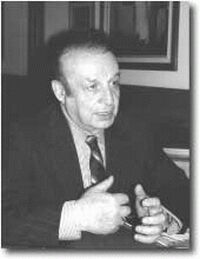
Professor Vahakn Dadrian
|
In the last sections of the book, Dadrian
describes the various post-war efforts by the Ottoman and Allied authorities to bring
those responsible for the massacres to book. The 1919 courts martial, however cannot be
taken entirely at face value because they were conducted by a government which was anxious
to pin any blame on the CUP leaders...
Despite the numerous documents cited and the
careful assembly of information about individuals and organizations, there is no decisive
evidence to support Dadrian's case.... Of course one may argue that even without clear
unambiguous documentary evidence the weight of so many pieces of indirect and
circumstantial evidence brought together could be persuasive, even conclusive, but one
must enter a caveat. The author's approach is not that of an historian trying to find
out what happened and why but of a lawyer assembling the case for the prosecution in an
adversarial system. What he wants are admissions of guilt from the defendants, first
Germany as the easier target and then Turkey. What is missing is any adequate recognition
of the circumstances in which these events took place; the surge of Armenian nationalism,
the ambitions of Russia, the fears of the Ottomans and the panic and indiscipline of war.
Dadrian is so obsessed by his theory of the long plan that he too often overlooks the
elements of the contingent. (Here's the rest of
what Yapp said, and more of Dadrian)
|
|
The Zoryan Institute (and we can recognize Zoryan director
Dadrian's voice behind what's being said; practically all is a product of Dadrian's
research, under the misleading methodology stated above. Dadrian and Zoryan will
thus be used interchangeably in the analysis that follows) prepared a 1999 piece
entitled: "The Key Distortions and Falsehoods in the Denial of the Armenian
Genocide. (A Response to the Memorandum of the Turkish Ambassador)." The
essay may be found at Zoryan.org's site.
ADDENDUM, 11-07: Zoryan
might have pulled this uncredited page from its site, although it has been
reproduced on several other Armenian web sites. Dadrian's authorship, I see, has
been confirmed elsewhere. The "23 page analysis" analyzed below was
prepared as a "swift response" to counter the "eleven pages of
genocide denial and false allegations against the Armenians" by the Turkish
ambassador. (Should "Armenian genocide claims" be synonymous with
"Armenians"?) It appears a congressman, New Jersey's Steven Rothman, gave
"an invitation... to analyze a letter the Turkish Ambassador in Washington sent
to every member of Congress," countering the claims of a genocide resolution of
the time, Resolution 155. (If it was anything like the utterly dishonest claims of
the 2007 resolution, and of course
it was, then it sure needed much clarification.) Dadrian's propaganda was
immediately "distributed to all Congressmen," and Dadrian later expanded
this work into a 92 page book ("Key Elements in the Turkish Denial of the
Armenian Genocide: A Case Study of Distortion and Falsification"), which the
Zoryan Institute is peddling for sale.
The drama began when the Armenians once again attempted to legislate their alleged
genocide by using the politicians who are in their pockets, and by exploiting the
abundance of their propaganda near-unilaterally presented for a century and longer.
Congressmen already not solidly in the corner of the Armenians are not historians.
The information about this tragic historical episode comes mainly from the
Armenians. They have aligned themselves with "genocide scholars," who
mindlessly or purposely accept the Armenian claims just as one-sidedly, but when
there are those like Elie
Wiesel among them, few are going to stop and scratch beneath the surface.
Whenever there is a voice emerging contrary to
this religiously-held genocide view, Dadrian has done an excellent job in coming to
the fore, bombarding the listener with his endless compilation of confusing facts
and figures, in an attempt to distract from what really happened: The Armenians
rebelled, continuing a policy that had been growing over the prior forty years in
particular, and they were relocated; not everything went smootly, and every death
resulting must dishonestly be presented as cold-blooded murder... even though
everyone else was dropping like flies for the same reasons: famine, disease, harsh
weather, combat, as well as massacres.
The object of Zoryan/Dadrian's attack: "The Turkish government, through its ambassador in Washington,
D.C., wrote a letter to all Congressmen, dated May 27, 1999, which included an
eleven-page report titled 'An Objective Look At H.Res.155'."
|
| |
We begin with an excerpt of Ulrich Trumpener's 1968
book, "Germany and the Ottoman Empire 1914-1918." The author tells us flat out
that "The annihilation of the Armenians" (which Dadrian has helpfully
paraphrased for us; he loves to use the word "annihilation" whenever he
can, even though the word means "to disappear without a trace." Dadrian himself
admitted, in a 1998 genocide commemoration he
signed, that a million Armenians survived) was "the result of a deliberate
effort by the Ittihad ve Terakki [Young Turk] regime to rid the Anatolian heartland of a
politically troublesome ethnic group."
I haven't read this book, but you can bet your
bottom holler Trumpener has no evidence, certainly nothing close to the
"evidence" that Dadrian has obsessively dug up since 1968. (And we're going to
get to the best of what Dadrian has to throw at us, in a minute.) In 1968, as in 1915 and
as with today. there was/is no shortage of people with deeply ingrained views. Everyone
says the poor, innocent Armenians were knocked off, everyone knows the Turks were (or
still are) barbarians as the dictionary's second meaning of "Turk" reminds us,
few bother to consider the true historical goings-on as that would uncomfortably challenge
our belief systems, and, voila. Instant, irresponsible conclusion: there was a deliberate,
systematic extermination attempt by the Ottomans.
If we want to get to the truth, we go to historians
who are honor-bound to remain faithful to their profession by leaving their emotions and
prejudices out. As Prof. Justin McCarthy reminds us, historians should love only the
truth. If there is no evidence whatsoever (besides the Andonian forgeries) that the
Ottomans were behind systematic extermination (quite the reverse: their internal reports
prove they hoped to safeguard the Armenians), we can conclude the level of credibility of
an Ulrich Trumpener, and others like him. Instead, we go with someone like Clair Price,
who professionally examined the situation with a level head (The Rebirth of Turkey, 1923):
....[A]rmed [Armenian] opposition
broke out at once, notably at Zeitun. . . Along the eastern frontier, Armenians began
deserting to the Russian Armies and the Enver Government, distrusting the loyalty of
those who remained, removed them from the combatant force and formed them into labour
gangs. . . .
In April, Lord Bryce and the ‘Friends
of Armenia' in London appealed for funds to equip these volunteers, and Russia also was
presumably not uninterested in them {The Dashnaks themselves have pointed to 242,900
rubles from the Russians, as intial funding}. . . . These volunteer bands finally
captured Van, one of the eastern provincial capitals, late in April and, having
massacred the Turkish population, they surrendered what remained of the city to the
Russian Armies in June. The news from Van affected the Turks precisely as the news from
Smyrna affected them when the Greeks landed there in May,1919. The rumour immediately
ran through Asia Minor that the Armenians had risen.
By this time, the military
situation had turned sharply against the Enver Government. The Russian victory at
Sarykamish was developing and streams of Turkish refugees were pouring westward into
central Asia Minor. The British had launched their Dardanelles campaign at the very
gates of Constantinople, and Bulgaria had not yet come in. It does not seem reasonable
to assume that this moment, of all moments, would have been chosen by the Enver
Government to take widespread measures against its Armenians unless it was believed that
such measures were immediately necessary. Measures were taken.
That was the reason, the only reason, why the
Armenians were transferred. The French did the same with some 120,000 of their
German-speaking citizens of the Alsace region, moving them to Dordogne and elsewhere, at
the point of Nazi invasion. Even without the threat of immediate foreign invasion, it has
been customary for suspicious minorities to have been resettled into less dangerous zones,
as with the American treatment of their non-rebellious Japanese in WWII.
|
|
 |
|
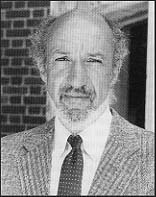
Professor
Richard Falk
|
Richard Falk, squarely in the corner of the Dadrians and genocide
scholars, has been established to consider strictly the pro-Armenian view, although
he might have loosened up in recent years. His quote, "Slowly, yet with
increasing authoritativeness, the reality of the Turkish genocide perpetrated
against the Armenian people has come to be accepted as established, incontrovertible
fact," is true only to the extent that the "genocide" has come to
be accepted as the fact. But this perception has nothing to do with historical
reality, an area that is not a specialty of the law professor. (The "genocide
scholar" with a background in history is a rare breed. Exceptions, like Prof.
Henry Huttenbach, who consider only one side of this story, seem to have forgotten
what being a "historian" means.) The fact that a lot of people have
mindlessly come to one conclusion, helpless against the onslaught of one-sided
propaganda and helped by their own ingrained prejudices, does not constitute
historical reality.
Another partisan who only considers one side of
the story, David Matas, has embarrassingly shown his ignorance by stating: "Because
the perpetrators of the Armenian genocide were not prosecuted, the Nazi-organized
Holocaust against the Jews became possible. There is a direct linkage between the
failure to prosecute the crimes against humanity before World War II and their
commission during World War II."
The British, French and Russians announced in May 1915 that the perpetrators of
Armenian massacres would be punished after the war. They were not interested in the
Armenians as much as justifying their divvying up of Ottoman lands, established
through secret treaties.
Regardless, the British had to make do on this promise, and also hope to justify
their relentless war propaganda,
portraying the Turks as inhuman monsters. They leaned on the puppet Ottoman
government to come up with culprits (or else, they warned, it would have been
curtains at the Peace Conference, as Dadrian
himself has revealed), but when these false 1919 courts didn't do the trick to
the satisfactory extent, the British took the best of the Ottoman
"villains" and holed them up in Malta for nearly two-and-a-half years. (Ironically, saving them
from a worse fate, as history would bear; the 1919 kangaroo courts were intent on
retribution.) The British learned their own propaganda was unusable, and so was
everything else available to that point, the bulk of which forming the basis of
genocidal evidence today. Every Turk was freed.
So it's not that the "perpetrators of the Armenian genocide were not
prosecuted," it's the alleged perpertrators COULD NOT be prosecuted. To their
credit, the British came around to the thinking that genuine judicial evidence is
what was needed. Where is Matas' honor, to come up with his own conclusions, without
such evidence? Would he appreciate it if he were haphazardly accused of a ruinous
crime? Would he not "deny" such baseless accusations?
Matas also shows his ignorance and blatant prejudice when he lays the blame for the
Holocaust on the doorstep of the Armenian tragedy. Without explaining this
"direct linkage" (I guess he is thinking of the "Hitler Quote" that even the rare
Armenian scholar has concluded was a fabrication; see Hitler section below), he
doesn't think about all the many episodes of potential systematic extermination that
came before the "First Holocaust of the 20th century" (another false
pro-Armenian claim). The Serbs tried to knock off the Albanians in 1912-3, in part
of the "Balkan Wars" theater that claimed the lives of many thousands of
civilian Turks/Muslims. The Germans tried to do the same with the Hereros [Africans]
in 1904-07, and the Americans with the Filipinos at the turn of the last century. We
won't mention the Turks/Muslims who were habitually the victims of systematic
extermination efforts of Orthodox nations since the 1821 Greek War of Independence.
Another mindless and irresponsible party who
only looks at what she wants to believe, Katherine Bischopi, is quoted as saying: "The
future of Holocaust denial may be foreshadowed by the persistent denial of the
Armenian genocide." "May be" is right. This is only an opinion.
Opinions, aside from outright falsifications and forgeries on the side of the
pro-Armenians, are all they have going for them. What's missing is
"proof." Bischopi should be ashamed of herself for cheapening the fate of
the Holocaust Jews by comparing their lot with an unproved genocide. Never mind the
"Rufmord" — murder of
reputation — she is committing against the honor of the Turks.
|
| |
After peppering us with
these useless opinions, of which there is no shortage, Zoryan/Dadrian then tackles
the crux of the Turkish ambassador's Memorandum.
"What follows is an effort to examine with as little bias
as possible the objections and sets of allegations put forward in a lengthy
Memorandum by the ambassador, and to demonstrate the spurious character of some of
them, and the untenable nature of most of them," we are told. As little
bias as possible! When one overlooks the historical reality and only focuses on
random bits and pieces, that is nothing but bias.
"It is as if none of
them had been effectively rebutted and discredited by eighty years of research and
publication by scholars not identified with Armenian interests." The
very job of extremist genocide-obsessed Armenians is to discredit. These people
don't come from the perspective of truth, as illustrated by Prof. Libaridian's
response to Prof. Feigl regarding the Andonian
forgeries, or what I have come to call the "Armenian AND? Anthem." One
can come up with weasely ways to discredit anything, and these Armenians are
professionals at the game, with poster boy Vahan Cardashian (the one who founded
what led to ANCA) laying significant “modern era” groundwork. These Armenians
know they can't succeed against genuine, impartial historical facts, so their only
ethically-challenged strategy is to try and discredit. And they are very effective;
Zoryan/Dadrian are a master in creating doubt. They have done a very good job with
this paper. Having "effectively rebutted and discredited"
has nothing to do with TRUTH, however. Let's see what they have wrought.
|
| Alternate Use of
the Words "Ottoman" and "Turkish" |
They're not entirely wrong, here. Of course, "Ottoman
Empire" and "Turkey" have been used interchangeably, even by Turks. But
here's the sleaze factor. We can also use "Soviet Union" and "Russia"
interchangeably, as was done often enough during the days of the Cold War. But today's
Russia is a different nation than the USSR, their actions in Chechnya notwithstanding. It
would be misleading to call a regime by the same name of a past one with a different
character.
But one needs especially to be careful with interchanging
"Ottoman Empire" and "Turkey"; during the time of the empire,
"Turkey" was often used as an informal description of the nation during the days
of empire, because the Turks were in charge, and it was a shorthand. Today, however, the
hope of the Armenians is to hold modern Turkey responsible for actions, real or imagined,
committed in the centuries-old regime that modern Turkey overthrew. This is one reason why
they're hoping to equate the two. And whenever they have a chance, they love to point
fingers at today's Turkey, attempting to show what an evil country it is. As Peter
Balakian blatantly put it, today's
democratic, secular Republic of Turkey is "totalitarian." It helps their
political agenda to combine today's "evil" Turkey with yesterday's
"evil" Turkey into one big bowl of evil Turkish soup. Responsible writers must
be very careful to separate the two terms. Richard Hovannisian, for example, sometimes
slips and offers the Christian code of "Constantinople" for today's Istanbul.
(Subliminally telling his readers, it's us Christians against those barbaric Muslims.) He
would not call New York by the older name of New Amsterdam, so why is he doing this? The
same reason why the ethically-challenged Dadrian now innocently tries to tell you there is no problem with equating
"Ottoman Empire" with "Turkey."
|
The Allegation of
"Inter-Communal Clashes"
|
This I find the most disgusting deception from those
like Dadrian. "There was no Armenian Rebellion" they tell us. Of course;
this truth goes squarely against the face of their big lie, that innocent Christian
Armenians ... for no reason (except for made up theories like pan-Turanism and
Muslims hating Christians), in the depths of desperation fighting a multi-front war
against superpowers, with no resources and manpower to spare, would suddenly engage
in the gigantean task of eliminating their precious resource, the Armenians, who
made the economic wheels turn in the bankrupt empire. Moreover, the Ottomans would
spend the equivalent of today's millions of dollars to finance the operation, when
the money was desperately needed elsewhere.
"[T]he Armenians, an
impotent defenseless minority," Dadrian tells us. The Armenians were the
wealthy ones, quite often potently
in charge of the industries. They had armed themselves to the teeth in years
past, in accordance with Hunchak/Dashnak decrees, including sophisticated weaponry
like their Mausers. They were treacherously waiting for the opportunity to strike,
when their nation — where the ingrates had prospered for so many centuries — was
at its weakest, during war. Days after war was declared, the wildly pro-Armenian New
York Times (which would freely print any horror story prepared by the [British
propaganda division] Wellington House branch operating illegally on U.S. soil) gave
us: “ARMENIANS FIGHTING TURKS;
Besieging Van — Others operating in Turkish Army's Rear,” on November 7,
1914.
The Armenian soldiers deserted in
droves to the enemy, taking their weapons with them... which is what led to the
disarming of the ones still remaining in the Ottoman army. [Dadrian and his ilk have
turned this move into a way to kill off all Armenian men.]
"On August 3, 1914, i.e. three months before Turkey
precipitated the war with Russia, all able-bodied Armenian men in the 20-45 age
categories, and later in sequences those in the 18-20 and 45-60 categories, were
conscripted in the Ottoman army," is what Dadrian tells us. Yes, of
course, the Armenians were called to serve in the defense of their country, like all
other able-bodied men in the empire were called. (This is why Morgenthau estimated
one quarter of the Turkish population died of hunger, because few were left to till
the fields.) But most of these traitors went off to Russia to join the Czarist
Armenian army of 150,000, the number Boghos
Nubar presented in his 1919 Times of London letter, attempting to prove to the
Peace Conference that the Armenians were “belligerents de facto.” (“...[S]ince
they indignantly refused to side with Turkey,” Nubar added. Of course he’s
referring to the Armenians within the Ottoman Empire.) Ottoman-Armenians also
treacherously joined the other 50,000, according to Nubar, who largely fought as a
“fifth column," "operating in Turkish Army's Rear," as the New York
Times reported.
ADDENDUM, 11-07: Nubar's total estimate of 200,000
included the Armenians from Russia as well, and not all served in the
Trans-caucasian fronts; an estimated 100,000 came from the Ottoman Empire, either by crossing the
border to join the Russians, or by staying behind and serving mainly as guerilla
units. Armenians from other nations were usually recent transplants from their
Ottoman home, as with this
example. This Ottoman vs. Russian Armenian issue is given a good look below.
|
| “I
must emphasize the fact, unhappily known to few, that ever since the beginning of
the war the Armenians fought by the side of the Allies on all fronts.”
Boghos Nubar, 1919 Times of London letter
As World War I threatened and the Ottoman
Army mobilized, Armenians who should have served their country instead took the side
of the Russians. The Ottoman Army reported: "From Armenians with conscription
obligations those in towns and villages East of the Hopa-Erzurum-Hinis-Van line did
not comply with the call to enlist but have proceeded East to the border to join the
organization in Russia." The effect of this is obvious: If the young Armenian
males of the "zone of desertion" had served in the Army, they would have
provided more than 50,000 troops. If they had served, there might never have been a Sarikamis defeat.
Prof. Justin McCarthy, March 24, 2005 speech
|
As far as the widescale conscription into the Ottoman army Dadrian tells us about, a lot
of the Armenians refused to join. Just because they were "called" didn't mean
they all joined. An Armenian
publication tells us that when the governor of Van (a villain of the Armenians who
liked to nail horseshoes onto Armenian feet, as detailed in Balakian's "Burning Tigris") asked for 3,000
Armenian soldiers (I don't know why he should have had to "ask"; were these the
Armenian men who were over 60, not already conscripted? Of course not), he was turned down
flat because (among other reasons) the Armenians knew trench warfare would have put them
in danger of death ("...[M]aladie contractée dans les
tranchées..."), so contagious were the diseases running
rampant at the time. (General Harbord believed 600,000 Turkish soldiers died of typhus
alone, a number that should not be taken at face value.)
"What was left behind in the Armenian community was a mass of
frightened, if not terrorized, old men, women and children," we are told. No
less than the Muslim community of the very same, also subjected to massacres from the
Armenians since the 1890s, now completely open — with all the men off at the fronts —
to the bloodthirsty attacks of those such as Andranik and Dro. Whereas the Armenian "old men, women and children" were
resettled, the majority of whom survived (according to even the most pro-Armenian sources
such as Toynbee's April 5, 1916 “Treatment” report and Morgenthau's Sept. 1915 private
diary entry, where 500,000 was given (as "making their livings," with
Morgenthau's account), the Muslim "old men, women and children" were totally
defenseless. Ottoman internal reports, not meant for release and thus cannot be construed
as propaganda, have documented 518,000 deaths
resulting from these Armenian attacks, abetted by the Russians.
 |
|
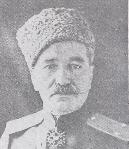
Andranik
|
Speaking of the topics of Andranik, Armenian desertions and
collaboration with the enemy, here is another internal telegram that cannot be construed
as propaganda, sent on December 2, 1914 from the province of Van to the Ministry of the
Interior: "At this point, Armenians are calm in the capital and in other areas;
however, all the Armenians of the region of Selmas are working with the Russians. The
person who leads the bands along the border is the notorious Antranik and his
companions, who had once engineered the Taluri rebellion [the second rebellion of Sassun].
After the Hanik battle, some Armenian privates deserted and joined the ranks of the enemy.
I was informed that an Armenian bishop was in contact with the Russian Commander in Gari.
I had him placed under police supervision." (From "The Armenian File.")
Dadrian digs up the testimony of historian Joseph Pomiankowski, from his 1969 Austrian
book translated as "The Collapse of the Ottoman Empire." we are told the
one-time vice-marshal who served as "Austro-Hungary's military
plenipotentiary (and attached throughout the war to Ottoman
General Headquarters), wrote the Young Turk regime first
liquidated the able-bodied Armenian men 'in order to render defenseless the rest of the
population' which ‘paved the ground for 'their annihilation'."
|
"I did not see a thin (Armenian
refugee) amongst a
good many thousand I saw, and most looked cheery
too. The massacres seem to have been a good deal
exaggerated."
General Sir W. N. Congreve to Chief of Imperial General Staff, General Sir Henry
Wilson, Cairo, 19 October 1919
"I
sure got to view misery, but planned cruelties? Absolutely nothing."
H.J. Pravitz, genuinely neutral Westerner
who was a genuine eyewitness. From "The Situation of the Armenians: By One Who was Among Them,"
Nya Dagligt Allehanda (Swedish newspaper), April 23, 1917
|
If the vice-marshal had any evidence backing up those claims, this debate would be over
today. Without evidence, what did he rely on? His opinion, based on Christian hearsay.
We'll get more to why Germans and Austrians had these kinds of opinions later on...
because Dadrian has done a great job of compiling what these select Germans and Austrians
had to say, ignoring what other Germans and Austrians have said.
|
The Redundancy of the Argument of
Armenian Rebelliousness |
I don't have a copy of the Turkish ambassador's
statement, but whomever prepared the Memorandum evidently came up with examples of
uprising, and Dadrian hopes to diffuse their truth by writing, "The four instances of uprising were not only isolated, local, and
disconnected incidents but, above all, they were improvised, last-ditch acts of
desperation to resist imminent deportation and thereby avert annihilation. Being
strictly defensive undertakings..."
How could they be called "defensive"
when we could see from the New York Times report the Armenians were ready and
waiting to strike at the outbreak of war? Why are we even attempting to prove the
irrefutable fact that the Armenians rebelled, even when their leaders are on record,
admitting it? (Quick answer: the Dadrian ilk have little honor, and they have
the ears of the prejudiced, ignorant masses.)
The sequence of events was "Armenians
stabbed their nation in the back with a force of many thosands according to an
Armenian leader," and not "Turks tried to exterminate Armenians and poor,
innocent Armenians tried to defend themselves." No, the Turks had their hands
full with trying to defend their desperate nation from mighty enemies, particularly
Russia, whose policies were to ethnically cleanse conquered regions of Muslims and
drive the rest into exile. Since the Ottoman Empire was the last stop, and there was
no other land to get exiled into, every Turk knew what lay in store for them if the
Russians crashed through the gates. Who would have had the energy or the ability to
divert precious resources for extermination of Armenians at this critical juncture,
even if the Ottomans were of the mind to do so?
Naturally, the Turkish ambassador's statement
couldn't go on and on about all of the Armenian rebellions and gave four examples.
These rebellions were far from "isolated, local, and
disconnected," as Dadrian deceptively informs us. For example, an
internal March 4, 1915 telegram from the Mahmudi district of Van investigated
tortures and massacres conducted by the Armenians. after the "kaza was taken
back." Killed in Merheku village: 55. Raped and killed: 4. Killed in village of
Ishtuju: 11. Among those raped still alive: 5. Wounded: 5. (1/2, KLS520, File 2024,
F.11-1) There are a series of telegrams documented in "The Armenian
File" (along with Internet sites; here’s a page on TAT) and anyone can
see the rebellion was well organized by the Dashnaks and Hunchaks. Anyone who says
otherwise, particularly one who has researched the matter as deeply as Dadrian,
truly suffers from a total lack of ethics.
I'll bet at least some of the "four" incidents the ambassador's statement
referred to took place before the end of May 1915, as the March 4 example presented
above. May was when the relocation order was signed. Yet, Dadrian tells us these
uprising instances "were improvised, last-ditch acts of
desperation to resist imminent deportation." (Deportation is the wrong
word to use, of course, as that means banishment outside a country's borders.) How
could these desperate Armenians have tried to resist "deportation" if the
"deportation" wasn't yet even decided upon? Were these Armenians psychic?
|
| |
We've already seen how Armenians had rebelled in Van
on November of 1914, days after Russia declared war. There were a series of
rebellions all over the empire, and Van kept having its share. On April 24, the
governor sent the following telegram to the Ministry of the Interior:
"Until now approximately 4,000 insurgent Armenians have been brought to the
region from the vicinity. The rebels are engaged in highway robbery, attack the
neighbouring villages and burn them. It is impossible to prevent this. Now many
women and children are left homeless. It is not possible nor suitable to relocate
them in tribal villages in the vicinity. Would it be convenient to begin sending
them to the western provinces?"
![Komitas/Gomidas Vartabed [1869-1935, a.k.a. Soghomon Soghomonian]](pics/Komitas.JPG) |
|
Komitas
|
(Let's all keep in mind the Van governor did
not write the above in the hopes of fooling those of us who are studying the matter
in the 21st century; his telegram was intended solely for the eyes of the central
government.) So here's the interesting situation: it's not the
"deportation" of the Armenians that is being thought of in the Armenians'
celebrated "date of doom." (As we all know, April 24 is the date 235
Armenian ringleaders were arrested in Istanbul as a result of the rebellions most of
these leaders had a hand in planning. Armenian propaganda tells us they were all
killed the same day, but even Peter Balakian told us differently in his
"Burning Tigris," citing a few survivors. There were others he didn't
mention, like the Armenian musician Komitas/Gomidas Vartabed [1869-1935, a.k.a.
Soghomon Soghomonian, before his church-proclaimed "rebirth"] who was
released after only two weeks' imprisonment in Cankaya Prison, heading off for Paris
in the years ahead.) No, it's the Muslims who are being thought of as needing to be
"deported"! And "deported" they were, as accounted in “The Armenian
Uprising in Van Through the Eyes of Eyewitnesses.”
It was because of the prevalent rebellion of
the Armenians that Enver Pasha began to think of a solution. Before the treacherous
Armenians helped to deliver Van into the hands of the invading Russians, the Deputy
Commander-in-Chief sent the following telegram to Talat Pasha on May 2, 1915:
Around lake Van, and in specific areas known
by the Governor of Van, Armenians are constantly gathered and prepared to continue
their insurrection. I am convinced that these Armenians who have gathered must be
removed from these areas, and that the rebellion's nest must be destroyed. According
to the information provided by the 3rd Army Command, the Russians brought the
Muslims within their borders into our country under wretched and miserable
conditions, on 20 April 1915. In order to respond to this, as well as to reach the
goal I have stated above, it is necessary to either send these Armenians and their
families to Russia, or to disperse them within Anatolia. I request that the most
suitable of these two alternatives be chosen and carried out. If there is no
inconvenience I would prefer that the families of the rebels and the population of
the region in rebellion are sent outside our borders and that the Muslim community
brought into our borders from abroad are relocated to their place.
His preferred idea was to truly
"deport" the traitors outside the country's borders, just like the
Russians were doing with their innocent Muslims. But the Ottomans did not do that.
They knew not all of the Armenians were guilty. They decided on the more humane
course of getting them out of the war zone. Given the desperation and lack of
preparation and proper resources, not everything went according to plan. But it is
up to the reader to determine which was the lesser of two evils. If the WWII
Americans had pushed their Japanese into Mexico with the shirts on their backs, as
Russia was doing with its Muslim population, and as the Armenians did with the
nearly one million Karabagh Armenians in 1992, many of whom are still languishing in
refugee centers, would that have been the better thing to do? (Keep in mind that
famine and disease, the main causes of death for the relocated Armenians, were no
less in force across the border. In 1967, Richard Hovannisian wrote 150,000-odd
Armenians died for these reasons while accompanying the Russian retreats, and outlined later conditions in another
work, prompting Sam Weems to conclude, "The real Armenian genocide was
caused by the Armenian peoples' 'own dictator leaders.'" [Hovannisian: "In
1919, for each 1000 persons in Armenia there were 8.7 births and 204.2 deaths, a net
loss of 195.5. It was verily a land of death"].)
|
| |
Near and at war's end, contrary to Armenian propaganda, many
Armenians came back. The Armenian Patriarch himself reported (to the British in 1921) up
to 644,900 Armenians were inside Ottoman borders
shortly before the Sèvres Agreement. Many Armenians didn't dare come back, knowing of the
crimes they committed. (500,000 in Transcaucasia/Russia: Hovannisian, "The Republic
of Armenia.") Many others had greener pastures to go to, thanks to open doors offered
by Christian-sympathetic Americans, French and others. Many preferred to stay in the Arab
lands they were relocated to. (Hovannisian gives a total in 1974's 'The Ebb and Flow of
the Armenian Minority in the Arab Middle East', Middle East Journal, Vol. 28, No. 1
as: 225,000. That excludes the 50,000 in Iran the Armenians willingly had travelled to,
since the Ottomans did not control Iran. (That adds up to a lot of Armenian survivors,
from an initial population of around 1.5 million.)
"Leaving Erivan on April 28, 1915... (Armenian volunteers)
reached Van on May 14 and organized and carried out a general slaughter of the local
Muslim population during the next two days while the small Ottoman garrison had to retreat
to the southern side of the lake," wrote Stanford J Shaw & Ezel Kural Shaw in
"History of the Ottoman Empire and Modern Turkey.," 1977, the year the
professors' house was bombed by Armenian extremists.
Dadrian/Zoryan then gives testimony from Metternich, German
ambassador to the Ottoman Empire (or "Turkey," as Dadrian puts it; see what's
going on? The Ottoman Empire, we are being told, was like the Nazi regime. Call them
Turkey, and anyone who believes in this “Nazi-Ottoman” connection can equally extend
the notion to today's Turkey. Unconscionable), which counts as much as the testimony of
another ambassador, Henry Morgenthau, who
never travelled outside Istanbul's environs after war's outbreak. (In other words: we know
Metternich similarly did not witness anything firsthand, and relied on the accounts
of Christian sympathizers.) Testimony of the Venezuelan adventurer and American cattle
thief Rafael de Nogales is also alluded to, and, frankly, I have yet to figure de Nogales
out. But before Dadrian celebrates de Nogales, he should bear in mind de Nogales also
supported the idea of Armenian rebellion. He said (as may be read here), Garo "passed over
with almost all the Armenian troops and officers of the Third Army to the Russians; to
return with them soon after, burning hamlets and mercilessly putting to the knife all of
the peaceful Mussulman villagers that fell into their hands," fully supporting
the fact of Armenian treachery. The result, as de Nogales continued, was "the
immediate disarmament by the Ottoman authorities of the gendarmes and other Armenian
soldiers who still remained in the army (probably because they had been unable to
escape)." The Venezuelan flatly tells us the Ottomans had reason to be
apprehensive, believing "the rest of the Armenian population in the frontier
provinces of Van and Erzurum (would) revolt likewise, and attack them with the sword. This indeed is precisely what happened a few weeks after my coming, when the
Armenians of the vilayet of Van rose en masse..."
Isn't it ironic Zoryan/Dadrian would attempt to prove "The
Redundancy of the Argument of Armenian Rebelliousness" by citing a witness who
clearly reported the revolt of the Armenians? Once again, the Dadrians only give us the
part of the story that affirms their agenda, hoping to pull the wool over our eyes.
ADDENDUM, 11-07: Dadrian brought up these
four rebellions elsewhere, and they have been examined here.
|
The Charge of Armenian Treachery
|
Dadrian/Zoryan makes a lot of points in this
section. Let's tackle them all.
Dadrian: "Reference
is made to 'the Ottoman Armenians' violent political alliance with the Russian
forces.' One is prompted to ask, 'what alliance' and 'by which Ottoman
Armenians?'" He attempts to demonstrate Ottoman-Armenian loyalty by
claiming "the Dashnaktzoutiun, as early as August 1914,
publicly declared their allegiance to the Ottoman state and vowed as citizens of the
state to fight for the defense of the country," and also that the
Patriarch told the Armenians to, in effect, be good.
Is he serious? Does Dadrian expect us to
take the word of these two parties, the terrorist Dashnaks and the often untruthful
Patriarch? We don't look at what they said, but what they did.
Who were the Dashnaks? K.S. Papazian, 1934's Patriotism Perverted: "The
purpose of the Armenian Revolutionary Federation (Dashnak) is to achieve political
and economic freedom in Turkish Armenia by means of rebellion. Terrorism has, from
the beginning, been adopted by the Dashnak Committee..." Do terrorists have
honor? If a terrorist can bring himself to kill innocent civilians, why would
Dadrian expect such immoral people to tell the truth? (Truth is far from a priority
for Dadrian; perhaps he identifies with the Dashnaks. It is a fact many Armenians
hero-worship their terrorists.)
Papazian continues:
"In August 1914 the young Turks asked
the Dashnag Convention, then in session in Erzurum, to carry out their old agreement
of 1907, and start an uprising among the Armenians of the Caucasus against the
Russian government. The Dashnagtzoutune refused to do this, and gave assurance
that in the event of war between Russia and Turkey, they would support Turkey as
loyal citizens. On the other hand, they could not be held responsible for the
Russian Armenians. . . . The fact remains, however, that the leaders of the
Turkish-Armenian section of the Dashnagtzoutune did not carry out their promise of
loyalty to the Turkish cause when the Turks entered the war... Prudence was thrown
to the winds; even the decision of their own convention of Erzurum was forgotten and
a call was sent for Armenian volunteers to fight the Turks on the Caucasus
front."
There you have it, in the words of an Armenian
historian, writing before genocide had been overtly politicized. Exposing
Dadrian/Zoryan for his blatant lie.
(It was at this conference, not incidentally,
that the Armenians were promised
actual autonomy... if only they would have done their duty as loyal Ottomans.
Instead, the Armenians went with their country's mortal enemy, known to double-cross
them many times in the past, and prepared to do so again.)
The first prime minister of Armenia, and
primary Dashnak leader in the position to know, Hovhannes Katchaznouni,
concurred: "In spite of the decision taken a few weeks before at the General
Committee in Erzurum {the same August 1914 event discussed
above}, the Dashnagtzoutune actively helped the organization of the
aforementioned groups, and especially arming them, against Turkey. . . . In the fall
of 1914 Armenian volunteer groups were formed and fought against the Turks."
Dadrian/Zoryan claims the very opposite: "...the leaders of the (Dashnaks) did all they could to stop the
Armenian volunteer movement that was gaining momentum in the adjoining Russian
Trans-Caucasus, but failed." No source is offered. It is simply
unbelievable, the lengths that Dadrian/Zoryan will go to... isn't it? Imagine his
expecting us to accept that the Dashnaks were loyal Ottoman citizens.
What of the loyal and trustworthy Patriarch?
In an August 5, 1914 letter, the Catholicos of
Etchmiadzin wrote to Vorontsov-Dachkov, the Governor-General of the Caucasus: "Based
on the information I have received from the Istanbul Patriachate and the Armenian
Assembly..." displaying close cooperation with the Patriarch. The
Catholicos was speaking on behalf of the Armenians of the Ottoman Empire when he
further wrote, "I request from Your Highness that you present to His Majesty
the Emperor, the devotion of his faithful subjects on my behalf and on behalf of
my congregation in Russia, the sincere loyalty and attachment of the Armenians of
Turkey, and at the same time that you defend to the Czar the hopes of the
Armenians of Turkey."
Vorontsov-Dachkov's replied on Sept. 2: "I wish that the actions of the
Armenians here, as well as those on the other side of the border, be now in
accordance with my instructions. I request that you use your authority over your
congregation, and ensure that our Armenians and those who reside in the border
regions implement the duties and services which I will ask them to carry out in
the future, in the event of a Russo-Turkish war, as in the situation of Turkey
today."
Kamuran Gurun wrote in “The Armenian File”: "The text of these letters
was included in Gr[egory] Tchalkouchian's work entitled The Red Book which was
published in Armenian in Paris in 1919. The second letter, in particular, indicates
clearly the kind of instructions the Armenians of Turkey would be given in the event
of a war."
Gurun provides another source:
"Turkish Armenians
living in Marseilles held a large meeting on 5 August 1914, and drew up a
declaration which was published in various newspapers." (Bearing Aram
Turabian's signature):
The Russian Armenians, in the ranks of the Muscovite army, will do their duty, to
revenge the insult made on our brothers' corpses; as for us, the Armenians under the
domination of Turkey, no Armenian rifle must be turned towards the friends and
allies of France, our second land. Turkey is mobilizing, she calls us on active
service, without telling us against whom. Against Russia? Surely not! We shall not
go and fight against our own brothers of Caucasus, against the Balkan States, for
which we have nothing but sympathy, never! ...
Armenians, Turkey calls you to fight without telling you against whom: join as
volunteers the ranks of the French Army and of her allies, to help destroy the army
of Wilhelm II, whose railway is built on the corpses of our 300,000
brothers..."
You can see even though these Armenians may technically now be
"French-Armenians," they refer to Turkish-Armenians as "us." Of
course! Practically all of these Armenians came from the Ottoman Empire.
And it didn't matter whose flag they fought under. We know from the testimony of
Russian and French officers the Armenians under their command fought as Armenians, completely out of control, as
they wreaked their havoc against the Muslim population in territories they occupied.
This is what Armenians have done since olden times, as Tacitus, the Roman historian,
recorded in his Annalum Liber: "The Armenians change their position relating
to Rome and the Persian Empire, sometimes supporting one and sometimes the other ...
they are a strange people." This is what many Armenians did in Georgia,
when Armenia attacked Georgia in 1918; they forgot they were
"Georgian-Armenians," and betrayed
their country. (Georgia responded by "deporting" some of them, according
to Hovannisian's "The Republic of Armenia.")
|
| "Although
most Armenians maintained a correct attitude vis-à-vis the Ottoman government, it can be asserted with some
substantiation that the manifestations of loyalty were insincere, for the
sympathy of most Armenians throughout the world was with the Entente, not with the
Central Powers. By autumn 1914, several prominent Ottoman Armenians, including a
former member of parliament, had slipped away to the Caucasus to collaborate with
Russian military officials."
Richard Hovannisian, "Armenia on the Road to Independence," p. 42
|
The deceptive Prosecutor Dadrian (don't forget the memory trick! The
outdated English verb "Didrian" means "to deceive") wants to throw us
a curve with, "Still, the fact remains that the bulk of these
volunteers eager to fight against the Turks in the ranks of the Russian army were either
Russian subjects or citizens of various countries in Europe and North America."
All in a day's work of his smoke-and-mirrors act, anything to cloud the truth.
An article in the wildly pro-Armenian New York Times, "The
Black Company" (December 15, 1915), correctly labeled "practically all of"
the Armenians enjoying a rest stop in "the United States, Canada, England, France,
and elsewhere" as "Turkish Armenians." Almost all of them had only
been in those other countries for a couple of years, and does anyone believe these
colonists were going to give first priority to their identities as, say,
"Canadian-Armenians"? The article reports these Turkish-Armenians:
"...[A]re drilled by Russian officers and formed into
Armenian regiments, the Russian Government supplying half of their equipment and they
themselves buying the rest out of their own pockets. Most of them have had military
training in Turkey. For instance, "Charl' Chaplin," the little leader who
drilled his company on the careening decks of our ship, had been a lieutenant in the
Ottoman army during the first Balkan War. By the 15th of last October 26,000 Turkish
Armenians had taken the field against their ancient overloads, and 15,000 more were
drilling at Tiflis, these groups being entirely distinct from the 75,000 Russian Armenians
that had already been welded into the Czar's army. Fully 2,800 of these Turkish Armenians
had been contributed by the Armenian colony in the United States. At the time this article
goes to press it is safe to state all of the above figures with a twenty-five per cent
increase."
Therefore, of the 150,000 Armenians in the Russian Army that Boghos
Nubar told us about, apart from the mostly Turkish-Armenian 50,000 "volunteers"
operating from mainly within Ottoman territory, half of what we presume to be
"Russian subjects" (as Dadrian calls it) actually came from the ranks of these
expatriate Turkish-Armenians.
Dadrian/Zoryan tells us, "In any event,
how could the presence of some Ottoman subjects, past and present, among these volunteers
in any way justify the resort to the sweeping indictment of 'Ottoman Armenians?'"
These volunteers, of course, weren't just "some" Ottoman subjects traitorously
fighting against their nation, but the bulk of them. For example, the Sivas governor in an
internal telegram wrote on April 22, 1915: "According to the statement of the
suspects who were caught, the Armenians have armed 30,000 people in this region,15,000
of them have joined the Russian Army, and the other 15,000 will threaten our Army from
the rear..." That's from the mouth of an Armenian prisoner, and all of these
Armenians originated from just one region of the Ottoman Empire... putting into plan their
full-scaled rebellion.
EXAMPLES OF NOTORIOUS OTTOMAN-ARMENIANS WHO JOINED THE RUSSIANS:
1) ARMEN GARO: Dashnak terrorist , part of the gang involved with the 1896 Ottoman
Bank takeover, and later Ottoman Parliamentarian; the one Rafael de Nogales
referred to above.
2) MURAD (Hamparsum Boyajian):
Hunchak terrorist who led the Kumkapi Rebellion (1890), among others, and later
Ottoman Parliamentarian. In 1915, he waged guerilla warfare against the Ottoman
Army, from the Yildiz Mountains off Sivas. [ADDENDUM:
There was another "Murad" the one described here might not have been
Boyajian.]
3) GOURGEN YANIKIAN: 78-year-old
hateful fanatic who murdered two Turkish diplomats in 1973, in a Santa Barbara
hotel room, setting off a new wave of Armenian terrorism. He had betrayed his
homeland as a young man, by going over to the Russians.
4) SOGHOMAN TEHLIRIAN: Dashnak
"Nemesis" assassin of Talat Pasha and of a fellow Armenian. The Erzurum Armenian
joined the Russians in 1914. His brother, Missak, also similarly betrayed
his country. As did an acquaintance, Levon Madatian, of Istanbul.
While an
example without famed notoriety, Hamidian is referred to as a
"Turkish Armenian" who served as a soldier with the British in
Mesopotamia (Ohanus Appressian, "Men Are Like That," p. 166). It was not only the
Russians the Ottoman-Armenians joined, when they betrayed their country.
It is not
difficult to ascertain the bulk of Ottoman-Armenian young men who joined the
enemy. One of the books Vahakn Dadrian admits influenced him on his genocide
crusade — "I Ask You Ladies
and Gentlemen" — clearly outlines the highly disloyal mood of the
Armenian community within the Ottoman Empire. According to this internal army report, every
Armenian over 13, based on confessions by Armenians, were forced to
enroll in Armenian committees as functionaries or soldiers, in major cities
of the empire.
|
As for why the “sweeping indictment” of relocating the bulk of
Armenians in the war zone and nearby regions, let's review the situation. Superpowers at
every front. The collapse of the Turkish force at Sarikamish, not helped by the mass
desertion of Ottoman-Armenian soldiers to the ranks of the enemy, meant the eastern gate
of the empire laid wide open to the Russians. The Armenians were hitting the Ottoman Army
in the back as well as the front. From the back, the entire network of the Armenian
community was supporting these traitors; many of the less enthusiastic ones had already
learned loyalty to their empire usually meant death, from the examples the Dashanks and
Hunchaks made of loyal Armenians. This was a very dangerous situation, nothing like the
comparatively safe atmosphere of the USA in WWII, "deporting" their Japanese.
Enver Pasha is given "equal time" in
Ambassador Morgenthau's phony book. After Enver supposedly states (Morgenthau's
ghostwriter, with Morgenthau's permission, had a habit of putting quotation marks around
words that were usually concocted) that he had given the Armenians fair warning, he
responds to Morgenthau's similar question by saying: "Your point is all right
during peace times. We can then use Platonic means to quiet Armenians and Greeks, but in
time of war we cannot investigate and negotiate. We must act promptly and with
determination."
What other country would do differently under the same
circumstances? I'll bet if the situation was as dire as it was for the Ottomans, many
would not have even bothered with a resettlement program.
Dadrian then tries to set up parallels by wondering why the
Armenians were targeted for "genocidal selection" when there were Azeris and
Kurds fighting in the Russian army against the Turks, and Jews who similarly served with
the British? For one thing, Dadrian is foolishly reminding everyone that the
"pan-Turanism" theory is an absurd one; should the intention have been to
"Turkify," the Kurds and Jews would have also been targeted for "genocidal
selection." More directly, the short answer, as Richard Hovannisian admitted when he
was caught with his pants down in
1988: "Because the (Ottoman) Jews did not aspire to a homeland of their
own."
To elaborate: the reason is, Ottoman Kurds and Jews did not
rise up in armed rebellion against their own nation. ADDENDUM,
11-07: Some Ottoman Kurds did rebel, and
a token group of Jewish spies also betrayed
their nation. The bulk of the Kurds and Jews remained loyal, however; the bulk of the
Armenians were disloyal, and posed a significant threat.
Dadrian quotes a Turkish officer as lamenting over the innocent
Armenians who needlessly suffered. That's the ugly side of war. The reason why Dadrian is
willing to embarrass himself by demonstrating what a blatant prevaricator he is... going
against solid evidence that there was a massive armed rebellion by the Armenians... is if
he fails to preserve the myth of Armenian innocence, the cat will be out of the bag. If
the Armenians did not rebel, nothing would have happened to them, just like nothing
happened to the Jews and the Kurds.
And the question is not why Armenians farther from the war zone were
included (the reader can get an idea
here; note "genocide map" directly below) in the relocation program.
(Dadrian wrongly tells us the program "engulfed Armenian
population clusters in all corners of the vast Ottoman Empire," failing to
mention the 200,000-odd Armenians of the west and northwest were largely exempt.) The
question is why were ALL Armenians not included. Armenians were betraying their nation in
the western region as well, by providing strategic information to the British, and by
poisoning food supplies of Ottoman troops. Even if there was not a single betrayal by an
Armenian in the western region, the better question to ask is why were these Armenians
exempted at all? Hitler did not exempt the Jews of whole cities like Berlin and Frankfurt,
did he?
|
The Utter Fiction of the Claim of
"Relocation"
|
In a slimy attempt to try and present the
picture of the relocation policy being a cover-up for extermination, Dadrian/Zoryan
gives us the biased opinions of American personnel in the Ottoman Empire. Someone
like Special Agent Lewis Einstein, far from the action in Istanbul's American
Embassy, could only rely on the massive propaganda reports being supplied by
Morgenthau's bigoted consuls and Wellington House (Britain's propaganda division which
Morgenthau, as the representative of a neutral nation, unethically shared
information with) which the U.S. press heartily ate up. One of those biased consuls
was Leslie Davis, employing Armenian
right hands just like Morgenthau employed a few, and Dadrian provides Davis' "Slaughterhouse
Province" as evidence. Davis apparently saw a number of corpses which does
not prove systematic extermination, in the whole of an empire that served as a
graveyard. His report to the State Department of "how
huge clusters of Armenian deportee convoys on their way to Mesopotamia were rerouted
to Harput 'only to be butchered in this province" was the kind of
"evidence" even the British could not make use of when the British
Ambassador in Washington studied the best of such horror stories in the U.S.
archives, upon preparation for the Malta Tribunal. The reason: the hearsay of
sympathetic missionaries and Armenians does not constitute judicial evidence. We
are also told "The candid testimony of a Turkish general
with military jurisdiction over the Mesopotamia regions in question ... emphatically
declared that 'there was neither preparation, nor organization to shelter the
hundreds of thousands of the deportees'."
That last one is true. The bankrupt "Sick Man" needing to implement this
program in a hurry as a response to wave after wave of Armenian rebellious actions
did not perform this task adequately... for which the Ottoman government surely
bears responsibility. But it was a life and death situation. Consider our modern
times, and America's actions in Iraq (recent at the time of this writing). America
had all the time in the world to plan properly for the operation, since there was no
emergency reason to invade a nation bearing no connection to 9/11. America is also a
very rich nation. Yet, poor planning spelled disasters that could have been avoided;
like the killing of a significant portion of Iraqi culture, by not taking necessary
steps against the looting of a national museum. War sometimes is just not fair. If
the Armenians want to cry, that's an option. But in fairness, if the revolutionary
committees undertook treacherous actions, and if the Armenian community as a whole
listened to them (most by choice, some by force)... that is, if the Armenians
declared war... then who is to blame?
|
| |
Unlike Dadrian's attempt to deny "the
transparently incredible assertion that the deported Armenian population was being merely
exiled to the deserts of Mesopotamia where they were being 'relocated',"
first, not all of those areas were "deserts."
Admiral Chester, whom the Dadrians of the
world have performed their immoral duty in an attempt to discredit: "...[T]he
Armenians were moved from the inhospitable regions where they were not welcome and could
not actually prosper, to the most delightful and fertile part of Syria. Those from the
mountains were taken into Mesopotamia, where the climate is as benign as in Florida and
California, whither New York millionaires journey every year for health and recreation.
All this was done at great expense of money and effort, and the general outside report was
that all, or at least many, had been murdered... In due course of time the deportees,
entirely unmassacred and fat and prosperous, returned (if they wished so to do), and an
English prisoner of war who was in one of the vacated towns after it had been repopulated
told me that he found it filled with these astonishing living ghosts."
Indeed, these regions were and are known as "The Fertile Crescent."
Chester was one of the few unbiased Americans who told it like it is, at great expense to
his reputation, the fate or risk of anyone who dares go up against the "smear
campaign" practicing Armenian genocide juggernaut. But the Armenian Patriarch himself
told us the exiled were allowed to return. Gurun: "In 1921, the Istanbul
Patriarch, in a statistic he gave to the British, showed the number of Armenians living
within the Ottoman borders before the Sèvres Agreement as 625,000, including those who returned after they had emigrated."
(At 1918's end, coinciding with the Ottoman decree officially allowing the Armenians to
come back [many had already returned, according to missionary reports], the Patriarch
claimed a figure of 1,260,000, nearly double.)
Contrast this with Armenian propaganda that loves to tell us no Armenians were left in the
empire after the war, all evidently "annihilated." (And let's bear in mind, the
Armenians' allies, the Russians, turned their backs on Armenian refugees.)
The relocation law was a temporary decision. It was accompanied by a
set of articles designed to safeguard the
lives of Armenians and their properties. The following two may be found in the British
Archives (Sonyel, Shocking new documents, London,1975; F.O. 371/9158 E.5523) :
Article 21. Should emigrants be attacked on their journey or in
camps, the assailants will be immediately arrested, and sent to martial law court.
Article 22. Those who take bribes or gifts from the emigrants, or who rape the women by
threats or promises, or those who engage in illicit relations with them, will immediately
be removed from office, will be sent to the martial law court and will be punished
severely.
If the Dadrians of the world wish to speculate there were two sets of orders, the
"secret" ones superseding the Law of the Land, they are welcome to come up with
the hard evidence. Opinions and hearsay do not constitute real evidence. We had plenty of
opinions before America entered Iraq, regarding Iraq's possessing weapons of mass
destruction. We later were reminded speculative opinions were one thing, and proof is
another. It's easy to form an opinion.
|
"Disloyal Ottoman Armenians
killed 1.1 million Muslims and 100,000 Jews"
|
Zoryan/Dadrian is correct to protest. Whomever
put the statement of the Turkish ambassador together should be ashamed about
claiming 1.1 million Muslims killed, if that is what was written. I don't have
information on the number of Jews killed by the Armenians, but 100,000 is obviously
exaggerated as well. That doesn't take away from the fact Jews were among those
killed in the Armenians' bloodlust for racial purification, in lands they hoped to
control, and gain a plurality. Even Greeks in Trabzon were killed by Armenians.
The question is, were these errors purposeful,
or repeated because the writer believed in them? I hope it was not the former. The
truthful, non-Armenian version of events cannot afford to have its credibility
questioned, and those making claims should be very careful. This doesn't even
scratch the surface of the myriad of Armenian prevarications, a good many of which
have already been exposed in this one paper. Regardless, every time I run across a
false fact from the side I believe in, I get upset.
518,000 is the number I believe at this point,
as far as the Muslims killed by Armenians, with Russian help; this is the number documented by internal Ottoman reports, not meant for
propagandistic exposure. "1.1 million" is off by more than 50%, which is
pretty bad. (This is actually around the figure for the loss of all Muslim Ottomans
from the eastern areas, dying from all causes.) But it's not as bad as the 1.5
million toll most Armenians claim of their numbers. Of the half million or so
Armenians who lost their lives from all causes combined, nobody knows exactly the
number who died of massacres. In 1977, Le Figaro estimated 15,000 from all
deprivations of the marches, not just massacres. That's only 1% of the figure
Armenians would have us typically believe.
But Zoryan/Dadrian shouldn't cry too loudly in
outrage. Don't Armenians, when they're squeezed into the corner when confronted with
their nonsensical numerical claims, wind up saying, "Numbers don't matter; it was genocide!"
|
| On the Number of
Armenian Victims |
Zoryan/Dadrian does not agree with the memorandum's statement that
"the number of Armenians claimed to have perished has tripled
over the last 80 years." They give us 800,000 as the 1919 figure claimed by
Ottoman Interior Minister Cemal. (ADDENDUM, 11-07: Here is
the lowdown on Cemal.)
Figures released from an administration occupied by the enemy are as reliable as WWII
Vichy French statistics that can be pointed to for their accuracy. We are told "Excluded from this figure are the Armenian conscripts who, in the wake of
their conscription, were liquidated in stages by fellow Turkish soldiers, and countless
children, young girls, and brides who were forcibly Islamised," without
bothering to tell us the bulk of the Armenian conscripts had deserted, and there is no
proof the majority had been murdered, as Armenian propaganda loves to run off the mouth
with. Furthermore, children cared for by individual Turkish families was an act of
kindness, and most Armenian children remained in orphanages. There is no proof the
children and women were "forcibly" Islamised; if the empire's policy was forced
religious conversion, all of the Balkans would be Muslim today. That's the Christian code
Dadrian is still hoping to milk, since such racist conclusions worked so well in the 19th
century. Then there are the German and Austro-Hungarian sources; from the footnotes:
German Interim Ambassador to Turkey, Radowitz: 1.5 million Armenians
died and 425,000 survived. Even the Armenians like Dadrian concede one million
Armenians have survived, so why is Dadrian trying to push this obviously wrong information
on us?
The German parliamentarian, Foreign Office Intelligence Director, and later Cabinet
minister, Erzberger: estimated 1.5 million victims. Why
should we regard a German politician as an authority on this topic? German major Endres,
serving in the Turkish army, estimated that "1.2 million
Armenians perished in Turkey during the war." Similarly, are we to believe a
military officer conducted accurate demographics?
Austrians: Vice Marshal Pomiankowski: one million. Austrian consul Dr. Kwatkiowski: "in round figure 1 million Armenians were with studied cruelty deported
from the six eastern Anatolian provinces as well as from Trabzon province and Samsun
district. From these only a fraction could escape death." He's saying one
million were deported, and he's guessing practically none survived. Another consul, Dr.
Nadamlenzki, is quoted as saying, "already 1.5 million
Armenians were deported." I thought our topic was the dead, not the
"deported." (Wildly anti-Turkish American Consul J. B. Jackson's 1916 report on the "deported",
"according to best information," was one-third: 486,000. Dadrian himself
has written that "[I]n 1916 ... the genocide had all but run its course.”)
There is a big difference between the 1.5 million one German claimed and the 1 million
figure an Austrian wound up with. Somebody has to be wrong, and in this case it happens to
be both: since there were some 1.5 million to begin with, and Armenians say one million
survived. How could these German and Austrian sources have been so off? The answer lies
with the sources they trusted.
Many Germans and the Austrians still
harbored deep-seated "Unspeakable Turk" prejudices. Their nations had centuries
of war with the race they considered particularly despotic and savage. The Austrians twice
were given the shivers at the gates of Vienna. Those memories die hard. In addition, many
Germans and Austrians were Christian sympathizers. They believed the horror stories they
were getting almost as intensively as the Americans and the British. German missionary Johannes Lepsius was doing his best to spread these
hateful, unsubstantiated tales. The alliance with the Turks was born of necessity; Germans
and Austrians did not suddenly develop affection or respect for the Turks. (Just a few
years previous, the Ausro-Hungary Empire had annexed Bosnia-Herzegovina from their Ottoman
enemies.)
The facts are these: the pre-war population of the Ottoman-Armenians
ranged from 1 million (1912 British Blue Book) to 1.6 million. The Ottoman census,
conducted with integrity (the reason why a census was taken was not to fool the world
about the Armenians; the Armenians did not exclusively dictate decisions of the Ottoman
Empire), was 1.3 million. Standard-bearers Christopher Walker and Richard Hovannisian
(1967) estimated a median of 1.75 million. Arnold Toynbee figured a fair 1.6 million in
his April 1916 propaganda report. Anything approaching the deceitful Armenian Patriarch's
2.1 million veers off into fairy tale land. In order for 1.5 million to have died, there
needed to be 2.5 million in the empire.... since Armenians concede one million survived.
Even the Patriarch didn't go that high.
(By the way: as noted above, the Patriatrch in 1918 broke down this 2.1 million winding down to
1,260,000 remaining alive, and 840,000 having died. Can you see the irony? These
Christian-sympathizing, propaganda accepting Germans that Dadrian is pushing down our
throats actually surpassed the mortality figures claimed by the exaggerating Armenian
Patriarch himself.)
In 1919, when the Armenians lobbied General Harbord, they claimed 600,000 dead. 1.5
million is a near tripling of the Armenians' own original figure, and 2 million —
another mortality figure the Armenians have claimed — surpasses it.
When one subtracts one million from a pre-war population of roughly 1.5 million, we get an
idea the 1919 Armenian figure was not too off the mark.
Most Armenians died from famine, disease, harsh weather and combat, like the rest of their
fellow Ottomans. The total mortality does not have anything to do with the number of
Armenians who were murdered.
|
The Legal and
Political Import of the May 24, 1915 Declaration of the Allies (The Entente Powers)
|
Dadrian/Zoryan’s weaseling reaches new heights in this section. Verily, he
protests the fact that the Allied declaration to punish the Ottomans after the war
was meant as wartime propaganda. However, it was these very same allies who had been
conspiring in an Ottoman land grab scheme via secret treaties during the war, and
were jockeying in position for years beforehand. Russia had already been calling
Istanbul “Czargrad,” for example. The fact that the Allies quickly disposed of
the Armenians after war’s end, once the Armenians had served their purpose, also
indicates the sincerity of their motives. It must also be borne in mind that Britain
attempted to punish the perpetrators not so much to live up to this 1915 declaration
as to justify their own hysterical war propaganda; this was the Malta Tribunal. No evidence could be
found to convict these “perpetrators” despite over two years of searching
desperately in the Ottoman archives the British had full control over, with
Armenians in charge, and the archives of their own country, the archives of France
that the French were obligated to turn up evidence from, and the archives of the
United States.
As for that war propaganda, Dadrian attempts to
knock out David Fromkin’s conclusion that "the British official
accounts" were “untruthful propaganda.” But Fromkin is far from the only
voice with such conclusions. Wellington House was in the business of falsifying the
facts, and even a surface examination of their methods can demonstrate the motives
of Lord Bryce and Arnold Toynbee were to make their enemies look as ferocious as
possible. When the mainly unnamed sources of the Blue Book are examined (even if
they are named, as Ara Sarafian claims to have documented in a reprint edition),
anyone can determine the hearsay accounts of missionaries, Armenians, Armenian
newspapers in America, and biased consuls all have conflicts of interest. Indeed,
the British themselves couldn’t use any of these accounts as valid evidence in
their own Malta Tribunal.
Toynbee himself denounced his work as propaganda after the war on pg. 50 of 1922's “The
Western Question in Greece and Turkey.”
Alarmed by reports of Armenians’ massacres of
Muslims, Toynbee wrote on Sept. 26, 1919: "To lessen the credit of Armenians
is to weaken the anti-Turkish action. It was difficult to eradicate the conviction
that the Turk is a noble being always in trouble... The treatment of Armenians by
the Turks is the biggest asset of his Majesty’s Government, to solve the
Turkish problem in a radical manner, and to have it accepted by the public."
Later in life, in his 1969 work “Experiences,” Dadrian points out with glee that
Toynbee had a change of heart again, writing the Ottoman government made a “largely successful attempt to exterminate” the Armenians.
This would be the same “Ottoman institution (that) came perhaps as near as
anything in real life could to realizing the ideal of Plato’s Republic,” which
Toynbee had also written.
Perhaps all of those fake missionary horror stories he was immersed in as a young
man had a delayed effect on his elderly mind. Perhaps he attempted to justify the
one stain on his record as a historian, when he compromised his ideals by working
for a propaganda division. Perhaps he
was too diehard a Christian, as his later pals Ismet Inonu and liberal writer
Yalman observed, and deep down couldn't accept the Turks were not the monsters he
was raised to believe. Whatever the reasons, it’s not Toynbee the ex-propagandist’s
opinion that matters. What counts is the work itself. When one examines the wartime
blue books, the blue books that Britain apologized to Germany for in 1936 (for
stories such as bayoneting Belgian babies), one can see the distortion of truth on
nearly every page. In the very 1916 work Dadrian cites, Toynbee wrote — for
example — that there was no Armenian rebellion. Toynbee was a propagandist after
Dadrian’s heart. Nearly a century later, Dadrian would still like you to believe
the very same.
The seriousness of the May
24, 1915 declaration may also be determined on the basis of new discoveries in the British Archives: "Lloyd George was
impressed by the intelligence Zaharoff was able to glean from Abdul Kerim about
relations between the Central Powers, and seemed ready to contemplate a payment of
$25 million to buy Turkey out of the war." [Keith Hamilton Historian, Foreign
& Commonwealth Office, Caillard to Zaharoff, 30 Aug 1918.] That carries the
implication of a pardon for any alleged war crimes. (Otherwise, how would Enver
Pasha, for whom the bribe was targeted, take the offer seriously?) Even the
Turk-hating British leader, Lloyd George, didn't give priority to the May 24, 1915
threat; if he truly believed the Turks behaved so monstrously, how could he have
even contemplated such a gesture?
As far as Dadrian’s "Documentation of the Armenian
Genocide in German and Austrian Sources" attesting to the Young Turk
regime’s complicity, there’s not one among them conclusively serving as
evidence. What Dadrian’s hard work to find only damning statements boils down to
is He said this, and another said that. Dadrian is trying to capitalize on the fact
that the Germans and Austrians were Ottoman allies, and the surface impression that
they would not have lied. But the religious and racist prejudices instilled in
Germans and Austrians superseded all else, even their wartime feelings of loyalty.
(As American George Schreiner gave an
excellent idea of when he tried to get the truth out through the German press
when his side’s censors refused.) The testimony of French and Russian officers is
an entirely different tale. The French and the Russians were raised to have positive
feelings toward the Armenians, when they had to choose between Armenians and
subhuman Muslims. We can then trust implicitly their many accountse of Armenian savagery against the Muslims.
|
| The
Non-Existence of "Malta Tribunals" |
The Malta Tribunal is among the most damning evidence against the
reality of Dadrian/Zoryan’s genocide, and he must do his utmost to try and discredit it.
He starts out by telling us, “Turkish suspects were being held for
future prosecution on charges of crimes perpetrated against the Armenians,” which
is true. Then Prosecutor Dadrian makes a classic weasel turn by informing us the trials
“never materialized, however — largely because of political
expediency.” He supports his theory by zeroing in on select quotations and
shutting his eyes, as usual, to everything else, like the false scholar he is.
Let’s not beat around the bush; many of the British involved with
Malta took a cue from their leader’s hateful attitude toward the Turks. (That would be
Lloyd "The Turks are a human cancer” George.) There’s going to be no
shortage of statements from those such as Lord Curzon offering opinions of anti-Turkish
contempt. So what do we make of his opinion, when Lord Curzon thought, “There would have been a row I think...The staunch belief among members [of
Parliament is] that one British prisoner is worth a shipload of Turks, and so the exchange
was excused"? (Ataturk had captured Britons — twenty two in all —in
retaliation for the detention of the Turks at Malta, numbering up to 144 at one point.) If
there were a parallel situation in WWII’s Nuremberg, does anyone believe the Allies
would have released Goering and company for the sake of bringing home a few grunts?
Dadrian really goes to town in pummeling the truth with his last
paragraph. To the Turkish memorandum’s "the charges were
exhaustively probed, investigated, and studied," Dadrian bald-facedly replies,
“Nothing of the sort happened.” Were the British
twiddling their thumbs during the whole near two-and-a-half-years process? Not if one
studies the British archives — all of it, and not just the parts serving Dadrian’s
agenda.
Dadrian tells us, “The Allies, especially
the British, studiously avoided getting judicially involved at that juncture of
developments. Everything was deferred for an eventual, anticipated international trial.”
This is complete balderdash. There were never plans for an international trial — quite
the contrary, the British discouraged other nations from getting involved, particularly
after an appeal was sent by the Ottoman Foreign Affairs Minister in early 1919, to five
neutral European countries (Switzerland, Denmark, Sweden, The Netherlands and Spain). The
British decided that "it might be worthwhile to give a 'hint' to the neutral
governments concerned." (British Archives: PRO-F. 0.371/4172/29498)
Far from “avoiding getting judicially involved,” the
British meticulously searched under every rock for incriminating evidence during that
entire near-two-and-a-half-year period. Depleted and frustrated, in early 1921, they
enlisted the aid of their own H.M. Attorney General and the Law Office of the Crown, but
both eventually refused to involve themselves with the alleged "Armenian
massacres"; it seems they sometimes even made sure to avoid the use of the
word "massacres," after discovering the flimsiness of the evidence. (In the
case of the British Attorney General, at any rate.)
The British had but one shot left, and that was to try and make use of the "large number of documents on Armenian deportations and massacres"
from the U.S. archives. This was all of the Morgenthau, Leslie Davis, missionary hearsay
Dadrian is still trying to present as legitimate. Now note how Dadrian/Zoryan has been
caught embarrassingly on record with his dishonesty. Dadrian provides the above partial
quotation because that is the part serving his purpose. Here’s the full quotation
from Geddes, the British ambassador in Washington:
"I have made several enquiries of the State Department and today I am informed
that while they are in possession of a large number of documents concerning Armenian
deportations and massacres, these refer rather to events connected with the perpetration
of crimes than to persons implicated." [The source in Gurun's book is F.O.
371/6503/9647/E.6311, vs. Dadrian's FO 371/6503/E6311, folio 34]. What does the above
mean? As Gurun writes, "The items of information given by the American Consuls did
not consist of eye witness reports but were rumours."
Geddes’ meaning is entirely different than what Dadrian wanted you
to believe. Here's the rest of what Dadrian informs us was the meaning of the rest of that
June 1 response: "... the Allies were not involved in the
specific task of prosecution that would require pre-trial investigations, the
administration of interrogatories, and the application of other methods of evidence
gathering." Isn't that absurd? Was it the duty of the British ambassador
to lecture the home office on what the purpose of the Allies was?
Dadrian deceives by telling us Geddes' message was in response
"To an incidental, single inquiry from London." In point of fact, Curzon's first
inquiry was on March 31, [F. 0. 371/ 6500/ E. 3552] and when he didn't receive a reply,
Curzon inquired a second time, anxious to speed up the process, on May 27. [F. 0.
371/6500/ E. 5845]. Mostly, Dadrian's deception lies with giving us the idea the June 1
response he misrepresented was the only one. In fact, the British Embassy in
Washington would go on to write again (some two weeks later, on July 13) that the the U.S.
State Department wished not to be identified as the source, should Britain wish to
make use of these documents, obviously from embarrassment over the value of the “evidence.”
The clincher of that now famous July 13 reply read: “I regret to inform your Lordship
that there was nothing therein which could be used as evidence against the Turks who are
being detained for trial in Malta.”
Conclusion of the July 13 message: "...The reports in the possession of the
Department of State do not appear in any case to contain evidence against these Turks
which would be useful even for the purpose of corroborating information already in
possession of His Majesty's Government, I fear that nothing is to be hoped from addressing
any further enquiries to the United States Government in this matter."
That’s what sealed the “The Non-Existence
of (the) ‘Malta Tribunals’," as Dadrian used for his heading. Despite the
British doing everything they could, the Malta Tribunal never came to be, because no true
genocidal evidence could be found (Or as the Foreign Office themselves put it, "Our
difficulty is that we have practically no legal evidence and we do not want to prepare for
proceeding which will be abortive" [FO 371/6502/E. 5845])... very much in
contrast to Dadrian’s final pitiful exclamation, “Nor did the
British ‘exhaustively search the archives of many nations,’ not in 1919, not in 1920,
or ever!”
|
The Juxtaposition and Equating of
Armenian Losses with Turkish Warfare Losses
|
In this section, Dadrian attempts to minimize
the rare even-handedness General Harbord demonstrated with his acknowledgment of the
dreadful Turkish losses ("Not over 20 percent of the
Turkish peasants who went to war have returned...Six hundred thousand Turkish
soldiers died of typhus alone...”) to Harbord’s testimony corroborating
Dadrian’s genocide. ("the wholesale attempt on the
[Armenian] race..."Testimony is universal that the massacres have always been
ordered from Constantinople.")
Well, we know just where we can put that “testimony”;
there are plenty of opinions supporting that “testimony,” but, unfortunately, no
evidence whatsoever.
 |
|
General
Harbord |
The problem with General Harbord is that while
he seemed generally on the level, he came from a very pro-Christian slant, as he
exhibited with his writings (“In the old family Bible, the name Armenia...” from
Oct. 19, 1919, the U.S. archives’ 66th Congress); and he also had an agenda.
Consequently, his report is anti-Muslim, since he mostly used as evidence what he
was told by Armenians rather than conducting a fully independent American
fact-finding mission (assigned by Preacher’s son, Pres. Woodrow "There
ain't going to be no Turkey" Wilson, while considering a mandate for Armenia.) The Harbord reports
misrepresented, for example, the findings of Niles and Sutherland, likely because, as Professor Justin
McCarthy speculated, "One cannot help but believe that their evidence was
not what those in power wished to hear."
One therefore must take with a grain of salt the claims of biased parties. (Even
Harbord’s rare “pro-Turkish” claims are doubtful; 600,000 Turkish soldiers
probably could not have died from typhus alone.)
Dadrian gives as source a June 1920 International Conciliation report from New York,
regarding: "the official reports of the Turkish
Government show 1,100,000 as having been deported," and Harbord’s
estimate of Armenian dead as "about 800,000."
Since the Ottoman census had on record only 1.3 million Armenians (and the
successive Ottoman government had to respect that figure), we know 1.1 million
couldn’t have been relocated, because Hovannisian himself reported 500,000
Ottoman-Armenians went to Russia/Transcaucasia on their own accord along with 50,000
to Iran, among those who were not subjected to or escaped being relocated. (In
addition to the 200,000 or so exempted in the western region of the empire.)
The reports of an enemy occupied puppet Ottoman government cannot be trusted. If
Harbord’s estimate of Armenian dead was 800,000, it surpassed what Armenians
themselves told him, when they lobbied the general in 1919. Harbord wrote (66th
Congress, 2nd session, Doc. 281): “The massacres of 1915-16 totaled some
600,000 of whom no less than 500,000 came from within the borders of the newly
proposed state. Probably an equal number were deported from the same area.” So
the Armenians told Harbord 600,000 were killed, and another 500,000 were “deported,”
coming close to the actual count of Anatolia’s some 1 million Armenians.
|
| Prosecuting the
Authors of the Armenian Genocide |
Dadrian/Zoryan begins his strategy to try and legitimize the 1919
Ottoman kangaroo courts by telling us, “It was only natural that
the occupants of the many Cabinet posts of successive post-war Turkish governments were
enemies of the defunct Young Turk regime. So were those sitting in judgment of the Nazis
at Nuremberg.” However, Germans did not sit in judgment of the Nazis at
Nuremberg; the judges were the Allies. If Dadrian wishes to use a real parallel to
Nuremberg, he must go with the Malta Tribunal. But he won’t, because his agenda directs
him to try and discredit the Malta Tribunal in whatever manner he can concoct.
Dadrian tells us, “The statement ‘why a government allegedly
intent on eliminating a portion of its citizenry would try and convict those who committed
crimes against those very citizens’ is an exercise in sophistry.” He explains,
“those trying to administer retributive justice in the post-war
era were in design and function the very antithesis of those who enacted the genocide
during the preceding war.” Indeed! One was an independent and legitimate
government, the other a puppet administration under enemy occupation. Besides, that “exercise
in sophistry” is an extremely logical question. There were convictions (and executions)
of Ottomans who committed crimes against the Armenians during the war, which makes
as much sense as Hitler’s punishment of SS men for harming Jews.
Dadrian presents a series of weasely points, holding public trials, defense lawyers, and
authentication of documents. Such is the pro-Armenian methodology to cloud and confuse.
There is no end to biased testimony from bigoted westerners attesting to an Ottoman “genocide,”
but the big picture is that Armenians rebelled and they got moved out; there is no hard
evidence proving genocide. Similarly, the Dadrians can present a line-up of arguments
designed to detract, but the big picture is that these courts were conducted under enemy
occupation. Case closed! Such courts can go through all the surface pretenses they can
muster, by providing defense lawyers, authenticating documents, and whatnot. But if the
underlying core is rotten and corrupt, who cares? Are we to legitimize Stalin’s courts,
which no doubt also made a pretense of justice?
Dadrian/Zoryan is truly making a mockery of whatever passes for his scholarship chops by
actually stating the 1919 kangaroo courts had “nothing to do with
post-war ‘politics." The trial transcripts (ADDENDUM,
11-07: That is, what was summarized in newspapers beholden to the puppet government; the
transcripts for these trials have not survived.) demonstrate the proceedings were
mainly about political retribution, and that had everything to do with post-war politics.
Here’s the deal: the unelected post war Ottoman government was eventually led by a
leader (Ferit Pasha) who not always had truth in mind, doing whatever he could to hold on
to power. This puppet administration that would go on to sign the death sentence of their
nation, in the form of the Sèvres Treaty, was totally dependent upon the victorious
Allied Powers that occupied the remnants of the Ottoman Empire. Peter Balakian informed us
in his “The Burning Tigris” that there were “almost a million”
British soldiers stationed throughout the Ottoman Empire after the Armistice (in November
1918).
|
The Conviction of Top Young Turk
Leaders by the Turkish Military Tribunal
|
Dadrain/Zoryan decries the Memorandum’s
assertion that none of these leaders "were convicted of
organizing and executing massacres against the Armenian people." The
fact of the matter is that these trials, with political retribution the main goal
(although the Turks were certainly and nervously on the look-out for massacre
culprits, since Britain warned the consequences would otherwise be most harsh during
the Peace Conference), encompassed more than the “genocide.” Offenses ranged
from violations of military order as minor as leaving a post without permission.
Indeed, everyone knows the primary CUP leaders were sentenced to death in absentia.
(Although the Turkish Memorandum was apparently mistaken if it wrote the
"Tribunal did not convict Dr. Behaeddin Shakir and Cemal Azmi.") The
question is whether these two leaders were found guilty for the Armenian massacres,
or for more than the Armenian massacres. Dadrian tells us they were, but Dadrian
plays fast and loose with facts, as he demonstrated with the fudging of British
archival words in the Malta Tribunal, above. It is Dadrian who likely translated
these Takvimi Vekayi reports that he presents as the source, and I’d prefer
to reserve judgment until someone trustworthy can take a look at them. Ottoman
Turkish in particular requires a deft hand to translate; one nuance can throw the whole meaning off.
|
| On the Value of
the Turkish State Archives Relative to the Task of Documenting the Armenian Genocide |
Dadrian/Zoryan asks, “how reliable, intact, and
complete are these depositories that purportedly cover the entire evidence on the wartime
treatment of Ottoman Armenians”? We’re getting at the standard charge that the
Turks have “sanitized” these records of incriminating evidence.
"Despite great impediments, the post-war Turkish Military
Tribunal had been able to seek, locate, and secure an array of documents, including formal
and informal orders for the elimination of the bulk of the empire's Armenian population.”
“Despite great impediments”? Perhaps Dadrian is confusing today’s “sinister”
Turkish government which he says restricts access to the archives, with the puppet Ottoman
government of 1919. (That’s what Dadrian perhaps gets for using “Turkey” and “Ottoman
Empire” interchangeably.) As soon as the British occupied Istanbul, they appointed an
Armenian by the name of Haigazn K. Khazarian as the head of the Archives Department. The
1919 kangaroo courts were working under the jurisdiction of the occupying forces. What in
the world could these “great impediments” have been?
Dadrian continues: “These documents implicated the Ottoman High
Command, the Ministers of Interior and Justice, and the top Young Turk leadership.”
(The reassuring source is Dadrian’s very own "The Turkish Military Tribunal's
Prosecution of the Authors of the Armenian Genocide: Four Major Court-Martial
Series.") “Yet, nowhere can one find a trace of these
archives of the Military Tribunal, which seem to have simply vanished.”
Gurun provides evidence in “The Armenian File” that “the British High
Commissioner in Istanbul had access to the Ottoman Archives”:
Dr Salahi Sonyel found document No. 9518 E. 5523 among the dossiers in File No. 371
during research that he undertook in the British Archives. This is the original text of a
secret order made by Talat Pasha concerning the relocation of the Armenians. This text was
enclosed in a letter dated 22 May 1923, written by Mr Nevile, the then High Commissioner.
From this letter it appears that these documents were very probably obtained by the
British intelligence service following the Mundros Agreement, that they remained from that
time in their safes, and that recently they were sent to the High Commissioner. The last
article of the order stated ‘Because this order concerns the disbanding of the
Committees, it is necessary that it be implemented in a way that would prevent the
Armenian and Muslim elements from massacring each other.'
In his memorandum about this order, D. G. Osborne of the British Foreign Office says: `. .
. the last article of the order states that one must refrain from measures which might
cause massacre' (371/4241/170751).
What can anyone with a high school degree, let alone a Ph.D, conclude?
1) The British had full access to the Ottoman archives during the entire time they
occupied Istanbul since the end of 1918. For over two years, the Armenian in charge had
the chance to scour every inch, in the hopes of finding incriminating evidence, before the
Turks had the chance to “sanitize” anything. Had the evidence been found, there would
have been no reason for the Malta Tribunal process to have lasted until mid-1921; it would
have been over by 1919-20, as were the 1919 Ottoman kangaroo courts.
2) If “the post-war Turkish Military Tribunal had been able to
seek, locate, and secure an array of documents, including formal and informal orders for
the elimination of the bulk of the empire's Armenian population,” as Dadrian
tells us, the British would have latched on to them immediately, just as they latched on
to the more important Turkish suspects for their own Malta Tribunal. If the British
twisted the arms of their puppet Ottomans to find culprits for the massacres, you can bet
the British were keeping a big eye out on the proceedings and on whatever incriminating
evidence the Turks would uncover. So where exactly is even one of these “formal”
orders to exterminate the Armenians? Is this wishful thinking on Dadrian’s part, or is
he presenting yet another spurious claim he wants his audience to accept at face value?
3) “Nor is there any credible account as to who made the vast
documentary corpus attesting to the facts of the Armenian genocide disappear, and how,”
Dadrian continues. Based on Dr. Sonyel’s research, if anyone made off with some of these
documents, it was the British. They seem to have focused on the documentation showing the
government was working against the massacres.
“[A] regime of preferential treatment was instituted. Those
well-known for their pro-Turkish proclivities or open partisanship were allowed access;
others were denied it.” Ulrich Trumpener, earlier cited for his 1968 book, was
provided as an example, when “Stanford Shaw, on the other hand,
had all this time free access to the same archives,” while researching for his
1977 work. However, this period was before the archives were opened in 1989, as Dadrian
informed us. How could Dadrian in good conscience provide a pre-1989 example, when the
archives people had every right to be selective, for whatever reason they wanted?
As for Ara Sarafian (also footnoted), he was reportedly allowed to freely photocopy
thousands of pages, along with fellow genocide proponent, Hilmar Kaiser. Sarafian, in
fact, discovered the 702,900 number of Gurun’s relocated Armenians pointed to Muslim
refugees. (He also disputed the money spent on the relocation program, analyzed here.) They were both banned for
misusing the system... which perhaps meant they couldn’t be trusted with valuable
originals; I don’t know. Dr. Stanford Shaw reports: "The only persons I know to
have been excluded from the archives are a very few persons who have abused the employees
or who have attempted to steal documents."
What I do know is that they were allowed what looks like free access to the archives at
one point. (Because both Sarafian and Kaiser are the typical one-sided agenda-ridden “scholars,”
it’s easy for this sort to make any claim that suits their purpose. Those who are not
approaching the matter honestly are not the kind whose word can be accepted at face
value.)
2005-END ADDENDUM: Kaiser's
"lifetime ban" was lifted in Sept. 2005. Based on my own investigations, I don't
believe there was ever a "ban" in the first place, at least in Kaiser's case.
The word of that "ban" came from Kaiser himself, and he might have been
dramatizing. TAT's "Archives" page, with copies of documents Kaiser and Sarafian
took out (they evidently worked as a "tag team," as the "Sari
Gelin" documentary implied), may be found
here.
Regardless, we can see the underhanded tactics of genocide proponents from this analysis
of Dadrian. Only facts supporting their beloved genocide will be used; these people are
not true scholars wishing to look at the whole picture, and to the complete truth.
Assuming there is truth to the archive director granting selective access (not agreed to
by scholars Shaw and McCarthy here), then
I can’t say I would blame them. If somebody is going to come into my house with the sole
purpose of wanting to do me dirt, and ignore all the materials pointing to my goodness in
favor of that one pornography magazine I might have forgotten in an old drawer, I would
think twice before granting complete access as well.
Before Dadrian complains of the archives in Turkey, he ought to, in fairness, campaign for
the complete opening of the archives in Armenia, and the ARF archives in Boston. But he
knows better than to do that.
|
Did the Ottoman Authorities Really
Punish the Perpetrators of the Massacres of the Armenians During the War?
|
Here Dadrian will attempt to show the
punishments during the war were half-hearted at best, and he has a few weasel facts
to throw our way. He begins by complaining Gurun’s book allowed Bernard Lewis to
change his views and revise “his earlier recognition of the Armenian genocide
which he had seen fit to characterize as a "holocaust." In other words,
Lewis is an accursed revisionist, even though it is the duty of the honest historian
to revise as better information comes along. Any honest historian who studies Gurun’s
impeccable “The Armenian File,” citing reliable sources, would have his or her
mind changed as well.
"The brutal Armenian tragedy, which the perpetrators
still refuse to acknowledge adequately, was conducted within the context of a
ruthless Turkish policy of expulsion and resettlement. It was terrible and
caused horrendous suffering but it was not part of a process of total
annihilation of an entire people."
Deborah E. Lipstadt, DENYING THE HOLOCAUST
|
(Meanwhile, it’s okay for a Deborah Lipstadt to proclaim the Armenian episode was
not a genocide in her early work, only to go on and sign the awful 1998
commemoration stating very much the reverse. Of course, genocide scholars must
acknowledge the Armenians’ story, otherwise they would be restricted access to
their exclusive club. Regardless, I haven’t heard anyone label Lipstadt a “revisionist.”)
“Indeed, why would a government organize a mass murder and
then turn around and punish some of the actual perpetrators?” Dadrian
presents as his set-up. Here is how he attempts to discredit: The ones who were
executed were put out of the way because they might “spill the beans” (as
Dadrian/Zoryan puts it) about the criminal purposes of the administration. Kind of
like the way the Mafia whacks anyone who might come back and finger them. A
delightful parallel for those such as Dadrian who are giddy to have you believe the
Turks are all criminally minded. To prove his case, of those executed (which might
have numbered sixty two, as "An Unjust Trial" put it; but I'd
prefer confirmation), he centers on the story of Major Ahmed and Lieutenant Halil,
both of whom Dadrian calls “part of the Special
Organization's killer squads.” Like a Mafia don, Talat Pasha is quoted as
saying of the latter, “His liquidation in any case is
necessary. Otherwise he will prove very harmful at a later date.” The
source, or one of the two sources, is “Yakin Tarihin Üç Büyük Adam (The three
great men from the recent past),” by Ziya Akir.
My Turkish is poor, but even I know the correct translation would be, “Three Great
Men from Recent History.” Not much difference between the words “past” and “history”?
The point is, if this is the kind of sloppiness Dadrian is comfortable with in his
translations, nobody should take his word on his translations at face value. For
example, is “liquidation” the real word Talat Pasha used? For a “scholar”
who likes to use incriminating words like “annihilation” at every turn, I wouldn’t
be surprised if the meaning was entirely different. If Talat Pasha is going to
revert to his executioner’s role Franz Werfel made famous in “The Forty Days of
Musa Dagh” (the book that made Dadrian crack up as a young man), how could the
title of this source book have referred to Talat Pasha (assuming he is one of the
three in question) as a great man?
Even if this story contains truth, that the Ottoman authorities purposely wanted to
murder their own “brigands” for some reason (if the reason was because they
massacred Armenians and the bosses were afraid they would “spill the beans,”
surely there were more than two killers needed to murder 1.5 million Armenians. Why
were the rest who would “spill the beans” let loose? [And what of the countless
other personnel not involved directly with the killings but who had to be acquainted
with the dirty details of a massive extermination program, similar to the Nazi
officer assigned to collect the loot of incoming concentration camp Jews? Couldn’t
any of them have “spilled the beans”?] The amazing smoke-and-mirror theories
Dadrian comes up with..!), how patently dishonest to make the examples of these two
represent the rest who were executed.
For example, in his footnote, Dadrian explains:
“It should be recognized in this respect that not only IVth
Army Commander Cemal in Syria and Palestine, but also IIId Army Commander Vehib
Pasha in eastern Turkey, despite their strong ties to the Ittihad Party, refused to
embrace the secret genocidal agenda of the party's top leadership and whenever they
could they tried to resist and discourage the attendant massacres. In 1916, for
example, Vehib court-martialed and hanged a gendarmery commander and his accomplice
for organizing the massacre of some 2,000 disarmed Armenian labor battalion
soldiers. He subsequently issued a proclamation threatening similar swift
retribution against any and all who might be tempted to attack and harm the
Armenians in the process of being deported. Ariamard (Istanbul), December 10, 1918.
Cemal Pasha acted similarly. In 1916, for example, he executed a gendarmery officer
on charges of rape and assault.”
So in other words, some of the criminals who were executed deserved it, but most
were assassins who “knew too much regarding the lethal
secret operations conducted against the victim population” who would have “spilled
the beans.” Now imagine this: “Good” German General Rommel discovers
what is going on at a concentration camp. He takes it upon himself to conduct a
court-martial of the camp’s SS, and hangs a few.
Is this a conceivable scenario? What would Hitler’s reaction have been? Similarly,
if Commanders Vehib and Cemal butted in with "party boss" Talat Pasha’s
supposed secret orders, and monkeyed around with the systematic extermination plan,
how long would they have lasted?
(ADDENDUM, 11-07: The 1919-20 kangaroo courts sentenced
Cemal Pasha to death, in a supreme demonstration of how invalid these courts were.)
For a further study of these 2,000 soldiers, here is where to go, including a
look at what happened when Armenians slaughtered an equal number of Turkish
soldiers... as related by an Armenian army officer. (When Dadrian tells this story elsewhere, by the way, the number goes up to
a whopping "2,500.")
|
ADDENDUM, 03-2006:
Taner Akcam attempted to discredit 1,397
having been punished for crimes against the Armenians, as Kamuran Gurun reported in The
Armenian File.
Turkish researchers have updated Gurun's figure, via documents in their country's
archives, with the following, as taken from the introduction of an upcoming book:
"[B]y mid-1916 the Ottoman Government had brought to justice 1673 people
with claims of attacking the Armenian convoys and punished 67 of them with death
penalty, 524 were jailed, 68 were exiled or similar, and 227 were found innocent. Out
of the 1673 who were court-martialed 170 of them were government officials and 678
were soldiers. Amongst them were majors, commanders, lieutenants, gendarmeries,
commanders, and police chiefs." |
Dadrian/Zoryan further attempts to provide weasel examples to conclude,
“the authorities were not in the slightest interested to prosecute
and punish massacrers, but to stop the massive embezzlements. By virtue of these abuses
the vast riches of the Armenian victim population were being personally appropriated by
the organizers and executioners of the massacres instead of being transferred, as was
their duty to do, to the Treasury of the state.” He cites what appears to be a
reliable source (even though what he wrote boils down to still another opinion), Toynbee's
liberal friend, Ahmed Emin (Yalman), Turkey in the World War, who wrote: “the whole thing amounted more to a demonstration rather than a sincere
attempt to fix complete responsibility."
In his memoirs, Talat Pasha explained more
could have been done. However, if the criminals were gone after aggressively, morale would
have been sacrificed, during a moment of the nation’s history when its very life was at
stake. I have seen this happen in my own country, with the Iraq invasion. The tortures of
Abu Ghraib were exposed, and only a handful of those involved were brought to trial. (I
believe the main perpetrator got fifteen years, the completion of which only time will
tell, and he rightly complained that he was “only following orders.”) Naturally! If
every single American soldier involved in those war crimes were to be convicted, that
would affect the nation’s morale. What’s done is to single out a few representatives,
so as not to endanger the already risky large enterprise at hand.
Sometimes the punishments of war crimes amount to a slap on the wrist. Lt. Calley, who led
the berserk American regiment that killed hundreds of innocent Vietnamese at My Lai,
served a total of only three days imprisonment. (Followed by house arrest; no one else
from the squad received punishment.) Compare with the nearly 1,400 Ottomans who were
punished. It’s disgusting of Dadrian to attempt to show the reverse of the reality: the
Ottomans’ hearts were in the right place, regarding the welfare of the Armenians.
Dadrian will go to any length to twist the facts to present his distorted picture. If he
had a real conscience, he would be asking why Generals Dro and Andranik got off scot free
when they helped orchestrate the murder of hundreds of thousands of non-Christian Armenian
Ottomans. Did Armenia (or Russia) attempt to convict these, and so many other Armenian
mass murderers? Dro was an essential part (War Minister) of the Armenian government until
the nation willingly joined the Soviet Union in Dec. 1920, and his remains were flown back
(after he had lived a comfortable life in America; the Simon Wiesenthal Institute
curiously had no idea — when inquired — of Dro’s work for Der Fuehrer in WWII, nor
of any other Nazi-Armenian) to a year 2000 hero’s ceremony attended by that country's
president and chief patriarch.
|
Hitler, the Holocaust, the
Nuremberg Trials and the Armenian Genocide
|
Here Dadrian attempts to prove the truthfulness
of the “Hitler Quote.” Of course; if this quote is successfully discredited,
what would “Armenian genocide” newspaper articles and TV shows have left, when
they try to list the “evidence”? Besides, taking the word of the infamously
immoral dictator is critical in establishing the all-important connection to the
Holocaust.
Dadrian slimes off: “Hitler
is reported to have included in his list the case of ‘the extermination of the
Armenians,’ among the mass murders in history that he perceived to have been
successful operations.” The key word: “reported.”
The source: “Edouard Calic, Unmasked: Two
Confidential Interviews with Hitler. ... 1971.” Already the precious Hitler
Quote is endangered since refusing to be admitted at Nuremberg; the officers of the
WWII tribunal realized something was fishy. The Armenian genocide obsession gains
rebirth in 1965, with a 50th anniversary remembrance. With the renewed interest, we
are offered mysteriously “confidential” interviews that hadn’t been uncovered
in the quarter-century past, despite the Hitler-mania from many historical quarters.
(Perhaps the Andonian-like “Hitler Diaries” forger got the idea from this 1971
work.) Two years after the book is released, an elderly Armenian (related above) who had betrayed his Ottoman homeland as a teenager (by
joining the Russians) shoots two Turkish diplomats in California, starting off a new
wave of Armenian terrorism.
Dadrian/Zoryan points to Prof. Gerard Weinberg,
whom I presented in the TAT site as the only evidence that made me wonder. But not
long ago, a reader informed me of a letter Dr. Robert John wrote back at the New
York Times (the two were having a little spar), and based on John’s
words, I don’t think as highly of Weinberg’s “evidence.” John is the rare
Armenian historian who dares to buck the tide, at least with the all-important Hitler Quote.
Dadrian then offers some genocide scholar
blather in the form of M. Cherif Bassiouni, who: “links the
mass murder of the Armenians ‘now commonly referred to as genocide [and which]
remained unpunished,’ to the calamity of World War II.”
What a perfect example of why we should never
take the word of ignorant genocide scholars. (1) Hitler didn’t need the example of
the Armenians to inspire his Final Solution; his nation had already engaged in
systematic extermination in 1904-07 with the Hereros, one of the real “first
Holocausts of the 20th century,” among others; the reader is advised to consult
Nick's excellent essay
examining Hitler's genuine genocidal influences (2) Even if Hitler got influenced,
particularly since he was living in Berlin during the Tehlirian trial (where the murderer was allowed to go free), who
was to blame? The Ottomans, who were accused of this hoax, or the shrill voices of
the West (in Hitler’s country, Vicar Lepsius
wasted no opportunity to scream his “Armenian massacres” stories) mindlessly
making slanderous accusations with extreme prejudice and no real facts? (3) It is
not lawful for an accused to be tried twice for the same crime. By stating the
Ottomans “remained unpunished,” Bassiouni obviously never heard of the Malta
Tribunal (or listens exclusively to the Dadrians who claim the trial process was
non-existent), where the accused were all released.
David Matas perhaps is not off the mark when
Dadrian quotes him as saying, "Nothing emboldens a
criminal so much as the knowledge he can get away with the crime.” No
wonder 1992 Armenia felt free to use the same “Death & Exile”
Orthodox technique that served so well in the past, when they massacred innocent Azeri civilians,
scaring off nearly a million, to take over Karabakh. That’s because the world didn’t
care about the 518,000 non-Armenian Ottomans the Armenians savagely murdered, with
Russian help. (Following the precedent of their killer forefathers, the Russians
helped also with Karabakh.)
Probably the only conclusive reference that
Hitler has been known to make about the Armenians was from a December 12,1942 speech
where he called the Armenians "unreliable" (UNZUVERLASSIG) and
"dangerous" (GEFAHRLICH).
|
| Raphael
Lemkin, International Law and the Armenian Genocide |
I never heard of this one! Albert Speer, in “Spandau: The
Secret Diaries,” wrote that punishment of World War I’s war criminals "would have encouraged a sense of responsibility on the part of leading
political figures if after the First World War the Allies had actually held that (sic) trials they had threatened."
But the Allies did prepare the groundwork for that trial. They couldn’t come up with evidence after an exhaustive
1919-1921 search, and the accused were, in effect, found innocent — they were all freed.
Perhaps Speer was referring to the unpunished war criminals like Dro and Andranik who
helped slaughter hundreds of thousands of defenseless, innocent civilians?
I am not convinced of Dadrian’s explanation of the “facts”
that some minor committee of the United Nations giving credence to Armenian propaganda in
1985 constitutes U.N. recognition of the tall Armenian tale. Dadrian concludes, "Of all the members of the U.N., as far as it is known, it is only Turkey
that is continuing to interpret this outcome as meaning that the U.N. ‘never recognized’
the Armenian genocide!"
"(The) United Nations has not approved or endorsed
a report labeling the Armenian experience as Genocide." Farhan Haq, U.N.
spokesman, October 5th, 2000. Juan Mendez, Special U.N.
Advisor on the Prevention of Genocide, confirmed
this non-recognition in a June 2005 genocide conference. The U.N.'s position was
also confirmed when Armenia's Foreign Minister Vartan Oskanian had the bad taste to usurp
a Holocaust commemoration in Jan. 2005, issuing a not-thinly-veiled plea for the U.N. to
hop aboard the Armenian genocide bandwagon: "The catharsis that the victims
deserve... obligates us here at the UN, and in the international community, to be witness,
to call things by their name..."
ADDENDUM: From Bruce Fein's article, "The
Armenian Issue Revisited; An Armenian and Muslim Tragedy? Yes! Genocide? No!" claims
the exact opposite:
The United Nations Economic and Social Council Sub-Commission on the Prevention of
Discrimination and Protection of Minorities examined the truthfulness of an Armenian
genocide charge leveled by Special Rapporteur, Mr. Benjamin Whitaker, in his submission,
"Study of Genocide," during its thirty-eighth session at the U.N. Office in
Geneva from August 5-30, 1985. The Sub-Commission after meticulous debate refused to
endorse the indictment for lack of convincing evidence, as amplified by attendee and
Professor Dr. Ataöv of Ankara University in his publication, "WHAT REALLY HAPPENED
IN GENEVA: The Truth About the 'Whitaker Report'." [This report is now available
on TAT.]
Dadrian has the gall to equate the “three
Entente powers(’)...May 24, 1915 declaration threatening the Turkish officials with
prosecution and punishment,” with the 1948 U.N. Convention. Never mind the
reasons why the three powers made their declaration with no care for the Armenians, as
they demonstrated after the war, once the Armenians had served their purpose and
abandoned... but rather to justify their greed for Ottoman lands they would steal at war’s
end. Leave it to Dadrian to cheapen the noble purpose of the genocide convention.
We are in for more chatter about how the “Nuremberg
military aggression and wartime domestic genocide were inter-linked...aptly (fitting) the
Turkish model of genocide.” With one important difference: the Holocaust is
proven, the Armenian allegations are not.
“Without provocation, but under German
prodding and generous promises of rewards, the Ottoman Turks intervened in the war by
attacking Russia unilaterally, thereby provoking the intended Russo-Turkish war.”
Dadrian must be super-cocky to think he can get away with distorting even well-known
details of WWI history. “Ambassador Morgenthau’s Story” itself outlines how
the attack on Russia was commanded by fez-wearing Germans operating the two German ships
flying under the Ottoman flag. Minister of the Marine (i.e., Navy) Cemal Pasha had no idea
of the action, something Morgenthau seems to have been a genuine eyewitness to, for once.
This was the way the Germans hoped to bring the Ottomans into war. (Refer to "The
Guns of August" for insight on the real history.) The Ottomans issued apologies,
did not follow up with other attacks, but it was too late. Russia declared war in early
November, and the treacherous Armenians were ready and waiting to rebel in Van almost instantaneously.
(ADDENDUM: It is possible Enver Pasha worked in collusion with the Germans, without the
approval of the Ottoman leadership.)
Regarding the application of international law to the case of the
Armenians, the reader may take a closer look at the U.N. rules, as well as an analysis of "law expert," Alfred de Zayas.
|
The Relevance and Significance of
the U.S. Archives
|
Unlike the Entente Powers, Dadrian explains,
the USA had the advantage of having a network of consuls throughout, and “this fact renders the American archives highly relevant for the
thorough study of Armenian deportations and massacres."
That might have been true if we didn’t
already learn these archives were the last-ditch hope to prosecute the Turks at
Malta, but none of the hearsay proved usable. So embarrassing was the caliber of
this “evidence,” the State Department only agreed to let the British make use of
it under the condition the source not be identified. Even in the reports that made
mention of two Ottoman officials, the British ambassador commented:
“...[E]ven in these cases the accounts given were confined to the personal
opinions of the writers; no concrete facts being given which could constitute
satisfactory incriminating evidence.”
That sums up the value of the consular and missionary testimony of the U.S.
archives. Aside from outright fabrications, the brunt boiled down to “facts”
obtained second hand, and “opinions.”
Whatever Dadrian tries to weasel into our hearts and minds is then meaningless. But
let’s see what he has come up with. Before we do that, however...
Let’s examine the attitude of the USA. Even though the USA excluded the Ottomans
from their list of foes when the USA finally entered the war (keeping in mind the
safety of the vast properties of the missionaries), the anti-Turkish propaganda in
the USA exceeded those even in the Entente nations. As Gurun wrote:
Without any doubt the USA was the country where
anti-Ottoman views were most prevalent in that period. The information sent by the
Protestant American missionaries in Turkey from the 1890s onward, and the attitude
of the press has poisoned public opinion in the United States with regard to the
Turkish people to such an extent that a member of that race is seldom thought or
spoken of in this country otherwise than as the "unspeakable" ... Nor was
the government itself impartial in its opinion and attitude concerning the present
or the future of the Ottoman state.... When Woodrow Wilson was considering the
appointment of ambassadors shortly after his election in 1912, Colonel House
suggested Henry Morgenthau as Ambassador to Turkey; Wilson replied, "There
ain't going to be no Turkey," to which House rejoined, 'Then let him go look
for it.' (“United States Policy and the Partition of Turkey, 1914-1924,” 1965)
(The preacher’s son President hated
the Ottoman Empire so much, he evidently already had in mind to do what he could do
extinguish it. That speaks volumes. No wonder Wilson turned the other cheek with the
“self-determination” part of his Fourteen Points after the war, with his carving
up intentions of the eastern provinces, giving these territories as a gift to the
Armenians.)
It was in this atmosphere that most U.S. consuls entered this alien land, with
religious and racist bigotry bursting through their pores, a hatred reinforced
through their frequent contact with the only fellow Americans nearby, the
missionaries. These are the representatives Dadrian would have us believe
entertained a “prism of neutrality.” If any representative would show even a
glimmer of neutrality, as with Admiral Bristol a few years later, his character
would be subjected to vicious attack as a “pro-Turk.” (ADDENDUM: See also
Hovannisian's smear treatment of
another objective American officer, Lt. Dunn.) “Neutrality” was defined (as
Dadrian is defining it now) by those Turcophobes such as consuls J. B. Jackson and
George (“The Blight of Asia”)
Horton, the latter of whom felt comfortable with equating the Turks with the
anti-Christ.
“[I]t is as if the stories of the Armenian genocide are just
an array of falsehoods maliciously fabricated by the representatives of the U.S.
government who, in reckless disregard of the mandates of their official duties,
deliberately misinformed and misled their superiors in Washington.” There
isn’t much in this paper where Dadrian managed to present the truth, but at least
he got something right. Let’s keep in mind these falsehoods were spoon-fed to the
consuls by missionaries and Armenians. The consuls never eyewitnessed any massacres;
Leslie Davis wrote he saw corpses, in a land littered by corpses.
|
| |
Dadrian attempts to portray Morgenthau’s testimony as unimpeachable,
a word Levon Marashlian likes to use for the ex-attorney ambassador. “...[H]e may have submitted to the impulses of his ghostwriter to embellish
certain points...” Dadrian writes, of poor, innocent Henry Morgenthau.
“In terms of authenticity and utmost reliability, his wartime
reports take precedence over the import of his book.” And it is these letters and
diaries Dr. Heath Lowry examined when he wrote “The Story Behind Ambassador Morgenthau’s Story”... some of which
cannot be reliable, as Morgenthau gave his Armenian assistant the freedom to write in
Morgenthau’s name. However, there are enough examples to see Morgenthau maintained a
friendly tone of equality with the Ottoman officials, well in contrast to his book’s
depiction of them as monsters, and of Morgenthau as the haughty, morally superior
Westerner. (Or, as George Schreiner put it in his critical letter, Morgenthau’s “omniscience
and omnipotence.”)
(For example, when Talat bids Henry a final farewell, the second part of the interior
minister’s gesture was “We feel almost as though you were one of us,"
revealing the nature of warmth between the two men. Through the intervention of “second
ghostwriter” Secretary of State Robert Lansing, that warm line was dropped, and the mean
one, "with the usual insincere oriental politeness," was added in its
place.)
“He emphatically confirms the genocidal
intentions of the leaders of the Young Turk regime and equally emphatically affirms the
reality of the intended genocidal outcome.” Morgenthau indeed does. The question
is, why? Was he brainwashed so totally by the tainted reports of his consuls and the
Armenian assistants who whispered in his ear? Or did he have an agenda of his own in mind?
Dadrian instructs anyone with doubts regarding the “extraordinary value of the U.S.
archives in terms of resolving the controversy on the Armenian genocide” to consult in
the U.S. National Archives a document named R.G. 59. 867 with seven separate listings and
dates. the first three are from July 10 until Sept. 3, 1915.
In early-to-mid September, after the three reports above, Zenop Bezjian, the Armenian
Protestants 'vekil' (representative), paid a visit, which Morgenthau records in his
'Diary':
"Zenop Bezjian, Vekil of Armenian Protestants, called. Schmavonian introduced him;
he was his schoolmate. He told me a great deal about conditions [in the interior). I
was surprised to hear him report that Armenians at Zor were fairly well satisfied; that
they have already settled down to business and are earning their livings; those were
the first ones that were sent away and seem to have gotten there without being massacred.
He gave me a list where the various camps are and he thinks that over one half million
have been displaced. He was most solicitous that they should be helped before winter set
in."
That powerful report from the mouth of an Armenian should have
instantly made Henry angry about a terribly misleading June 30, 1915 message Consul Leslie
Davis wrote, that the Turks’ objective was "to destroy the Armenian race."
(Perhaps Morgenthau was too simpatico with Davis, since they both had in common being
ex-lawyers, and employing Armenian assistants.)
If these half million Armenians were “earning their livings” in the towns they had
settled in — no one can make connotations of “concentration camps,” as we often
encounter in deceptive pro-Armenian literature — and if Morgenthau was “resolving the controversy on the Armenian genocide” in the first
three reports, then we can see how wrong he was.
And if he was continuing to “resolve” in the next four reports, dated October to
December, then we can see what a liar he was.
Morgenthau was like the American officials being deceived
years later by being told Iraq had weapons of mass destruction. After latter-day America
learned there were no such weapons, then America had to confess its mistake. That's what
removes Morgenthau; if Morgenthau were a current American official, after coming across
the reality that America was told a falsehood, Morgenthau would still be insisting Iraq
had weapons of mass destruction.
What was Henry’s motive? Dadrian tells us Lowry’s contention of bringing the USA into
the war is without merit, since the letter the ambassador wrote to President Wilson (where
Morgenthau “admitted that he wanted to go public with the evidence
he had gathered” to "win a victory for the war policy
of the government") was dated November 26, 1917, eighteen months after his
ambassadorship was through.
Yet we know from the 145 articles in the New York Times from 1915
(its publisher, Adolph Ochs, was an old Morgenthau friend [Samantha Power, "A Problem
from Hell"], from New York City's Jewish community) that Ambassador Morgenthau kept
stressing the horrors; his inclination appeared to be to bring the USA into the war well
before he got the idea to write his damning book. He kept writing false reports to the
State Department, even though the private word was the Armenians were all right.
ADDENDUM, 11-07: As the reader
may determine from the top of this page,
as Prof. Lowry informed us, Morgenthau's idea was not to bring the USA into the war (the
USA was already in the war by late November 1917, although not against the Turks); because
he was "[g]reatly discouraged at the amount of outright opposition and the
tremendous indifference to the war," Morgenthau wished to rally support by
writing a book of propaganda. Perhaps by concentrating on the demonization of Turks,
Morgenthau hoped that the USA's war would expand into the Ottoman Empire, for the reason
speculated below. If Dadrian indicated Lowry was misleading us, it turns out that Dadrian
was doing the misleading. But what else is new?
In 1915, The New
York Times printed this story:
CRITICISES MR. MORGENTHAU
-------------------------------------------------------------------------
London Times Correspondent Says He Wasted Energy on Zionists
-------------------------------------------------------------------------
Special Cable to THE NEW YORK TIMES.
LONDON, Friday, Oct. 8,--The Times published a long account from a correspondent, of
the American massacres in which he says:
"Attempts of the American Ambassador to procure some alleviation of the lot of
the Armenians have thus far proved unsuccessful. Mr. Morgenthau, in the opinion of
good observers, has wasted too much diplomatic energy on behalf of the Zionists of
Palestine, who were in no danger of massacre, to have any force to spare.
|
|
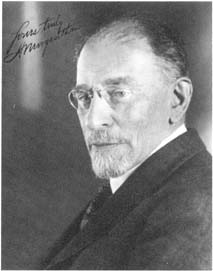
|
|
Henry
Morgenthau
|
The clue is with one of the New York Times articles accusing Morgenthau
of caring more for the Jews. As we learned in “The Burning Tigris,” although
author Balakian ingenuously asserted Morgenthau was not a Zionist, the ambassador
was under the spell of über-Zionist and hysterical pro-Armenian activist Rabbi
Stephen Wise. The ungrateful idea was to knock out history’s greatest pre-USA
protector of Judaism, to clear the path for a Jewish homeland... a homeland that
could not have gotten started without the Ottomans’ allowance for its roots, in
the first place. America’s entry into the war would have guaranteed the defeat of
the Sick Man of Europe.
 |
|
Abram
Elkus -- separated at birth?
|
Morgenthau’s
pre-Bristol successors surely were not going to make radical changes in Morgenthau’s
“Hate the Turk” policy, as the bigoted consular network was already well
entrenched. The immediate temporary fill-in, U.S. Chargé Hoffman Philip, was likely
under the same influences, if he worked under Morgenthau’s wing. We don’t know
of the motivations of the official next ambassador, Abram Elkus (who visually
appears to have been “separated at birth” with Morgenthau); but he obviously
didn’t have the courage or fairness of Admiral Bristol, to look at the picture
evenly.
ADDENDUM (06-06)
While it is true Elkus was no
Bristol, the above assessment of branding Elkus as a clone of Morgenthau might
have been premature. (Aside from the physical resemblance, of course; Elkus
also shared Morgenthau's faith and lawyerly occupation.) Joseph Grabill
provides clues (in p. 74 of his book) that "Abraham I." Elkus was carefully
selected to carry over the outlook of his predecessor. However, as Turkish
reporter Recep Guvelioglu put in (in an impressive piece entitled, "Lesser-known
facts about the Armenian genocide claims," The New Anatolian, May 16,
2006), and citing Germany, Turkey and Zionism: 1897-1913 (Isaiah
Friedman, Oxford, 1977) as reference (a book that appears to corroborate
Morgenthau's Zionist intentions, as Guvelioglu puts it: "He thought a
British victory would provide the best solution to the Palestine problem and
Jewish homeland. He was strongly in favor of U.S. participation in war on the
side of Britain for a complete defeat of Turkey"), Elkus is said to have
prepared reports and evaluations "very different from those of
Morgenthau."
Guvelioglu continues: "Morgenthau was described as a 'charming, but
over-emotional, erratic and particularly untactful personality and sometimes
acts as a bull in a china store.' ... Elkus was an entirely different
personality and had very different political views than Morgenthau. He was
described as a quiet but extremely effective diplomat, achieving practical
results of far-reaching consequences. He greatly valued good relations between
the U.S. and Turkey, and restored them to an excellent relationship which had
been in poor shape due to Morgenthau's lack of tact. He was against U.S.
participation in the war and strongly opposed a U.S. declaration of war
against Turkey and achieved it. Instead of publicity or agitation, he devoted
his efforts to provide help to the relocated Armenians."
|
Dadrian accuses Lowry of pointing to the “few ailing trees
— the purported flaws of Morgenthau's book — thereby ignoring the robustness of
the forest — the fundamental truth about the extermination of the Ottoman Armenian
population.” Is the prosecutor-professor living in a dream world? The
forest in its entirety is a black one, with “slander after slander,” as Lowry
puts it. The fact that Henry Morgenthau emerges as such an unscrupulous, dishonest
character is all we need to know to decide on the worth of this phony book. If he
lies constantly, nothing he says can be taken seriously. Perhaps Dadrian cannot
understand this concept, since he is another pea in Morgenthau’s deceptive pod.
However, the reader can turn to Lowry’s analysis, using as evidence Morgenthau’s own words, and
decide.
As an example, Dadrian complains that Morgenthau’s parting words with Talat aren’t
evidenced in Morgenthau’s private entries. (Talat says, "We are through
with [the Armenians]." Of course, being “through” means the Armenians
have been moved out, and the rebellion danger they presented has been averted... in
other words, the problem has been solved. However way Morgenthau’s Armenian
translator explained this word, assuming Talat actually said such a thing, and
whatever other word Morgenthau overlooked to go for a more sinister meaning in the
writing of his propagandistic book, Talat surely would not have told Morgenthau that
the Armenians were all killed off... even if that were the case.)
With glee, Dadrian points to another account where Talat makes a similar statement
to Bernstorff, who happens to be the German ambassador. ('What on earth do you
want? The question is settled, there are no more Armenians.') Yet another
Christian-sympathizing German, Bernstoff had no idea what was really taking
place, like his American ambassadorial counterpart; As George Schreiner wrote in his
preface to “The Craft Sinister,” "It is to be hoped that the future
historian will not give too much heed to the drivel one finds in the books of
diplomatist-authors.” One future “historian” is Vahakn Dadrian, although
we have seen time and again that the sociologist is anything but a historian. A real
historian does not cover up the parts that don’t serve his agenda.
One perfect example of Dadrian’s lack of morals is his complete overlooking of
Schreiner as the rare, genuine eyewitness of the Armenian convoys. In his book,
Schreiner flatly stated there was no extermination policy, and the tragedies that
resulted occurred from Ottoman “ineptness.” Dadrian does not like Schreiner’s
indictment of Morgenthau, so what does Dadrian do? He presents us with select
passages from Schreiner’s books pointing to the suffering of the Armenians.
Genuinely neutral Western eyewitness H.J. Pravitz also recounted
terrible Armenian suffering in his own report, but his truth was that there was no extermination
policy. ("I
have seen dying and dead along the roads — but among hundreds of thousands there
must, of course, occur casualties. I have seen childrens' corpses, shredded to
pieces by jackals, and pitiful individuals stretch their bony arms with piercing
screams of "ekmek" [bread]. But I have never seen direct Turkish
assaults against the ones hit by destiny.") Schreiner was the ONLY
(yes! The ONLY) American field reporter who witnessed the Ottoman interior in
1915 (Pg. 297, "America and the Armenian Genocide of 1915"), and he
observed terrible suffering. But suffering does not equal genocide; Schreiner's
honest testimony that the aim was relocation and not liquidation is one that cannot
be ignored.
Forget about the fact that no Turk denies the
Armenians suffered, and quite a few died of massacres; even if 1% of 1.5 million as “Le
Figaro” figured (from massacres and other deprivations of the marches), that
would still be 15,000 too much. If we go with Dadrian’s forest analogy, it is the
Armenian prosecutor who neglects the whole, and concentrates on the trees that suit
him. Here, the overlying whole from Schreiner is that there was no genocide. How
could Dadrian be so wholly devoid of ethics as to try and cover that up?
|
| Conclusion |
In this section, Dadrian hopes to have us swallow the notion that the
Turks are powerfully influential in the United States. This is not an atypical Armenian
tactic. They do the crime, and then point their fingers at the Turks for doing the same.
The fact of the matter is, the Turks are woefully without influence; public relations are
their worst point. If the situation were contrary, the Turks would not have the negative
image they have today, constantly perpetuated by the hateful and relentless propaganda of
Turcophobic groups. Yet, Dadrian informs us that some Turks “are
wont to brag that they are ‘the spoiled brats of the Americans!’" (Like
who, I wonder.)
Dadrian has it wrong. The Americans don’t grant privileges to the Turks from thin air.
American aid generally comes in the form of loans that need to be paid back.
In the rare case when Turkey doesn’t jump to America’s call, as with the Iraqi
invasion, suddenly all the many examples of Turkey’s selfless gestures from the past can
be forgotten.
A spoiled brat is one who barely lifts a finger to do his bit, and can count on being
rewarded regardless. The real spoiled brat are the Armenians. They give nothing to
America, but take much in return — thanks to their powerful lobbying organizations like
the Armenian Assembly of America, and ANCA. Here’s how Sam Weems described it, in a 2002
interview:
(Championing) Turkish Americans ... are too few and they have
little funding to compete against a well-oiled and funded Armenian lobby organization. The
Armenians have perhaps 40-50 full time professionals in Washington DC doing nothing but
working each and every day to undercut Turkey and Azerbaijan and promote themselves for
more foreign aid taxpayer funding. Turkish Americans have -0- staff and office working for
them in Washington DC. The Turks really should do more to protect themselves. All they
have to do is tell truth! Here is an eye-opening calculation for you:
Armenians, in the last 10 years, have probably spent about 14 million dollars to support
all the political candidates that they did. When those candidates got elected, Armenia got
1.4 billion dollars in the same 10 years as US Foreign Aid. That is, for every one dollar
Armenian Americans "invested," they got $100 back in US Aid to Armenia! 100 to 1
return!
Dadrian then summons up all his will and tries to submerge his overpowering “Armenian-ness”
by briefly waving the American flag. He offers flowery speeches on Jefferson and Lincoln,
and reminds us of our nation’s Library of Congress. “Just as
libraries are much cherished as fertile grounds for the pursuit of knowledge and truth, so
are national archives,” Dadrian says in preparation to sell the nth Armenian
genocide resolution before Congress. (He couldn’t sustain his American patriotism for
more than a paragraph before reverting to his true passion... Armenia!) He cries the
legacy of Thomas Jefferson should be adhered to. “Let the National
Archives serve the lofty purpose for which they were created. Let the truth emerge.”
|
|
As with “Invasion of the Body Snatchers,”
the Armenian pods have made excellent strides in infiltrating practically every
corner of western (and other) societies. The 1911 Encyclopedia Brittanica, for
example, claimed a pre-war Ottoman-Armenian population of 1.5 million, the fair norm
among “neutral” parties. In 1953, this figure skyrocketed to over 2.5 million.
The writer was an Armenian.
National Geographic Magazine came up with a 2004 article on Armenia, where the false
1.5 million mortality claim was repeated., along with other propagandistic claims.
An editor of Armenian origin is on the magazine's editorial staff.
Now I’m very proud of the Library of Congress; the Library of Congress should be
my nation’s harbinger of truth. So imagine my surprise when I discovered the web
site of the Library of Congress repeating the familiar Armenian propaganda:
“...(T)he Ottoman government ordered large-scale roundups, deportations, and
systematic torture and murder of Armenians...”
“...Prewar population of about 3 million Armenians...” (That
number keeps going up and up!)
“...By 1917 fewer than 200,000 Armenians remained in Turkey...”
"1895: Massacre of 300,000 Armenian subjects by Ottoman Turks."
The Library of Congress has become a hotbed for the worst of Armenian propaganda.
With a little investigation, I learned the man in charge of the appropriate
department (the Middle East Division) was one of the pod people, a Dr. Levon
Avdoyan. A letter to the head librarian, James Billington, predictably produced no
response. Pod people have a tendency to create other pod people.
Billington is so simpatico with the
Armenians that he actually besmirched the Library of Congress's good name by
co-sponsoring a Sept. 2000 "Armenian Genocide Conference" with... the
impossibly partial Armenian National Institute! (This led to the propaganda book, "America
and the Armenian Genocide of 1915," edited
by pro-genocider Jay Winter. Billington's daughter, Susan Billington Harper,
contributed a chapter on a missionary.)
This is the Library of Congress. Anyone pointing to the Library of Congress can
expect no second guessing of the information provided there. (Indeed, that’s how I
learned about the information; I read a letter from an Armenian saying, SEE! That’s
what the LIBRARY OF CONGRESS says. Just like when the missionaries and consuls got
their notes together in WWI and their claims substantiated one another. Just like
the Armenians and their genocide scholar allies point to each other today. The
sinister effect results in what seems to be an overwhelming consensus.
And Vahakn Dadrian wants you to go to these
sources to find out the truth. It’s a sad day when one can’t even go to the
Library of Congress to let the truth emerge.
To borrow Dadrian's smart-aleck words, the French essayist Montaigne once observed:
no one is exempt from talking nonsense;
the misfortune is to do it solemnly.
- Essays v. III, i.
|
| |
|
|