|
|
Professor Heath W. Lowry
The ISIS Press, İstanbul - Turkey, 1990
With Thanks to www.eraren.org
|
|
|
| Why
Was Ambassador Morgenthau's Story Written? |
ANY examination of the genesis of the Morgenthau
'Story,' must begin by focusing on a letter the Ambassador addressed to his friend and
confidant, United States President Woodrow Wilson, on November 26, 1917. For it is in this
previously unpublished letter that Morgenthau set forth both his idea of writing a book,
and his aims and objectives in desiring to do so. He combined his concept with an appeal
for the President's 'blessing' as it were for his proposal. Given the fact that his sole
aim was fostering public support for the United States war effort by writing a work of
anti-German, anti Turkish propaganda which would "win a victory for the war policy of
the government," he not surprisingly received it. He couched his idea to Wilson in
the following terms:
"...Greatly discouraged at the amount of outright opposition and the tremendous
indifference to the war, as well as by the lack of enthusiasm among the mass of those who
are supporting the war...
I am considering writing a book in which I would lay bare, not only Germany's permeation
of Turkey and the Balkans, but that system as it appears in every country of the world.
For in Turkey we see the evil spirit of Germany at its worst - culminating at last in the
greatest crime of all ages, the horrible massacre of helpless Armenians and Syrians. This
particular detail of the story and Germany's abettance of the same, I feel positive will
appeal to the mass of Americans in small towns and country districts as no other aspect of
the war could, and convince them of the necessity of carrying the war to a victorious
conclusion...
We must win a victory for the war policy of the government and every legitimate step or
means should be utilised to accomplish it."1
In its simplest form, this study intends to evaluate the ensuing work from the perspective
of whether or not, as written, Ambassador Morgenthau's Story exceeds or adheres to his own
criteria of utilising "every legitimate means" to reach his stated goal of
convincing the "mass of Americans" to support the war.
Within a year of the date of Morgenthau's letter to Wilson, Ambassador Morgenthau's Story,
as the work he proposed was eventually titled, had been written; serialised in monthly
installments in one of America's best-known magazines, The World's Work (circulation:
120,000);2 appeared in over a dozen of the country's largest newspapers with a combined
circulation of 2,630,256; 3 released with great fanfare as a book by Doubleday, Page &
Co.,4 and already accumulated sales of several thousand copies (by July 1st of the
following year those sales would reach 22,234 copies).5
 |
|
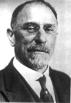
Morgenthau
|
In short, Morgenthau's goal of contributing to
America's war effort by authoring a book which would in his words, "appeal to the
mass of Americans in small towns and country districts as no other aspect of the war
could,"6 had been attained in a manner which must have exceeded even his wildest
expectations. Indeed, no sooner had World's Work begun its installments of the book's
opening chapters in May,1918, than Morgenthau received an offer from Hollywood for the
film rights of his 'story,' an offer companied by the promise of $25,000 for said rights.
After initial excitement, and the writing of a basic film treatment,7 Morgenthau's
enthusiasm for a career in the movies cooled following receipt of a second letter from
President Wilson which expressed his disapproval in no uncertain terms. Wilson wrote:
"I appreciate your consulting me about the question whether the book shall be
translated into motion pictures, and I must frankly say that I hope you will not consent
to this... Personally I believe that we have gone quite far enough in that direction. It
is not merely a matter of taste, -I would not like in matters of this sort to trust my
taste; but it is also partly a matter of principle... There is nothing practical that we
can do for the time being in the matter of the Armenian massacres, for example, and the
attitude of the c (? Country?) toward Turkey is already
fixed. It does not need enhancement."8
Less than a year earlier it had been the approval of Wilson which Morgenthau sought prior
to beginning the book project, and, indeed, it was only when Wilson had blessed the
proposal and written: "I think your plan for a full exposition of some of the lines
of German intrigue is an excellent one and I hope you will undertake to write and publish
the book you speak of,"9 that Morgenthau responded positively to preliminary
inquiries from Burton J. Hendrick of Doubleday, Page & Company's The World's Work, 10
and the project began to materialise. It would be somewhat surprising to find the
President of the United States of America and an ex-Ambassador communicating on a topic of
this nature. But, this was wartime and, as the Morgenthau-Wilson correspondence
illustrates, from its inception, Ambassador Morgenthau's Story was conceived as an
integral part of 'President Wilson's Story' as well. It was a desire to increase support
for Wilson's war effort which prompted Morgenthau to write an anti-German, anti Turkish
work, which would convince the American public of the "necessity of carrying the war
to a victorious conclusion,"11 In other words, as envisaged by Morgenthau, his
'story' was intended as wartime propaganda, i.e., as a contribution to the Entente war
effort. It is against this background that we must attempt to examine how and by whom the
book was actually written, as well as the larger questions concerning the accuracy or lack
thereof of the 'story' it purports to tell.
FOOTNOTES
The largest public collection of papers relating to the life and career of Ambassador
Henry Morgenthau (1856-1946), is preserved in the Library of Congress, Washington, D.C.
Housed in the Library's 'Manuscript Division; under the title 'The Papers of Henry
Morgenthau; they consist of approximately 30,000 items which are made available to
researchers in the form of a set of 41 reels of microfilm. In the present study references
to materials in this collection will be given in the following format: LC: PHM-Reel No.
-followed where applicable (as in the case of correspondence) by a date. In the case of
the present document, the citation is LC: PHM-Reel No. 8 - HM letter to President Woodrow
Wilson of November 26,1917.
The World's Work was a
monthly publication owned in this period by Doubleday, Page 8z Co., the New York
publishers. Beginning in its Apnl,1918 edition with an article by Burton J. Hendrick
entitled: "Ambassador Morgenthau's Story-Introductory Article,' this periodical
serialised in seven installments (which ran between May and November), the Morgenthau
book. To Professor Robert J. Rusnak of Rosary College in Illinois, I am indebted among
other things, for the circulation figures of The World's Work. Prof. Rusnak's doctoral
dissertation was devoted to a study of this journal and its impact.
The second major collection
of Morgenthau Papers is housed in the Franklin Delano Roosevelt Presidential Library in
Hyde Park, New York, as part of the collection titled: The Papers of Henry Morgenthau, Jr
;' Ambassador Morgenthau's only son who served for many years as a member of the Franklin
D. Roosevelt Cabinet. This collection, comprising some 414 linear feet, is divided into
eleven series, of which Series nos.8 and 10 contain papers relating to Ambassador
Morgenthau. Specifically Scries No. 8, the 'Gaer File; is material collected by Joseph
Gaer, Morgenthau Junior's collaborator in his unpublished autobiography. In this series we
find a typed transcript of all correspondence between Ambassador Morgenthau and his son.
Material in this series which is cited in this study, will appear as: .FDR: HMJ/Gaer-Box
No. . Series No.10 is titled the 'Papers of Henry Morgenthau, Sr.' and consists of some 10
linear feet of primarily business and personal correspondence. When cited in this study,
items from this collection will appear as: FDR: HMS-Box No.
The circulation figures for
the newspapers which published Ambassador Morgenthau's Story are found in a letter from
Frank Doubleday of Doubleday Page & Co. (Morgenthau's publisher), to Henry Morgenthau,
Sr. of October 17,1918 (FDR: HMS - Box No.12). This letter was originally accompanied by a
list of the actual papers which were running the serialised version of the book.
Unfortunately, this list is lost or separated from the letter.
Having worked in Libraries and Archives in a number of countries, I would b&127;
remiss were I not to express my thanks and appreciation to the staff of the Roosevelt
Library, who made my all too brief stay in Hyde Park a working pleasure. In particular my
research benefited from the gracious assistance provided by Ms. Susan Y. Elter, an
Audiovisual Archivist at this facility.
FDR:HMS-Box1)To.12 (Letter of October 17,1918 from Doubleday to Morgenthau) mentic Zs that
the publisher has arranged windows in Macy's, Brentano's, Wanamaker's, Scribner's, etc.,
in addition to sending out advance copies of the book and various publicity releases.
The third major collection
of materials utilised in this study, arc the personal papers of the late Burton J.
Hendrick. Hendrick, a distinguished author and journalist was the individual who actually
'ghosted' the Morgenthau book. Through a New York Times obituary (March 25, 1949), which
detailed the life and achievements of Hendrick, I was able to trace his grandson, a Hobart
Hendrick, Jr. of Hamden, Connecticut, who most graciously answered all my queries. He, in
turn, put me in touch with a cousin, Martha Rusnak of Winfield" Illinois, whose
husband, Robert Rusnak, a professor of History at Rosary College, has actually written on
his wife's grandfather. Professor Rusnak most kindly provided me copies of a number of
documents from the 'Papers of Burton J. Hendrick; which are in their collection. Those
included correspondence between Morgenthau and Hendrick, and, in particular an unpublished
Rusnak study on Hendrick, called: "'To Cast Them in the Heroic Mold': Court
Biographers - The Case of Burton Jesse Hendrick." Professor Rusnak also informed me
that Hendrick had participated in the Columbia University Oral History Project and been
interviewed by Alan Nevins shortly before his death in 1949. Material cited in this study
from the Hendrick materials supplied by Prof. Rusnak will appear as: Hendrick/Rusnnk
together with a description of the actual item being referred to.
The sales information
figures given here are found in a handwritten document in the Hendrick/Rusuak papers which
is headed: "Statement of Profit and Loss to July l,1919 on 'Ambassador Morgenthau's
Story' by Henry Morgenthau:' This document, apparently written by Morgenthau himself,
shows sales as of that date totalling 22,234 copies.
LC: PHM - Reel No. 8 : HM Letter to President Woodrow Wilson of November 26,1917.
Hendrick/Rusnak Among the
material provided by Robert Rusnak relating to the Morgenthau-Hendrick collaboration, is a
typed 8 page document titled: "Proposal for a Moving Picture on tho Near East, Based
to a Considerable Extent on Ambassador Morgenthau's Story." Across the top of this
document is the following handwritten note: "This great scheme (for which the moving
picture people o f offered us $25,000) was busted by the was suddenly coming to an end!
B.J.H."
LC: PHM - Reel Nu. 8:
President Woodrow Wilson letter to Henry Morgenthau of June 14,1918. The emphases in this
quotation and throughout this study are the present author's.
LC: PHM-Reel No. 8:
President Woodrow Wilson letter to Henry Morgcnthau of November 27,1917. Interestingly,
whereas Morgenthau's November 26,1917 letter to Wilson has never been published, he did
include the President's answer in his 1922 autobiography, All In A Life-Time. New York
(Doubleday, Page 8z Co.),1.922. p.297, and cites it as the reason he wrote his book.
FDR:HMS - Box No. 11 : Frank
Doubleday letter to Henry Morgenthau of November 7,1917; Henry Morgenthau letter to Frank
Doubleday of November 12,1917 in which Morgenthau states:
"Since Mr. Hendrick
called upon me I have again carefully considered the advisability of writing a book about
my experiences in Turkey and have now definitely concluded that this is not the time to
publish it:' However, upset by lack of public support for the war, two week later he asked
the President's blessing and following receipt of Wilson s November 27,1917 letter changed
his mind and immediately entered into serious negotiations with the publisher. See also:
Frank Doubleday letters to Henry Morgenthau of 23 November and 5 December 1917, and Arthur
Page to Henry Morgenthau letters of 8 December and 20 December 1917. By the latter date,
all contract arrangements for the book had been completed.
LC:PHM-Reel No. 8: HM Letter
to President Woodrow Wilson of November 26, 1917.
|
Whose 'Story' is it?
|
Our sources for the history of Ambassador
Morgenthau's Story, are two collections of surviving Morgenthau papers, one housed
in the Library of Congress in Washington, D.C., which is known a 2 The Papers of
Henry Morgenthau (Hereafter: LC: PHM),12 and the other, part of the Henry Morgenthau,
Jr. Papers in the Franklin Delano Roosevelt Presidential Library in Hyde Park, New
York (Hereafter: FDR: HMS).13 These two collections, which comprise literally tens
of thousands of documents, must be supplemented by a wide variety of published and
unpublished materials, the most important of which are the papers of the well-known
Pulitzer Prize winning journalist,l4 biographer and historian, Burton J. Hendrick.
14 For, not only did Ambassador Morgenthau need the approval of President Woodrow
Wilson to proceed with the plan for the book which bears his name, more importantly
he needed the skilled hand of Burton J. Hendrick, to actually write the work in
question. In point of fact, it appears that the actual concept of the book
originated in the mind of Hendrick, who first suggested it to Morgenthau in April of
1916.15 It is through an examination of several thousand letters and documents in
the above-mentioned collections that eventually the rather murky origins of the work
in question emerge. To unravel the many threads which went into Ambassador
Morgenthau's Story, we must begin by discussing the various sources upon which it
was based.
First and foremost, is a typed-transcript called 'Diary' which covers the actual
period of Morgenthau's sojourn in Istanbul (Constantinople), that is, the period
from November 27, 1913 (the date of Morgenthau's arrival in the Ottoman Capital), to
his departure from Turkey on February 1,1916,16 a period of twenty six months. From
internal evidence, in particular Morgenthau,s comments about dictating to his
secretary, a Turkish Armenian named Hagop S. Andonian,17 it appears that on a
regular basis Morgenthau related his day's experiences to Andonian, who in turn
typed them up for posterity. Though extremely detailed, in particular as regards his
contacts with the Young Turk leaders, Said Halim Pasha, Enver Pasha, and Talaat Bey,
the version of events recorded in his daily 'Diary' entries often bears little
relationship (as will subsequently be demonstrated) to the descriptions of the same
meetings and discussions narrated in Ambassador Morgenthau's Story. Despite this
problem 9 there can be no doubt ; that the key source material upon which the book
was based is the daily record preserved in the 'Diary.'
In addition to his 'Diary,' and based primarily upon it, Morgenthau was in the habit
of writing a lengthy 'round robin' type weekly letter to various members of his
family back home in the United States. 18 These letters were likewise prepared by
Hagop S. Andonian, Morgenthau's personal secretary, and indeed often, as Morgenthau
tells us in a letter of May 11,1915, actually written by him:
"I have really found it impossible to sit down and dictate a letter quietly. So
I have instructed Andonian to take my diary and copy it with some elaborations of
his own. Of course this relieves me of all responsibility for any errors."19
It was then a combination of the Morgenthau 'Diaries' and 'letters' which served as
the basic raw material out of which the work was ultimately assembled. These two
sources were supplemented in some instances by copies of actual reports received by
Morgenthau in Constantinople, or dispatched by him to Washington, D.C.20 Stated
differently, these formed the skeletal framework upon which the finished product was
to be hung.
With this background in mind we must now turn to an examination of the actual manner
in which the book was written, and to the even more complex question of by whom it
was written. In this regard, in each and every edition, the author appeared solely
as: Henry Morgenthau. And today, seventy two years after its appearance, no one has
ever suggested in print that anyone but Morgenthau authored Ambassador Morgenthau's
Story.21 Despite this fact, there are abundant clues scattered about in the
surviving Morgenthau material to provide us hints as to the identity of the work's
actual author. First and foremost, is an acknowledgment made by Morgenthau in the
'Preface' to both the book's American and British editions, where he wrote: "My
thanks are due to my friend, Mr. Burton J. Hendrick, for the invaluable assistance
he has rendered in the preparation of this book."22 This acknowledgment is, to
say the least, an understatement. For in point of fact, Ambassador Morgenthau's
Story emerged from the pen of Burton J. Hendrick, with the editorial assistance of a
large number of individuals, including Morgenthau himself. In addition, he was
assisted by his Armenian secretary Hagop S. Andonian who followed Morgenthau to the
States and lived with him throughout the period in which the book was under
preparation.
Very little is known concerning the life of Hagop S. Andonian. In numerous
appearances of his name in both the 'Diary' and 'Letters' he is generally referred
to by Morgenthau as "my secretary," though on occasion he clearly
fulfilled the role of "Dragoman," (translator) as well.23 The 'Diary'
records the fact that he was a frequent guest at the Morgenthau table, and often
accompanied the Ambassador to the movies in the evening. From a reference in
Morgenthau's family 'Letter' of July 15, 191424, it appears that Andonian was a
student at the American run Robert College around the turn of the century. A
surviving photograph of the Embassy staff taken during Morgenthau's tenure, shows
him to have been in his early thirties at that time. While nothing specific has
apparently survived to shed light on the question of why he returned to the United
States with the Morgenthaus, a 'Diary' entry for February 8, 1916 clearly
establishes that he left Turkey with the Ambassador. On that date in describing a
shipboard masquerade party en route to New York, Morgenthau records that his son
"Henry was dressed as a Greek and Andonian as a Turkish lady. "25 Among
the surviving Morgenthau correspondence is a copy of a letter addressed by the
Ambassador on January 9, 1918 to the Honorable Breckenridge Long, Third Assistant
Secretary of State, requesting that official's assistance in obtaining a deferment
from military service for his secretary, Mr. Hagop S. Andonian. This letter includes
the following paragraph:
"You probably know that with the approval of the President, I have undertaken
to write a book. Mr. Andonian is assisting me in the preparation of that work and
owing to his intimate knowledge of the east and his unusual experience, his services
to me are really indispensable".26
This passage establishes three facts of interest: a) One reason for Andonian's being
in the U.S. was to assist Morgenthau with the book; b) the actual work on the book
had begun by the beginning of January 9, 1918, and, c) by 1918 Andonian was eligible
for military service in the U.S.
There are also three short references to Andonian in Morgenthau's 1918
Diary/Appointments Calendar: 1) an entry for April 26, 1918 which reads: 'Dictated
at Yale Club to Andonian and examined galley proofs of second instalment next book;'
2) an entry for April 17, 1918 reading: 'Dictated all day to Andonian and Hendrick
and, 3) a two-word notice on September 9, 1918 which reads: 'Andonian left.'27 The
next and final references to Andonian in the Morgenthau Papers are two handwritten
letters dated December 16 1920 and December 24, 1920 28. Written from Istanbul on a
letterhead bearing the names: 'Haig, Nichan, Hagop Andonian' and listing their role
as agents for the 'Sun Insurance Company,' and as real estate brokers, Andonian
writes to inquire about the truth of rumors then circulating in the Ottoman capital
to the effect that Morgenthau is to be appointed by the U.S. President to mediate
between the Kemalist and Armenian forces. Andonian offers his services to Morgenthau
should these rumors prove true (they didn't).
To anyone familiar with Turco-Armenian history in the post war period, the question
of a possible relationship between Morgenthau's Secretary Hagop S. Andonian and,
Aram Andonian, the author of the collection of forged documents known as: The
Memoirs of Naim Bey: Turkish Official Documents Relating to the Deportations and
Massacres of Armenians, London (Hodder & Stoughton), 1920, immediately comes to
mind. Both were natives of Istanbul and shared the rather uncommon surname of 'Andonian,'
which raises the possibility that they may have indeed been related. To date, no
additional information on this question has been uncovered.
Another key figure who had significant input in the preparation of the book was
Arshag K. Schmavonian, yet another Turkish Armenian who, in 1918 was in the employ
of the State Department in Washington, D.C. as a 'special adviser,' and who had
worked as Morgenthau's interpreter in Istanbul and accompanied him in all meetings
with Turkish officials. Schmavonian's role as friend confidant and adviser to
Morgenthau both during and after his stay in Istanbul is easily traceable in the
various surviving Morgenthau Papers. Indeed, almost from the day of his arrival in
Turkey, Morgenthau relied upon Schmavonian as his eyes and ears in what must have
seemed an alien environment given the fact that Morgenthau knew neither Turkish,
French, Greek nor Armenian, the four principal languages spoken in the Ottoman
Capital. Already, in a 1914 interview given shortly after his arrival in Turkey to a
correspondent of The New York Herald, Morgenthau acknowledged his dependence on
Schmavonian in the following terms:
"It will be my duty to dive into the very heart of things surrounding me. With
the help of the Legal Adviser of the Embassy, Mr. Schmavoni, who knows the Orient so
well, I shall be able to master the task in a more or less satisfactory manner in a
few weeks."
There is hardly a page of the Morgenthau 'Diary' which does not contain reference to
Arshag K. Schmavonian. He accompanied Morgenthau on almost every official visit he
paid to members of the Young Turk Government, he sat in on Morgenthau's meetings
with American businessmen (many of whose legal affairs he handled in Turkey), he
participated in all meetings with the American missionary interests (whose legal
affairs he also handled), and, also assisted Morgenthau in the writing of his cables
to Washington, D.C. The National Archives in Washington, D.C. houses a collection of
Schmavonian Papers.31 Though the overwhelming majority of these papers deal with,
Schmavonian's representations of various American business and missionary interests,
they also preserve a few handwritten notes from Morgenthau to Schmavonian, all of
which bear the salutation: 'My dear Mr. Schmavonian.' In the Morgenthau papers there
are also a large number of letters from Arshag Schmavonian to Ambassador Morgenthau,
covering the years 1914-1921.32 All of the letters written prior to 1919 bear the
salutation: My Dear Chief.'
The extent to which Morgenthau relied upon his Armenian adviser can be partially
measured by a speech he gave when raising funds for Armenian and Syrian Relief
following his return to the United States. Of Schmavonian, he wrote:
"The first man I found in the Embassy whom I could lean upon for all kinds of
assistance, the man who has done the yeoman work of the American Embassy, is an
Armenian [Schmavonian]. He has been connected with our Embassy for sixteen years. I
found him to be an unusual man, held in high regard by the Turkish authorities. My
private secretary [Andonian] was also an Armenian.
Through these two men I became acquainted with some Armenian priests and with
patriots and professors, and learned not only to respect but to love and admire many
of the Armenians."33
Nor did this relationship end with Morgenthau's departure from Turkey. The two men
were reunited in 1917 when Morgenthau was sent by President Wilson to Europe, and
Schmavonian joined him once again in the role of interpreter. Then, following the
rupture of relations between Turkey and the United States, Mr. Schmavonian was
transferred late in 1917 to Washington, D.C. where he remained in the capacity of a
'Special Adviser' until his death in January, 1922. Morgenthau wrote a moving
tribute to his memory, which illustrates the closeness of their relationship:
'Great was my pleasure to find upon meeting Mr. Schmavonian that the enthusiastic
praise of my predecessors [Ambassadors Straus and Rockhill] was not only fully
justified, but had failed to do him adequate justice. He had all the traditions of
the office most methodically stored away in his mind, and made them accessible to me
at any time, day or night, at a moment's notice, and it was the same as to all the
American missionary and educational activities in Turkey. He was so eminently just,
and so absolutely truthful, that every one with whom he came in contact, promptly
recognised the sterling qualities, and soon learned to love their possessor.
'He was a delightful social companion and graced any assembly which he attended. The
services which he rendered to the United States government and to all the
Ambassadors at Constantinople, to the missionary interests, American business
interests, and the Armenian and Jewish populations in Turkey, were unexcelled by
anyone.
'He was unobtrusive to a fault, and never claimed any credit for himself. His
devotion to his mother and to the service possessed him completely, and he was
always thoroughly loyal to his own people, the Armenians.
'The United States has lost one of its most faithful servants, and I, one of my
dearest friends.'34
Some idea of the extent of Schmavonian's role in shaping Ambassador Morgenthau's
Story may be had by an examination of his surviving correspondence with Morgenthau
during the period in which the book was written:
a) January 16, 1918 letter from Schmavonian to Morgenthau responding to an earlier
request for the names and titles of various Ottoman Cabinet members during
Morgenthau's tenure 35
b) January 26, 1918 letter from Morgenthau to Schmavonian asking him to supply facts
based on the cables and dispatches which Morgenthau sent the Department of State
from Turkey. 36
c) An enclosure of August 29, 1918 of comments on Morgenthau's manuscript prepared
by the State Department, appears to have been written by Schmavonian as well, thus
raising the possibility that he was (as might logically be expected) the official in
the Department assigned to comment on the draft of Morgenthau's book. 37
d) September 3, 1918 Morgenthau to Schmavonian letter, clearly establishes that it
was Schmavonian who was commenting on Morgenthau's manuscript. When Morgenthau
writes:
'I am sending by this mail our article No. 7, the first half of the Armenian
story... I do hope that in your good natured and accommodating way, you will work
over time, and I will promise you that I shall not write more books that have to get
the approval of the State Departanent.' 38
In short, Schmavonian was a key aide to Morgenthau both throughout his tenure in
Turkey, as well as during the months in which Ambassador Morgenthau's Story was
being written in 1918. He was even entrusted by the State Department with the task
of approving Morgenthau's manuscript. .
Despite his role at each and every stage of the project, he is not mentioned by name
in Ambassador Morgenthau's Story, an oversight which is hard to comprehend. This is
particularly so in light of the fact that he is named in Morgenthau's 1922
autobiography: All in A Life Time. In this book, which Morgenthau wrote in
collaboration with French Strother, Scnmavonian appears (as he in reality was) a
close confidant of Morgenthau.39 Can it be that Morgenthau felt that reference to
his dependence upon his Armenian assistants (Andonian is not mentioned either) might
appear strange in a book devoted partially to the Armenian Question?
Yet another participant in the project was 'the U.S. Secretary of State, Robert
Lansing who (at the President s behest?) read and commented upon every chapter of
the work in progress. The nature of Lansing's role will be discussed below; however,
a number of letters, dating from the gestation period of the book fully illustrate
that it was not insignificant:
a) Lansing to Morgenthau letter of April 2, 1918, in which the Secretary states:
"I am returning herewith the first installment of the proof of your book which
I have read with particular interest... I have made various marginal notes
suggesting certain alterations or omissions in the text before publication and I
trust that you will agree with these suggestions".
b) Lansing to Morgenthau letter of April 27, 1918, accompanying another segment of
the draft manuscript "accompanied by a few suggestions which after careful
consideration we venture to propose."
c) Lansing to Morgenthau letter of August 29, 1918, together with proof sheets and
more suggestions;
d) Lansing to Morgenthau letter of September 17, 1918 with "suggestions and
remarks,"
e) Morgenthau to Lansing letter of September 22, 1918 asking permission to
acknowledge in the Preface to the published book, his appreciation for the
"trouble taken by the Secretary of State Robert Lansing in reading the
manuscript and of the many valuable wise suggestions he has made;"
f) Lansing to Morgenthau letter of October 2, 1918 declining Morgenthau's wish to
acknowledge his assistance with the book on the grounds "that on the whole it
would be advisable not to mention my name in connection with the book."40
When one recollects the fact that prior to beginning his project, Morgenthau
received the written blessings of the President of the United States, Woodrow
Wilson, and, that as the work progressed, each chapter received the personal stamp
of approval of the U.S. Secretary of State Robert Lansing, it is clear that
Morgenthau's book may be said to bear the imprimatur of the United States
Government.
This said, what literary merit the work has, and all its reviewers found it very
readable indeed, is purely the result of Hendrick. While Hendrick was never accorded
his due in terms of open recognition of his role in 'ghosting' the story, he was
well paid for his efforts, as a surviving letter from Morgenthau to him dated July
5, 1918 attests. In lieu of a formal written contract, which does not appear to have
existed between the two men, Morgenthau wrote the following to Hendrick:
I desire to put in writing that I intend to transfer to you a share of the income of
the book, 'Ambassador Morgenthau's Story,' about to be published by Doubleday, Page
& Company.
'The definite arrangement is to be made when your work on the book is completed, but
if anything should happen to me in the meantime, I hereby direct my Executors to
arrange that you are to receive two-fifths of any profits that are coming to me from
Doubleday, Page & Company, until you have received Ten Thousand [$10,000)
Dollars, and that the first five thousand ($5,000) Dollars coming to me are to paid
to you on account.'41
Hendrick, an individual fully deserving of serious scholarly study in his own right,
must have been fully satisfied with the final 'arrangement' made at the completion
of the book. From a receipt which has survived in the Morgenthau papers we may
surmise that whatever the final agreement was, it guaranteed Hendrick's 40% share
throughout the life-time of the book. It shows that in the period between January
2,1932 and July l,1932, that is, fourteen years after its initial publication,
Ambassador Morgenthau's Story was still in print. In this six month span it
registered a grand total of $2.00 in sales, of which the author's one-half share,
i.e., $1.00, was divided as follows:
Mr. Burton J. Hendrick's 40% share . . . . . 40
Mr. Henry Morgenthau's 60% share . . . . . 60 42 Thus fourteen years after its
initial publication, the American edition of the book was still providing income to
Hendrick and Morgenthau. As for Hendrick's feelings, they were recorded in an Oral
History interview he gave the historian Alan Nevins at Columbia University, a few
months before his death in 1949. He stated:
"I had one job of 'ghosting.' That was the elder Henry Morgenthau's
Reminiscences. That book created quite a good deal of interest. I worked with Henry
all the time.
He was an interesting character. Henry Morgenthau was a very capable person, very
chummy and good natured and was a very successful man. He, of course, made a great
fortune here in New York in real estate...The writing of my books on Sims and
Morgenthau was very interesting - more or less of a job..."
Hendrick44 who within ten years of the publication of the Morgenthau book was to
receive three Pulitzer Prizes, one for the book he co-authored with Admiral William
S. Sims: The Victory at Sea (recipient of the Pulitzer Prize in History in 1920),
and two in Biography for his 1922 work, the Life and Letters of Walter H. Page and
in 1928 for his second Page volume entitled The Training of an American, was already
in 1918 a well-known journalist who had done stints as an editorial writer with The
New York Evening Post, McClure's Magazine, and The World's Work. In these positions,
in the words of his New York Times obituary writer, Hendrick "developed a
reputation for painstaking accuracy,' honest thinking and good humor and developed
an appetite for research in subjects of great historical interest." The Times
obituary goes on to say that "critics of his biographies and histories almost
invariably would remark that his freshness and penetrating analysis bore the mark of
his early journalistic training." 45
Ironically, at least one reviewer of Ambassador Morgenthau's Story, a 'W.K.K.'
writing in December 5, 1918 issue of the Detroit Michigan News, instinctively sensed
that Morgenthau must have had a journalistic collaborator when he wrote:
"...Henry Morgenthau, our Ambassador to Turkey in the first year of the war, is
either a born journalist, or else he had journalistic help in the preparation of his
volume; for 'Ambassador Morgenthau's Story' is pure journalese.."46
What we are faced with is less the memoirs of one individual, Ambassador Henry
Morgenthau, than a memoir by committee as it were. Morgenthau's Istanbul notes
(consisting of his 'Diary' and Family 'Letters'), are reworked initially by
Morgenthau and Andonian, together with Hendrick; edited for content by Schmavonian
(on behalf of the State Department); then fine tuned' by the Secretary of State
Robert Lansing (on behalf of the Executive); and, finally written down as Ambassador
Morgenthau's Story by Burton J. Hendrick.
As to the question of whose story it really is, as our subsequent examination will
illustrate, it is a collective story bearing only a cursory relationship to what was
actually experienced by Henry Morgenthau during his tenure in Turkey.
FOOTNOTES
See: Footnote #1 above.
See: Footnote #3 above
See: Footnote #5 above
FDR: HMS - Box No. 9: Burton J. Hendrick letter to Henry Morgenthau of April 7,
1916, in which Hendrick refers to discussions with Morgenthau of the possibility of
Doubleday, Page 8z Co. publishing a book which would appear in a series of
"personal narratives of all the big people who have figured in this war."
This is apparently the earliest surviving document which specifically relates to the
book project.
LC: PHM-Reel No. 5 (Containers 3£ 4):
Contain the only known ropy of this daily record of Morgenthau's sojourn in Turkey.
Simply labelled as the 'Diary; this document provides a day by day account of
Morgenthau's activities while in Constantinople. When cited in the present study, I
have listed the following information: LC: PHM-Reel No.5: 'Diary' date:. All
references in the text to 'Diary' refer to this key source of information on
Morgenthau's day by day contemporary record of his activities.
References of this nature include the following: LC: PHM - Reel No. 5: 'Diary'
entries for September 25,1914, February 19,1915. The July 8,1915 entry reads:
"We worked at the book from 7:15 to 8. Then Schmavonian and Writhe took supper
with n. " This passage raises two possibilities: a) that others than Andonian
may have also had a hand m compiling the 'Diary' and, b) that Morgenthau's 'Diary'
may have all along been envisaged as the outline for a book he intended to publish.
Given the fact that he does not appear to have ever kept such a detailed 'Diary' at
any other stage of his life, this interpretation may well be true.
Copies of Morgenthau letters arc found primarily in two separate sections (series)
of the FDR Library - Morgenthau Papers. Specifically, they are in the FDR: HMS/Boxes
5, 7, 8,10 and in the FDR: I-IMJ/Gaer- Boxes Nos. I-2. While clearly based on the
'Diary' entries for the period they describe, there is often additional data found
in the 'Letters' in that they provide a useful supplement to the sometimes laconic
'Diary' entries.
FDR: HMS-Box 7: HM to children letter of
May 11,1915. That this comment does not relate solely to the May ll,1915 letter is
confirmed by FDR: HMJ/Gaer- Box 1-2: HM letter to Henry Morgenthau, Jr. of September
l,1915, where we read: "I am sending you one of the copies of the general
letter which recently has been written by Andonian, so don't blame me if it is too
impersonal and skeletonish:' On another occasion we find the following in a letter:
"1 don't know whether you folks all noticed the difference in style between
this letter and the preceding ones. I have dictated this one myself and filled the
mere skeleton notes that I gave Andonian and from which the recent letters were
written:' (FDR: HMS - Box No. 8: Letter of 7/13/1915 - p.l5)
Copies and 'paraphrases' and Morgenthau's cable traffic are found scattered
throughout the LC: PHM-See, in particular, Reels No. 5, 7, 8,17. This material was
compared with copies of Morgenthau's official reports preserved in the National
Archives in Washington, D.C. In particular: Record Group 59 - General Records of the
Department of State: Decimal File 867.4106 - Race Problems (Microfilm Publication
353: Reels 43-48).
Henry Morgenthau, Ambassador
Morgenthau's Story. New York (Doubleday, Page & Co.),1918. (hereafter: AMS).
AMS: p. vii.
LC: HMS - Reel No. 5 for March
15-16,1915, where Andonian accompanied Morgenthau to the Dardanelles in that
capacity.
FDR: HMS - Box No. 5.
LC: PHM-Reel No5.
LC: PHM - Reel No.:8
LC: PHM - Reel No.6.
FDR: HMS - Box No.13.
LC: PHM-Reel No. 37-date is illegible.
LC: PHM-Reel No.5.
National Archives: Record Group No.
84-Personal Correspondence of Arshag K. Schmavonian - 4 Boxes.
FDR: HMS -Boxes No. 5 (17letters from
1914), 9 (4 letters from 1916),10 (2 letters from 1916),12 (3 letters from 1919),14
(5 letters from 1921).
LC: PHM - Reel No. 22.
LC:PHM-Reel No.40
LC:PHM-Reel No.8
FDR:HMS-Box No.12.
FDR:HMS-Box No.12.
FDR:HMS-Box No.12
Henry Morgenthau (in collaboration with
French Strother), All In A Life Time, New York (Doubleday, Page & Co.),1922.
See: pp.178,187, 215, 216, 224, 227, 259, and 266.
FDR: HMS - Box No.l2.
Hendrick/Rusnnk: Morgenthau to Hendrick
letter of July 5,1918.
LC: PHM-Reel No.l7.
I am indebted to Mr. Ronald J. Grele,
Director of the 'Oral History Research Office' at Colombia University's Butler
Library, for a copy of the 62 page Nevins interview entitled: 'The Reminiscences of
Burton J. Flendrick.' The passage quoted above is taken from pages 31-32 of this
interview, and is a summary of Hendrick's comments. In addition to the Hendrick
materials discussed earlier in what I have termed the Hendrick/Rusnak Collection,
and the Nevins interview, there are also 75 Hendrick letters in the archives of the
American Academy of Arts and Letters in New York City. I am informed by Ms. Nancy
Johnson, the 'AAAL' Librarian, that this material consists primarily of letters
relating to Hendrick's membership in the 'AAAL; an organisation to which he was
elected in 1923, and of which he remained a member until his death in 1949.
The most detailed work on Hendrick's
career is Robert Rusnak's unpublished paper entitled: "To Cast Them in the
Heroic Mold": Court Biographers - The Case of Burton J. Hendrick." I am
indebted to the author for a copy of this study. Additional biographical information
has been consulted in the following reference" works: a Obituary notice.
'Burton Hendrick, Historian, 78, Dies, The New York Times, Friday, March 25,1949.
p.23. (Hereafter: Hendrick, Times: p.23.) b) Burton Jesse Hendrick entry in: The
National Cyclopaedia of American Biography. Vol. XXXVIII., page 476. Ann Arbor, MI
(University Microfilms),1967. c) Louis Filler, "Burton Jesse Hendrick,"
entry in The Encyclopedia Americana (International Edition). Vol.14, page 91.
Danbury, CT (Grolier Inc.) ND. d) Burton Jesse Hendrick entry in the 1922-1923 Who's
Who in America. Vol.12, page 1482. Chicago (A.N. Marquis & Co.),1923.
Hendrick, Times: p.23.
LC: PHM - Reel No. 40.
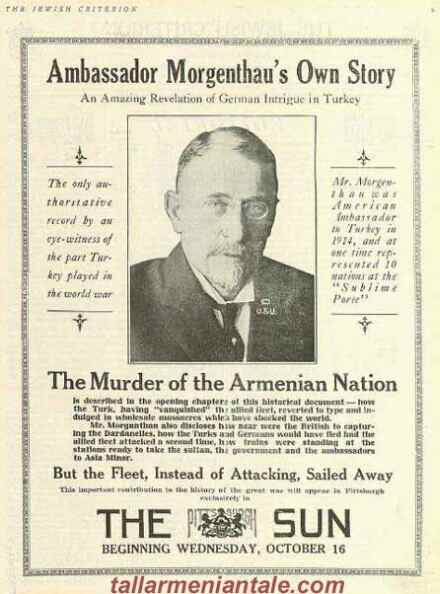
Advertisement appearing in The Jewish Criterion,
Oct. 11, 1918; "The only authoritative record of an eye-witness
of the part Turkey played in the war...The Murder of the Armenian Nation is
described in the opening chapters of this historical document -- how the Turk,
having 'vanquished' the Allied fleet, reverted to type
and indulged in wholesale massacres which have shocked the world." Morgenthau's
work is then described as an "important contribution to the history of the great war..." (Thanks to Gokalp.)
|
| The
Intent and Scope of the 'Story' |
The key questions with which the remainder of this study is
concerned are these: how much of Ambassador Morgenthau's Story which doesn't originate
from the 'Diary' or 'Letters' comes from the fertile journalistic imagination of Burton J.
Hendrick, and how much of it was invented by Morgenthau in support of his aim of writing a
sensational book damning the Turks and Germans and thereby stirring up support for the war
among his fellow Americans? In the same vein, what was the nature of the input from U.S.
Secretary of State Robert Lansing? That is, did he confine himself to censoring
potentially embarrassing diplomatic disclosures on the part of Morgenthau, or did he take
an active role in attempting to blacken the reputations of Turks and Germans alike in
keeping with his Presidential employer's and the author's stated aims? Were Morgenthau's
views of the disputes between Turks and Armenians shaped by his Armenian eyes and ears,
namely Arshag K. Schmavonian and Hagop S. Andonian?
Most importantly, what were Morgenthau's real views of the Turkish leaders and German
diplomats he dealt with during his tenure in Constantinople and how (and to the extent
possible why) had these views been altered some two years later when Ambassador
Morgenthau's Story was written?
For the benefit of those unfamiliar with Morgenthau's book, it may be necessary to set
forth its basic themes, which are four in number, in summary form:1) German ·
imperialistic motives led the naive Young Turk Government into the war; 2) The Young Turk
leadership, in particular Talaat Bey and Enver Pasha, decided to use the cover of the war
to once and for all 'Turkify' the Ottoman Empire. To aid this objective they conceived and
perpetrated a plot to exterminate the Ottoman Armenian population, whom they falsely
accused of aiding and abetting their Russian enemy in wartime; 3) Henry Morgenthau was a
lone voice tirelessly attempting to dissuade the evil Talaat and Enver from their
nefarious scheme of destroying the Armenians; and, 4) Morgenthau's efforts failed for the
sole reason that the one man who could have persuaded the Turks to alter their action, the
German Ambassador Baron Wangenheim, sat idly by and refused to speak on behalf of the
helpless Armenians.
Morgenthau's themes are given credibility by virtue of the fact that throughout his
'Story,' literally from beginning to end, his troika of villains, Wangenheim, Talaat and
Enver, repeatedly condemn themselves with their own voices of his charges, i.e., over and
over Morgenthau provides us first-person accounts, complete with quotation marks, of
comments allegedly made by these individuals which buttress his contentions as to their
roles. Indeed, the only crime that they did not openly confess to, if Morgenthau's account
is accepted, was that of 'genocide,' and that only because the term had not yet been
coined.
The question we must ask is, did these alleged conversations actually occur in the manner
described by Morgenthau/Hendrick? To answer this query we must compare a series of
statements in the book with the parallel accounts provided in the 'Diary,' 'letters,' and
reports submitted by Morgenthau to the Secretary of State Lansing in Washington, D.C.
At the outset, one fact is indisputable: None of the statements given in quotation marks
throughout the book, and purporting to be comments made by one or another Turkish or
German official, are based on written records. There simply are no such statements'
recorded in any of the sources used in writing Ambassador Morgenthau's Story. Stated
differently, the use of such quoted statements is simply a literary convention adopted by
Hendrick in telling Morgenthau's 'Story.' Their purpose can only have been to make the
words put into the mouths of the various players more believable. While this does not de
facto establish that they were false, it does mean that we should subject them to far
greater scrutiny than they have hitherto received.
|
The
Treatment of Talat Bey: a Case Study
|
The principal villain of Ambassador
Morgenthau's Story, and the subject of its greater invective, is Talaat Bey, the
Ottoman Minister of Interior. An examination of the treatment accorded him,
therefore, will serve to establish the inexplicably wide discrepancies between
events as recorded by Morgenthau in his 'Diary' and 'letters,' that is, during his
actual sojourn in Constantinople (November, 1913 - January,1916), and in his 1918
book. While in no way comprehensive, the following examples, presented in the order
in which they appear in Ambassador Morgenthau's Story, will serve to illustrate this
point:
1) In describing "Talaat, the leading man in this band of usurpers,"
Morgenthau states:
"I can personally testify that he cared nothing for Mohammedanism for, like
most of the leaders of his party, he scoffed at all religions. 'I hate all priests,
rabbis. and hodjas,' he once told me."44
In point of fact, there is not a single reference in any of Morgenthau's
contemporary Constantinople papers to support this statement. To the contrary, the
sole reference to Talaat's religious attitudes is found in a 'Diary' entry for July
10, 1914, where, in describing a small supper party he gave on the previous evening
for Talaat Grand Rabbi Nahoum and his wife, and Schmavonian, Morgenthau recorded:
"Talaat told me the other evening that he was the most religious in cabinet;
and that Djavit had none and Djemal little." 49
Even were it not known that Talaat Bey was indeed the most religious of the Young
Turk leadership
Morgenthau's own Diary' and 'Letters' contain literally dozens of references to the
close relationship which existed between Talaat and the Grand Rabbi Haim Nahoum,
leader of the Ottoman Jewish communities which make the quote attributed to him in
which he allegedly stated to Morgenthau his "hate (of) all Priests Rabbis, and
Hodjas," extremely unlikely.50
Why then did Morgenthau choose to portray Talaat Bey as an atheist, when his own
'Diary' gives the lie to his contention? The obvious answer is that he felt it would
be useful in generating the desired disgust and revulsion on the part of his
intended audience to portray the villain of the piece as a godless atheist rather
than as a supporter of religion, even if it were Islam.
2) In a section of his work dealing with the forced return of Greek settlers on the
Aegean coast of Anatolia to the islands from which they originated (in late spring
and early summer 1914), Morgenthau writes:
"By this time I knew Talaat well; I saw him nearly every day, and he used to
discuss practically every phase of international relations with me. I objected to
his treatment of the Greeks; I told him that it would make the worst possible
impression abroad and that it affected American interests."51
Contrary to Morgenthau's claim of almost daily intimacy with Talaat Bey, a thorough
analysis of his 'Diary' entries for the period between January l ,1914 and July
2,1914, establishes that Morgenthau and Talaat met on a total of only twenty
occasions, of which only eight were actual substantive meetings, the remainder being
social events where they happened to be guests at the same dinner parties.52
Throughout the period in question, Morgenthau saw Talaat for substantive purposes an
average of only once every three weeks. Indeed, during the height of the expulsions
(Mid-May - June 1914) Talaat and Morgenthau did not meet at all. Morgenthau's
'Diary' records meetings only on May 4th and again on July 2, 1914.53
Nor does the 'Diary' record a single instance, despite Morgenthau's assertion, in
which the Ambassador remonstrated with Talaat Bey over his treatment of the Greeks.
To the contrary, it establishes that the matter was the subject of discussion in
only one of their meetings, that of July 2,1914, an occasion on which Morgenthau
simply recorded Talaat's reasoning for relocating the Greeks without any indication
that he objected to it in any manner whatsoever:
"Schmavonian and I called on Talaat. He was very determined to have Greeks of
the country, not cities, leave their country he said the, Greeks here pay taxes to
Greece Government collected by Metropolitan; he says they want their islands back
admitted Greek superiority in education and mercantile capacities..."54
In the weekly letter to his family of July 15, 1914, he records the same
conversation as follows:
"In the afternoon, I paid a visit on Talaat. He was extremely frank... They are
unquestionably determined to have such Greeks as live out of their cities to part
from their country as peaceably and as soon as possible. The thing that seemed to
annoy him most was that these very Ottoman Greeks are paying taxes to the Hellenic
Government, and some of the very money that is earned on Turkish soil will be used
to pay for the ships that Greece has just purchased from us. My secretary [Hagop S.
Andonian] just informs me that when he attended Robert College twelve years ago, the
Greek students used to pay every week something from their pocket money as a
contribution to the Hellenic fleet. Talaat admitted to me that they either want the
islands back or the Greeks expelled from the mainland.' 55
Far from remonstrating with Talaat Bey over the Ottoman treatment of their Greek
population, there is not a hint in anything Morgenthau recorded to suggest that he
found their policy unacceptable. Why then in 1918 does he claim that "I
objected to his treatment of the Greeks," or that he "saw him [Talaat]
nearly every day" and "he used to discuss practically every phase of
international relations with me? 56 Once again, there can be only one reason: he is
laying the groundwork for his claim of intimacy with Talaat on one hand, and, on the
other, seeking to establish his credentials as a defender of any and all minorities
persecuted by the hands of the Moslem Turks.
3) In attempting to describe the motivations impelling Talaat's treatment of
minorities, Morgenthau writes:
"...Talaat explained his national policy; these different blocs in the Turkish
Empire, he said, had always conspired against Turkey; because of the hostility of
these native populations, Turkey had lost province after province — Greece,
Serbia, Rumania, Bulgaria, Bosnia, Herzegovina, Egypt and Tripoli. In this way the
Turkish Empire had dwindled almost to the vanishing point. If what was left of
Turkey was to survive, added Talaat, he must get rid of these alien peoples. 'Turkey
for the Turks' was now Talaat's controlling idea." 57
This alleged conversation, complete with Talaat's use of the phrase "Turkey for
the Turks," was, according to Ambassador Morgenthau's Story, part of the same
discussion referred to above in which Talaat explained his desire to force the Greek
settlers along the Aegean Coast to return to their original homes on the islands. As
we have already seen, no reference to anything supporting Talaat's alleged views on
'Turkey for the Turks' was recorded by Morgenthau in either his 'Diary' or 'Letter'
dealing with that meeting.
Why then did Morgenthau put these words into the mouth of Talaat
Bey? Again, the answer is simple: he wanted to have the strongest figure among the
Young Turk triumvirate embracing verbally what is one of the major leitmotifs of
Ambassador Morgenthau's Story, namely, it was runaway Turkish nationalism which
prompted their attempt to "exterminate" the Armenians. This theme, which
does not find a single iota of support in either the 'Diary' or the 'Letters,' runs
throughout his book. Over and over we read statements such as 'Turkey for the
Turks,' 58 'In his eyes Turkey was the land exclusively of the Turks; he despised
all the other elements in its population,'59 'It was his determination to Turkify
the whole Empire. 60 'They decided to establish a country exclusively for Turks,'61
'Their passion for Turkifying the nation seemed to demand logically the
extermination of all Christians,'62 and, 'The time had finally come to make Turkey
exclusively the country of the Turks.'63 It is almost as if we are being subjected
to some kind of 'subliminal' repetition designed to convince us that the Young Turks
were racist ideologies. If Morgenthau himself had come to believe this of the Turks
in 1918, he had certainly done so after leaving Turkey in 1915, for seemingly
nothing he recorded during his sojourn in Constantinople serves to buttress such a
view.
4) In describing a meeting with Talaat on October 29, 1914, in which the topic of
discussion was the Turkish German alliance, Morgenthau relates the following
discussion:
"At this meeting Talaat frankly told me that Turkey had decided to side with
the Germans and to sink or swim with them. He went again over the familiar grounds,
and added that if Germany won — and Talaat said that he was convinced that
Germany would win — the Kaiser would get his revenge on Turkey if Turkey had not
helped him to obtain his victory." 64
In other words, Talaat is portrayed here as an individual who has taken a real
politik decision and decided to side with Germany on the grounds that in his own
opinion she is going to win the war. While no family letter covering this meeting
has survived, Morgenthau did record his actual impressions of his October 29,1914
meeting with Talaat in his 'Diary,, presumably within hours of its occurrence. This
is what he wrote:
"Called... on Talaat... We had a most interesting talk, He admitted frankly
that they had decided to side with Germans; sink or swim with them; he said they had
to have strong country to lean on and if they had not agreed to depend on Germans,
they when defeated would have been first to suggest cutting up Turkey; they were
prepared to swim or sink with them." 65
In the book, Morgenthau has twisted his 'Diary' entry to transform a very reluctant
Talaat, one who has no opinion as to the likely outcome of the war, one who has
simply embraced the lesser of two evils in a hope to stay afloat, into a calculating
pro-German, who, having weighed the alternatives, comes down on the German side
because of a belief in German invincibility. Why? Because it hardly suits his thesis
to have his key villain not firmly committed to the evil German war machine. Once
again, Morgenthau has sacrificed any claim to historical accuracy for what can only
be termed the short-term propaganda coup.
5) In discussing a late evening visit on the night of November 3, 1914 to Talaat's
home for the purpose of protesting the treatment of English and French civilians,
Morgenthau writes:
"'Well, Talaat,' I said, realising that the time had come for plain speaking,
'don't you know how foolishly you are acting? You told me a few hours ago that you
had decided to treat the French and English decently and you asked me to publish
this news in the American and foreign press...
A piece of news which Talaat received at that moment over the wire almost ruined my
case... Talaat's face lost its geniality and became almost savage, he turned to me
and said:
"The English bombarded the Dardanelles this morning and killed two Turks.'
And then he added:
'We intend to kill three Christians for every Moslem killed!'
...Finally the train was arranged. Talaat had shown several moods in this interview;
he had been by turns sulky. good-natured, savage and complaisant.." 66
This account, which covers some six pages in the Morgenthau book, portrays Talaat
Bey as some kind of eccentric child, beguiled by the candor of Morgenthau into
eventually acceding to his every wish. A good part of it consists of alleged
conversations given as direct quotations. Much is made of Talaat Bey, who started
life as a telegraphist, "sitting there in his grey pyjamas and his red fez,
working industriously his own telegraph key, 67 etc. etc. In point of fact, the
entire source for this six page uninterrupted dialogue between Talaat and Morgenthau
is the following entry in his 'Diary' for November 3,1914:
 |
|
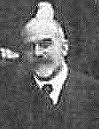
Arshag Schmavonian |
"Schmavonian and I went to [Sublime] Porte
and then to Talaat's house, he in pajamas, wife peeping through doors. Bedri
appeared phone working. I put it strong that I had spread news all the world and if
they balked condemnation follows; he admitted it was general German Chief of Staff
who had just returned thought they were too lenient and interfered. There is already
conflict between civil and military and Germans and Turks; troubles ahead; Promised
to try and let foreigners [stay in) interior unless Beirut, Smyrna, or other
unprotected ports were bombarded, then all would be kept as hostages. Smyrna
Governor would inform our Consul that three Christians be killed for every Moslem
that was killed. Dardanelles had been bombarded from 8:30 to 8:40 and two Turks
killed At 7:45 Talaat told us train could go. We returned to station about 8:10 when
it was announced it could go. Such joy." 68
Here is an almost classic case of the account in Ambassador Morgenthau's Story
bearing almost no resemblance to the passage in the 'Diary' upon which it should
have been based. From the portrayal of Talaat "this huge Turk" hunched
over his telegraph machine and "banging the key with increasing
irritation,"69 (when in point of fact he was speaking on the telephone), to his
alleged response to the bombing of the Dardanelles which had resulted in two
civilian deaths, of promising to 'kill three Christians for every Moslem killed, 70
(combining two totally unrelated events out of sequence), that is, from start to
finish, the entire section appears to be nothing more real than the rambling of an
overactive imagination; Again, the question is why? Here too, it is Morgenthau s
intent to portray Talaat Bey, as his prototypical Turk, as bestial, crude, and
vicious in his actions. Only the cajoling influence of the American Ambassador,
Henry Morgenthau can stem the unpredictable, dangerous Turk. In reality, the
Minister of Interior, and de facto head of government of a state to which Morgenthau
was accredited as Ambassador of a foreign country, received him in a crisis
situation at home, and spent some time resolving the issue of foreigners who were
citizens of belligerent nations wishing to leave the country without exit visas, via
a series of phone calls. This act of gracious kindness is twisted into a parody of
fact in which Talaat is depicted as an emotionally unstable, petulant schoolboy who
can only be controlled by the firm-speaking Henry Morgenthau. While Burton Hendrick
could be excused if he had misunderstood the laconic entries in the 'Diary ' it
appears that all the fictional detail in this section of the book had to have been
added in 1918 by Morgenthau himself.
6) Many times it is hard to find any linkage between the passages in the book and
the 'Diary' references they are obviously supposed to be drawn from. One such
example is the following. Morgenthau et al. write:
"I called on Talaat again. The first thing he did was to open his desk and pull
out a handful of yellow cablegrams.
Why don't you give this money to us?' he said, with a grin.
What money?' I asked.
Here is a cablegram for you from America, sending you a lot of money for the
Armenians. You ought not to use it that way; give it to us Turks, we need it as
badly as they do.'
'I have not yet received any such cablegram.' I replied.
'Oh, no, but you will,' he answered. 'I always get all your cablegrams first, you
know. After I have finished reading them I send them around to you. 71
Not only does Talaat Bey read other people's mail, he brags about it. Not only does
he carry out the 'extermination' of the Armenians, he is so heartless that he
actually dares to ask Morgenthau to give him the money which generous Americans have
collected for the relief of these suffering people. It takes a careful reading of
the Morgenthau 'Diary' to find the entry that served as the source for this
statement. It reads.
"He [Talaat] asked me if I would take additional money offered by U.S. to me by
cable received today; it was an admission that he had read or knew contents of my
telegram. 72
There are several problems with the interpretation of this passage given in
Ambassador Morgenthau's Story:
a) The 'Diary' entry for its source is dated October 14, 1914, a full six months
prior to the onset of the Armenian deportations, and at least ten months prior to
the arrival of any American aid earmarked for Armenians,
b) The 'Diary' entry makes it clear that Morgenthau has already received the
telegram in question, i.e., Morgenthau does not suggest that Talaat is referring to
a message he has not already seen;
c) Morgenthau only infers from Talaat's question that he has seen, or has been
informed of a cable on the subject of funds; he is not so informed by Talaat himself
who, in the book, brags of receiving all cables prior to Morgenthau ever seeing
them.
Clearly, Hendrick, with the tacit approval of Morgenthau, has simply fabricated yet
another discussion between Talaat and Morgenthau for the purpose of portraying the
Turkish leader as a thoroughly disgusting and inhuman character.
7) On occasion, Morgenthau even goes beyond 'poetic license' and
literally records alleged conversations which, have no foundation whatsoever in
either the Diary or the 'Letters. In perhaps the most damning indictment of this
nature, Morgenthau writes:
"One day Talaat made what was perhaps the most astonishing request I had ever
heard. The 'New York Life Insurance Company' and the 'Equitable Life of New York'
had for years done considerable business among the Armenians. The extent to which
these people insured their lives was merely another indication of their thrifty
habits.
'I wish,' Talaat now said, 'That you would get the American Life Insurance Companies
to send us a complete list of Armenian policy holders. They are practically all dead
now and have left no heirs to collect the money. It of course all escheats to the
state. The Government is beneficiary now. Will you do so?
This was almost too much, and I lost my temper. 'You will get no such list from me,'
I said, and I got up and left him. 73
Perhaps more than any single incident related in Ambassador Morgenthau's Story, this
callous disregard for human life and decency etches itself into the reader's memory.
Surely, no one could have invented such a conversation. It must have occurred as
related by Morgenthau. But did it? A careful examination of everything written by
Morgenthau from the beginning of the Armenian deportations in April of 1915 to the
date of his departure, on February 1, 1916, fails to locate a single reference to
this alleged conversation. Given the fact that we have hundreds of references in the
'Diary' for this period to Talaat and to matters affecting the treatment and
mistreatment of Armenians, this lacuna is difficult to explain. Morgenthau, in
addition, filed numerous reports to the Department of State relating to Armenians,
not one of which makes any reference to this discussion. Finally, for the period in
question we have a complete run of 'Family Letters,' comprising several hundred
pages, which are literally filled with references to meeting with Talaat and
discussion of the treatment of Armenians. Their contents refer to every single day
during the last twelve months of Morgenthau's tenure in Turkey, and yet, they too,
fail to make any reference to Talaat's callous request that the Turkish Government
be recognised as the beneficiary of the insurance policies held by the very
Armenians whose lives had been lost as a result of the treatment they had been
accorded. More telling than his argument by absence' is the fact that this is the
only alleged conversation between Talaat and Morgenthau mentioned in Ambassador
Morgenthau's Story for which there is no basis, either in the 'Diary' or the
'Letters.' In short, this appears to be rioting more than an attempt to further
darken the already fully tarnished image Morgenthau has painted of Talaat Bey.
It is upon closer examination of the Morgenthau Papers that an even more disturbing
explanation for Morgenthau's having included this bit of fiction in his book,
suggests itself. When one goes back over the 'Diary' entries prior to the period of
the Armenian deportations, i.e., prior to April 24, 1915, one sees that Morgenthau
did in fact discuss the affairs of one the companies named in his book with Talaat
Bey. On April 3, 1915 (a full three weeks prior to the beginning of the
deportations), we see the following entry:
"Called on Talaat at Minister of Commerce's Office, spoke to him about 'New
York Life Insurance Company's funds. 74
Can it be that it was this two line entry in Morgenthau's Diary which served as the
springboard from which Hendrick constructed the alleged conversation discussed
above? As in the discussion on Talaat Bey reading Morgenthau's cables and suggesting
that money earmarked for Armenians be given to his government, is it possible that
Hendrick has simply fabricated (presumably with the connivance of Morgenthau) this
entire episode? Once again, the answer is, yes. While there was an issue involving
funds belonging to the New York Life Insurance Company which had been frozen in
Turkey, it had nothing to do with Ottoman Armenians. To the contrary, a series of
entries in Morgenthau's 'Diary' for the months of March and April 1915 allow us to
state categorically that the issue was just the opposite of what was portrayed in
the book.
We may summarise the 'Diary' entries relative to the 'New York Life Insurance
Company' issue, as follows.
1) On 24 March, a Mr. Feri, the Constantinople representative of the Insurance
Company, paid a visit to Morgenthau and informed him that the Ottoman Government was
refusing to release their bank accounts because their company headquarters was in
Paris, France (a country with which the Ottoman Empire was then at war);75
2) On 29 March, Morgenthau took up the company's problem in a discussion with Talaat
Bey, who informed him of the following: "as to the New York Life funds, the
company had never registered and they don't want them to withdraw their funds, as
they fear that they would not pay their losses here; 76
3) As noted above, on 3 April, Morgenthau's 'Diary' notes that he "called on
Talaat at Minister of Commerce's office; spoke to him about New York Life Insurance
Company's funds; 77
This then is the extent of references to the New York Life Insurance Company funds
in the Morgenthau papers. The March 29, 1915 entry makes it clear that, far from
wanting to serve as the beneficiary of deceased policy holders, Talaat's and the
Turkish Government's interest was in making sure that the company maintained enough
capital in Turkey, so as to guarantee their ability to pay any future claims which
might arise under their coverage.
Simple logic tells us Morgenthau's account must be false, as his 'Diary' establishes
that throughout his tenure in Constantinople, the New York Life Insurance Co. had
its own representative in the Ottoman capital; that is, had Talaat Bey wanted a list
of their clients he had only to demand it. 78
Once again, the question we must ask is: Why does this passage
appear in Ambassador Morgenthau's Story in the first place? In addition to the by
now obvious aim on the part of Morgenthau, namely, to blacken the reputation of
Talaat Bey in every conceivable fashion and whenever possible, there may well have
been an even more venal reason for the inclusion of this passage. A thorough reading
of the Morgenthau papers shows that at the very time Morgenthau's book was being
written he was also a member of the Board of Directors of the Equitable Life
Assurance Society of New York. 79 Indeed, his 'Diary' for the year 1918 shows that
on March 21 he attended a meeting of the Equitable Life Assurance Company at 12:00
and then met with Burton J. Hendrick at 2:30 80 (presumably to work on the
manuscript). Morgenthau, who had been elected a member of the Society's board at ifs
December 1,1915 meeting, 81 was very proud of his being so recognised and even wrote
his son Henry Jr. to the effect that: "I think my selection as one of the
Trustees of the 'Equitable Life Assurance Society' shows that the financial powers
are already realising that my name and advise [sic. advice] will be of some value.
82 It may well be that the passage in question was nothing more than a 'plug' for
the life insurance business. By naming the 'Equitable Life Assurance Society' and
praising Armenians for having the foresight to insure their lives, Morgenthau may
simply have been throwing in a free advertisement for his fellow trustees who had
the good sense to recognise back in 1915 that, in his words "my name and advise
will be of some value." While there is no way to advance this suggestion beyond
the realm of hypothesis, one thing is clear - there is nothing in the Morgenthau
papers to suggest that the alleged conversation between Talaat Bey and Morgenthau
ever transpired.
8) Not satisfied with relating fictitious conversations between himself and Talaat,
Morgenthau also at times simply brings together events which transpired on separate
occasions, thereby creating a totally erroneous impression. A case in point of this
technique concerns the most serious discussion Morgenthau ever had with Talaat on
the treatment of the Armenians. This talk, which occurred on August 8, 1915, took
place at the initiative of Talaat who sent word to Morgenthau (through their mutual
friend, the Grand Rabbi Haim Nahoum) that he wanted to see the American envoy alone,
that is, without his Armenian escort-interpreter Arshag K. Schmavonian as he desired
to discuss "Armenian matters. 83
Morgenthau's version of this meeting in his 'Story' begins as follows:
"In the early" of part of August...he sent a personal messenger to me,
asking if I could not see him alone he said that he himself would provide the
interpreter. This was the first time that Talaat had admitted that his treatment of
the Armenians was a matter with which I had any concern. The interview took place
two days afterward. It so happened that since the last time I had any visited Talaat
I had shaved my beard. As soon as I came in the burly Minister began talking in his
customary bantering fashion.
'You have become a young man again,' he said: `You are so young now that I cannot go
to you for advice any more.'
'I have shaved my beard,' I replied, 'because it had become very grey — made grey
by your treatment of the Armenians."'
In actual fact, the 'beard incident' occurred not in the course of the August 8,
1915 meeting on 'Armenian matters,' but rather a month earlier on 3 July when
Morgenthau's 'Diary" records the following:
"...Talaat teased me about having shaved beard and said I had become young and
he would no longer take my advice...I told him I shaved it because it grew grey on
account of treatment of Armenians. 85
By juxtaposing the banter of the 3 July conversation with the very serious
appointment on the "Armenian matters" which occurred a month later,
Morgenthau creates the impression that Talaat was not very serious in asking him to
come discuss the Armenian question on 8 August. How could he be serious when he
began a talk about life and death matters by joking about Morgenthau's beard?
It is only when we read the actual 'Diary' entry for August 8,1915, that we realise
just how serious the talk actually was:
"I called on Talaat. He had his man there to interpret for me. First he spoke
English but as Talaat himself noticed he was very slow, he asked him to try German
which worked better. Talaat told me that he greatly preferred that I should always
come alone when I had any Armenian matters to discuss with him. By this he admits
that he was willing to discuss Armenian affairs with me. He told me that they based
their objections to the Armenians on three distinct grounds:
1) that they had enriched themselves at the expense of the Turks;
2) that they wanted to domineer over them and establish a separate state;
3) that they have openly encouraged their enemies, so that they have come to the
irrevocable decision to make them powerless before the war is ended.
I argued in all sorts of ways with him but he said that there was no use; that they
had already disposed of three-fourths of them, that there were none left in Bitlis,
Van, Erzeroum, and that the hatred was intense now that they have to finish it. I
spoke to him about the commercial losses, he said that they did not care, that they
had figured it out and knew it would not exceed for the banks etc. five million
pounds. He said they want to treat the Armenians like we treat the negroes, I think
he meant like the Indians. I asked him to make exceptions in some few cases which he
promised to do; he also definitely promised that the people living in Constantinople
could depart. I asked him about the removal of some sixty people,. he said those are
people who have come here from Izmid. It was simply impossible to
move him. He said they would take care of the Armenians at Zor and elsewhere but
they did not want them in Anatolia. I told him three times that they were making a
serious mistake and would regret it. He said, 'we know we have made mistakes, but we
never regret. 86
In tone and content that was a far more serious discussion than the account in
Ambassador Morgenthau's Story implies. There is no-hint of banter in the 'Diary'
entry; far from it, Talaat emerges as being extremely candid. A close reading of his
comments as recorded in Morgenthau's 'Diary' suggests that his comparison of their
plans for the Armenians with the American treatment of the Negroes may have been,
despite Morgenthau's suggestion, well spoken. It is in fact 'segregation' which he
is referring to, as is clear from the final statement attributed to Talaat on this
matter, to wit, "He said they would take care of the Armenians at Zor and
elsewhere but they did not want them in Anatolia. 87
Why does Morgenthau not challenge Talaat on this statement Because
it is not out of keeping with what he is hearing at that time from others, including
Zenop Bezjian, the 'vekil' (representative) of the Armenian Protestants in the
Ottoman Empire. A month after the above-mentioned conversation with Talaat,
Morgenthau receives a visit from Bezjian, which he records in his 'Diary' in the
following terms:
"Zenop Bezjian, Vekil of Armenian Protestants, called.
Schmavonian introduced him; he was his schoolmate. He told me a great deal about
conditions [in the interior). I was surprised to hear him report that Armenians at
Zor were fairly well satisfied; that they have already settled down to business and
are earning their livings; those were the first ones that were sent away and seem to
have gotten there without being massacred. He gave me a list where the various camps
are and he thinks that over one half million have been displaced. He was most
solicitous that they should be helped before winter set in." 88
All comments in Ambassador Morgenthau's Story notwithstanding, as
late as September 1915, Morgenthau had not firmly concluded that the Armenians were
the subject of an attempted 'extermination' by the Young Turk leadership.
9) In addition to inventing conversations, on occasion Morgenthau and Hendrick take
unsubstantiated rumor, surround it with quotation marks and put it in Talaat's mouth
as well. One such example is the following passage, which reads:
"Talaat's attitude toward the Armenians was summed up in the proud boast which
he made to his friends: 'I have accomplished more toward solving the Armenian
problem in three months than Abdul Hamid accomplished in thirty years.' 89
Given the violent means by which Sultan Abdulhamid II responded to the Armenian
uprising in 1895-1896, this boast attributed to Talaat can not help but send a chill
down the spine of the reader. For what Talaat is implicitly saying is that he has
killed more Armenians in three months than Abdulhamid did in thirty years. Once
again, he has the criminal publicly boasting of his crime. One's only question can
be who are the friends in whom Talaat thus confided, and which of them passed his
boast along to Morgenthau?
Morgenthau's 'Diary' entry for July 18,1915 provides us the answer to these queries,
he writes:
"Gates told me Talaat had said that he has accomplished more in three months
about crushing the Armenians than Abdul Hamid could do in thirty three
years."90
About the last person one would expect to see listed among the 'friends' of Talaat
Bey is Caleb Gates, the former American missionary who served as President of Robert
College during Morgenthau's tenure in Constantinople. Far from being 'friends' they
were hardly acquainted, as is clear from Gates' own book: Not To Me Only. Not
surprisingly, Gates does not choose to repeat the rumor he mentioned to Morgenthau
in his own writing or to record it as fact. 91 Morgenthau suffered from no such
inhibition himself. If it served the general purpose of casting Talaat in a negative
light it was deemed worthy of inclusion in his book. Even rumor, if dressed up with
quotation marks and placed in the mouth of Talaat Bey, found its place in
Ambassacior Morgenthau's Story. Understandably, this Gates-inspired rumor did not
find its way into Morgenthau's weekly 'Letter' of July 22,1915. For Morgenthau's
views of Talaat in 1915 were far different than in 1918 when his book was written.
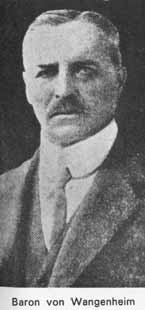 |
0) Discussing a chance meeting with the German
Ambassador Wangenheim, which occurred on October 15, 1915, Morgenthau states:
"A few days after his [Wangenheim's] return, I met him on his way to Haskeuy;
He said that he was going to the American Embassy and together we walked back to it.
I had been recently told by Talaat that the intended to deport all the Armenians who
were left in Turkey and his statement had induced me to make a final plea to the one
man in Constantinople who had the power to end the horrors. 92
A close examination of Morgenthau's 'Diary' and 'letters, establishes that, contrary
to the claim in this passage, Morgenthau had not seen Talaat Bey at all during the
first half of October (nor had he been told anything resembling is during his four
previous meetings on September 6,13, 20 and 30,1915).93 What he had heard was
gossip, passed on not by Talaat Bey as he alleges, but rather by his two Armenian
staff members, Schmavonian and Andonian. His 'Diary ' entry for October 7, 1915
includes the following comments.
Schmavonian today received two absurdly contradictory statements, one from an
Armenian Deputy who said that Talaat Pasha had stated to him that nothing further
would be done against the Armenians, that now they intended to take [up] the
question of their Greek subjects; while another man told him that they contemplated
to complete matter. Andonian reported to me about Armenian Patriarch's interview
yesterday with Talaat. Talaat's statements to the Patriarch were not at all
reassuring. He had said that all their measures against the Armenians were perfectly
justified, had expressed great resentment at Armenians having tried to secure
European intervention to establish a proper government and introduce reforms in
Anatolia and had said that they were just waiting for such a chance to punish the
Armenians...When Patriarch answered that they ought to punish responsible parties
and not women and children; he said these things are inevitable!"94
In other words, Morgenthau's statement in his book relevant to his October 15, 1915
meeting with Wangenheim, should have read, "I had been recently told by
Schmavonian that he had been told by an unnamed man that the Turks were
contemplating to complete the matter and deport the remaining Armenians,"
rather than his claim that: "I had been recently told by Talaat that he
intended to deport all the Armenians who were left in Turkey." Once again, we
see Morgenthau take rumors passed on to him, this time by his Armenian
adviser/interpreter as coming from an unnamed source, and credit them to Talaat.
11) Given the consistency with which Morgenthau has misquoted, modified statements
of, and simply fabricated most of the remarks he has attributed to Talaat, it seems
only fitting that his description of his final meeting prior to his departure from
Istanbul with the Turkish leaders should also be noteworthy primarily for its lack
of veracity. He begins his account by saying:
"I had my farewell interview with Enver and Talaat on the thirteenth of
January."95 and even in this short sentence manages to falsehood a) he did not
hold a farewell interview with Talaat and Enver at all but met each man separately;
and, b) his separate meetings with Talaat and Enver actually occurred on January 29,
1916. 96
With this less than auspicious beginning, one might well wonder how Margenthau is
going to record his leave-taking from the Turkish leaders, Talaat Bey and Enver
Pasha, with whom his. "Diary" and "Letters" show he had enjoyed
friendly social and professional relations. He begins with the following statement:
"But we hope you are coming back soon, he Talaat added, in
the polite (and insincere) manner of the oriental. 97
The reminder to the reader that Talaat was not even sincere in his leave-taking
appears at first glance to be typical Morgenthau-Hendrick invective. However, an
examination of other surviving documents relating to the book, establishes that in
this instance the slander's author was none other than the Honorable Robert Lansing,
the U.S. Secretary of State. As noted earlier, Morgenthau sent drafts of each
section of his "Story" to Lansing, who personally commented on them.
Indeed, just prior to the book's publication, Morgenthau wrote Lansing asking
permission to acknowledge the "trouble taken by Secretary of State Robert
Lansing in reading the manuscript and of the many valuable and wise suggestions he
has made. 98 Lansing declined the honor with "I'm sure that you will agree with
me that on the whole it would be advisable not to mention my name in connection with
the book."99 Morgenthau agreed, and helped perpetrate an important omission
which has lasted until today. For Lansing's comments (in his own hand), were taken
seriously by Morgenthau and the present example illustrates their nature. In the
Morgenthau-Hendrick draft of the closing chapters of Ambassador Morgenthau's Story,
the passage quoted above actually read:
"But we hope you are coming back soon,' he [Talaat] added. We feel almost as
though you were one of us." 100
Lansing's contribution was to pencil in the phrase: "with the usual insecure
oriental politeness,"101 an emendation which Morgenthau immediately instructed
Hendrick to incorporate.l02 Not only was Lansing's input totally uncalled for, but
also a reading of Morgenthau's 'Diary' entry relevant to his final meeting with
Talaat Bey fully illustrates the real nature of the relationship enjoyed by the two
men:
"I also called on Talaat and requested his promise that he would not interfere
with any American or other interests entrusted to me or [with) the Jews. He promised
to everything except that he wanted to reserve the right to have a little fun with
the British and French. He said that his promise only held good if I came back...
I asked Talaat whether I should call on the Sultan to say good bye and he said that
I certainly should and that he would arrange it. 103
Anyone reading this passage realises that, contrary to what Lansing implied, there
was a frank and open friendship linking the American Ambassador and the Ottoman
Minister of the Interior. Why does Morgenthau allow the inclusion of so much
slanderous material regarding Talaat Bey two years after the fact? The answer is
simple and relates to the fact that Morgenthau was writing a piece of wartime
propaganda with the expressly stated purpose of mobilising support for President
Wilson's war effort. He consciously down played the close relationships he enjoyed
with the Young Turk leadership throughout his sojourn in Constantinople and
sacrificed truth for the greater good of helping to generate anti-Turkish sentiment
which would transform itself into pro-war sentiment.
It is in the final section of Morgenthau's comments on his farewells with Talaat,
that he establishes just how far he is willing to stretch the truth:
"And now for the last time I spoke on the subject that had rested so heavily on
my mind for many months. I feared that another appeal would be useless, but I
decided to make it.
"How about the Armenians?"
Talaat's geniality disappeared in an instant. His face hardened and the fire of the
beast lighted up his eyes once more.
'What's the use of speaking about them?' he said, waving his hand. 'We are through
with them. That's all over.'
Such was the farewell with Talaat. 'That's all over' were his last words to
me."104
As we have seen, Morgenthau's 'Diary' contains nothing even vaguely resembling this
closing harangue. Only one thing can really be said about the manner in which
Morgenthau and Hendrick portrayed Talaat: it was consistent. It moved from slander
to slander and when it seemed to lag near the end, Secretary of State Robert Lansing
was on hand to pick up the level of the invective once again.
FOOTNOTES
Throughout Ambassador Morgenthau's Story, Talaat I3cy is vilified in every
conceivable fashion. See: AMS - pp. 20-24, 34-40, 50-51, 58, 78,
99-100,123-127,137-145, 154,172,194-95,198-99, 253-55, 286, 326-342, and 390-392. A
grimmer portrait is hard to imagine, nor one less in keeping with what is generally
known about Talaat's character. I have used contemporary English spelling as found
in Ambassador Morgenthau's Story, rather than modern Turkish orthography throughout
this study. Hence 'Talaat' rather than 'Talat' and 'Abdul Hamid' for Abdulhamid:
AMS: p. 20.
LC: PHM-Reel No. 5: 'Diary' entry for
July 10,1914. See also: FDR: HMS- Box No.5 Morgenthau family Letter of July 15,1914
pp. 10-11.
LC: PHM-Reel No.5: Morgenthau's 'Diary'
entries for the entire period of his stay in Turkey, are full of entries dealing
with his close social relationship with Talaat Bey and Grand Rabbi Haim Nahoum. Only
two examples will suffice to illustrate that relationship: 1) On February 16, 1914
Morgenthau's Diary includes the following note. We dined at Rabbi Nahoum. May,
Helen, Ruth, Schmavonian, Talaat and I, and remained until, talking; and, 2) Just
three days later on February 19,1914, the diary includes the following:
"Talaat, Nahoum and Schmavonian were here for supper; we had a very intense
talk about Turkish conditions."
51. AMS: p. 50.
52. LC: PHM-Reel No. 5: Entries for the period between January 1,1914 and July 2
1914.
53. LC: PHM-Reel No. S: See the entries for the period between May 4,1914 and July
2,1914.
54. LC: PHM-Reel No. 5: Entry for July 2,1914.
55. FDR: HMS - Box No. 5: Morgenthau family 'Letter' of July 15, 1914, pp.3-4.
56. AMS: p. 50.
AMS: p. 51.
AMS: p.116. Labelled as the
"central point of Turkish policy.
AMS: p.133. Sentiment attributed to
Bedri Bey, the Prefect of the Police in the Capital.
AMS: p.174. Stated to be the aim of
Djemal Pasha.
AMS: pp. 283-84. Stated to be the goal
of the Young Turks.
AMS: p. 290. Given as a rationale for
wanting to kill non-Turks.
AMS: p. 292. Given as Turkey's wartime
agenda.
AMS: p.124.
LC: PIIM-Reel No. 5: Morgenthau 'Diary'
entry for October 29,1914.
66. AMS: pp.141-l46.
AMS: p.144.
LC: PHM-Reel No. 5: Morgenthau 'Diary'
entry for November 3,1914.
AMS: p.144.
AMS: p.144.
71. AMS: p. 332.
72. LC: PHM-Reel No. 5: Morgenthau 'Diary' entry for October 10,1914.
73. AMS: p. 339.
LC: PHM-Reel No. 5: Morgenthau 'Diary' entry for April 3,1915.
LC: PHM-Reel No. 5: Morgcnthau 'Diary'
entry for March 24,1915.
LC: PHM-Reel No. 5: Morgcnthau 'Diary'
entry for March 29,1915.
LC: PHM-Reel No. 5: Morgenthau 'Diary'
entry for April 3,1915.
LC: PHM-Reel No. 5: Morgenthau 'Diary'
entry for October 5,19l5, records the following in regard to the status of the New
York Life Insurance Company,' in Istanbul "Representatives of the New York Life
Insurance Company and their lawyer called for advice about what steps to take about
registering under the new law." Clearly, with representatives stationed in
Istanbul, any and all information which the Government might wish to obtain
concerning the business affairs of this company was easily available. That Talaat
Bey would ask Morgenthau for information on any matter concerning this Company is
unlikely.
Indeed, Morgenthau had a long-time
relationship with Equitable, going back at least as far as 1905, when as a member of
the 'policy-holders committee' he successfully fought to protect the Company from
Edward H. Harriman. For a detailed account of his role with Equitable, see: Burton
J. Hendrick, "Ambassador Morgenthau's Story-Introductory Article," The
World's Work, April,1918. pp.620- 637. See: LC: PHM - Reel No. 7 for a letter of
December 2,1915 (while Morgenthau was still Ambassador in Turkey), appointing him a
'Director of the Society' of the 'Equitable Life Assurance Society of the United
States.'
LC: PHM-Ree1 No. 6: Morgenthau 'Diary'
entry for March 21,1918.
LC: PHM - Reel No. 7: Equitable Life's
S.S. McCurdy letter to Morgenthau of December 2,1915.
FDR: HMJ/Gaer- Box Nos.1-2: In a letter
addressed to "My Dear Children," of June 29,1915, Morgenthau discusses his
selection as a 'Trustee' of the Equitable Life Assurance Society, suggesting that he
may initially have been chosen as a Trustee (prior to June 29,1915), and then,
subsequently, elevated on December I,1915 to the position of 'Director' of the
Society.
Although Morgenthau fails to name the
messenger in his book, the 'Diary entry for August 5,1915 makes it clear that, as
was often the case, Talaat had chosen to communicate with Morgenthau via their
mutual friend, the Grand Rabbi of the Jewish Community, Haim Nahoum: When I returned
I found Mrs. Nahoum who said her husband had a message for from Talaat. I sent for
him and they stayed for supper, Nahoum told me that Talaat wanted me to call on him
without Schmavonian as he wanted to talk to me about Armenian matters." (LC:
PHM - Reel No. 5) It may be that Morgenthau's failure to name Nahoum as the
messenger stems from the fact that having systematically portrayed Talaat Bey as a
less than desirable character, he did not want to have to answer queries from his
co-religionists as to why the leader of the Jewish Community in the Ottoman Empire
was on such intimate terms with evil incarnate.
AMS: p. 336.
LC: PIIM-Reel No. 5: Morenthau 'Diary'
entry for July 3,1915
LC: PHM-Reel No. 5: Morgenthau 'Diary'
entry for August 8,1915.
LC: PHM-Reel No. 5: Morgenthau 'Diary'
entry for August 8,1915.
LC: PHM-Reel No. 5: Morgenthau 'Diary
entry for September 26,1915. See also: FDR: HMS-Box No. B: In his family 'Letter' of
October 16,1915 (pp.5-6) Morgenthau adds the phrase: "in the interior' to his
comment that Bezjian told him "a great deal about conditions..." -.thereby
clarifying the nature of their discussion.
AM5: p. 342.
LC: PHM-Reel No. 5: Morgenthau
'Diar'&127; entry for July I8,1915.
Caleb Gates, Not To Me Only. Princetown
(Princetown University Press),1940. See pp. 188- for Gates' less than flattering
portrait of Talaat. However, despite numerous anecdotes about his relations with
Talaat during the war years, Gates makes no reference to the 'gossip' he passed on
to Morgenthau, which the latter chose to present to the world as fact.
AMS: p. 380.
LC: PHM-Reel No. 5: Morgenthau 'Diary'
entries for Scptcmber,1915. See also: FDR: FIMS - Box No. 8: Morgenthau to family
'Letters' of September 13,1915. and October l,10,16, and 25,1915.
LC: PHM-Reel No. S: Morgenthau 'Diary'
entry for October 7,1915.
AMS: p. 390.
LC: PHM-Reel No.5: Morgenthau
"Diary" entry for January 29, l916.
AMS :p. 391
FDR: HMS - Box No.12: Morgenthau to
Lansing letter of September 22,1918.
FDR: HMS - Box No.12: Lansing to
Morgcnthau letter of October 2,1918.
FDR: HMS - Box No.12: Page 6 of 'Article
Nine' appended to the Lansing to Morgenthau letter of October 2,1918.
FDR: HMS - Box No.12: Ibid.
FDR: HMS - Box 12: Morgenthau to
Hendrick letter of October 3,1918 includes the following passages: "Enclosed
please find suggestions of the Secretary of State. I have marked the pages upon
which they appear in the typewritten article which we sent him. I think most of the
suggestions are good.. In regard to suggestion 3, I think it would be well to insert
at the end of line 13, after the word "ADDED", WITH THE USUAL INSINCERE
ORIENTAL POLITENESS!"
LC:PHM-Reel No.5: Morgenthau
"Diary" entry for January 29, 1916
|
| A
Contemporary view of Ambassador Morgenthau's Story |
Nor was the treatment accorded Talaat Bey by Morgenthau unique in
any way. A similar comparison of the comments he made about Enver Pasha (and other
Young Turk leaders), and the German Ambassador Wangenheim, with his actual opinions
of their characters as recorded in his daily 'Diary,' in the 'Letters' to his family
members, and even in the dispatches he sent to the Department of State in
Washington, D.C., establishes a similar lack of veracity in Ambassador Morgenthau's
Story. The best that can be said in defence of Morgenthau's rewriting of history is
that between his departure from Turkey at the beginning of February, 1916 and two
years later when the book was written in 1918, he must have radically altered his
opinion about the cause and effect of events on which he had reported. An
alternative explanation, and one which seems far more likely, is that he so truly
believed in the justness of his goal to stir up public opinion in favor of President
Wilson's war policies, that he convinced himself he was serving the greater good by
making crude stereotypes of three individuals (Talaat, Enver and Wangenheim), whose
friendship and confidence he had shared throughout his tenure in Constantinople.
Therefore he portrayed them as evil incarnate, in his desire to 'personalise' the
evil of the war.
Did no one comprehend the enormity of the injustice perpetrated by Morgenthau's
book? This is the question which must occur to anyone who systematically compares
the written records compiled by Morgenthau in the course of his twenty six month
sojourn in Turkey (a record which shows him to have been a fairly active participant
in a very complex game of international politics), with the crude half
truths and outright falsehoods which typify his book from cover to cover. A single
letter, fortuitously preserved among the Morgenthau papers in the Roosevelt
Library,105 addressed to the Ambassador by George A. Schreiner, proves that at least
one of his contemporaries took strong exception to his efforts.
Dated December 11,1918, the Schreiner letter, written by a distinguished foreign
correspondent who had served in Turkey from February through the end of 1915,
literally gives voice to all the queries we must have after this examination. We
recognise Schreiner's name from references to him in Ambassador Morgenthau's Story.
106 in the 'Diary' entries for 1915,107 and from mention in the weekly family
'Letters' as well. 108 There can in fact be no question that Morgenthau and
Schreiner saw quite a bit of one another in 1915 as the 'Diary' records the two men
met on no less than thirty occasions between the dates of 9 February and 31 May.109
In his book, Morgenthau refers to Schreiner as "the well-known American
correspondent of the 'Associated Press,110 while in the Diary en for February 9,
1915, he adds the information that Schreiner was a "special travelling
correspondent of the 'Associated Press of America"' whose stories were carried
in "937 daily papers."111
Schreiner, whose letter to Morgenthau was occasioned by a
chance meeting in the State Department (in December, 1918) as well as by the fact
that he had recently read Ambassador Morgenthau's Story, addressed him in the
following terms:
"…. I am writing this letter under the impression that the peace of the world
will not gain by such extravagant efforts as yours. Before there can be
understanding among peoples each must have the right perspective of things, and that
perspective consists of knowing the true proportions of right and wrong."
"Since I knew Baron Wangenheim probably better than you did, I do hope that
future historians will pay little attention to what you said of the man. But it has
ever been easy to slander the dead. You know as well as I do that the German
ambassador was not at all the figure you and your collaborator have fashioned.
|
|
|
The
unethical lawyer
|
Nor did you possess in Constantinople that omniscience and
omnipotence you have arrogated unto your self in the book. In the interest of truth
I will also affirm that you saw little of the cruelty you fasten upon the Turks.
Besides that you have killed more Armenians than ever lived in the districts of the
uprising. The fate of those people was sad enough without having to be exaggerated
as you have done. I have probably seen more of the Armenian affair than all the
Armenian attaches of the American embassy together.
"… To be perfectly frank with you, I cannot applaud your efforts to make the
Turks the worst being on earth, and the German worse, if that be possible, You know
as well as I do, that Baron Wangenheim all but broke relations with the Turks on one
occasion, when to his pleas for the Armenians he was returned a very sharp answer by
Talaat Bey, then minister of the interior. Has it ever occurred to you that all
governments reserve to themselves the right to put down rebellion? It seems to me
that even Great Britain assumed that stand towards the Fathers of the Republic. That
the effort of the Turk went beyond all reasonable limits is most unfortunate, but
have you ever considered for a moment that in the East they do not view things with
the eye of those of the Occident?
"… I wonder what your erstwhile friends in Constantinople think of that
effort. Enver especially fares poorly, and this after you had made so much of him.
Is it not a fact that Enver Pasha was as enlightened a young leader as could be
found? Of course, he was rather inexperienced, as you know somewhat impulsive and
given to being confidential, often in the case of untrustworthy characters. Apart
from that he was in no respect what you picture him. Of course, if we are to take it
for granted that we of the West are saints, then the Turk is any good. You will
agree with me, no doubt, that the Turks count among the few gentlemen still in
existence.
"I do not want you to look upon this as a declaration of war. My purpose in
mentioning these matters is to let you know that there is at least one human being
not afraid to break a lance with an ex ambassador of the United States. Ultimately
truth will prevail. I have placed my limited services at her command... Of
diplomatic events on the Bosphorus more will be heard as soon as I can get at my
notes and documents now in Europe. I do not rely on memory in such cases, as my book
may have shown to you already. Being a newspaper man, instead of a diplomat, I must
be careful in what I say." 112
Almost seventy two years were to pass before Schreiner's claim that "ultimately
truth will prevail,' was to even begin to tarnish the self image of
"omniscience and omnipotence" which Morgenthau attributed to himself in
his 'Story,' and, before Morgenthau's efforts "to make the Turk the worst being
on earth," were to be queried. Ironically, it was Morgenthau's penchant for
keeping old letters that accounts for the fortuitous survival of the Schreiner
letter. 113
Schreiner's analysis of Morgenthau's aims and objectives was correct. Without being
privy to the Wilson-Morgenthau correspondence prior to the Ambassador's decision to
produce his book, Schreiner realised and rejected the rationale that such a work
could in any way contribute to the "peace of the world," due to its
failure to distinguish the "true proportions of right and wrong."
Likewise, he understood and rejected Morgenthau's efforts to blacken the reputation
of the deceased German Ambassador Wangenheim, as well as those of Talaat Bey and
Enver Pasha, and the Turks in general. And he did so on the grounds that from first
hand experience he knew that this was not the way Morgenthau actually felt while in
Constantinople. Further, Schreiner rejects Morgenthau's treatment of the Armenian
persecutions and charges him with having "killed more Armenians than ever lived
in the districts of the uprisings." In so doing, Schreiner makes the
interesting point "that I have probably seen more of the Armenian affair than
all the Armenian attaches of the American embassy together." That he had indeed
been an eyewitness to events in Anatolian is shown by an examination of Schreiner's
book on his experiences in Turkey: From Berlin to Baghdad: Behind the Scenes in the
Near East,114 in which he details meeting the first convoy of Armenian deportees
(those who had revolted in Zeytun), on the road near Adana on April 26 1915.115 Upon
his return to Constantinople he wrote up these experiences and presented them to
Morgenthau, thereby providing the Ambassador the first eyewitness account of the
deportations he received. Indeed, the original of this document, dated and signed by
Schreiner on May 24, 1915, is still preserved in the Morgenthau papers. 116
Perhaps we owe the survival of the Schreiner letter in the Morgenthau material to
the veiled threat with which it ends. When Schreiner states: "of diplomatic
events on the Bosphorus more will be heard as soon as I can get at my notes and
documents now in Europe," Morgenthau may have taken it as a sign of Schreiner's
intent to place before the public the kinds of charges found in the letter. If that
was the case, his fears were not rewarded. Schreiner did indeed write a book
attacking Wilson's habit of sending untrained individuals as Ambassadors to European
capitals in wartime, and, as might be expected, Morgenthau is one of his case
studies of this practice. However, The Craft Sinister, as his book was titled, adds
little detail to the charges contained in the letter. 117 This despite a comment in
his 'Preface' which leads the reader to think otherwise:
"It is to be hoped that the future historian will not give too much heed to the
drivel one finds in the books of diplomatist-authors. I at least have found these
books remarkably unreliable on the part played by the author. It would seem that
these literary productions are on a par with the 'blue books' published by
governments for the edification of the public and their own amusement, as in some
cases I will show."118
What Schreiner contents himself with doing, in a chapter titled "Diplomacy in
Turkey," is to detail the close relationship which existed between Morgenthau
and his German counterpart, Baron Wangenheim, and, likewise, the very warm
friendship in which Morgenthau held Enver Pasha. He prefaces his remarks on the
Wangenheim Morgenthau relationship by saying:
"But the books of diplomatists must not be taken too seriously. The ambassador
who avers that from the very inception of trouble he was with this or with that side
may be doing nothing more than presenting just one side of his attitude, with slight
exaggerations, possibly. The fact in this case is, Mr. Morgenthau was well liked by
the German diplomatists in Pera, and, long after the outbreak of the War, was not
averse to being known as a friend of Baron Wangenheim." 119
As for Morgenthau's contacts with Talaat Bey and Enver Pasha, Schreiner writes:
"Among the men who especially cultivated the new United States ambassador was
Enver Pasha, who was a welcome guest at the teas or luncheons of Mme. Morgenthau
long after Turkey had entered the War. Talaat Bey, too, was on the best terms with
the American ambassador, and so were a number of other officials and officers."
120
Anyone doubting the accuracy of Schreiner's statements in this regard has only to
peruse the pages of Morgenthau's 'Diary' and family 'Letters.' As late as January
12,1916, just two weeks before he left Constantinople for good, Morgenthau records
the following exchange with Talaat Bey:
"I then tried for Talaat Bey and he agreed to receive me. We called on him and
found him in very good humor... In speaking about our not seeing each other, I told
him he should come to see me. He told me he could not come until he was invited. So
I asked him for what he wanted to be invited, lunch or supper. He preferred
luncheon, so I invited him and asked whom else I should invite. He said Halil
[Minister of Foreign Affairs]. I said allright and he said you need not invite him,
I will bring him, I can answer for him." 121
Three days later, on 15 January, Morgenthau recorded his reaction to the luncheon in
the following terms:
"At 12:30 Talaat and Halil came and we went over our business and then we had
lunch at which Philip and Schmavonian joined us. It was a very strange proceeding so
to say to have the government come to me to transact business.
"We had a very elegant luncheon, and they both, as I told them 'the stout
members of the Cabinet,' displayed extraordinary appetite..." 122
It is simply impossible to reconcile the above bantering tone, which a scant two
weeks prior to Morgenthau's final departure from Turkey still marked the two men's
relationship, with the portrayal of Talaat Bey as a devil incarnate which permeates
Ambassador Morgenthau's Story from beginning to end.
The fact is, as Schreiner said so openly in his letter to Morgenthau, and as a
comparison between the facts as recorded in Morgenthau's 'Diary' and 'Letters' and
the text of Ambassador Morgenthau's Story so clearly illustrates, the book is a
fictionalised account woven around real events and real characters in such a manner
as to give it the gloss of factual history.
FOOTNOTES
FDR: HMS - Box No.12: Schreiner to
Morgenthau letter of December 11,1918.
AMS: p. 225: Interestingly, Morgenthau
claims to have "secured permission" for Schreiner to visit the war-zone in
the Dardanelles, a statement strongly contradicted both by the testimony of the
Morgenthau Diary entries dealing with his relationship with the journalist, and, in
the Schreiner letter as well. In regard to Morgenthau's claim, Schreiner wrote:
"Such minor matters as that you were responsible for my trip to the
Dardanelles, when that was at all the case, I can afford to overlook..." (FDR:
HMS - Box No.12) -Schreiner to Morgenthau letter of December 11,1918.
LC: PIIM-Reel No. 5: Morgcntllau 'Diary
entries for 1915 show that Schreiner visited on the following dates: 2/9, 2/10,
2/11, 2/14, 2/15, 2/16 (twice), 2/18, 2/20, 2/22, 2/23, 2/25, 2/26, 2/27, 3/2, 3/16,
4/5, 4/6 (twice), 4/9, 4/13, 4/14, 4/15, 4/16, 4/17, 4/18, 4/22, 5/23, 5/24, 5/31,
6/8, 7/2, 7/12, 8/9, 8/27, and 8/29/1915.
FDR: IIMS-Box Nu. 7: Family 'Letter' of
March 15,1915, p. 9, where Morgenthau comments on Schreiner, who was covering the
Dardanelles campaign at the time of Morgenthau's two-day visit, in the following
terms: "We then returned to our ship where I was met by the two American
reporters, one representing the American Associated Press, and the other the Chicago
Daily News, and I willingly submitted to an interview. They acted like a couple of
young fellows off on a fishing trip. They told me they were being very well treated
and given every opportunity to witness the fight. They are both strongly pro-German.
Schreiner, of the Associated Press, was born in South Africa and fought against the
English there. The other one Swing is the grandson of a former President of Holyoke
College." (LC: P IM - Reel No. 5: 'Diary' entries for February-March,1915).
LC: PHM-Reel No. 5: Morgenthau 'Diary'
entries for dates between February 9, 1915 and May 31,1915.
AMS: p. 225.
LC: PIIM - Reel No. 5: Morgenthau
'Diary' entry for February 9,1915.
FDR: FIMS - Box No.12: Schreiner to
Morgenthau letter of December 11,1918.
While scattered throughout several reels
of the 'Library of Congress: Papers of Henry Morgenthau' material, there are letters
dealing with the book, most are clearly in the nature of congratulatory notes.
Schreiner's is the only example of a letter written by a close acquaintance of
Morgenthau in the Constantinople period expressing strong disagreement with the
views set forth in the book.
Among the numerous publications of
George A. Schreiner, that dealing in greatest detail with his assignment in Turkey,
is: From Berlin to Bagdad: Berlin the Scenes in the Near East. I New York (Harper
& Brothers),1918. Strangely, this 350 page detailed diary-like account of the
nine month period in 1915 which Schreiner spent in Turkey, seldom if ever is
mentioned in 'Bibliographies' of books dealing with the period of the Ottoman Empire
in the First World War. It is an eyewitness account to some of the most significant
clashes of the Dardanelles campaign and many other interesting events. (Hereafter:
Schreiner, Near East).
Schreiner, Near East: pp.18213, a
chapter titled: "Armenia's Red Caravan of Sorrow,' is evidently the earliest
eyewitness account of the 1915 Armenian deportations.
LC: PHM-Reel No. 22: A two-page single
spaced typewritten document, bearing the title: "Statements concerning
Armenians met on road from Bozanti to Tarsus" and signed: George A. Schreiner
Constantinople, May 24,1915.
George A. Schreiner, The Craft Sinister:
A Diplomacy Political History of the Great War and its Causes-Diplomacy and
International Politics and Diplomatists as Seen at Close Range by an American
Newspaperman who Serve in Central Europe as War and Political Correspondent. New
York (G. Albert Geyer),1920. For American diplomacy in Turkey, see: pp.110-135 in
particular. (Hereafter: Schreiner, Craft Sinister).
Schreiner, Craft Sinister: p. xxi.
Schreiner, Craft Sinister: p.126.
Ibid.
LC: PHM-Reel No. 5: Morgenthau 'Diary'
entry of January 12,1916.
LC: P IM-Reel No. 5: Morgenthau 'Diary
entry for January 15,1916.
|
| Why Bother With Ambassador Morgenthau's Story Today? |
Were this book to have remained simply the memoirs of
a successful real-estate developer, turned campaign fund-raiser, who was rewarded for his
efforts not with the cabinet post of Secretary of the Treasury, which he sought, but with
the lesser political plum of Ambassador to the Ottoman Empire, we could forget Henry
Morgenthau as the world would have done half a century ago. But this is not the case. In
1990, seventy two years after its initial appearance, Ambassador Morgenthau's Story is
still in print. In the same year it has been repeatedly cited on the floors of the U.S.
Congress, by a host of well-meaning Senators, as proof of the fact that the Young Turk
Government planned and carried out a 'genocide' against its Armenian minority.l23
Currently, a number of 'Genocide and Holocaust Studies Curricula Guides' which are in use
in high schools in the U.S. expose students to passages from the book as furnishing
examples of the twisted minds that can plan and perpetrate a genocide, etc. etc.l24 In
short, far from having found the well-earned rest it deserves, Ambassador Morgenthau's
Story remains today a lynch pin in the body of literature which has and continues to
present the Turks as some of the unrepentant genocidal villains of history.
While the purpose of the present study is less an examination of the question of whether
or not the fate of the Ottoman Armenians ought to be described as 'genocide,' and more of
an attempt to distinguish between the reality and the fantasy in Ambassador Morgenthau's
Story, we must need be cognisant of the broader implications it suggests.
In addition to his role as the U.S. envoy in Constantinople, Morgenthau must be seen as
the key figure in disseminating reports to the rest of the world about the wartime
suffering of the Ottoman Armenians. Indeed, there are three names generally associated
with spreading the Armenian saga while the war continued. They are Lord Bryce, whose 1916
compilation of documents entitled: The Treatment of Armenians in the Ottoman Empire,
sounded the first alert; the German Protestant Pastor Johannes Lepsius, whose 1917 18 Le
Rapport Secret du Dr. Johannes Lepsius sur les Massacres D'Arméninne,126 spread word to
the rest of Europe; and, Ambassador Morgenthau's Story, which appeared simultaneously in
Europe and the United States in 1918. What is less known is the relationship between these
three works, and, in particular, the role played by Henry Morgenthau in each of
them.
On July 31, 1915, Morgenthau's 'Diary' contains the following account of the first meeting
between the American envoy and the German Pastor Lepsius:
"At 3 p.m. Dr. Johannes Lepsius, from Potsdam, called. He told us a great deal about
the Armenian matters and was anxious to know what we knew... Lepsius seems to be really in
earnest to do something. He suggests going to Geneva from here and appeal to the
International Red Cross, heads of the neutral nations, and Pope join in universal
protest."127
The family 'Letter' which discusses this meeting repeats the above and adds the following:
"I arranged an interview between Tsamados, the Greek Charge d' Affairs and Lepsius,
as the Professor wanted to know how the Greeks were treated."128 So impressed was
Morgenthau by this meeting that on the very same day he sent a cipher telegram to the
State Department requesting permission to provide all the information the Embassy had on
file to Lepsius. In his words:
"The Doctor [Lepsius] proposed to submit matter to International Red Cross for common
action to try to induce Germany to demand a cessation of these horrors. He earnest
requests access to information Embassy has on file. Will give him if Department has no
objection. 129
Though the request for access to information originated with Lepsius, the tone of
Morgenthau's cipher makes it absolutely clear that he concurred with it. As a follow up to
their 31 July meeting, Morgenthau invited Lepsius to dinner on the evening of August 3,
1915. Morgenthau's 'Diary' entry for that day records the following on their
discussion:
"We had a long and full discussion about Armenian affairs. Lepsius told us about his
past activities in the matter... Lepsius thinks little can be done at present to stop the
deportations but that he will go to Switzerland, Geneva, to stir up International Red
Cross. I told him that he should see Helferich, and explain to him that this will be the
economic destruction of Turkey and that the Germans would and empty husk when they
obtained possession. I sent for Schmavonian and he came and participated in the discussion
after supper."130
On August 6, 1915, Morgenthau received a cipher telegram from Secretary of State Robert
Lansing in Washington which stated that: "You are authorised to use your discretion
in matter of giving Lepsius access to files."131
Then on August 11, 1915, Lepsius once again visited Morgenthau and informed him that he
"had expected to have interview with Enver that afternoon but had little hopes of
accomplishing anything; that the authorities seemed set upon carrying through their
scheme."132 On 14 August, Lepsius visited Morgenthau once again. The 'Diary' provides
the following account of their meeting
"Lepsius called, I gave him some of the reports to read and a translation of an
Arabian pamphlet. He told me all about his interview with Enver. [He) was surprised how
freely Enver talked to him about their plans to rid themselves of the Armenians. Enver
told him that this was their opportunity and they were going to use it. He told him about
111e same thing that he had told me."33
The family 'Letter' of August 2,1915 contains a passage which serves to clarify somewhat
the opening sentence of the 'Diary' entry, due to the fact that from the 'Diary' it is
unclear whether Morgenthau simply let Lepsius look over some reports ["I gave him
some of the reports to read"), or whether he actually was given copies of the reports
from the Embassy files. The 'Letter' indicates that in fact Lepsius was provided copies of
the materials:
Dr. Lepsius called and I gave him some of the reports we had received from our various
Consuls and also the translation of a pamphlet written in Arabic."134
Even without the above passages, a simple comparison of the accounts published in the
Lepsius books with the reports submitted to Morgenthau by his Consuls and the American
missionaries alike, would serve to establish that Morgenthau was a key source for the
Lepsius work. Given the fact that Lepsius spent only a month in the Ottoman capital during
the war, and that the number of German missionaries in the interior of Anatolia was
relatively small, it is not surprising that much of his material on the deportations
should have been derived from American Protestant missionary sources. The fact that
Morgenthau's "discretion" consisted of giving Lepsius open access to his
Embassy's files and copies of their contents, suggests that he may well have been
stretching the intent of Lansing's instructions to their limit.
Even more interesting is the fact that Morgenthau apparently chose to interpret Lansing's
semi-approval in the case of Lepsius to mean that he was free to use his
"discretion" whenever the occasion arose. And arise it did. Less than a month
after receiving Lansing's cipher, Morgenthau received a letter from Lord James Bryce, with
whom he had become acquainted in the course of a 1914 trip to Palestine.
Bryce, who had already lent his name to Wellington House's propaganda usage of atrocity
stories, in the case of the Report of the Committee on Alleged German Outrages, or the
'Bryce Report,' as it was commonly known, after commenting on the reports of
"shocking massacres committed on the Armenians," comes to the real purpose of
his letter. He asks:
"If any reports come to your Embassy from the American missionaries scattered through
Asiatic Turkey which would cast light on the situation, possibly you would allow me to see
them occasionally. Your own consular reports would of course be sent to your own
Government only." 135
If Morgenthau bothered to request permission in this instance, a thorough examination of
his papers and of the General Records of the U.S. Department of State, where, presumably
copies of his cables should be, has failed to uncover it. But he certainly wasted no time
in responding to Lord Bryce's request. Even a preliminary comparison of the documents in
Bryce's 1916 The Treatment of Armenians in the Ottoman Empire, with the preserved copies
of the reports submitted to Morgenthau, clearly establishes the extent to which he served
as a source for Bryce.136 or was he bothered by Bryce's reminder (or was it a hint to the
contrary?) that his own 'consular reports' should of course be sent only to the State
Department. For, within a few months of their submission the reports of the American
Consul J. B. Jackson from Aleppo were published, albeit anonymously, in the Bryce
volume.137
That this was no coincidence, i.e., that the British had not gotten hold of this material
from other sources, is confirmed by no less an authority than Morgenthau himself, who,
writing in the Red Cross Magazine of March,1919 said the following about his role in
supplying material to Bryce:
"I took occasion, in order that the facts might be accurately recorded, to have
careful records kept of the statements which were made to me by eye-witnesses of the
massacres. These statements included the reports of refugees of all sorts, of Christian
missionaries, and of other witnesses... Much of the material which I collected has already
been published in the excellent volume of documentary material collected by Viscount
Bryce.
When one realises that this material which forms the backbone of what was one of the most
effective pieces of wartime propaganda directed against the Turks was supplied to British
intelligence by a neutral United States Ambassador where it was published as part of the
British efforts to stir up the American public opinion against the Turks and Germans, with
an eye to getting America into the war, one can not help but wonder about the discretion
of Morgenthau himself.l3s Nor was the Bryce report the only British propaganda effort to
make use of the Morgenthau material. Arnold Toynbee, described in one study on British
propaganda during the First World War, as "the distinguished historian and member of
Wellington House who became something of a specialist in atrocity propaganda, described
and condemned the Turks in Armenian Atrocities: Murder of a Nation (London, 1915) and The
Murderous Tyranny of the (Tur)k (London, 1917)."140 What is not mentioned is the fact
that many of the atrocity stories published by Toynbee in the 1915 work, were supplied by
none other than Henry Morgenthau. 141
Leaving aside the all important question of the value of the material supplied by
Morgenthau, one fact is indisputable, namely, his key role in the genesis of all the
wartime atrocity books relating to the Turkish treatment of Armenians. Through his role as
a conduit for material flowing to the German Lepsius and England's Lord Bryce and Arnold
Toynbee, et al., Henry Morgenthau was a major factor in the shaping of American public
opinion vis-à vis Turks and Armenians long before he ever approached President Wilson
late in 1917 with the project which ultimately became Ambassador Morgenthau's Story.
That such an important book has not until this monograph ever been the subject of a single
published study, would be inconceivable in any historical field except that narrow
subfield known as 'Turco-Armenian History,' where all too often, raw emotion serves as a
substitute for dispassionate scholarship, and propaganda passes for history.
What can be said of scholars working on the Armenian 'genocide,' who, in publication after
publication, over the past decades quote the outright lies and half truths which permeate
Morgenthau's 'Story' without ever questioning even the most blatant of the
inconsistencies? 142 This, despite the fact that their bibliographies indicate that they
have utilised the Morgenthau Papers in the Library of Congress collections wherein the
'Diary' is preserved. 143
One can not help but wonder how many of the young Armenians who turned to the terrorist
assassinations of Turkish officials (and bystanders) in tl1e 1970's and early 1980's, were
influenced by reading Ambassador Morgenthau's Story? How many of them came to view
innocent individuals not even born at the time of the First World War as fair game for
terrorist attack simply because they were ethnic descendants of Talaat Bey, who (according
to Morgenthau) bragged that he had "accomplished more toward solving the Armenian
problem in three months than Abdul Hamid accomplished in thirty years. The duty of
scholars is to find, nourish and preserve truth. It should not be to help perpetuate hate
by disseminating fantasy as fact and outright lies as truth. Henry Morgenthau, Sr. has
been dead for forty four years. It is long past the time that his book should likewise be
laid to rest. His legacy rightfully lies in the 'Diary, his family 'Letters' and his
cabled dispatches and written reports in the form of letters submitted to the U.S.
Department of State during his twenty six month stay in Turkey. They, and they alone, are
the real Ambassador Morgenthau's Story.
FOOTNOTES
The Congressional Records-Senate' for the dates of February 20-22 and 27,1990 are full of
references to Morgenthau's 'Story' as proof of contention that the Ottoman Armenians were
victims of a Turkish perpetrate ed 'genocide' during World War I.
A good case in point (one of many) is the Margot Stern Strum and William S. Parsons,
Facing History and Ourselves: Holocaust and Human Behvior. Watertown, Massachusetts
(International Education),1982, a curriculum which is widely used in a variety of states
throughout the country. In pp. 31682 of this guide a chapter titled: 'The Armenians -A
Case of a Forgotten Genocide- Do We Learn From Past Experiences?," makes frequent use
of Ambassador Morgenthau's Story, including lengthy quotations on pp. 322-323, 367-68 and
372.
Great Britain: The Treatment of Armenians in the Ottoman
Empire: Documents Presented to Viscount Grey of Fallodon, Secretary of State for Foreign
Affairs. With a Preface by Viscount Bryce. London (Hodder & Stoughton),1916. This tome
of over 700 pages in length was actually compiled by the historian, Arnold Toynbee.
(Hereafter: Toynbee: Treatment).
Lepsius, Johannes: Le Rapport Secret du Dr. Jolannes
Lepsius sur les Massacres 'Arménie. Paris (Payot & Cie.).1918.
LC: PHM -Reel No. 5: Morgenthau 'Diary' entry for July
31,1915.
FDR: HMS - Box No. 8: Morgenthau 'Letter' of August 9,1915,
p.9.
NA; Record Group 59: 867.4016/83 for text of Morgenthau to
Secretary of State telegram of July 31,1915. See also:
LC: PIIM-Reel No. 7:'Paraphrase' in Morgenthau papers of
cipher telegram to the Department of State, dated July 31,1915.
NA: Record Croup 59: 867.4016/83 telegram of August 4,1915
from Lansing to Morgenthau. See also: LC: PHM- Reel No. 7:'Paraphrase' in Morgenthau
papers of cipher telegram from Lansing in Washington dated 4 August and received August
6,1915.
LC: PHM-Reel No. 5: Morgenthau 'Diary' entry for August
11,1915.
LC: PHM-Reel No. 5: Morgenthau 'Diary' entry for August 14,
79l5.
FDR: HMS - Box No. 8: Morgenthau Letter dated August 23
1915 .5
LC: PIIM - Reel No. 7: Bryce to Morgenthau letter of August
7,1915. For a discussion of the manner in which Lord Bryce lent the credibility of his
name to the propaganda efforts of Wellington House which were designed to bring the United
States into the war, see: Michael Sanders & Philip M. Taylor, British Propaganda
During the First World Wnr,1914-1918. London (The Macmillan Press),1982. pp. 143-144.
(Hereafter: Sanders/Taylor, Propaganda).
Morgenthau's papers, in particular: LC: PHM- Reels No. 7
arul22, contain copies of a large number of missionary, consular and traveler reports,
submitted to Morgenthau between early May and the end of 1915.
See for example, Toynbee, Armenians: p. 547:'Aleppo: Series
of Reports From a Foreign Resident at Aleppo; Communicated by the American Committee for
Armenian and Syrian Relief: Report dated 12th May 1915.' The "foreign resident"
at Aleppo was none other than the American Consul J.B. Jackson, and the passage in
question is taken directly from a report he submitted to Morgenthau (See: LC: PHM - Reel
No. 7).
Henry Morgenthau, "The Greatest Horror in History,'
Red Cross Magazine (March,1919), p.8.
Sanders/Taylor, Propaganda: pp.144-46.
Sanders/Taylor, Propaganda: pp.145-46.
A comparison of the contents of Arnold J. Toynbee s:
Armenian Atrocities: TI Murder of a Nation. London (Hodder & Stoughton), 7915, and The
Murderous Tyranny of to Turks. London (Hodder & Stoughton),1917, with the missionary,
consular, and traveler reports preserved in the Morgenthau papers (See: LC: PHM - Reels
Nos. 7 m 22) establishes this fact. On the basis of the surviving record it is impossible
to state with certainty that Morgenthau passed the material directly to Bryce/Toynbee. He
may have done so through intermediaries.
A case in point is the Armenian-American
scholar Richard G. Hovannisian, who from his early works such as: Richard G. Hovannisian,
Armenia on the Road to Independence, 1918. Berkeley
(University of California),1967. p;52 until the recent: Richard G. Hovannisian, ed., The
Armenian Genocide in Perspective. New Brunswick (Transaction Books),1986: pp.29-30 (in his
article entitled: "Historical Dimensions 1878-1923" ' and, again on p. 112 in
his article: "The Armenian Genocide and Patterns of Denial"), makes frequent use
of quotations from Morgenthau. Clearly, Hovannisian, whose current activities focus on
lecturing and writing on those who attempt to deny the historical reality of the Armenian
'genocide' (most recently, his: "Patterns of Denial Fail to Veil Genocide," in
Armenian International Magazine. Volume l., No. I (July,1990), pp.16-17), might benefit
from a more careful examination of the sources upon which he bases his characterisation of
the fate of the Ottoman Armenians.
Richard C. Hovannisian, The: a Bibliography Relating to the
Deportations, Massacres, and Dispersion of the Armenian People,1915-1923. Cambridge,
Massachusetts (Armenian Heritage Press),1980. On page 13, in a listing of collections of
papers preserved in the U.S. Library of Congress, Manuscript Division, Hovannisian makes
the following reference to the Morgenthau papers: "Henry Morgenthau Sr. (includes
hundreds of reports about the massacres and the Ambassador's futile attempts to
intercede). Despite the fact that such reports number in the dozens rather than the
hundreds, Hovannisian's statement implies (given the absence of published studies in 1980
based on these papers), that he must indeed have examined the 'Papers of Henry Morgenthau'
preserved in the Library of Congress.
|
Holdwater's Closing Comment
|
And yet, Professor Levon Marashlian writes a
letter to a major newspaper stating Morgenthau's testimony is "unimpeachable"... in addition
to his mentor, Richard Hovannisian, referring to Morgenthau as a
valid source.
Professor Lowry, how you must have suffered when the Armenian forces, led by Peter
"Mr. Double Killing"
Balakian, mobilized against you, easily recruiting famous literary names who only
relied on the Armenians' side of the story, in their blind ignorance or racism, and
harassed your good reputation and psychological well-being for two years... the
effects of which continue, thanks to the ubiquitous Armenian web sites reporting on
what a Turk-Tool you were, in an attempt to keep discrediting you.
The only thing that matters is the
quality of your research, when all is said and done. The impeccable job you have
done on "The Story Behind Ambassador Morgenthau's Story," along
with the few of your other works that I have read (featured on this TAT web site),
speaks for itself. You have much to be proud of.
|
| More: |
Exposing the Lies of "Ambassador
Morgenthau's Story"
|
|