|
|
Vahakn Dadrian may be identified in various ways. He is a sociologist. He is a
story-teller. He is a con man. He is anything but a “historian.”
Several of his works have already been examined in TAT, and with each new
analysis, it becomes all the more clear as to what a lack of scruples the man
has. He is prone to making any false statement, to distort translations, to
take statements out of context, and to selectively present from his arsenal of
cherry-picked, genocide affirming “facts,” while ignoring uncomfortable
and sometimes painfully obvious realities. He brings to mind the Green Goblin,
in that one never knows what little bomb Dadrian will bring forth from that
bottomless pouch of weaponry attached to his belt.
One can almost not blame this utterly genocide-obsessed man; Dadrian appears
unable to help himself. We can, however, blame the publications that accept
his hateful propaganda without question.
The one we’re going to look at this go-round was published in The Journal
of Genocide Research (2003, June, pp. 269-279). Even though this rag will
be expected to air one-sided views of genocide scholars, you’d think the
editor(s) would set at least minimal standards, and require authors to present
a semblance of fairness and objectivity. Instead, by providing a forum for
pure propaganda without restriction, such publications become an accomplice in
the propagation of hatred and racism.
Knowing the editors are totally on his side, Dadrian vomits his pea soup
without let-up; he’s out of control with his brand of viciousness in this
particular article. It’s called:
“The signal facts surrounding the Armenian genocide and the Turkish
denial syndrome.”
|
|
|
| |
Dadrian characterizes Turkish attempts to present this conflict in its true historical
light as “organized attempts to cover up the record of past
atrocities... by successive Turkish governments of the 1915-17 genocide against the
Armenians in which some 1.5 million people lost their lives.” Dadrian already is
on record for having written that
1916 is when the genocide had “all but run its course”;
the brunt of the resettlement process, after all, had taken place in 1915. For him to
state that his “genocide” lasted until 1917 in a way that readers will take to be
entirely unabated as with the Holocaust, is the beginning of his many distortions. (In
March 3,1916, Vahan Cardashian had quoted Morgenthau, in a letter to Lord Bryce, that the
government's attitude was "passive" toward the Armenians, and that good numbers
of them could be found in nearly all the internal cities of the empire. [The Armenian
Review, Winter 1957, p. 107] There were only incidental "deportations" after
early 1916, and as you'll read below, the relocations were first ordered to halt in August
1915. Since "genocide" is the faithful's synonym for the resettlement process,
for all intents and purposes, the "genocide" was over in 1915).
We should at least be grateful he did not extend his genocide to 1923, as commonly
claimed. However, already Dadrian presents cause for questioning his own thesis. If the
idea was to “annihilate” (if we may use the word Dadrian prefers) the Armenians, why
stop in what he dishonestly presents as 1917, with hundreds of thousands of Armenians
still in Ottoman clutches?
Demonstrating the absence of editorial reins, the master propagandist ups the victim
numbers to 1.5 million, the total pre-war
Ottoman-Armenian population. Note Dadrian supported
in a 1998 commemoration that the total mortality was “more than a million,” with one
million survivors. Even if he chooses to go with the Armenian Patriarch’s
propagandistic figure of 2.1 million pre-war Armenians, the mortality figure Dadrian
presents now would make a million survivors impossible. (That is, 2.1 million minus 1.5
million dead would equal 600,000 survivors. The Patriarch accounted for 1,260,000
survivors in 1918’s end.) Once again, an example of “Numbers Don’t Matter,” practiced by Armenian “scholars.” (Real
scholars, of course, evaluate all relevant information before reaching dispassionate
conclusions... instead of beginning with the conclusion first, and using any
below-the-belt means to affirm the conclusion.)
An amusing paragraph follows soon after:
The future of Holocaust denial may be foreshadowed by the persistent
denial of the Armenian genocide... The apparent paradox is the refusal of many Jews to see
in the Armenian genocide a catastrophe similar to their own, while the political situation
at the end of the Second World War still obliged the Jewish representatives to use the
Armenian genocide and the precedent of the Sèvres Treaty (concluded between Turkey and
the allies at the end of WWI) to advance legal recognition of the Jewish Holocaust.
Of course, that was not “Turkey,” but “the Ottoman Empire,” and an
Allied-occupied, puppet empire at that—signing a treaty that amounted to a death
sentence for the Turkish nation; but Dadrian will make this criminal treaty, leading to
the Turks’ overthrow of their empire, sound legitimate. Naturally, too, knowledgeable
Jews will reject the Armenians’ myth as similar to the very unique Holocaust, a true
genocide that followed the rules of the 1948 U.N. Genocide Convention. Not only were there
“intent” and no political alliances, but the Jews were targeted for no reason other
than being Jews, in line with the “as such” requirement of Article 2 of the
Convention. The funny part here is where Dadrian is practically reprimanding Jews for
being so ungrateful; Jews politically used the Armenians for their own Jewish Holocaust,
he is saying, and now where is the payback?
Dadrian begins with his “Introduction: the problem of the
persistence of the Turkish denials.” He writes:
“...[N]o manner of denial can adequately answer the paramount
question: how did the Armenians so swiftly and near totally disappear from their ancestral
territories?”
The answer, of course, is that the Armenians did not disappear from the “genocide”
of “1915-17,” as the Armenian Patriarch attested in his 1921 report, vouching for nearly half the pre-war population of 1.5 million
still present in what was left of the empire. Hundreds of thousands had already moved out
on their own accord to lands not under Ottoman control (Including 50,000 to Iran, 120,000
to Greece [Noradungian] and 500,000 to Transcaucasia [Hovannisian]). If Armenians left
after 1921, they chose to leave [and some felt they had no choice, given their ethnic
cleansing actions in Cilicia, with the French]; those who had left could have exercised
the right to return, as stipulated
in the Treaties of Gumru and Lausanne.)
Dadrian explains the above as “a repertoire of rationalizations,
distortions and falsehoods ... created and made an integral part of the prevailing denial
syndrome.” Is he telling us Armenian sources are not to be believed?
|
|
V. D. next moves on to “The historical background: the
antecedent massacres as a rehearsal and prelude to the genocide,” where he
explains it all began with “The Red Sultan.” Abdul Hamit “unleashed in the 1894-1896 period the historically notorious ‘Armenian
massacres.’ Approximately 150,000 Armenians... fell victim to these empire-wide
bloodbaths.” As with the 1915 period, the master propagandist makes no
mention of the terrorist groups’ violence initiating “bloodbaths” that went
both ways. Dadrian quotes William Langer as having written (The Diplomacy of
Imperialism, 1935): “It was perfectly obvious that the
Sultan was determined to end the ‘Armenian question’ by exterminating the
Armenians,” and it would be worthwhile to dig up whether that was Langer’s
conclusion, or whether he was quoting another’s opinion.
Reason for suspicion rests with the lack of logic for a deeper thinker as Langer; if
Abdul Hamit had intended to “exterminate” the Armenians, it would have made as
little sense for him to have stopped in 1896 as it similarly makes no sense for the
Young Turks to have stopped in 1917... and as Prof. Jeremy Salt concluded after scholarly
analysis, “there is nothing that links Abdulhamit to a policy of massacre."
Langer’s book is also filled with contradictory statements, as on p. 157 of the
book’s second edition: “Europeans in Turkey were agreed that the immediate
aim of the [Armenian] agitators was to incite disorders, bring about inhuman
reprisals, and so provoke the intervention of the powers." For more of
Langer’s thoughts on the sultan, tune in here, and here for a further
examination of the events and mortality figures: After deceptively summing up the
fate of the Armenians as “wholesale annihilation”
(remember, the definition of annihilation means “not a trace is left”), Dadrian
tells us:
The resolve of the Turks not to allow the Armenians, the only
Christian nationality then still under Ottoman rule, likewise to emancipate,
substantially contributed to a Final Solution decision, the implementation of which
decision significantly coincided with the ruinous disintegration of the very Ottoman
Empire at the end of World War I.
The truth is, the greater the freedoms granted the Armenians, under the Tanzimat
period and particularly in 1909 (when the Armenians were more than
"emancipated"; what is V. D. talking about? Likewise, Greeks and Assyrians
were other Christians under Ottoman rule), the more the Armenians would aim at “terrorizing
the Ottoman Government, thus contributing toward lowering the prestige of that
regime and working toward its complete disintegration,” as Louise Nalbandian wrote about the Hunchaks. Armenia’s
first prime minister, Hovhannes Katchaznouni, concurred in whitewashed
fashion:
“...[T]he struggle begun decades ago against the Turkish government brought
about the deportation or extermination of the Armenian people in Turkey and the
desolation of Turkish Armenia. This was the terrible fact!”
In other words, the reason for Armenian suffering during “1915” had nothing to
do with Turkish oppression, and everything to do with Armenians having fired the
first shot, particularly during a war where the Ottomans were fighting for their
nation's life. Now, while Katchaznouni may be excused for using terms such as “extermination”
(he was addressing an audience of fellow terrorist Dashnaks) look at Dadrian’s
choice of words: a “Final Solution.” As we have seen with the vast number of
Armenians still in what was left of the empire after war’s end, no “Final
Solution” could have been implemented. (If so, “zero” Armenians would have
been left.) Yet the unscrupulous propagandist feels no compunction over making such
a serious charge, particularly without offering factual evidence.
“Armenians were not going to be allowed to enjoy equal
rights, equality having been declared anathema to Islam by the Ottoman Muslim
hierarchy.”
What can one expect from such a dishonest author? In effect, Armenians were the masters of Ottoman
society, allowed to prosper as never before in their history, and by enjoying an “internal autonomy” in this
extremely tolerant society. They had it much worse under Russia, and for greater perspective, Muslims and
other minorities in “enlightened” European nations often fared little better
than slaves. But Dadrian decided here to address the wonderful tolerance of the
Ottomans:
The rare instances of Armenians having been favored for
appointments in the Ottoman government, bureaucracy and Civil List, and the royal
household, were but exceptions to the rule. Some of them were token appointments,
others were in default appointments given the then existing paucity of competent
and/or trustworthy Turkish functionaries.
Isn’t that absolutely unbelievable, the depths this “foremost authority of the
Armenian Genocide” will sink to? Sure, at a time when a Catholic could barely get
elected dog catcher in the United States, an Armenian would be allowed to go near
the top, such as the Foreign
Minister in 1912-13... and this should be considered a “token” appointment? (Or an
appointment made because Turks were not good enough? If Turks were such subhuman
incompetents, how could the run-by-Turks empire have lasted for some six centuries?)
Even Armenian terrorists, such as Garo Pastermadjian, were allowed to serve in the Ottoman
government.
|
| |
In this paper, it is interesting that Dadrian chose to pay lip service to the terrorists,
which was a rarity for him:
...[G]roups of Armenians in Europe and Russia opted to challenge
these authorities by embarking upon limited revolutionary activities in various parts of
the Empire. The result was the acceleration of the conflict and parallel aggravation of
the woes of the Armenians which became punctuated by episodic massacres against them.
The terrorists did not add to, or accelerate, the conflict,, they began the
conflict. The aim of these greedy fanatics was to get their fellow Armenians massacred, in
hopes of European intervention. And their revolutionary activities through the
thirty-forty years before “1915” were plentiful, not ‘limited”; these activities
lay at the core of the problem.
To give an example, if we may again resort to a favorite source of Dadrian’s, William
Langer; he also wrote in his Diplomacy of Imperialism book (quoting Lord Warkworth,
after a visit to Van):
"Those who in England are loudest in their sympathy with the aspirations of a(n
Armenian) people ‘rightly struggling to be free’ can hardly have realized the
atrocious methods of terrorism and blackmail by which a handful of desperados, as careful
of their own safety as they are reckless of the lives of others, have too successfully
coerced their unwilling compatriots into complicity with an utterly hopeless
conspiracy."
If we know our Dadrian, of course it’s not going to take him long to get to the
nitty-gritty. He does so under his heading, “The compelling
character of the evidence on the genocide.”
“When a crime of such magnitude continues to be denied,
confounding many well-meaning and disinterested people, the most effective, if not only
way to refute and falsify such a denial is to search for, locate, and produce evidence
that under the circumstances may be deemed to be as compelling as possible.”
Let’s get something straight: if people are truly “well-meaning
and disinterested,” the only thing they would be interested in would be truth.
Truth is not determined by agenda-ridden propagandists, who map out a strategy that states, “There is
no need to prove that the government of the Ottoman Empire committed genocide against
Armenians,” instead focusing on “why the genocide had taken place and what were
its historical and legal consequences.” The strategy is enforced by the prevailing
Western prejudice against Turks, monetary support of genocide institutes, and smear
campaigns against those not going along for the ride.
“Despite their certain value, one may discount in this respect the
vast corpus of official documents assembled in the depositories of the state archives of
those countries that comprise the camp of Turkey’s World War I enemies, i.e. Great
Britain, France, and Russia and, after April 1917, the United States. These documents may
be attempted to be dismissed by the deniers as wartime enemy propaganda. By the same
token, eyewitness account of Armenian survivors of the mass murder may be deprecated by
them as products of victim bias or of victim embellishments.”
Thank you, Vahakn Dadrian, for confirming in so many words what utter junk this “vast corpus of official documents” mostly comprises. Of course
statements by bigoted individuals who received their information almost entirely from
Armenians and missionaries cannot substitute for valid evidence; it’s the very reason
why even the British rejected these archival sources for their Malta Tribunal process, pointing out that “personal opinions”
presents a problem when one seeks genuine facts. And when it comes to their genocide,
Armenians practice an “end justifies the means” way of operation (as we know so
well from the methods of Vahakn Dadrian himself), following the M.O. of the Hunchaks and
Dashnaks. Of the former, the Turk-detesting missionary, Cyrus Hamlin, wrote that “Falsehood is, of course,
justifiable where murder and arson are.” As unreliable as “Armenian Oral History”
is, the claims can sometimes be revealing; if one reads between the lines, many of these testimonials actually demonstrate the
treachery of the Armenians.
But what have the deniers to say about the amplitude of documents
with which are replete the state archives of Imperial Germany and Austria-Hungary, the two
principal and committed World War I allies of the Ottoman Turks? Armenian genocide
literature is suffused with a large body of such documents that are not only reliable but
are explicit about the premeditated and centrally organized nature of the mass murder in
question.
Nope; that argument is not going to fly anymore. Only a few years prior, Austria-Hungary
demonstrated its belligerence toward the Ottomans by illegally annexing
Bosnia-Herzegovina. An Austrian of integrity, Dr. Stefphan Steiner, who came around to seeing the truth (“The subsequent
events that happened in Turkey afterwards were only the consequences of this first hostile
attitude of the Armenians.") spelled out his previous mindset:
"... I was already a sympathizer of the Armenians... I had already heard plenty of
revolting details on the Armenian mass murders in Turkish Armenia and the Europeans...
attributed blame to the Turks alone and they regarded the Armenians as the innocent
victims of Turkish religious hatred and of the bestial passions of a barbaric
population."
He was speaking for all Austrians and Germans. What can we expect of them? Just as we know
the West harbors a terrible prejudice against Turks today, back then these feelings of
antipathy were at least as bad. Although the Ottoman Empire was on its last legs, its
reputation over the centuries was that of bogeyman; once it was a world power that
threatened Christian Europe. Austria, for example, was threatened twice, at the gates of
Vienna. (They consequently invented the croissant; biting into these crescent-shaped
pastries was a way of demonstrating anti-Turkish animosity.)
The Germans were no different. Germans and Turks were driven into each others’ arms from
geo-political circumstances and necessities, not out of any love. Overall, the Germans
were highly contemptuous of the “second-class” Turks. Tune in this page for more.
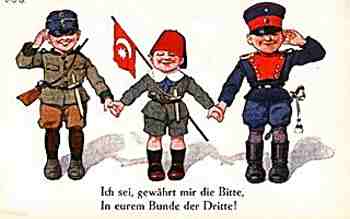
To present an idea of Germany's feelings of friendship toward the Ottomans, in Feb. 10,
1912, while the powers were still jockeying for position, Britain's Secretary of State
Haldane met with the German Chancellor von Bethmann Hollweg in Berlin. "We also had a
satisfactory conversation," Viscount Haldane wrote in his 1920 book, Before the
War, "about the Bagdad Railway and other things in Turkey connected with the
Persian Gulf, and we discussed possibilities of the rearrangement of certain interests of
both Powers in Africa."
It would defy any logic, not to speak of the established rationale
of exigent solidarity among wartime allies, that Ottoman Turkey’s political and military
partners would be motivated to falsely discredit that country in the midst of the crisis
of the war by recording and documenting a capital crime.
Particularly as the years dragged on, German efforts to keep a lid on the issue
diminished. As American newspaperman George Schreiner discovered, when even Germans refused to publish the truth about
Armenian-Turkish relations:
“The religious societies of Germany had finally managed to present the case of the
Armenians to the emperor and had prevailed upon him to interest himself in these fellow
Christians.”
We must bear in mind that the Wellington
House designed propaganda against the Turks was so powerful, the Germans also hoped to
distance themselves from the charges; to the world, it looked as though these overlords of
the Ottoman Empire must have been the masterminds of the massacres.
In fact, German ambassador after German ambassador (Wangenheim,
Hohenlohe, Kühlmann, and Bernstorff) consistently and repeatedly used the word Ausrottung
(extermination) to describe the Armenian experience. In contemporary parlance that term
denotes the idea of genocide.
And that certainly must prove it. These Germans, as the others, did not eyewitness a
thing. Their Christian-sympathizing hearts went to teary-eyed Armenians and missionaries,
especially when those from the latter group were fellow Germans, as Johannes Lepsius. The reports they read derived from such
sources, their Armenian interpreters whispered in their ears, and it was easy to reach
conclusions such as "Ausrottung.” But their personal opinions are no
substitute for the truth. Particularly, when there were reports from German officers on the field presenting a very different
side of the equation.
They have rendered that crime verifiable by such
record keeping. If one adds to this the additional fact that these records were at the
time compiled for strictly internal use, i.e. for in-house consideration, and were not
intended for public consumption, one may be reasonably safe in declaring the evidence
obtained thusly as incontestable.
Not when the sources these records relied upon were corrupt to begin with. Incidentally,
if Vahakn Dadrian sincerely believes in what he is telling us, he has exposed his own
shameful hypocrisy. The Ottoman archives are top-heavy with such records “compiled for strictly internal use,” that show the Ottomans were
protecting Armenians, and that also show the massacres, crimes and treachery of the
Armenians. What is Dadrian’s excuse for totally ignoring these records? (Or his attempts
to dismiss them, by attempting to demonstrate the Turks were liars, or whatever other
reason he concocts. Why does not Dadrian similarly conclude, as he goes on to write about
the German records, that Ottoman records have “the attributes of
reliability, explicitness, incontestability, and verifiability, {and} is compelling
evidence”?
|
Why rely on Ottoman archival accounts to write history? Because
they are the sort of solid data that is the basis of all good history. The Ottomans
did not write propaganda for today's media. The reports of Ottoman soldiers and
officials were not political documents or public relations exercises. They were secret
internal reports in which responsible men relayed what they believed to be true to
their government. They might sometimes have been mistaken, but they were never liars.
There is no record of deliberate deception in Ottoman documents. Compare this to the
dismal history of Armenian Nationalist deceptions: fake statistics on population, fake
statements attributed to Mustafa Kemal, fake telegrams of Talat Pasa, fake reports in
a Blue Book, misuse of court records and, worst of all, no mention of Turks who were
killed by Armenians. (Dr. Justin McCarthy at the Turkish Grand National Assembly, March 24, 2005)
|
To obviate unnecessary arguments about questionable
authenticity and “victor’s justice,” the discussion thus far has been
deliberately kept free from any and all references to the court-martial proceedings
of the Turkish Military Tribunal prosecuting the authors of the Armenian genocide in
the 1919-1920 Armistice years. Despite the valiant efforts of the Young Turk party
leaders to remove and destroy all incriminating evidence in this regard, inevitably
an exiguous number of documents randomly survived these cleansing operations.
Thank you, Vahakn Dadrian, for spelling out why the bread and butter of Dadrian’s
genocide thesis, the 1919-20 kangaroo courts,
are next to worthless. Although the fact that he dismisses the reasons of “questionable authenticity and ‘victor’s justice’” as
“unnecessary” serves as a further testament to the
man’s lack of honesty. If these do not constitute solid reasons as to why we
should think twice before considering them, the British themselves would not have rejected their findings for their
own Malta Tribunal process. He winds up the above with another convenient assertion,
that the Young Turk party leaders tried to “remove and
destroy all incriminating evidence,” without presenting the proof. Indeed,
between the sparse time when the Armistice was signed and the British occupied the
defeated nation (immediately appointing an Armenian in charge of the archives), the
Ottoman leaders who were attempting to make a getaway were scrounging through
thousands of documents, shredding the ones implicating them. (They must have made a
beeline to the handy-dandy “genocide” section.)
Before being introduced as exhibits in the trials, each one of
them was authenticated by competent Interior Ministry officials who appended the
notation “it conforms to the original” to them.
Yet as Guenter Lewy succinctly and inarguably told us, “ few historians would take period officials at
their word without verification." Remember, these were corrupt courts, set
up for reasons of retribution from a dishonest successor government, and also
because a gun was placed at their heads by the Allies. (As Dadrian himself instructed.) If a Nazi puppet court
officer from Vichy France wrote “it conforms to the original,” who would
accept this sort of validation at face value?
It is no accident that that the two foremost genocides of this
century were consummated in the vortex of two global wars. Official German and
Austrian documents clearly indicate that in broad outlines and in sketchy form there
was a pre-war scheme to liquidate once and for all the Ottoman Armenian population
at the first propitious moment.
One can’t compare a powerful Nazi Germany at the outset of WWII, with the luxury
and means to act as an aggressor, with the bankrupt “Sick Man” fighting a
desperate war of defense against superpowers bent on the nation’s extinction. If
the Ottomans were of the mind to exterminate the Armenians, the welfare and
existence of their nation would have demanded that they wait, and make use of their
great national Armenian resource first. As victors, there would be time to get
genocidal later. As losers, there would be no nation left, and the extermination of
the Armenians would serve as a moot point. (As history has borne out, the Ottoman
nation ultimately suffered an extinction, and if it weren't for one man, there may not have been a
Turkey today.) Moreover, insofar as those documents from bigoted and/or ignorant
Germans and Austrians opining on hearsay, “broad outlines
and... sketchy form” can never serve as concrete evidence. We also
possessed not long ago in “broad outlines and in sketchy form” the fact that
Iraq had weapons of mass destruction.
Here’s Dadrian’s own broad outline in regards to how his genocide got
implemented:
1. Within 24 hours after signing on August 2, 1914 the secret
Turko-German political and military alliance, the Turkish High Command ordered
General Mobilization, as a result of which practically all able-bodied Armenian
males in the 20-45 age categories were conscripted in the Turkish army. After having
been used for a while as labor battalion soldiers, most of them were executed by
Turkish officers and fellow soldiers.
Our "scholar" is making it sound as though Armenians were targeted
exclusively for conscription when all Ottoman men were conscripted. These Armenians
were trained and equipped as all Ottoman soldiers; every man was needed in the
desperate fighting to come. As Dadrian well knows, Armenian soldiers were put to use
in the fighting at the beginning phase of the war, as in Sarikamish. That is when the
evidence of Armenian treachery kept getting reinforced; while some Armenians fought
dutifully, there were too many who deserted, or sabotaged their side’s efforts. At
this point the Armenian soldiers were disarmed, and placed in labor battalions. (In
actuality, the decision to disarm Armenian soldiers had been made shortly before the
war began in November 1914, but took several months to implement.) Note Dadrian is
hoping to get away with the notion that they were placed in these labor battalions
from the get-go. And while some Armenian soldiers were massacred (Dadrian is aware
that in probably the most major example taking place in Sivas, Vehip Pasha tried and
executed some of the perpetrators, actions disproving a government-sponsored
extermination policy; Jemal Pasha also
convicted and hanged two officers for a massacre near Urfa), there is no evidence to
signify “most” were executed.
Dadrian keeps confirming his missing morality when he makes such inflammatory
statements without legitimate back-up.
|
| (After the Armenians of the
Ottoman Third Army had passed over to the Russians to return soon after to massacre
Muslims, the result was) "the immediate disarmament by the Ottoman authorities
of the gendarmes and other Armenian soldiers who still remained in the army (probably
because they had been unable to escape)." — Raphael de Nogales |
2. About the same time, the War Ministry in close cooperation
with the supreme directorate of the Young Turk party, the so-called Committee of
Union and Progress (CUP), restructured and refurbished the notorious Special
Organization, the Teshkilati Mahsusa, as the main instrument of the planned mass
murder. Thousands of bloodthirsty criminals were released from the main prisons of
the Empire over extended periods of time. After a week’s training on the
campgrounds of the War Ministry, they were deployed in the interior of Turkey for
massacre duty. In the words of a Turkish military intelligence officer at the time
on duty in the Ottoman General Headquarters, “they perpetrated the greatest crimes
against the Armenians.”2
The Special Organization (S. O.) is Vahakn Dadrian’s invented “Gestapo Fall Guy.”
The S. O. was a military special operations unit, “dealing with both Arab
separatism and Western imperialism” (Philip Stoddard), and they had plenty to
worry about on their hands than to pay attention to killing Armenians. The great
manpower shortage was the reason why convicts were recruited, so that secondary
duties as guarding Armenians would not be performed by the professional soldiers,
desperately needed at multiple fronts. Making use of convict manpower is
historically not an uncommon practice
for many nations. (Remember “The Dirty Dozen”? The idea was inspired by
convict usage by the USA during WWII.) These convicts were used as gendarmes, but
not for the sensitive duties required by the S.O.; this unit played no role in
the relocations. Dadrian’s footnote is Ahmet Refik, [Two Committees, Two
Massacres. 1994, p. 27), where the “Turkish military intelligence officer”
(Elsewhere, Dadrian gave Refik the
job of “deportation official”) is unscrupulously made into an “inside
genocide man” as much as possible, so that we won’t question the selective quote
provided by Dadrian, the one about, “they perpetrated the
greatest crimes against the Armenians.”
Yet the translation in Dadrian’s “The Armenian Genocide: an interpretation” (America
and the Armenian genocide of 1915, p. 93) was as follows: "These felons
who were released from the prisons committed the greatest crimes during the Armenian
horrors."
Let’s go to Dadrian’s essay
against Guenter Lewy that appeared in Jihad Watch, where Dadrian wrote that
Refik “singled out the brigands, the 'chettes' of the Special Organization who, he
said 'committed the greatest crimes,' (en buyuk cinayetteri)
during that genocide.” Now the blame falls on the “chettes,” which are
partisan, criminal gangs. (Or, as Moss and Gilliam wrote in 1923’s “The Turkish Myth”: “roving bands
about as lawless as the mobs in parts of the American South, and about as
out-of-hand politically as the banditti who infest parts of Italy and Spain.”
When there were massacres, it was these lawless, renegade forces that committed
them.)
While essentially offering the same meaning, the translations offered are so
different, one's trust in Dadrian to relay further information becomes more eroded.
Only a reading of Altinay's book will determine whether he was laying blame on the
convicts or the "chettes." Regardless of whether V. D. is making things
up, we know he is leaving things out. Refik Altinay witnessed the most despicable
crimes of mass murder perpetrated by Armenians (that would be the second committee
and massacres that forms his book’s title), and "...fresh corpses lying
about in the streets and deep in the wells covered with blood not yet dried were
those of the poor Turks killed by Armenians” was just one of the things he wrote in this very book, regarding
the invisible victims of this equation.
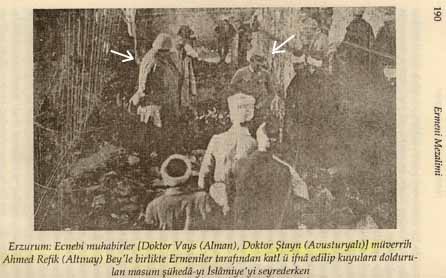
From Karabekir's book, "Armenian
Cruelties"; Ahmet Refik must be the man in the middle of the two others
identified by arrows (added by Holdwater), likely "Dr. Weiss (German),"
and "Doctor Stein
(Austrian)." They are observing wells filled with Muslim bodies, recording
(during April-May 1918) the devastation left behind by the retreating Armenians.
Vahakn Dadrian BUSTED:
Ahmet Refik Altinay
Instead of groping in the dark about how badly Dadrian must have manipulated
one of his most important Turkish sources, I figured it was high time to
consult what the original source had to say. I wondered if Prof. Kemal Cicek
(who helped with busting Dadrian’s claims regarding Halil Pasha) was familiar with
Refik’s book, and here is the real story:
Refik was not a “Turkish Military Intelligence Officer.” Quite
the contrary, Refik was a staunch opponent of the CUP and never got on well
with the party from the beginning. “He was in fact a supporter of the
opposition party, which was known as Itilaf Partisi, the Party of
Reconciliation,” Prof. Cicek wrote. In other words, Refik was an enemy
of the CUP and subsequently was never given a responsible position during
WWI. “When the war broke out in 1914 he was called into the military
service with the rank of Yüzbasi (Major) and appointed as the head of the
Recruitment Department in Eskisehir. This was not a critical position as
there were such departments in all towns.” After returning to Istanbul
due to illness and later appointed to the General Inspectorate of
Censorship, Refik Altinay wrote an insulting biography about Enver Pasha’s
father. “He was dismissed in 1915 and sent to the town of Ulukisla as a
civil servant charged with Acquisition of barley and saman [straw?].”
Prof. Cicek also reminds us that “Ahmet Refik accuses Armenians in
eastern Anatolia of starting the atrocities and siding with the Russians.
Dadrian never touches on this very important detail.”
The original in Turkish will appear on this page if you click here.
“Nihayet Ermenilerin Van kit’ali,
askeri hareketlere engel teskil etmeleri, Ittihatçilarin milli gayeleri
için mühim bir firsat vücuda getirdi. Adil ve kuvvetine güvenir bir
hükümetin böyle bir vaziyet karsisinda yapacagi sey, hükûmet aleyhine
isyanlari tahakkuk edenleri tecziye eylemekti, fakat Ittihatçilar
Ermenileri imha etmek ve bu suretle Vilâyât-i Sitte meselesini de ortadan
kaldirmak istediler. Anadolu’nun sark sinirlarinda Ermenilerin artik
yevm-i halasi (kurtulus günü) geldi zannederek alelacele kiyam-i
kitâllere mebde (baslangiç) teskil etti. Ermeni, Türk binlerce vatan
evladi komitelerin ayaklari altinda çignendi. Harbin bidayetinde Anadolu’ya
Istanbul’dan birçok çeteler gönderilmisti. Bu çeteler mahpustan
çikarilan katiller ve hirsizlardan mürekkepti. Bunlar Harbiye Nezareti
meydaninda bir hafta talim görürler, Teskilat-i Mahsusa marifetiyle Kafkas
hududuna gönderilirlerdi. Ermeni mezaliminde en büyük cinayetleri bu
çeteler ipka ittiler. Mamafih Sarkî Anadolu’da umumi bir herc ü merc
hakim ferma idi. Burada çeteler ve halk birbirini imha ediyor, kan gövdeyi
götürüyordu. Ermeniler Ruslara iltihak etmisler, Van sehrine hücum
ediyorlardi. Hatta Ermenilerin bu hareketleri Ruslarin takdirini celp itmis,
Sasanof bu mes’eleye dair resmi beyanatinda (Van’a) taarruz eden
Ermenilerin gayret ve secaatlerini takdir eylemisti. Fakat en masum, en
bigâne hiçbir cürümleri olmadigi halde tehcir felaketleriyle tebah olan
Ermeniler, Brusa, Ankara, Eskisehir ve Konya vilayetlerinde yasayanlardi.”
[Close]
The Turkish extract is from p. 23 of the original 1919 version, evidently
conforming to p. 27 of Dadrian’s 1994 reprint. Here is Dadrian’s
version:
"The criminal gangs who were released from the
prisons, after a week's training at the War Ministry's training grounds,
were sent off to the Caucasian front as the brigands of the Special
Organization, perpetrating the worst crimes against the Armenians... . The
Ittihadists intended to destroy the Armenians, and thereby to do away with
the Question of the Eastern Provinces." "In order to justify this
enormous crime [of the Armenian genocide] the requisite propaganda material
was thoroughly prepared in Istanbul. [It included such statements as] the
Armenians are in league with the enemy. They will launch an uprising in
Istanbul, kill off the Ittihadist leaders and will succeed in opening up the
straits [to enable the Allied fleets to capture Istanbul]. These vile and
malicious incitements [were such, however, that they] could persuade only
people who were not even able to feel the pangs of their own hunger."
"among those Armenians who were atrociously wasted, despite the fact
that they were most innocent, guiltless, and who had committed no crime
whatsoever, were the Armenians of Bursa, Ankara, Eskiehir, and Konya."
The Dadrian source was not provided, but we can assume Dadrian has not made
a "straight through" translation, and what is featured are
piecemeal parts. What is below is the "actual" translation:
"In the end, massacres in Van and hindrance of
military operations by the Armenians had created an opportunity for the
national goals of the Unionists [CUP]. The thing that a just and strong
government would do under such conditions would be to punish those who
rebelled against the government. But the Unionists wanted to destroy the
Armenians, and thereby solve the Question of the Eastern Provinces.
Assumption that the day of salvation had finally come for the Armenians in
the eastern borders of Anatolia started all of a sudden many atrocities and
massacres. Armenian, Turk and thousands of people were crushed under the
feet of these gangs (komiteler). At the beginning of the War, many gangs had
been sent from Istanbul to Anatolia. These gangs were made up of murderers
and thieves released from prison. These gangs were being trained for a week
at the square of the War Ministry, and then were sent off to the Caucasian
front by the Special Organization. These gangs perpetrated the worst of the
crimes during the Armenian atrocities. Nevertheless there was such a chaotic
situation in eastern Anatolia. There, the people and the gangs were
destroying each other, and a very bloody war was prevalent everywhere. The
Armenians had joined Russia and attacked the city of Van. In fact, the
Russians welcomed this behavior of the Armenians and Sasanof praised the
energy and the heroic fighting of the Armenians in his official statement
with regard to this incident. Unfortunately, the Armenians of Bursa, Ankara,
Eskisehir and Konya had become the subject of the disastrous displacement
despite the fact that these were the most innocent, guiltless, of [the
Armenians] who had committed no crime whatsoever."
What are the discrepancies? Dadrian attempted to make Refik an “inside man”
of the genocide in his other writings, by tying him with military
intelligence or by terming him outright as a “deportation official.” The
fact is, Refik was totally out of the loop. So we don’t know what
Refik was basing his opinions on; he was not involved with these matters at
all. The main genocidal point that he made was that “the Unionists
wanted to destroy the Armenians.” It is obvious that if the Unionists
had destruction in mind, the majority of Armenians could not have survived.
(A factor that could have influenced this statement is that Refik had a beef
against the CUP government.)
What he was saying, to answer the questions raised above, is that the
convicts formed the chettes, trained and unleashed by the Special
Organization. So Dadrian was not manipulating this meaning after all. What
needs to be asked is how Refik could have arrived upon this conclusion, as
he was not on the inside track; perhaps, as a foe of the CUP, he read some
of the assertions of those involved in early 1919's courts-martial,
published in the now anti-CUP government newspapers, and which Dr. Gwynne
Dyer has correctly characterized as "gossip."
It seems to me that the humanitarian Ahmet Refik was lamenting the fact that
the government moved the Armenians out with a heavy hand, taking innocent
and guilty alike; ordinarily, he would have been right about that. But if
there is another nation threatened with extinction in the thick of war that
would have treated a rebellious minority more sensitively, I wonder which
nation that could have been. Nations such as the USA and Canada in WWII and
Great Britain in WWI, neither threatened with extinction nor even invasion,
headed off their potentially rebellious minorities at the pass, before these
minorities even had a chance to rebel. (The Japanese and Germans, respectively.) The moral of this story is that
“war is unfair and it stinks.” (Ahmet Refik wrote “The thing that a
just and strong government would do under such conditions” would have
been to single out strictly the lawbreakers. He is 100% correct, but war
changes the standards of “just.” [In my country of recent times, for
example, think two words: “Patriot Act.”] And the Ottoman Empire was not
a “strong” government; central command was weak, as even Ambassador
Morgenthau has attested.
This is why locals sometimes felt free to take matters into their own hands,
ignoring Talat’s August 1915 order to cease further Armenian relocations.)
===================
"It appears obvious that the Turkish
authorities, anxious for the safety of their lines of communication, had no
other alternative than to order the removal of their rebellious subjects to
some place distant from the seat of hostilities, and their internment there.
The enforcement of this absolutely necessary precaution led to further
risings on the part of the Armenians. The remaining Moslems were almost
defenceless, because the regular garrisons were at the front as well as the
greater part of the police and able-bodied men. Already infuriated at the
reports of the atrocities committed at Van by the insurgents, in fear for
their lives and those of their relatives, they were at last driven by the
cumulative effect of these events into panic and retaliation and, as
invariably happens in such cases, the innocent suffered with the
guilty". (Henry Wood, U.P.A. Correspondent [USA] stationed in the
Ottoman Empire during a part of 1915.)
===================
Otherwise, Ahmet Refik is accurately painting the picture that everyone was
at each other’s throats, the “intercommunal fighting” reality of WWI’s
Ottoman Empire. What is Dadrian doing? Deceptively making it seem as though
Ahmet Refik offered actual evidence of a “genocide,” since Ahmet Refik,
as Dadrian falsely portrayed, was an insider. And look at the horrible way
Dadrian went about translating some of Ahmet Refik’s words. For example,
Ahmet Refik stated flat out that the Armenians had joined the enemy. The way
Dadrian twisted this was to write the government had prepared propaganda claiming
that the Armenians were in league with the enemy. As Dr. Guenter Lewy put it, “Vahakn Dadrian is... guilty
of willful mistranslations, selective quotations, and other serious
violations of scholarly ethics.” Guilty as charged.
Prof. Cicek informs me that he is preparing a book tentatively entitled “Dadrian’s
Gallery of Shame.” Finally a scholar is taking the trouble to consult
the mysterious Turkish sources Dadrian has misused and abused all of this
time. Let’s hope this book will be translated into English and made
available outside Turkey. (But Dadrian and his supporters may still breathe
easily; they know how hopeless the Turks are in making important information
available. Can the reader believe that this 1919 book of Ahmet Refik
Altinay, “Two Committees, Two Massacres,” is evidently still
untranslated and unavailable outside Turkey?)
|
3. Between this period and the initiation of the deportations
and massacres in April 1915, the provincial Armenian population had been subjected
to a constant barrage of provocative acts involving rape, plunder and murder. As
attested to by German consuls on duty in the interior of Turkey, segments of the
Armenian population as early as November 1914 had been challenged to resist, and
even to retaliate to provide pretexts to the Turks for leveling against the
Armenians in general pre-planned charges of rebellion... German Ambassador
Wangenheim... transmitted to Chancellor Bethmann Hollweg a report of Captain Dr.
Paul Schwarz, his consul at Erzurum. Detailing the provocations of the brigands...
the consul spoke of the acute alarm of “the Armenian population of Erzurum,
especially the rural population.”3 ...(referring) to these provocations as “harbingers
of new massacres” ... Another consul, Scheubner-Richter... likewise reported to
Berlin on “the excesses and severe harassment” of the targeted Armenians by the
Turkish authorities, but especially by the Special Organization cadres, the
so-called chetes.4 Major General Otto von Lossow... declared, “Wherever possible,
the Armenians are being aroused, provoked in the hope of thereby securing a pretext
for new assaults on them” ...5 (In the footnotes, the first report is dated
December 1914, no date is provided for the second, and the third is August 5, 1918.)
The reality is that the Armenians were prepared with secret caches of arms and
ammunition stored throughout the empire, ready to strike as soon as their nation was
at their weakest, as the Hunchak charter spelled out. (“The most opportune time
to institute the general rebellion for carrying out the immediate objectives was
when Turkey was engaged in war.” Nalbandian,
1963) Days after war broke out, Armenians stirred trouble in Van (see New York
Times link below) and soon eruptions would break out throughout many areas of
the empire (consult pp. 196-200 of Gurun’s “The Armenian File,” 1985,
for a sampling of internal Ottoman telegram communications, reporting upon many
different villages; here’s a few for the Van area, and one for Sivas; as Dadrian instructed above, reports prepared for
internal use would be looked upon “thusly as incontestable”), helped by
the $13 million (in today’s money) that the Armenians received from Russia (“for
the initial cost of arming and preparing the Turkish Armenians and to start riots
within the country during the war,” as the Dashnak military minister put it during February 1915). Now what
are these Christian-sympathizing German consuls reporting far from the spot, and
mainly from the comfort of their offices, having derived their information from
their Armenian assistants and who knows where else? The first one is telling us that
the poor, innocent Armenians were “challenged to resist, and
even to retaliate to provide pretexts to the Turks.” Is that really what
was happening, or were the Armenians firing the planned first shot, as usual... as
even The New York Times reported?
The third one's contention is especially ludicrous, and he (von Luslow) appears to
be the only non-consul of the bunch (he should have known better, as the on-the-spot
honest German officer pointed to
above, and another will below). Assuming von Luslow was
reporting on conditions in eastern Anatolia (Armenian propaganda tells us there were
practically no other Armenians left in the rest of the empire, so for that and
common sense reasons, it’s reasonable to assume as such), Armenians were in charge
of good parts of this territory in 1918, committing the most devilish acts of mass
murder, as their Russian allies recorded. So who was going to arouse the Armenians? The
Armenians needed no help in being “aroused.”
Assuming Dadrian translated these passages responsibly, it is lamentable what this
“foremost authority on the Armenian genocide” is doing. Thanks to the words of a
few ignorant bigots, not in keeping with the historical reality, we are asked to
believe crimes committed by Armenians were a “set-up” by the Turks!
(Not incidentally, Dadrian’s third footnote “5,” from 1918, and most likely
the second and undated footnote “4” are irrelevant, as his notion pertained
strictly to “Between this period [Aug. 1914] and the
initiation of the deportations and massacres in April 1915.” Also not
incidentally, every genocide-cheering Armenian has it tattooed on his or her
forehead that the “genocide” began on April 24, 1915. Yet the “deportations
and massacres” did not take place on April 24; the resettlement order was decided
on in May 27, and implemented days later. The first sign of a relocation decision
took place on May 2nd, as signs of
Armenian treachery became too plentiful to ignore.)
|
| |
The massive nightly surprise arrests of some 2345 Armenian leaders
in Istanbul 6 from the fields of commerce, education, politics, religion and the arts on
April 24, 1915 ushered in the actual first phase of the Armenian genocide as similar mass
arrests were carried out in all large cities of the Empire, especially in the eastern
provinces. None of these arrested were charged or tried in a court of law, and very few of
them escaped summary murder at the hands of the brigands of the Special Organization.
With the above statement, Vahakn Dadrian proves once again what a low-lying scoundrel he
can be. He knows with every fiber that the number of Armenians arrested on April 24 was
235, and not 2,345. the 2,345 figure was what appears to have been a typographical error
in the book of Esat Uras, “The Armenians in History and the Armenian Question,”
(more on this below*) and has been mindlessly repeated at times
by Turkish scholars. (Dadrian’s footnote is “Kamuran Gurun, Ermeni Dosyasi [The
Armenian File] (Ankara: 1983), p 213.” Dadrian no doubt has the corrected later 1985
edition in English, where the figure is given as 235. On p. 206 the “235” figure is
given twice:
“Upon this instruction of the Ministry of the Interior, 235 people were arrested in
Istanbul. This day, 24 April, on which the Armenians hold demonstrations each year
claiming it is the date of the massacre, is the day when these 235 people were arrested.”
The director of the Turkish archives, Yusuf Sarinay, has examined these documents and has
confirmed the figure to be 235. (Which only makes sense. It would take an army to go
directly to over two thousand homes in one night and following day. How numerous a force
constituted the “Constantinople Cops”?) Johannes Lepsius also cited 235 in the 1921
Berlin trial of Soghoman Tehlirian. You can read more as this mystery was being uncovered,
and Prof. Cicek helped with its unraveling as well.
Of course, the slippery Dadrian is going to go with the mistaken 2,345 because 2,345
sounds much worse than 235. The facts don’t matter to Vahakn Dadrian; anything that
shows the Turks to be monstrous is what the “genocide scholar” prefers to go with.
(And notice nothing is said regarding the treachery of these "leaders," the very
word used by the Armenian historian Borian, when revealing the motives of these leaders. As you'll
read later on this page, a Dashnak Armenian implicated some of these
very Istanbul leaders in their plans for rebellion.) As Prof. Malcolm Yapp astutely observed, “The author's approach is not that of
an historian trying to find out what happened and why but of a lawyer assembling the case
for the prosecution in an adversarial system.”
(*The oddly translated passage — with the presumably figurative usage of the word
"soldiers" — from the 1988 English language version of Uras' classic book, p.
872, is: "Indeed, if it is remembered that in Istanbul out of an Armenian
popuation of 77,735 only 2,345 soldiers who were accused of having participated in the
rebellion were arrested, and that the rest continue to live and work in peace and comfort,
it must be admitted that the measures were in no way directed against the Armenian people
as a whole but were implemented in order to meet a specific need dictated by the
circumstances." There is no documentation that supports this figure, in the event
that it was supposed to represent the number of Istanbul Armenians arrested in total
over the years, and not just April 24. Once again: Uras's information does not
single out April 24.)
Regarding Dadrian’s ending comment on this matter, “None of
these arrested were charged or tried in a court of law, and very few of them escaped
summary murder at the hands of the brigands of the Special Organization,” of
course they were tried. (At least Dadrian does not go so far as what Armenian propaganda
typically tells us, that these men were all killed the same night.) They were first
imprisoned, and then tried; 25 were found guilty and sent up the river in two prisons, 57
were “deported” to Zor (where presumably they were not placed behind bars, but allowed
to mingle), and 35 were released in the four months between their arrest and August 31. No
doubt the bulk of the numbers unaccounted for were executed (and the “Special
Organization” had nothing to do with imprisonment measures; notice how our
"scholar" inserts the Special Organization every chance he gets), as is the
standard fate for any citizen organizing a treasonous rebellion in practically all nations
of the world. None of these facts matter to Vahakn Dadrian; he will make any false
statement, as long as he feels he can get away with it.
It is necessary to point out that Dadrian's source, "The Armenian File,"
is a powerful book, loaded from top to
bottom with Turk-unfriendly sources, which cannot be construed as "Turkish
propaganda." Dadrian credits this book for the turning around of one-time genocide
proponent, Prof. Bernard Lewis.
Since Dadrian admits to having read this book, what is his excuse for ignoring its many
irrefutable facts? When he refers to this book in his countless papers over the years, it
is only to take advantage of the book's few errors. Could there be stronger evidence to
prove Dadrian is anything but a truth-teller?
- The second phase involved the wholesale
deportation, and destruction in one way or another, of the bulk of the remaining Armenian
population that consisted of terrified old men, women, and children. In order to give this
undertaking a semblance of legality, a Temporary Law of Deportation was decreed on May 27,
1915, by administrative fiat.
If Dadrian is now telling us the “deportation” began on May 27 (after dopily implying
young Armenian men throughout the entire country must have all been killed by May 27),
then why did he state earlier that “the initiation of the
deportations and massacres (took place) in April 1915"? Is his loophole word
“initiation”?
(Yet credit goes to our ethically-challenged foremost authority for pointing out the law
was indeed “temporary.” All those relocated had the
option of returning by 1918’s end, and a good number had already gone back home before
that time; see box below, for example. Odd for a people supposed to
have been subjected to “wholesale annihilation.”)
As we know from the reams of Armenian
oral testimony, the relocated people being limited to “old men,
women and children” is another falsehood. Plenty of men from all ages were also
in on the ride. For example, Hrant Sarian’s
father and uncle were not taken to the side to be shot. As another example, one of the
three books Dadrian read to turn him on to his immoral crusade (“I Ask You, Ladies
and Gentlemen”), flatly reveals the
author’s father and an uncle were among those sent off. The reason why younger men were
few is because many had been drafted, many of those drafted deserted, and many refused the draft in the first
place, instead heading over to the Russian border (like Talat’s killer, Soghoman
Tehlirian, and his brother Missak, in 1914), or to make way to the mountains to harass
Ottoman armies from the rear.
“The second phase involved the wholesale deportation, and
destruction in one way or another....” What does that mean? If “one way or
another” signifies non-murderous methods, such as famine and disease — causes claiming
most of the lives of the 2.7 million other Ottomans who died (including soldiers, who also
died by the thousands of famine and disease) — are we to conclude these deaths were
intentional?
Many of the deportee convoys were ambushed and destroyed through
butchery, drowning in the tributaries of the Euphrates River or in the Black Sea, or
through burning alive in specially dug large pits, haylofts, stables and barns. The rest
was allowed to perish through starvation, disease and infirmity.
If the rest were “allowed” to perish, then the massive
number of non-Armenian Ottomans who also died from these causes must have similarly been
given such “permission.” Some, not “many” of the convoys were ambushed, not always
resulting in their destruction. When the authorities got wind of these horrid ambushes,
they took steps to minimize future occurrences, by (for example) changing the routes for
those forced to take a hike. (Armenians fortunate to travel by rail mostly arrived unmolested.) The question to ask in
order to get at the bottom of whether there was a “genocide” or not is, who was behind
these ambushes and crimes? Lawless bands, often composed of Kurds, were the culprits.
There is no evidence the central authorities were behind these ambushes; quite the
contrary, the real evidence points to the authorities’ having the safety and welfare of
the Armenians in mind.
There have been plenty of excavations revealing the many Muslims the Armenians murdered, but I’m not familiar with one example
of “specially dug large pits” where Armenians were
interred after being massacred. Iraq and Syria are no longer under Turkish control, and
one would think the mega-wealthy genocide industry would have sponsored such excavations
by now. Surely there must be no end to such burial grounds, especially since Vahakn
Dadrian keeps telling us 1.5 million Armenians were victims of “wholesale
annihilation.” (ADDENDUM, 3-07: Ara Sarafian seemed
gung-ho to unearth a supposed mass grave of 12,000 that Leslie Davis wrote about, and the Turkish Historical Society's Yusuf
Halacoglu offered to team up. Sarafian flirted with the idea, but ultimately bowed out. More.)
This is not to say Armenians were not massacred; of course a good many were. What we are
focusing on are the rash, “anything goes” claims of the “foremost authority of the
Armenian genocide,” without providing proof. Yes, Armenians and missionaries became
experts in inventing tales of Turkish deviltries, many requiring little imagination as it
was the Armenians perpetrating the most unimaginable horrors. But tales of hateful hearsay are no substitute for fact. As
an example, a Swedish officer was on
the spot along “the tributaries of the Euphrates River,”
and he did not find any evidence of such mass drownings. As for the Black Sea drownings,
even Ara Sarafian risked his reputation in the Armenian community by questioning whether such drownings — and there certainly were some
— could have been all that plentiful.
|
"[T]he
Armenians felt excessive pleasure at having killed such unfortunate people."
— Raphael de Nogales
|
The third phase affected the multitudes of emaciated survivors
of the exhausting and debilitating treks of deportation. In the deserts of
Mesopotamia, in Ras-ul-Ain, Deir Zor and Shedadi in particular some 150,000 such
survivors were slaughtered by Chechen and Kurdish tribes in the summer of 1916 on
the order of Turkish authorities who were unpleasantly surprised by such a
relatively high survival rate.
What is giving this “scholarly” goof the idea that these “Chechen and Kurdish
tribes” were beholden to orders of the authorities? Some Kurdish tribes also
revolted during these war years, and their unmanageability is a historically well-known phenomenon. I also
wonder why Dadrian decided to give Chechens prominence, when they were far fewer in
number than the Kurds, and the other groups of the, at times fanatically Muslim,
Circassians and Arabs. (The credit for these four groups as the killers has been
often given by Armenian survivors. Footnote 40 in Lewy’s “Resettlement”
chapter — coming up — cites a French work by Raymond Kévorkian [“The
Extermination of Ottoman-Armenian Deportees in the Concentration Camps of
Syria-Mesopotamia”] and another by Kapikian [“Yeghernabadoum”].)
The fact of the matter is, there is no evidence that the Kurds and the others were
coerced or incited to act against Armenians. It was simply business as usual for the
criminals in these tribes, where human life was deemed as cheap. (But that won’t
stop Mr. Dadrian from making an unethically unsubstantiated statement such as “on the order of Turkish authorities.”
Vahakn Dadrian did not like it when he was accused of sexual harassment. The charge was true, and he lost his tenured
position as a university professor. But Dadrian still was not happy, and fought
against the repercussions of his misdeed. Now imagine making such a charge on no
evidence. Further imagine that the charge involves the worst crime of murder.
That is what this unscrupulous man is indulging in.
He is actually telling us 150,000 Armenians were “slaughtered.” Where did he get
this number from? What happened to the Armenians after they were resettled is an
episode that is tackled by reliance on tainted sources. Even solid scholar Guenter
Lewy, in his Herculean efforts to be fair (one reason likely being to lessen the
odds for the brave scholar to be branded as “pro-Turk”; no matter what he did,
he was going to be accused of such by the out-of-control genocide smearers), relied
almost entirely on these tainted sources (Armenians, missionaries and consuls) for
the “Resettlement” chapter of his book, The Armenian Massacres in Ottoman
Turkey: A Disputed Genocide. What we can be certain of is that many resettled
Armenians went through a horrible experience. What we can’t be certain of is that
those who were deliberately killed were done away with on the orders of the Ottoman
government. The best evidence is that the perpetrators were most often lawless “chettes,”
or gangs.
Here are the numbers from this chapter, for the heck of it. Ras-ul-Ain, an apparent
transit camp on the way to Zor that generally wound up being a kind of permanent
residence, had 20,000 Armenians in Feb. 1916 (Consul Jesse Jackson), reduced to
almost nothing by June of 1917. (Source: German missionary Bruno Eckart, one of Lepsius’
most “zealous and trusted co-workers”; Eckart felt the reason for the killings
was greed.) Lewy agrees the cause for death of these Ras-ul-Ain-detained Armenians
was murder. Meskene, another transit camp, had 55,000 dead by July’s end, 1916
(Consul Rossler). Rakka, a town by the Euphrates, and surroundings had 10,000
Armenians in Feb. 1916 (Consul Jesse Jackson), 6,000 in April 1917 (Swiss missionary
Künzler) and 1,000 by December 1917 (“Friend of Lepsius” Consul Rossler; 2,500
were taken to Urfa in Dec. 1916 and another large group to do Urfa road work in the
summer of 1917.) Der-el-Zor’s most authoritative figure appears to be 40,000 in
March 1916 (Consul Rossler); larger figures might have been referring to the entire
district and not the city. The original governor, Ali Suat Bey, treated the
Armenians conscientiously, but things got worse when replaced by Zeki Bey in April 1916. Obeying the
stipulation that Armenians were not to exceed 10% of the Muslim population, Zeki
expulsed thousands with dire results. 15,000 were left by the end of August 1916
(Consul Rossler). The ending location in this chapter is Damascus, but this one
doesn’t count, since Armenians were treated fairly by Jemal Pasha. It appears only
20,000 of 132,000 in southern Syria died (Maud Mandel review of Kévorkian’s book,
The Armenian Forum, Autumn 1998).
It’s hardly scientific and excludes the other areas Dadrian mentioned (but also
includes areas not mentioned), in addition to representing total figures
(Dadrian limited his 150,000 only to the "summer of 1916";
when did his remainder of 1.5 million-1.2 million minus 150,000 die?), yet let’s
add it up: 20,000 dead in Ras-ul-Ain, 55,000 in Meskene, let’s say 5,000 dead in
Rakka, and 25,000 dead in Zor. This serves as the most generous estimate, assuming
the difference between the numbers “before” and “after” meant all the
Armenians were killed. (Of course, that was not the case; groups were sometimes
moved out elsewhere, and no one can say with certainty what became of them.) Result:
105,000, a difference of 45,000 with Dadrian’s figure. (If we include the Damascus
mortality, the difference is reduced to 25,000.) Let’s keep in mind Lewy’s
figures were provided 100% by Armenian sympathizers. Additionally, let’s not
forget most victims had died of famine and disease, and Dadrian was being his usual
mean, dishonest self by telling us they had all been “slaughtered.”
What we can also be certain of is that the majority of resettled Armenians survived.
If extermination was the plan, figuratively speaking, there is not a single Armenian
under Ottoman control who would have been left alive. If “Turkish
authorities... were unpleasantly surprised by such a relatively high survival rate”
— that is, if they suddenly realized they had erred in their evil extermination
plan — why would the “genocide” have “all but run its course” in
1916?
(ADDENDUM, 9-07: Please bear in mind that Dadrian's
timetable for the "completion of the main part" of his genocide points to January-February
of 1916.)
The ending paragraph of Lewy’s “Zor” section bears repeating:
A German officer, Ludwig Schraudenbach, who passed through
Der-el-Zor in early 1917, reports hearing of horrible atrocities committed on the
orders of Zeki Bey. Children were said to have been tied between wooden boards and
set on fire. Schraudenbach’s account makes it clear that he heard of but did not
see any of these outrages. Dadrian leaves out this important qualification and
refers to these allegations as fact. (The original Schraudenbach source is
provided, along with Dadrian’s: “German Responsibility in the Armenian
Genocide...”, p. 195, n. 179)
Aside from serving as yet another corroboration of Dadrian’s fraudulent nature,
what’s revealing about the above passage is that Armenian propaganda was so
prevalent in German circles, even the military men could not help but be influenced
by what they had heard. That went across the board for all Germans and Austrians.
You’d think if Germany was so interested in protecting the reputation of their
Ottoman allies, the overwhelming view would have been that the Turks were innocent.
This was not the case, as we can see from this revealing example, helping us to
better understand as to why Germans and Austrians were quick to believe pro-Armenian
claims.
|
"RESETTLEMENT
OF REFUGEES AND THE RESULTING VIOLENCE"
"By November of 1917, long before the war had come to an end, the Ottoman
government had discovered that its policy of resettling or deporting large groups of
people for strategic or other reasons was a resounding failure. Removing the few able
bodied men who were left after the massive conscription begun at the start of the war
had disrupted both agriculture and trade, decimating the market place and adding to
the results of the British naval blockade of the eastern Mediterranean to create
massive shortages of food, with supplies far short of what was needed to feed the
cities, let alone the thousands of refugees living in camps around the country.
Starting in late March, 1918, therefore, long before it was required to do so by the
Armistice of Mondros, the Ottoman government worked systematically to resettle
Armenians, Jews, Turks and Arabs who had been deported, relocated or driven out of
their homes in the war zones during World War I...."
"Deportation caravans carrying Armenians and Greeks to exile in interior
provinces were ordered stopped and their passengers returned to their homes. The
provincial and district governors were ordered to help the investigation committees
draw up detailed lists of all the Armenians and Greeks who had lived in the areas
under their jurisdiction before the war, how many had been deported and to where, how
many had been exempted from deportation and why, how many of those who had been
deported from other places were still living where they had been placed, and how many
had fled and could no longer be located. Detailed statistical reports were also drawn
up showing the ethnic populations of the districts and provinces before and after the
war so that they could be submitted when required to the Paris Peace Conference. All
Armenians who had been imprisoned for political crimes had to be released at once so
they could join the caravans returning the deportees to their homes, but Greek
political prisoners, like those Ottoman Greeks who had deserted from the army and fled
abroad, had to remain where they were until exchange agreements were made by treaty
between the Ottoman Empire and Greece..."
Prof. Stanford Shaw, "From Empire to Republic: The Turkish War of National
Liberation, 1918-1923 ," 2001, pp.236-237; more. |
It may be said that altogether some 1.2 million
Armenians perished in the course of this wartime disaster, even though by official Turkish
statistics the number of Armenians killed outright during the deportations was 800,000. 7
The source (provided with Turkish disclaimers, to Dadrian’s rare credit) is “Interior Minister Cemal’s public declaration in the Turkish daily Alemdar,
March 15, 1919,” a Turkish source as valid as the misprinted 2,345 Armenians
arrested on April 24... but that is not going to stop our “bezonian” scholar from
using it. (Did you know there was such a word, basically meaning “dishonest person”?
What a cool choice to describe an Armenian varlet as Vahakn.) Isn’t it interesting that
Cemal’s figure was almost exactly the same as the propagandistic mortality figure of
840,000 provided by the Armenian Patriarch? I wonder how Cemal had justified this figure,
since Ottoman statistics had the pre-war Armenian population at 1.3 million. If 800,000
died, only 500,000 Armenians would have been left alive, which is half the figure of what
even Dadrian points to! No less curiously, Dadrian’s trumped up mortality figure of 1.2
million almost exactly matches the Patriarch’s 1,260,000... only the Patriarch was
referring to Armenian survivors. (By the way, Dadrian opened his paper with the
statement that in the “1915-17 genocide against the Armenians...
some 1.5 million people lost their lives.” He can’t get the numbers straight
even in the same paper, proving once again that for genocide-obsessed Armenians, “numbers
don’t matter.”)
The reason why Cemal offered a mortality figure in agreement with the Armenian Patriarch
was because Cemal was part of the Allied-occupied, postwar puppet administration. Shame on
Dadrian for presenting this source as an authoritative one; the 1919 facts and acts
offered by the corrupt government of Damad Ferid Pasha constitutes Dadrian’s bread and
butter; in particular the kangaroo courts-martial of 1919-20.
THE LOWDOWN ON CEMAL
(ADDENDUM, 3-07)
1) Interior Minister Cemal's interview was not with the Turkish Daily Alemdar,
but with the French-language newspaper, Moniteour Oriental. Evidently, all
of the Turkish dailies from the period (such as Ikdam, Hadisat, etc.) used
the translation from the French on 15 March 1919.
2) On 19 March 1919 (only four days after this news was published in the
newspapers), Minister Cemal (sometimes "Djemal") denied that he
said 800.000 Armenians were killed; rather, he stated this was the number of those
who were relocated. He said he remembered very clearly that he did not
claim eight hundred thousand were killed, adding that it was clear the number of
killed could not have approached such a high level. This retraction was published
in the daily Tasvir-i Efkar on 19 March 1919 ("19 March 1335" by
the Ottoman Calendar.) Source: Ferudun Ata, Isgal Istanbul'unda Tehcir
Yargilamalari ("Relocation Trials under Occupied Istanbul"), Ankara,
2005, THS. pp. 141-142.
Dadrian's Alemdar also printed the retraction of Cemal's words, with the
interpretation that Minister Cemal realized this figure would prove to be harmful
at the peace negotiations. Source: Nejdet Bilgi, Ermeni Tehciri ve Bogazliyan
Kaymakami Mehmed Kemal Beyin Yargilanmasi ("The Armenian Relocation and
the Trial of Mehmed Kemal Bey, the Prefect of Bogazliyan), Ankara, 1999, p. 131.
Dadrian disciple Taner Akcam is reported to have admitted Cemal later claimed the
800,000 was the number resettled and not killed, doing his mentor one better in
terms of credibility. However, Akcam editorializes (as to be expected), that Cemal
was performing damage control.
In this same interview from Moniteour Oriental that the Turkish newspapers
all reported from on March 15, Cemal also claimed that the CUP had
exterminated/killed 4 million Turks. (Source: same books and page numbers above.)
The Allied puppet government Cemal formed a part of was anxious to pin blame on
the previous administration; in other words, the point was CUP caused the death of
Turks by having entered the war, kind of committing a "genocide" on
their own. Note the consensus (Dadrian notwithstanding) for the total Turkish loss
for 1915-1922 is around 2.5 million, and Cemal had made this statement before the
Greeks had invaded (which caused a Turkish mortality of 640,000, according to
McCarthy, Death and Exile, p. 331, footnote 195.) So Cemal doubled the real
figure of around 2 million to 4 million, and compounding matters further,
told us these 4 million were deliberately killed by the CUP (a government
that, Dadrian ironically tells us, was pursuing a Turkification policy).
Conclusion: Cemal would make the Armenians proud with his knack for falsifying
figures, and can't be taken seriously.
With all the egg on his face, let us pray Vahakn Dadrian checks his cholesterol
levels frequently.
Many thanks to Hector, and his outstanding research.
|
Moving on to his last section before the wrap-up, entitled “The untenable elements in the ‘controversy’ surrounding the Armenian
genocide,” Dadrian writes:
In their attempts to portray this genocide as questionable or
debatable, the protagonists of “the Turkish point of view” continue to advance several
lines of disjointed arguments, such as (1) the Ottoman government is responsible only for
its order to deport, (2) the deportations were limited to the war zones, (3) the attendant
massacres were largely the result of “inter-communal clashes” over which the central
authorities had no control, (4) most of the Armenian casualties resulted from inadequate
resources needed to protect the deportee convoys, to care for their sanitation and
feeding, (5) anyway, the intent of the Ottoman government was not to cause the destruction
of the deportee population but its relocation in their points of destination, (6) there
was a civil war between the Armenians and the Turks in the context of a larger global war,
as a result of which the Turks sustained heavy losses, and (7) the overall Turkish losses
throughout the entire period being about 2.5 million, they by far exceed the scope of
total Armenian losses.
Son of a gun! Dadrian is beginning to make sense at last, as points 1-7 are all generally
based on historical fact. Too bad he can’t claim the credit for any of these statements.
Given the limitations of space, attention will be focused only on
the last three items whose inclusive thrust does incorporate elements that may address the
issues raised by the other items as well.
We're ready.
First of all, how did the Young Turk authorities expect to resettle
in the deserts of Mesopotamia hundreds of thousands of dislocated people without securing
the slightest accommodation or other amenities affording the barest conditions of
subsistence for human beings? ... Even the Chief of Staff of the Ottoman Fourth Army...
stated, “there was neither preparation, nor organization to shelter the hundreds of
thousands of the deportees.”8 (“Orgeneral Ali Fuad Erden, Birinci Dünya Harbinde
Suriye Hatiralari [Syrian Memoirs of World War I], Vol 1 [Istanbul: 1954], p 122.”)
The old man has a point. Unfortunately, the serious situation of national life and death
warranted this terrible move without adequate preparation. Enver Pasha also embarked on
his Sarikamish affair, to disastrous results. (In other words, optimism for things working
out is human nature. Sometimes things plain go wrong, but such does not prove that was the
plan all along.) George Schreiner, the only American newspaperman who travelled into the
Ottoman interior in 1915 (Thomas C. Leonard, “When news is not enough...”, “America
and the Armenian genocide of 1915,” 2003, p. 297) summed it up in his own book: “I saw none of the cruelties the
Turks have later been charged with... The inquiries I made at the time and later have
caused me to believe that Turkish ineptness, more than intentional brutality, was
responsible for the hardships the Armenians were subjected to.” “Ineptness”?
Yes. “Intentional”? No.
If the Armenians are unhappy about their fate, they should have thought twice before
allowing their terrorist leaders to hold sway. “The terrible fact” is, to
borrow Katchaznouni’s phrase once again, nothing would have happened to the Armenians
had they remained loyal.
“The Turks, having their hands full already with a difficult war, took ruthless steps
to quell the uprising. They deported what was meant to be the entire population of Armenia
to Syria and Mesopotamia. Their organization was insufficient; a third of the Armenian
population escaped deportation...” R. P. Lister, Turkey Observed,1967
Equally important, these “hundreds of thousands” were not deported merely from “the
war zones,” as repeatedly claimed, but they were deportees from all parts of the Ottoman
Empire.
And some were certainly targeted unfairly. However, the Armenians throughout the empire
were at one with the Entente Powers, and friend could not be separated from foe with
dangerous enemies at every front. (Dr. Edward Erickson described the desperation
beautifully: "During this period [of near-simultaneous allied attacks] almost
every Turkish Infantry Division would be committed to combat in a strategic situation akin
to the Dutch boy plugging the dyke with his finger.") Traitors were all over;
western Armenians poisoned food supplies of the army, to assist British and French
invaders in Gallipoli. Moreover, Armenians were not rebelling strictly in the eastern
zones, as with the example of Sivas.
As official documents unmistakably reveal (and American Ambassador
Morgenthau confirms) only the rapid deterioration of Turkey’s military situation and the
resulting time constraints prevented the authorities from carrying out the projected
comprehensive deportation and liquidation of the rest of the Armenian population.
Have you got that folks? Our propagandist is telling us the only reason why the “genocide”
had “all but run its course” by 1916 is because the Turks ran out of time. Yet some
two years still remained before the war was over, and the Ottoman Empire’s military
situation waxed and waned throughout that time; the serious deterioration taking place
only in the last year.
|
If the idea was for the “liquidation” to be seen through
until the bitter end, Talat Pasha certainly would not have issued his order on August
29, 1915, instructing that there would be no further relocations. (“...[A]side
from those who have already been transferred and relocated, no additional
Armenians are to be removed.”) And he certainly would not have kept
re-issuing the same order, since the locals kept disobeying. For example, in March
16, 1916, the order to the governors was: “Owing to administrative and
military considerations it has been determined that from this time forward the
transfer of Armenians will cease. It is ordered that from this time forward no
Armenians, other than those already relocated, will be transferred for any reason.”
Still disobeyed, Talat was forced to reissue a similar order on Oct. 24, 1916:
“As the transfer of Armenians is revoked, it is no longer appropriate to
dispatch convoys of Armenians who are to be transferred and relocated. Therefore,
if investigations have determined that there are dangerous individuals who should
be transferred, we are to be promptly notified of their names and total number.”
As Guenter Lewy wrote in his The Armenian Massacres in Ottoman Turkey: A
Disputed Genocide, where the foregoing has been referenced (pp. 205-207), : [T]he
deportations for all practical purposes had finally come to an end, and there was
even talk of an amnesty that would allow the deportees to return to their homes.
(Source: Embassy minute, December 11, 1917, PA, Botsch. K/174 [fiche 7270])
ADDENDUM, July 2007:
Lewy's source for the Aug. 29,
1915 telegram is Orel and Yuca's The
Talat Pasha 'Telegrams': Historical Fact or Armenian Fiction?, 1986, p. 129.
This is the book that examines the Andonian forgeries. I have since looked at Armenians
in Ottoman Documents (1915-1920), Directorate of Ottoman Archives, 1995,
listing telegrams in chronological order, and there is no such telegram for August
29. There is one, however, for October 27, 1915, with the heading of "Halting
the Deportation of Armenians." Its description: "Ciphered
telegram from the Ministry of the Interior to various provinces and governors of
sanjaks, regarding that Armenians, other than those who have been gathered in
order to be sent to specific locations and who have set out on the road, not be
sent." It's signed by Talat Pasha (BOA, DH. SFR, nr. 57/135).
ADDENDUM, September 2007:
I've gotten the picture that the English summaries in "Armenians in Ottoman
Documents" are unreliable, they sometimes alter the meaning because they are
not exact and are not full-text. The information from the Orel-Yuca book is as
such:
Authentic Document No. LII
Ciphered telegram from the Ministry of the Interior to the Governors of the
provinces of Hudavendigar [Bursa], Ankara, Konya, Adana, Aleppo, Sivas,
Mamuretilaziz [Elazig], Diyarbakir and Erzurum; and to the Governors of the
sanjaks of Izmit, Maraş, Urfa, Zor, Kütahya, Karesi [Balikesir], Nigde,
Karahisansahib [Afyon], and Kayseri:
The only goal which the Government hopes to attain by the removal of the
Armenians from their places of residence, and their transfer to specified areas,
is the prevention of their activities against the Government, and to put them in a
position where they will be unable to pursue their dreams of establishing an
Armenian Government. As this decision is not intended to destroy innocent people,
it is the absolute wish of the Government that every measure to ensure the
security and protection of the convoys during the relocation process be taken.
Further, that the individuals being transferred are to be adequately fed from the
Immigrants’ Appropriation. In addition, it is the wish of the Government that, aside from those who have already been transferred and
relocated, no additional Armenians are to be removed. As has been previously announced, the families of soldiers, artisans in
the necessary proportion, and the Protestant and Catholic Armenians, are not to be
transferred.
It is ordered, to begin without delay,legal prosecution against those who attack
the convoys, and those who engage in robberies, and who commit rape, succumbing to
bestial feelings. Officials and gendarmes who have participated in these acts are
to be severely punished. All such officials are to be immediately discharged, and
turned over to the military courts. Their names are to be sent to us at once.
Henceforth, the provinces or sanjaks will be held responsible for any such
incidents which occur [within their boundaries].
16 August 1331 [29 August 1915].
Minister of the Interior.[54]
Holdwater: In other words, the first
time Talat Pasha halted the relocations does indeed occur on August 29, 1915, and
aside from the two other times Prof. Lewy told us the order was repeated,
apparently, Talat Pasha sent this order a fourth time, with the October 27,
1915 communication. (Thanks to Erman.)
ADDENDUM, December
2007:
A new (2007) book by the name of
"Turkish-Armenian Conflict Documents," edited by H. Ozdemir and
Y. Sarinay, reveals what I have taken to be meticulous and trustworthy
translations of Ottoman documents. Further clarifications to our discussion:
1) The August 29, 1915 telegram above is indeed the same, albeit translated differently, but with
no differences in meaning. (Save for this one's saying Armenians who were slated
to be relocated will still be in line for relocation, and indeed there were
relocations that went on after this date.) As a side note (and this is important,
as it can be confusing), there was a second (and actually a third,
to Bursa) telegram dated August 29 as well, this one addressed
only to the Governorate of Ankara; it regards
Talat Pasha's regret that Armenians have not been sufficiently protected, and he
comes down hard on those who have broken the law, requiring all officials involved
to be held responsible "from now on," and criticizing "the
obvious incompetence of the officials in charge" as well as the "audacity
on the part of the gendarme and the local people who acted on their bestial
instincts to rape and rob the Armenians." In this telegram, Talat says
the relocation should never be left in the hands of fanatics, and that the
Armenians must be protected. The part that comes closest to suggesting a halt is:
"At the places where such a protection could not be provided, the transfer
of Armenians should be postponed."
2) The October 27, 1915 telegram was not addressed to all corners of the empire,
but to the Governorates of Bursa, Ankara, Aleppo and Adana provinces, and the
sanjaks of Maras, Alyan, Eskisehir, Kutahya, Izmit and Nigde. In totality, Talat
wrote: "No more Armenians shall be sent, other than those who came from
certain provinces or other places to be transferred to the designated areas, or
those who have already set off."
3) The March 15, 1915 (here it is dated one day earlier than what we were offered
above) telegram by Talat, addressed to all, reads in totality: "It is
hereby communicated through this circular letter that due to the administrative
and military necessities, it has been decided to stop, henceforth, the sending of
the Armenians other than those [who] already had been
sent, no more Armenians shall be relocated for any reason and on any
grounds." (Two follow-up telegrams were sent to Aleppo on March 27 and
30, as the ones in Aleppo were not getting with the program.)
|
It will be interesting to analyze how Dadrian decided to “prove” his claim, that
this supposed “Final Solution” was intended to be followed until the bitter end:
In the case of Istanbul, for example, then the capital of the
Empire, by November 1915 already 30,000 Armenians had been surreptitiously, and by a
system of quotas, removed, according to a confidential report to Berlin by German
Ambassador Metternich.9 As to Smyrna, only the forceful intervention of German
General Liman Von Sanders, the regional military commander, stopped the completion
of the deportation of that major mercantile harbor city’s Armenian population.
That intervention was triggered by the dispatch of Smyrna’s first Armenian
deportee convoy as ordered by the province’s Turkish governor-general Rahmi.10
That was his best shot. What do you think? Did he prove the “intent” to “annihilate”?
If Dadrian is telling us Istanbul Armenians were subjected to the resettlement
program in as en masse a way as he is indicating (did Metternich have an
inside track with the Ottoman government in order to derive that 30,000 figure? Or
is that what his Armenian assistants whispered?), the Armenian Patriarch himself
disagreed:
The Armenians of Istanbul, and the Armenians in the sanjak of Kutahya and the
province of Aydin had not been required to emigrate. The Armenians who at the
present time are in the sanjak of Izmit and in Bursa, Kastamonu, Ankara, and Konya,
are those who had emigrated from these areas, and who have returned. There are many
Armenians in the sanjak of Kaiseri, and in Sivas, Kharput, Diyarbekir, and
especially in Cicilia and in Istanbul, who have returned, but who are unable to go
to their villages. The rest of the Armenians of Erzurum and Bitlis are in Cilicia.
The Armenian Patrirch, elaborating after the late 1918 decree
permitting Armenians to return; British Archives, F.O. 371/6556/E.2730/800/44
There are various estimates of the pre-war Armenian population of Istanbul
(70,000-160,000), but the general consensus is that they were largely untouched. As
Lewy instructs us in his book (p. 204), some have excused this exception to the
large number of foreign diplomats and merchants in the capital (e.g., Hovannisian,
“The Armenian Genocide in Perspective”), and Lepsius gave the credit for
saving these Armenians to Germany. 30,000 is a significant percentage of the
population, and a real scholar does not latch onto it as a fact because one source
gave an opinion. As we all know, Vahakn Dadrian is not a real scholar, and he lives
to dig up Turk-defamatory dirt... of which there is no shortage. If 100 people are
saying one thing, and one person says the reverse, Dadrian will present the latter
view as the fact, as long as it fulfills Dadrian’s “patriotic duty” to curse at Turks.
 |
| Vahakn N.
Dadrian. |
Dadrian’s contention that Liman von Sanders
saved Izmir’s Armenians from resettlement is even more cockeyed. The 1921 Berlin
trial testimony of the German general himself reveals the number of Armenians he
saved was 600, only 3-5% of Izmir’s Armenian population. And this took place in November
1916, well after the “genocide” had “all but run its course”! (And this
was after the third of Talat’s repetitive orders, on Oct. 24, to cease
further relocations; the potential to go beyond these 600 in later months would have
been next-to-nil.) Evidently, only 300 Armenians had been booted out previously, and
the credit for saving the Izmir Armenians does not go to Liman von Sanders, but to
Izmir’s vali, Rahmi Bey; known for being a moderate and opposed to the
relocations. He promised von Sanders there would be no further relocations, and
Rahmi Bey kept that promise. To demonstrate what a potentially biased man the German
ambassador Metternich was (the one who came up with the 30,000 figure for relocated
Istanbul Armenians), Metternich wrote to Berlin (Dec. 18, 1915) that Turkish
promises to undertake no new relocations was “worthless.” (More.)
This intervention proved a mere respite, however, as in 1922
the insurgent Kemalists destroyed Smyrna in a holocaust that consumed large segments
of the surviving Armenian population, as well.11
Dadrian’s source: Marjorie Housepian Dobkin, “Smyrna 1922: The Destruction of
a City.” Can you believe it? This is almost as bad as when Dadrian referred to an Aram Andonian
forgery, to make a point. Housepian is another Dadrian-style (although she does not
reach Dadrian’s utterly shameful highs; who does?) cherry-picking weasel of a
non-historian. For example, she preferred the testimony of Greek firemen to the
report of the eye-witnessing Austrian fire chief, laying the blame of the fire to
the Armenians. Consult Dr. Lowry’s busting of the Armenian professor of English here. (And contrary to what Dadrian is
puking above, Greeks and Armenians lined up in the quays to eventually be transported to Greece, frightened and
miserable, but alive; Armenians were not "consumed" by the fire in large
numbers.) Yes, the desperate and devastated Turkish nation of 1922 was in dire need
of the great supplies of their major port city, once liberated. The Greeks and
Armenians of that city, who had treacherously allied themselves with the invaders
from Greece, desired these supplies not to fall into the hands of their Turkish
enemy. It would only be logical for the Turks, then, in Dadrian’s “holocaust,”
to send their own city up in smoke.
ADDENDUM, 3-07: If there was a
"holocaust" in this part of the world at that time, the commission of the
allies gave us a good idea as to where that was, in their report dated 23 May 1921: "The
members of the Commission consider that, in the part of the kazas of Yalova
and Gemlik occupied by the Greek army, there is a systematic plan of destruction
of Turkish villages and extinction of the Moslem population. This plan is being
carried out by Greek and Armenian bands, which appear to operate under Greek
instructions and sometimes even with the assistance of detachments of regular
troops." (Toynbee, The Western Question in Greece and Turkey, 1970,
p. 284; as recorded in The Armenian File, 1985, p. 286.)
|
Many
Armenian scholars use selective evidence or otherwise distort the historical record,
but V. N. Dadrian is in a class by himself. His violations of scholarly ethics, which
I document in my book, are so numerous as to destroy his scholarly credentials.
Prof. Guenter Lewy, Zaman interview,
April 24, 2006 |
As to the argument of a civil war, the frivolity associated
with it is exceeded only by the absurdity intrinsic to it. As a rule, civil war
implies either a breakdown in the system of central authority, or the existence of a
central government that is impotent and, therefore, dysfunctional.
As in the American Civil War, with two functional governments at odds with one
another?
The resulting armed clashes between antagonistic factions are
afforded because of the emerging authority vacuum. The cardinal fact with respect to
wartime Turkey is, however, that the Ottoman state organization was not only fully
functional but on account of it its armed forces were able to wage for four years a
multi-front gigantic war against such formidable enemies as England, France and
Tsarist Russia.
Looks like Dadrian inadvertently admitted that this could not have served as the
time to conduct a resource-consuming “genocide,” particularly if the nation was
bankrupt to begin with. Once again, it’s simple logic, as C. F. Dixon-Johnson wrote in 1916’s “The Armenians”:
“The Turks had just sustained in the Caucasus a severe defeat. They needed
every available man and every round of ammunition to cheek the advancing Russians.
It is therefore incredible that without receiving any provocation they should have
chosen that particularly inopportune moment to employ a large force of soldiers and
gendarmes with artillery to stir up a hornet’s nest in their rear. Military
considerations alone make the suggestion absurd.”
An integral part of this argument of civil
war is the assertion of “Armenian rebellion” for which purpose the four major
Armenian uprisings, Shabin Karahisar (June 6-July 4, 1915), Musa Dagh (July
30-September 1915), Urfa (September 29-October 23, 1915), and especially that of Van
in the April 20-May 17, 1915 period, are cited as proof positive. Yet, without
exception these uprisings were improvised last-ditch attempts to ward off imminent
deportation and destruction. Without exception they were all local, very limited,
and above all, highly defensive initiatives; as such they were ultimately doomed to
failure.
(Note how Dadrian has demonstrated for us how Armenians had
"fired the first shot," by dating the Van rebellion as beginning before
April 24, the date he described above as having "ushered
in the actual first phase of the Armenian genocide.")
Of course most would have been doomed to failure. The idea of the “fifth column”
Ottoman-Armenians who had stayed behind (and not crossed over to join the Russians)
was to harass the Ottoman armies, and to deplete their energy. If the four cited
were “major” uprisings, there were many more “minor” ones. (One example of a
not-so-minor one: Zeitun. Their first WWI era revolt — they were famed for many other rebellions in previous
years — broke out before war began, in Aug. 30, 1914, when they refused to be
conscripted, killing many soldiers and gendarmes. ADDENDUM,
4-07: "... rebellions occurred on 23 July 1915
in Boghazlian, on 1 August 1915 in Findikchik (Marash), on 9 August 1915 in the
village of Germush of Urfa, on 14 September 1915 in Antakya (Musa Mountain), on 29
September 1915 in Urfa, on 7 February 1916 in Islahiye, on 4 April 1916 in
Akdaghmadeni, and on 9 April 1916 in Tossia." Gurun, The Armenian
File.) The Armenian uprising was no joke; there was a super-powered enemy
in the front, and their allies in the back, cutting telegraph lines, shooting,
sabotaging and engaged in all kinds of efforts to take the defenders’ attention
away from the main hazardous thrust. Yet Dadrian is still going to maintain the
false “self-defense” notion, when these rebellions were planned well in advance,
coiled in readiness to strike... simply waiting for the right opportunity.
Take the one in Urfa; the Urfa Armenians planned their rebellion, at the urging of
guerilla leader Mugerditch, for a long time. When Talat’s Aug. 1915 order to cease
relocations came through, Ephraim Jernazian (as he related in his 1990 book, “Judgment
unto Truth: Witnessing the Armenian Genocide,” p. 75; this Armenian author
went along the lines of “self-defense” as well, of course) asked Mugerditch
whether the uprising ought to be postponed now that the Armenians would not have to
worry about getting booted out. Mugerditch’s partial reply: “I don’t care
whether this is the wrong time or not.” (Lewy’s book, p. 201.) The resulting
battle lasted sixteen days (Dadrian gave it another week in his dates above, but
Lewy has written the rebels surrendered on Oct. 16), and only with the appearance of
6,000 siphoned-off Turkish troops desperately needed elsewhere. (It should be noted
not all Urfa Armenians desired this rebellion, and as the missionary Künzler wrote,
took revenge by pointing out hiding places to the Turks. We must not forget there
were many Armenians agonizing over the risks to their usually comfortable lives,
forced to go along with the madmen leading them.)
The temporary success of the Van uprising was entirely due to
a very fortuitous circumstance: the timely arrival of the advance units of the
Russian Caucasus army. A delay of one or two days in this movement might well have
sealed the fate of the defenders.
Vahakn Dadrian is really some “bezonian,” isn’t he? (This may now well be my
favorite word to describe unscrupulous Armenians. After all, the word was good
enough for Shakespeare: “Great men die by vile bezonians.”
Henry VI, act IV.) He’s actually making it sound as though the Russians
appeared by “accident.” As the Parisian newspaper Le Temps reported in Aug. 13, 1915
about their “Seventh Ally,” the “Armenian element... so brilliantly
participated in the war against Turkey." The Russians even rewarded the
guerilla leader, Aram Manoukian, with governorship later. There was nothing “fortuitous”
about the appearance of the Russian army; that was the coordinated plan all along.
(The Van rebels were not “defenders,” by the way;
they were the “attackers.”) Just as the French warship which picked up
the thousands of Armenian fighters in Musa Dagh wasn’t “fortuitous.” The
Armenians and the Allied forces were on the same side, and were working together.
Regarding Van, the reader is advised to read the excellent 2006 book spelling
everything out, with the utilization of Class-A scholarship: “The Armenian
Rebellion at Van,” Justin McCarthy.
The vivid and painful memories of the Abdul Hamit era
massacres had prompted certain Armenian groups to stockpile at great risk and with
considerable difficulty an assortment of weapons that could easily be hidden.
It was the terrorist revolutionaries’ strategy to stockpile these weapons in
preparation for revolt; Abdul Hamit had nothing to do with it. Similarly, it was the
activities of the terrorist revolutionaries that forced Abdul Hamit to keep his
society’s peace. Why were there no massacres against Armenians earlier in the 600
year old empire? Did the Ottoman Turks suddenly decide to kill Armenians for sport?
What a thoroughly dishonest attitude.
At least Dadrian has managed to answer an earlier question of his (2001 speech at Harvard): “Where is going to
come the weaponry?” When one embarks on a course of grand scale dishonesty, it
is not easy to maintain consistency.
|
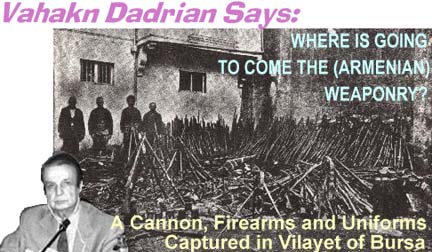 |
As the wartime Austrian Military Plenipotentiary to Turkey stated in
his memoirs, the Van uprising was “an act of desperation” ...The Armenians, he went on
to say “recognized that the general butchery... had begun in the environs of Van and
that they would be the next [victims].”12 (Vice Marshal J. Pomiankowski, “The
Collapse of the Ottoman Empire,” 1969)
Another compelling reason not to take the word of bigoted and/or ignorant Germans and
Austrians at face value. (Not to say much else of what Pomiankowski has written was at
this poor level.) It was the Armenians who started the “general butchery,” a policy
they would continue with horrifying results. The uprising itself was a calculated plan, a
long time in the making. In 1910 the revolutionary committees began to distribute the “Instructions
for Personal Defense” throughout eastern Anatolia, the blueprint for their impending
rebellion. With sections such as “To Attack Villages,” it was far from a manual
on self-defense. (The Armenian Rebellion at Van, p. 183.)
A similar comment was made by Germany’s veteran Aleppo consul,
Walter Rössler, with respect to the uprising at Urfa. He declared that the memory of the
harrowing 1895 Urfa massacre and the spectacle of the unfolding mass murder in their area
in the summer of 1915 animated the resolve of the Urfa Armenians to hastily organize their
defenses.13 (November 8, 1915 report) How could desperate groupings of people trying to
stay alive by defending themselves be described as “rebels” supposedly bent on
undermining a mighty state system intent on destroying them?
We just went through the background of the Urfa rebellion and have seen the idea of “defending themselves” had not much to do with the situation, as one
can only defend oneself if one is being attacked. It was the Armenians doing the attacking.
If the Armenian-sympathizing Walter Rössler misread the situation, and based his
information on what Armenians and missionaries were telling him, we do not point to Walter
Rössler as an authority on the subject — particularly if he was stationed far away in
Aleppo. (“We” being honorable truth-seekers; that leaves the slippery Dadrian out.)
 |
|
Paul Graf
Wolff Metternich zur
Gracht (1853 - 1934) was also
ambassador in London (1901-1912);
soaking up the rabid anti-Turkish
coverage in the hysterical British
press. His existing prejudices could
have been reinforced, over a decade.
|
In a 72-page comprehensive report to his
government in Berlin, German Ambassador Paul Count von Wolff-Mettemich addressing this
problem declared: “there was neither a concerted general uprising, nor was there a fully
valid proof that such a synchronized uprising was organized or planned.”14 Referring to
the four uprisings mentioned above, Mettemich furthermore emphasizes in that report the
fact that all of them were but attempts to ward off imminent deportation, and were,
therefore, defensive acts ...15 (September 18, 1916 report.)
Must be awful to preserve on historic record what an absolute idiot a person can be by
being so completely wrong. And it was this man’s duty to correctly size up situations.
Surely an infinitely more reliable source than the out-of-the-loop
German would be V. Papazian, a Van Parliamentarian and leading Dashnak. In Papazian's
article entitled "World War and the Mus[h] region: The Russo Turkish War,
1914-1915" (which appeared in Vem), a good portion of which Esat Uras
reproduced in pp. 885-889 of Uras's “The Armenians in History and the Armenian
Question” (1988), we learn of the "secret organizations of the Dashnaks"
considering their strategies in the event of war. Such notables as Armen Garo, Shahrikian,
Hajak, Hrach, Vartkes Pashaian, Sarkis Minasian, Sarkis Parsehian, and Krikor Zohrab
(these were the kind of traitorous "Armenian intellectuals and cultural leaders"
arrested on April 24; Garo
would go on to assist Dro in mass murdering Muslim innocents), discussed two proposals of
action, left to the central committees to consider. Papazian wrote:
"The Turco-Russian confrontation was seen as inevitable. Mass meetings were held
and speeches were given to sway the thoughts and enflame the emotions of the people. It
was as if preparations were being made for a crusade. The Armenian youth on both sides of
the border put pressure on the Dashnaktsutiun to occupy the leading position and direct
the guerilla bands. Among these young militants, Hamazasp, who had returned from the
General Congress, was one of the most active. His ambition was to be appointed head of the
guerilla forces and to command them."
Uras summed up: "Papazian's article reveals that
revolts, enlistment in the Russian army, the formation of volunteer bands, and attacks on
the Ottoman troops did not come about as a reaction to forced relocation ('deportations'),
but that relocation took place because of them." ADDENDUM,
2-08: Garo's 1918 book claimed Vahan
Papazian was one of two rebel leaders behind the 1915 revolt at Sassun.
It is an established fact that individual Armenians and even some
small groups of Armenians in very isolated cases resorted to espionage, sabotage and other
anti-Turkish hostile acts. As American Ambassador Morgenthau and German consuls Rössler
and Scheubner-Richter in their reports to their governments underscored, the Armenians had
every right to be disaffected and alienated — given the historical record of sustained
Turkish oppression and episodic massacres. Furthermore, Scheubner-Richter argued that such
acts are common occurrences in all theatres of war.16
No, it’s not a common occurrence for a citizen to sabotage one’s own country while at
war. When that happens, it is known as “treason,” which generally carries the
highest punishment, often of the capital variety. These Christian-sympathizing, bigoted
Germans felt free to justify the criminal acts of the Armenians to their hearts’ desire,
but that did not make them correct. If the Armenians thought they knew “oppression,”
they learned its true meaning at the hands of the Russians, their “Great Protector.”
The Armenians were left alone and free to prosper in the Ottoman Empire, and the only
reason why Morgenthau and the Germans thought Turks were mindless killers stemmed from
listening to too much Armenian propaganda, added to the existing anti-Turkish prejudice of
these men. And can the reader believe Dadrian’s own pathetic attempt to excuse the
treasonous Armenians by defining these occurrences as “very
isolated cases”?
|
"Armenians do not have the right to live in Erzurum."
First order of the Russian General Commandment
during the Russian occupation of Erzurum in 1916. B.A. Boryan, Armeniya
Mejdunarodnaya Diplomatiya; SSSR. Cast 11, Moscow, 1929
|
It is also a fact that several thousands of Armenians from all
over the world, including several hundred former Ottoman subjects, rushed to the
Caucasus to enroll in the ranks of the Russian Caucasus army to fight against the
Turks; the majority of them were, however, Russian subjects.
If the majority of them were Russian, that does not mean a significant portion did
not come directly from the Ottoman Empire. Even those who came from other countries
were in the Ottoman Empire a short time before. The fact of the matter is, there was
no distinction between “Russian” and “Ottoman”; the Armenians regarded
themselves as “Armenians” first. (Or, as Prof. Justin McCarthy put it in p. 26
of "Death and Exile": "Armenians under Russian and Ottoman
rule obviously viewed each other as brothers, no matter their citizenship.")
Let’s keep in mind the Armenian “volunteers” were numbered at 50,000 by Boghos Nubar, in addition to “the
150,000 Armenians in the Russian armies.” (Of the latter, only 75,000 may have been
Russian-Armenian; thousands of Ottoman-Armenians enrolled directly in the Tsar’s
armies. A Turkish historian has figured 50,000
Ottoman-Armenian soldiers joined the Russian forces, and Prof. Justin McCarthy estimates up to 100,000
Ottoman-Armenian men in all who potentially waged battle against their own nation.)
Can the reader believe Dadrian the Bezonian actually limited the number of
Ottoman-Armenians in the Russian army to “several hundred”?
[There were] a host of other ethnic and nationality groups and
individuals who likewise indulged in such anti-Turkish hostile acts during the war,
including sabotage, espionage and volunteering for service in the armed forces of
Turkey’s enemies. Foremost among these were the Kurds who, like the Armenians,
were engaged in pro- as well as anti-Turkish activities. On the eastern front
several of the spies caught by the Turks were themselves Turks; so were a number of
Greeks operating in the west of Turkey. Nor can one exempt the Jews who provided two
distinct volunteer corps fighting against the Turks at two different fronts, the
Dardanellels [sic] (in 1915) and Palestine (in 1918). Moreover, one of the largest
wartime espionage networks, the NILI in Yaffa, Palestine, which was caught by the
Turks, was run by a small Jewish group.17
Yes, everyone was in on the “let’s get a piece of the pie, since the Turks’
days are numbered” act; we can add Arabs and Assyrians to the list above, as
well. Is that supposed to excuse the treachery and mass murder committed by
Armenians?
It was the tolerant ways of the Turks that bred the ways for these traitors. The
Turks preserved the language, religion and culture of each of these minorities, and
the ones in the Balkans, while conquerors from Europe usually imposed their ways
upon their subjects. South and Central America, for example, are Christian and
Spanish-speaking today. There are probably no “pure” natives left in Hawaii any
longer, a minority in their own land; and there is a Christian church in every
corner.
"'Do you believe that any massacres would have taken place if no Armenian
revolutionaries had come into the country and incited the Armenian population to
rebellion?' I [Sydney Whitman, from his book, "Turkish Memories,"
London, 1914, p. 74] asked Mr. Graves [The British consul]. 'Certainly not,' he
replied. 'I do not believe that a single Armenian would have been killed.'" This
conversation took place in regards to the 1894-96 events, but the same may be said
about “1915.” ADDENDUM, 12-07: What do you
know! The "1915" parallel to the contention that no Armenian would have
been harmed had they remained loyal comes courtesy of none other than the terrorist
"Armen Garo" Pasdermadjian.
Shakespeare was quoted earlier from Henry VI, and let’s add another line
from the same work: “Choose your leader or take the consequences.” The
Armenians chose their leaders (albeit some were left with little other choice);
their leaders led the Armenians to disaster. Yet Armenians are simply not “man”
enough to take the consequences; their perpetual victim mentality forces
them to blame others, even a whole near-century after events had taken place.
To further illustrate these rebellions were nurtured by Turkish
tolerance, Whitman quoted an Ottoman "Israelite," while travelling in the
eastern provinces, circa 1898:
"If [the Armenians] had ventured to play their revolutionary game in Russia,
the Russians would not have left a man of them alive."
And ain’t that the truth..!
|
Whitman continues in his book (pp. 93-94), relating to the pre-1915 period (the
following is taken from Esat Uras’ “The Armenians in History and the Armenian
Question,” 1988, pp. 677-78, and it sounds like the following words are still
the "Trebizond" Jewish-Ottoman’s, quoted above):
In Russia, the Armenians are called up for military service
and are usually posted in distant parts. Their letters are censored. In Turkey, on
the other hand, they have a very comfortable life, they amass wealth, and are exempt
from military service. They are free to have their own schools. They teach their own
national history, and instill their pupils with hatred of the Turks.
...There are missionaries everywhere, who unwittingly deceive these people. All the
interpreters and assistants in the consulates are Armenians. Whatever they say, the
consuls and ambassadors write down. If these consuls had been in Russia or in
Germany, would they have been able to write such things? The whole point of the
matter is that they are Christian consuls in a Muslim country. The Armenian
revolutionists incite peaceful Armenian farmers, artisans, labourers. They point to
Turkish attacks on their religion. Yet from Trabzon to Erzerum, the roads are lined
with churches and monasteries. The Armenian schools and churches are a thousand
times freer than in Russia.
ADDENDUM 7-07: Be warned
the above (translated from the Turkish) is not a direct quote from the book, but a summary
of ideas expressed on different pages. For example, direct quotes regarding
comparison with Russia:: "...the Armenian language and the Armenian schools
have always been entirely free, and in Turkey the Armenians are exempted from
military service—a most distasteful profession to them—on paying a nominal sum. Moreover, the
Armenians have been able, in the course of centuries, to gather into their hands the
greater part of the wealth of the country.... In Russia, on the other hand, the
Armenians are rigorously drafted into the army, and are generally sent to serve
their time in districts far away from their homes, while their schools and their
language are interfered with by a severe censorship." A missionary is
quoted: "The Russians are much more intolerant—much more reactionary than
the Turks.." Of the missionaries, Whitman wrote: "Still there
cannot be any doubt that their teaching—not their doctrines, perhaps—and the
result, probably never intended, and one it has taken a couple of generations to
attain, of fostering the Armenian revolutionary movement throughout Asiatic
Turkey.." Of the consuls: "Their dragomans and servants are mostly
Armenians. When these Consuls walk abroad, accompanied by their armed bodyguard, it
is as superior beings, as petty Ambassadors... They report the outcome of their
investigations to their Ambassador at Constantinople, who thereupon proceeds to
examine and cross-examine the Turkish Government at the Sublime Porte on the basis
of the Consul’s communications... Imagine the great towns in England, or the
United States, or France, or Germany favoured by the presence of Moslem Consuls
walking abroad like Ambassadors, with extra-territorial immunities, present in every
law court, and reporting every petty larceny that takes place to their
Ambassador!" One more: "Now the Armenian language, creed, and
schools are perfectly free in Turkey, whereas they have always been persistently
interfered with in Russia. The Armenians accuse the Turk of persecuting Christians,
whereas the high road from Trebizond to Erzeroum, as already stated, is dotted with
Christian monasteries and churches unmolested during centuries."
|
Aside from a small number of Jewish traitors that formed NILI, Ottoman Jews remained the most loyal
among the minorities. It would be good to learn more of these two Jewish “volunteer
corps” Dadrian has referred to, and whether the Jews originated from the Ottoman Empire.
It’s hard to believe the 1915 one in the Dardanelles would have had Ottoman Jews in
their ranks. This is the kind of information that cried for a footnote.
And yet, a relatively mild, if not insignificant and inconsequential
treatment was accorded to them by the Turkish authorities. These authorities at that time
did not think it prudent to extend their operations of ethnic cleansing to these
nationalities and minority groups and thereby compound the already existing problems
arising from the ongoing mass murder of the Armenians.
Let’s make a note of that, folks. Dadrian has shot himself in the foot again. He
decimated the prevalent “Pan-Turanism” theory for “genocide,” that the reason why
Armenians were supposedly exterminated was because it was “Turkey for the Turks” time.
The lie behind this claim becomes clear when the Turks left their other minorities
basically alone, and did not subject them to “genocide.” (Although some Greeks and
Assyrians have also hopped aboard the genocide bandwagon. You see, when their rebellious
traitors were dealt crushing blows, the Turks must always be accused of massacres or “genocide.”)
Dadrian tries to cover his tracks by editorializing, without offering any evidence, that
the Turks did not think it “prudent” to extend their
ethnic cleansing operations.
What are we going to do with this character? As Prof. Mary Conroy has sized his work up, Dadrian “relies
too much on theory and educated guesses and too little on facts or Turkish archival
sources.”
As to the claim of 2.5 million Turkish victims in the 1914-1922
period, one is amazed at the blatant sophistry at work here. Even if that number were
accurate, it encompasses disparate categories of events such as losses in World War I,
losses in the post-war Turkish campaign for independence, as well as losses due to
epidemics, malnutrition and succumbing to the rigors of the elements, especially in World
War I.
Those numbers are certainly accurate, verifiable not only through the estimates of the few
responsible Western people from the period, but through the careful demographic work of
scholars from this period, principally Justin McCarthy. Indeed, in “Death and Exile,” McCarthy provides the
above figure as a minimum, given that there were a few hundred thousand unaccounted for.
The losses were at least 2.7 million.
And exactly what is Dadrian complaining about? No Turk is saying they suffered a “genocide”
with a loss of 2.5 million, that every one of the 2.5 million was murdered. It’s true,
the bulk of those victims died of famine and disease. Exactly in the same manner that
caused the deaths of the bulk of the half-million Armenians who died. The “genocide”
part of the 2.5 million, at the hands of Armenians and some Russians & French, amounts
to around 500,000; meaning that Armenians
murdered significantly more non-Armenian Ottomans than the other way around. (A total
of one million "Muslim" Ottomans died in eastern Anatolia, where the remaining
half-million succumbed to famine and disease.)
What is fundamental in all these losses is that overwhelmingly they
are the byproducts and the results of warfare with Turkey’s external enemies.
No different than the Armenian mortality being the “byproducts and
the results of warfare,” stemming not only from the Ottomans’ enemies (for
example, the British naval blockade contributed significantly to the famine suffered by
all), but also from the Armenians’ decision to ally themselves with the Ottomans’
enemies.
|
|
These warfare losses are cryptically blended, juxtaposed and
composed with the number of the victims of an organized mass murder. Indeed, the two
categories are collapsed whereby victim and victimizer groups are subsumed under a
single, undifferentiated category, having been leveled almost beyond
differentiation, and no longer discernible as separate, if not antithetical,
categories.
And therein lies Dadrian’s dilemma; try as he might, he hasn’t succeeded in
offering a single shred of concrete evidence to back up his repulsive
conclusions. Far from being antithetical, losses from both groups are very similar.
The one difference is that the “organized mass murder”
on the part of the Turks is unproven, while the “organized mass murder”
on the part of the Armenians is inarguable. Their own allies eyewitnessed
these wholesale atrocities, whereas atrocity reports condemning Turks are all based
on hearsay and forgeries.
As one example from his “Conclusion,” Dadrian
points to a Wannsee Conference style “top-secret speech
party boss Talaat delivered... in August 1910 in Saloniki” which “outlined” the genocidal “lethal
designs... in a rudimentary form.”
Some three months later these designs were embraced by the top
leadership of the party during a series of deliberations that were secretly held
outside the purview of the regular sessions of the party’s annual convention in
the same city.19 Accordingly, Turkey was to be purged of its alien elements and
forcibly homogenized under the motto “Turkey for the Turks.” [Vahakn N. Dadrian,
Warrant for Genocide: Key Elements of Turko-Armenian Conflict (1999), pp
96-97.]
That must have been some “top secret” plan, intending to get rid of all those
who were not ethnically Turkish. Dadrian himself told us a few paragraphs ago that
no other Ottoman ethnicity was subjected to “genocide,” five to eight long
years after 1910!
If this plan was so “top secret,” how would Dadrian have been privy to the
details? He certainly was not cooperative with his footnote, leading us instead to
his book. One thing is for certain, however; if this “top secret” plan offered
any real evidence, in the form of the Wannsee Conference of WWII, this genocide
discussion would have been long over.
The aforementioned Prof. Conroy reviewed
this very Warrant for Genocide book, by the way. Ironically, in response to
Conroy’s criticism of Dadrian’s failure to use Turkish archival sources, she
explained: “Dadrian's excuse for not documenting Turkish policies with internal
governmental sources is that the policies were secret.” Isn’t it funny the
one time Dadrian consults such an alleged “internal governmental source,” it
happens to be “top secret”? Apparently, this “top secret” plan did not
impress Prof. Conroy one bit. Instead, she wrote that Dadrian “does not
convincingly document these theories. It is thus unsatisfying as a whole. This book
is more a work of journalism than solid history and is not recommended.”
|
Guenter
Lewy on the 1910 "Top Secret" Plan
The sources reporting on these secret proceedings all rely on secondhand
information, and none speak specifically of a planned destruction of the Armenian
community. The British vice-consul at Monastir, Arthur B. Geary, is said to have
been one of several foreign diplomats who obtained the text of Talaat's secret
speech; but according to his report rendered on August 28, the relevant part of the
speech mentioned nothing worse than the needed task of "Ottomanizing the
Empire"5 Others claiming knowledge of the secret decisions include Galib Bey,
the former director of post and telegraph in Erzurum and a participant at the
congress. According to Dadrian, Galib "confided to his close friend Dikran
Surabian, a Catholic Armenian and official interpreter at the French Consulate in
Erzurum, that these plans 'made one's hair stand at end'... As the main source for
this information Dadrian cites the memoirs of Jean Naslian, the bishop of
Trebizond.6 However, even pro-Armenian authors such as James H. Tashjian and Yves
Ternon acknowledge that Bishop Naslian's work has serious errors.7 Moreover, the
chain of transmission for the damaging information is rather lengthy-- Galib
confiding to Surabian, who presumably told Bishop Naslian. Dadrian is aware of the
"limitations and problems" of such sources,8 and most readers will regard
this as an understatement.
Ternon, referring to the allegation that the Saloniki congress accepted the idea of
the Armenian genocide, writes: "This assumption is not based on any solid
proof."9 The British historian Andrew Mango uses even stronger language:
"I know of no evidence to support the assertion that in several secret
conferences of the 'Committee of Union and Progress,' held in Salonica from 1910
onward, the elimination of all Armenians was adopted as a central object of Young
Turk policy."10
"The Armenian Massacres in Ottoman Turkey: A Disputed Genocide,"
2005, p. 44.
5. Great Britain, Foreign Office, British Documents on the Origin
of the War 1898-1914, p. 208.
6. Jean Naslian, Les mémoires des Mgr. Jean Naslian, évêque de Trébizonde,
p. 10 (n. 6), 148, 412, quoted in Vahakn Dadrian, "The Secret Young-Turk
Ittihadist Conference and the Decision for the World War I Genocide of the
Armenians," Journal of Political and Military Sociology 22 (1994): 194
(n. 14).
7. James H. Tashjian, "On a 'Statement Condemning the Armenian Genocide of
1915-18 Attributed in Error to Mustafa Kemal, Later 'The Ataturk,'" Armenian
Review 35 (1982): 228, 232-33; Ternon, The Armenians, p. 289 (n. 24).
8. Dadrian, "The Secret Young-Turk Ittihadist Conference," p. 179.
9. Ternon, The Armenians, p. 134.
10. Andrew Mango, "Understanding Turkey," Middle Eastern Studies 18
(1982): 212.
|
When Turkey, in October 1914, intervened in
World War I through a combined Turko-German preemptive naval attack against Russia in the
Black Sea and soon thereafter launched its major offensive against the Russian Caucasus
army, the stage was already set to embark upon the implementation phases of the projected
blueprint of the Final Solution targeting the Armenian population of the Ottoman Empire.
Our “bezonian” is actually making it sound as though the Oct. 28 attack on the Russian
coastline (resulting in the deaths of a few civilians and the sinking of a Russian
gunboat) on the part of the Germans (under the command of German Admiral Souchon, anxious
to get the indecisive Turks into the war) along with their one Ottoman accomplice, Enver
Pasha (the Ottoman Cabinet had no idea of this attack; in “Ambassador Morgenthau’s
Story,” we learn even the Naval Minister, Jemal Pasha, was completely taken by
surprise), signaled the official beginning of the Ottomans’ entry into war. The Ottomans
apologized to the Russians for the token attack, but could not express greater evidence
for neutrality, because as Talat pointed out, "the government, the palace, the
capital, they themselves, their homes, their sovereign and Caliph, were under (German)
guns." (In the words of historian Barbara Tuchman, The Guns of August, 1962,
Ch. 10). The Entente Powers couldn’t wait to use this excuse to finish off the Sick Man,
with an eye on its goodies. Russia declared war in early November, and Britain and France
followed a day or so later with their own war declarations. (See this Oct. 31 New York
Times article confirming that the
Russians knew the Ottomans were not to blame.)
Now out of control, Dadrian then followed up with an example of the Ottomans’
omnipotence, citing the disastrous Sarikamish attack, when the Ottoman army in the east
was almost totally destroyed. Dadrian has thus set the stage to tell us the Ottomans were
so tough and confident, they could now start their “Final Solution.” What a nut! If
anything, being dragged into a dangerous world war against their wishes and losing their
eastern army would have convinced the Ottomans to preserve their already sparse resources
and manpower; the last thing they needed was to embark on a costly plan of forced
migration, moving out and caring for hundreds of thousands of people.
Of course, Dadrian and other genocide propagandists will choose to display the Turks as
the aggressors, in line with their strategy to perpetuate the stereotype that the subhuman
"Terrible Turk" can't help but be inclined toward violence... regardless of the
historical realities. It's fascinating that scholars such as Erik Zurcher and Robert Jay Lifton are totally content to damage
their credibility by reliance on the "twist and turn" word of Vahakn Dadrian.
All available and verifiable evidence indicates, on the other hand,
that the underlying causes of the Turkish genocidal decision-making are to be located in
sets of condition that precede World War I and transcend in importance that war’s
exigencies and crises.
Unfortunately, Dadrian has provided not a single factual piece of that “available and verifiable evidence” to prove his completely
illogical and unethical genocidal theory. If anything , the genuine available
and verifiable evidence points in exactly the opposite direction: the Armenians
traitorously rebelled, and it was the Ottomans’ duty to protect themselves... as it
would be the duty of any government in the same predicament. While most governments would
have very likely polished off such rebels
and their communities (as European and American imperialists have shown time and again,
even when their immediate homelands were not endangered), the Ottomans tried to protect their Armenians, failing in some
instances because central command was weak; but succeeding in the long run, as the
majority of the Armenians pulled through.
The Journal of Genocide Research ought to be ashamed for being a party to this
hateful drivel, allowing its author absolute free rein without the imposition of any
editorial control.
Vahakn Dadrian was introduced in TAT's Armenian Professors page
See also: Vahakn Dadrian's Genocidal Evidence
The Key Distortions and
Falsehoods in the Methods of the Zoryan Institute
Vahakn Dadrian Objects to Guenter Lewy
Vahakn Dadrian Objects to Edward Erickson
|
|