|
|
"Under conditions of great stress people
are poorer perceivers, because stress causes a narrowing of attention."
Guenter Lewy, "The Armenian Massacres in Ottoman Turkey: A Disputed
Genocide." (Footnoted source: "Eyewitness Testimony: Civil
and Criminal," Loftus & Doyle, pp. 21-31.)
Dr. Lewy tells us that doesn't mean all Armenian testimony are invented, and
that they must be analyzed carefully and critically. Agreed, some appear to be
on the level, such as the record of
this "Anne Frank"-style Armenian. The thoughts were written as
events were occurring, and the author appeared free of bias.
Dr. Lewy embarked on a highly difficult mission, and that was to travel
straight down the middle of the genocide debate, a debate that is extremely
polarized. In order for this Holocaust survivor to stave off charges of
"Holocaust denier," it's my personal feeling that Dr. Lewy cut the
Armenians a lot of slack.
I don't have to worry about being diplomatic, and can afford to be brutally
upfront. Armenians are a very close-knit society, and this genocide is like a
religion. Honorable Armenians who know the genocide is a myth are afraid to
speak, because of the well-established "Armenian Curtain of Fear."
The extremists in Armenian Genocide Land (as with most arenas controlled by
hysterical fanatics, these are the voices that overpower those of reason and
truth) employ the "end justifies the means" measures. Hardliners
such as Peter Balakian and
Vahakn Dadrian think nothing
of outright lying; even past liars like Aram Andonian are utilized by these present liars (for example,
Balakian did so in his "Burning
Tigris," and Dadrian in a 1985 report),
as long as their genocide "religion" becomes affirmed.
When these 80 and 90-year-olds were interviewed, the level of clarity such
Armenians managed to retain is nothing short of shocking. What is going on?
The "genocide" is of the greatest political significance for the
monolith of the Armenian diaspora, and naturally the interviewees can't resist
embellishing their recollections with political nuances of genocide-speak (as
Leon Surmelian demonstrated in his
I Ask You Ladies and Gentlemen. It's remarkable, all the details he was
familiar with, as a little eight-year-old child.) And you can bet many of the
genocide fanatics (whose partisan agenda is to "prove" genocide)
conducting such interviews coached these old people with failing memories.
Another bugaboo are the translations. For example, what you are about to
consult on this page has relied on one Armenian source, where we are informed,
"Translated from Armenian by Tigran Tsulikian and Anahit Darbinian."
One witness speaking of death by typhus describes the process as
"extermination." Naturally, dying from illness has nothing to do
with intentional murder. Was that the word in the original Armenian, or did
the translators go out of their way to choose more "genocide
friendly" words? (Armenian translators, or dragomen, have had a rich
history of unscrupulous, purposeful
distortion.)
"Armenian Oral History," by and large, cannot substitute for
genuine history.
Yet with all Armenian propaganda, as long as the truth-seeker is willing to
filter out the overwhelming sludge, it's possible to wind up with a few choice
nuggets here and there. That is what this page is about.
Reader Gokalp went through some of these testimonials in
one of the countless Armenian Genocide web sites offering such matter. It's
remarkable, what he has found.
ADDENDUM
(10-06):
The testimonials presented below turn out to be from a book, "Memories
of Eyewitness-Survivors of the Armenian Genocide," written by
the Egyptian-born Verjiné Svazlian. In one of her other books ("The Armenian Genocide and the
Historical Memory"), she tells us:
That is why it is particularly
important to expose and to put, by means of the present study, into
scientific circulation the popular factual-documentary testimonies of
the eyewitness survivors concerning the whole course of the Armenian
Genocide, the innocent martyrs and the lost homeland, since GENOCIDE is
a CRIME, which should be brought to light also with the help of the
eyewitnesses. And the greatest witness is the People, who, painfully
reliving, have narrated and continue to narrate and testify their tragic
past. That past, which is the past of the Armenian people, their
history, their collective historical memory, which should be presented
to the world and to the righteous judgement of mankind.
There you have it. However,
the funny thing is, the very testimony of the "People" often
sinks these claims. Time after time, even in the page linked above,
Svazlian's own "evidence" tells us what we had going on here
was rebellion, not "genocide."
She repeats the propagandistic notion that the reason for the
"annihilation" was the establishment of a "Pan-Turanic,
Pan-Islamic state," but her own witnesses say otherwise. For
example, one tells us that "when
the Sultan's reign was overthrown, people were singing in the
streets:"
Get up, compatriots!
Let us rejoice, friends!
Freedom has come to you:
Long live the Ottomans!
That was the very idea; for
every one of the Ottomans to be faithful citizens, stressing their
brotherhood rather than nationalistic separatism. A government cannot
have pure-hearted ideas of "liberty" in 1908 only to revoke
them just a few short years later, in the interest of a purely Turkic
state. If that were the case, other minorities would have been affected,
like Jews and Arabs. The reason why the Armenians suffered was precisely
because of what another example on the above linked page implies:
In the following
Armenian-mixed Turkish song, which is widely known among the Western
Armenians, the Turkish officer asks the young Armenian:
- Hey! gâvur (unbeliever), tell the truth,
Have you got a gun?
The Armenian youth denies the accusation, considering it a slander:
- No, sir, it’s a lie,
I don’t know, I haven’t seen,
I don’t know, I haven’t seen.
But then he adds secretly in Armenian:
It’s hanging on the wall, I won’t tell.
I won’t betray the Armenian nation.
That says it all, ladies and
gentlemen. The Armenians betrayed their Ottoman nation. (Along
with corroborating that Armenians will effortlessly lie, in the pursuit
of Hai Tahd.)
But what can we expect from an author who provides "genocidal
proof" as the following:
On the 15th of April 1915 a
secret order signed by the minister of Internal Affairs of the Turkish
government, Talaat pasha, the war minister, Enver pasha and the general
secretary of Ittihad and minister of education, Doctor Nazim, was sent
to the authorities concerning the deportation and the extermination of
the Armenians. And Talaat pasha warned with violent hatred: "We
have to square accounts with the Armenians," and promised to spare
nothing for that purpose. [Antonian 1921: p. 232]
Author Verjiné Svazlian has the shame to refer to proven forgeries. Anything will do, as long as the
Armenians' precious "genocide" is affirmed.
|
Let's begin with an introduction Gokalp prepared. Mind you,
he looked into this in a manner that did not appear intended for publication
(he circulated his findings among a handful who might be interested), and a
little editing has been performed by myself, to make the business more
presentable. Please rest assured the "Armenian Genocide Survivor"
testimonies have not been altered in any way, and are being placed exactly in
the manner that Gokalp offered.
|
|
|
| Gokalp's
Introduction |
Foreword
This is a mere collection that I have prepared by reading through 120 testimonies by
Armenian eyewitnesses, which were available in a single web
site. The link of each testimony is supplied as a heading.
The Armenians are translating and publicizing these testimonies in order to fortify their
so-called Armenian genocide claims. Many believe that these testimonies represent the most
powerful tool in the Armenian arsenal. This is true to some extent… The description of
these tragic events and massacres that was carried out by both sides (yet testimonies of
course tell the Armenian side) is simply nauseating for any human and inevitably makes you
feel for the victims. This makes these testimonies extremely effective in winning people’s
sympathies. When it comes to the claim of Genocide, however, these testimonies will likely
serve quite a contrary purpose since:
Some 15 percent of testimonies (of people who are old enough to really remember
anything) tell us that at least one person of their family was either in Andranik’s
army or in some kind of resistance or effort against the Ottoman army or government.
Ex: “Find your brothers, bring them home, let the members of the family come together
again." But how would they reunite as most of them were in Andranik's army?”
Almost half of the testimonies refer to an Armenian “armed resistance” of a kind.
Ex: “In 1915 the Armenians fought against the Turks, the fedayis fought.”
Many testimonies state that Armenians refused to join the army or escaped (even some to
Russian army). Ex: “A few Armenian soldiers had decided to run away; the Turks
opened fire on them, but they threw themselves into the Arax River and were saved. They
joined the Russian army.”
Many testimonies clearly state that Armenians were in possession of arms of different
qualities ranging from daily hunting guns to grenades. .Ex: “My father secretly
brought arms to Van.”
Many testimonies describe a happy life before the events countering the usual
Armenian claims suggesting there was no freedom of religion, Armenians were continuously
oppressed and enslaved. Ex: "Our teachers were scholars, who had studied in
Europe. There was no beating or thrashing in the classroom, they taught us with advices
and education. There were thirty-thirty five pupils in each class. We studied English in
the Protestant school and French in the others."
Some testimonies describe a fancy and luxurious life showing that at least some
Armenians were influential and quite rich. (Interestingly but not surprisingly these
are the people who were more actively working in revolutionary efforts) Ex: “He and
my father used to go to the eighteen villages and administered them. My father secretly
brought arms to Van.” — “In the past the Armenians were on high posts. The Turks
were soldiers, policemen; they sold fruits on donkeys, while the Armenians were merchants
and craftsmen. We used to have many guests; besides the Armenians we had special rooms to
receive Turkish guests. Pashas and beys came to our houses and we laid abundant tables.”
Some testimonies even tell that Turks were killed by Armenian “fedayis” (militia,
Guerilla) or Volunteer units (like Andranik `s) Ex: "He made short work of the
Turks of that village, may I fall a victim at Andranik's feet."
Several testimonies present the development of events and the tension between
societies so well that it can even be used to ridicule the “young Turk government
suddenly deciding to purify Anatolia” story.
Ex: “and my grandfather, put the sword beside me, saying: "Let him be a
fedayi."”
“But we, the Armenians loved the Russian soldiers; we called them 'kind Russians.'”
“There were many minstrels in Van, who played on chongour (musical instrument) and sang
about Andranik and Serob pashas.”
I made several lines bold, which had an extreme and unavoidable importance (for me). I
refrained from making single line quotations. Instead I put whole paragraphs for the sake
of authenticity and reliability. I aimed to show that I did not have the slightest
intention to forge or create quotes by selective copy pasting. Yet I could not refrain
from putting some comments in brackets where I witnessed a super line or paragraph. These
are colored with red.
One should not think that this is all we can get from testimonies. I am just an amateur
with interest but without robust background or required academic formation. These
testimonies contain valuable information for anyone who knows what he seeks. I am
completely sure that these testimonies will actually be a deathblow to “genocide”
claims if refined and studied properly by an expert. I am rather astonished to see that
this “gold mine” is not exploited by any until now!
I strongly advise anyone to read these testimonies, also feel to check their authenticity.
If you are not in the mood just trust me all are real. Any mistake (I hope none exist) is
unintentional or is directly sourced from the original testimony or the translator or the
site itself.
Holdwater adds: No need to be "astonished," Gokalp!
This is an arena, with rare exceptions such as Guenter Lewy, that has been avoided by
legitimate scholars... especially after a few were sent the message that it is dangerous to tangle
with fanatical Armenians, and their unscrupulous allies, the "genocide
scholars." Any historian who mindlessly
accepts what this bullying "common wisdom" is claiming is not a real historian.
And certainly any non-Armenian
"scholar" who begins with an agenda-ridden conclusion first and tries to
build the case with whatever available
tainted evidence is no real scholar, but a propagandist.
In other words, the last thing scholarly frauds who are in charge today are interested in
is good, objective truth and research.
Once genuine scholars and historians enter the field in good numbers, this insanity will
be blown out of the water, and the reputations of "genocide scholars" will be
mud. They will be left in the lurch, just as the once respected and feared Senator Joe
McCarthy... an object of ridicule and derision, today.
As Gokalp told us, his highlighting will be maintained, along with his personal
comments in brackets and in red.
(The latter with minor editing, at times.) At the bottom of some testimonials will be my
own reflections, in this color of yellow, targeting what is being said between the
lines... and, surprisingly, in more than enough cases, in the lines themselves.
|
Yeghiazar Karapetian,
born in 1886, Taron, Sassoun (link)
|
“The Armenians enjoyed great privileges: they even interfered with the law suits
and the complicated disputes.”
“The hatred towards the Armenian subjects was getting deeper and deeper. The fury
was not limited only to the Armenian volunteers who had joined the Russian army and
were fighting against them.”
“To worsen the irritation of the Turks against the Armenians, the government
spread turbulent news declaring that the Armenian soldiers and officers serving
in the army deserted the front when they seized the convenient opportunity and
passed to the Russian side, betraying them and conveyed military secrets and turned
their guns against the Turks. To this were added also the old spite and revenge.
Talaat's and Enver's constitutional Turkey decided, by means of sword and fire, to
eradicate the Armenians, their subject citizens who had always made the country
flourish. An order came to disarm the Armenian soldiers serving in the Turkish army
and form from them "Amele Tabours." They took the guns from all the
Armenians serving in the Turkish army, formed labor battalions and made them
construct roads and carry loads in the severe winter cold.”
"On February 20, at night, eighty representatives, invited from fifteen
villages, gathered in the Arakelots Monastery for consultation and to get prepared
for self-defense. The Sassounites had one thousand and five hundred rifles."
" In the night of February 27, 1918, a telegram was received informing that
Andranik had left Erzroom to the Turks, because the soldiers hadn't obeyed his
orders, and that the Armenian army had retreated to Hassanghala, toward
Sarighamish."
WE LEARN: The Armenians were largely well off, and not
oppressed. Ottoman-Armenians betrayed their country and joined the enemy. The
"hatred" that resulted had nothing to do with the dishonest reasons the
genocide industry provides, such as the Armenians' Christianity. During wartime, any
nation's people will frown upon a minority community that turns treacherous, and the
community will suffer as a whole. In other words, of course "spite and
revenge" would develop against a people who behave as traitors.
If Armenian soldiers were deserting in good enough numbers, what recourse would
there be for any nation but to disarm the rest who had demonstrated enough acts of
treachery? These soldiers still had to serve (what army in the world would say,
"You can go home now"), so they were assigned to labor battalions. As for
the "severe winter cold," the soldier's lot is not an easy one, and it was
not only Armenian soldiers who
suffered. At least these men did not have to deal with the stress and danger of
front line action.
Note the dishonesty in the next-to-last paragraph. Every Dashnak Armenian has it
tattooed on his or her forehead that April 24 marked the beginning of the
"genocide." Thus, there could have been no "self-defense" on
February 20. These Armenians with the 1,500 rifles were preparing for rebellion.
Every Armenian treated Antranik
as a god, and they wouldn't obey his orders? (For example, Soghoman Tehlirian, Talat
Pasha's assassin, prayed to be part of Antranik's regiment when Tehlirian betrayed
his country in 1914.) If Antranik was as great as his reputation, he would have
rallied his troops (as we are told Dro had a special knack for doing) and tried to
save Erzurum. Antranik's "military specialty" was in killing thousands of
defenseless villagers.
|
| Khachik
Grigor Khachatrian, born in 1900, Sassoun, Shenik Village (link) |
There were no Turks in our village: the government representative came with a gendarme and
took his share and took it to the state. The Turks and the Kurds had nothing to do with
us. The state was the owner of the land.
There were many Kurd villages in our vicinity. Till the deportation we didn't know the
Kurdish language. There were three well-known fedayis in our village — Zalo, Manuk
and Ghazar. They were devoted to their nation; they had rifles, guns, spy-glasses and
their special uniform. Wherever they were needed, they would call them. The people loved
and respected them. All three of them were our relatives. In 1907 one of them was
killed by betrayal. The peasants didn't have guns. If we had guns, would we be defeated so
easily?
WE LEARN: As Richard Hovannisian instructed in his 1967 book, the
Armenians had an internal autonomy. In
this case, when we had a non-mixed, purely Armenian village, the Turks had practically
nothing to do with the Armenians, other than expecting them to pay their taxes.
Turkish absence, signifying freedom from the Turkish persecution we are always reminded
of, also meant lack of protection when neighboring Kurds went on their raids. When the
three fedayis are said to have been devoted to "their nation," the "oral
historian" was not referring to the Ottoman nation. Such was the degree of disloyalty
among many ordinary Ottoman-Armenians. Since these fedayis would be regarded as outlaws by
the Ottoman administration, the one who was "killed by betrayal" in 1907 had to
be betrayed by a fellow Armenian, possibly one of the loyal Ottoman-Armenians. (And
probably because the fedayi was terrorizing the loyalist.) In the eyes of the "oral
historian," a loyalist to the Ottoman nation would be regarded as a traitor. It was,
in fact, these Dashnak/Hunchak fedayis — despite being presented here as Robin Hoods —
who terrorized their own kind. Two
out of three victims of Armenian terrorism during the years of 1904-1907 were
Armenians.
|
Hakob Manouk Grigorian, born
in 1903, Sassoun, Talvorik (link)
|
In 1915 the Armenians fought against the Turks, the fedayis fought. The
Turkish army came and massacred us. We ran to the mountains, to the woods. The Turks
killed all my relatives. Only I remained alive from our family. They killed them all
before my eyes. We ran away and hid ourselves in a dilapidated Turkish village. I
became a shepherd to a Turk, I used to chop wood and serve my master.
Suddenly we heard that Armenian fedayis had come.
WE LEARN: Dashnak fedayis spread the spirit of rebellion to
already disloyal Armenian villages, so that the "Armenians fought against
the Turks," particularly during dangerous wartime, and such treachery
provoked a response from the authorities. Those who got killed in the crossfire
became "massacre" victims. What is being neglected in this discussion is,
Who Fired the First Shot? If
the Armenians had not acted treacherously, as in the example of the Ottoman Jews,
would anything have happened to them?
The witness was twelve-years-old at the time. If "all" of his relatives
were killed "before [his] eyes," why would he have been spared?
|
| Tonakan
Abraham Tonoyan, born in 1893, Moosh, Bulanekh, Hamzashekh village (link) |
In 1908, in the days of Hurriyet*, my eldest brother Aghadjan, who was already
married to avoid military service, had joined Andranik's army, and, I don't know
how, he had gone to Russia, and had been living in Yalta for seven years far from
his family. After four years, in 1912, I was called to serve in the Turkish army,
but I ran away and went to look for my brother. My mother Mariam, tears in her eyes,
used to repeat: "Times are complicated, son. A new storm is being prepared for
the Armenians. Find your brothers, bring them home, let the members of the family
come together again."
But how would they reunite as most of them were in Andranik's army?
Hrant had seen many hard days. In the spring of 1915 the Turk askyars invaded
Hamzashekh to search for weapon and recruit the youth, but their main aim was to
plunder, pillage, kill and deport the Armenians. They drove the inhabitants to the
wilderness. My mother decided not to leave her house, so she stored weapons and
provisions in the far end of our yard in the huge barn, and hid there. The soldiers
opened fire on them, but my mother didn't shoot, she spared the children. But when
they approached the door and tried to break it down, my mother fired, and didn't
allow the soldiers closer. The policemen left a soldier to watch the barn, and they
go away.
(*"Hurriyet" means "Liberty," referring to
the liberal Constitution, circa 1908, of the Young Turks. "Askyar" means
"soldier.")
WE LEARN: Even as early as 1908, when Ottomans and Dashnaks were briefly
"buddies," Ottoman-Armenians were disloyal enough to run off and join the
forces of Antranik, who had proved his disloyalty to his own Ottoman nation many
times by this point, recently by fighting against the Turks in the Balkan Wars. Come
1912, still well before the "genocide," another son of this family went
off to join the enemies of the Ottoman nation.
Note the ridiculous inconsistencies. It was the job of the authorities to come into
Armenian villages to recruit disloyal Armenians into the army. Now these Armenian
men were already reluctant, and the best way the Ottoman authorities figured to win
them over was to "kill and deport." ("Deport"?) By the way, our
"oral historian" is presumed to be in Antranik's army, far away, by the
time of these happenings. He could not have witnessed any of these events, and was
most likely "told" about them years later. (This was the exact pattern for
Soghoman Tehlirian, Talat Pasha's assassin.
He perjured himself at his 1921 Berlin trial, relating 1915 events as if he were
there, when he was instead with Antranik, mowing down defenseless Turkish
villagers.)
Here we have the mother who was entirely on the side of the rebellion to have
"stored weapons" (do people understand why women also needed to be
relocated during the forced migrations?). She actually fired on the
"soldiers" or "policemen," we are told. I am living in the USA
in the 21st century, and let me tell you if the police attempt to break my door
down, and if I were to fire on them, I'd be pretty much signing my death warrant.
Yet the Ottoman authorities left the woman alive to probably tell this tale years
later. Does that make any sense?
|
| Shogher
Abraham Tonoyan, born in 1901, Moosh, Vardenis village (link) |
We had Kurd friends from Kurd villages; they used to come to our house. The plates,
spoons, cups for the Kurds were washed and kept in the bread barns. We had no right to eat
with them. My cousin was ten years old during the massacre; our Kurd friend took him to
their place and saved him. The Kurds were better than the Turks. There are good and bad
people among the Turks, there are good and bad people among the Kurds, and there are good
and bad people among the Armenians. There are good and bad people among every nation.
Teacher Margar, God bless his soul, was a revolutionary; he fought with the askyars,
they took him to Moosh and hanged him. The Turks cut off his head. The Armenians bought
his head with gold, took it to St. Karapet of Moosh and buried it under the monastery
wall. It is said that a ray of light descended every day on his grave. Margar's grave
had become [a] sacred place of pilgrimage for the Armenians.
They came and told Andranik that the Turks had filled the
young boys into the chimney and had burned them alive. Andranik pasha took off his papakh,
knelt on the ground and swore that he would avenge the young boys' massacre. He did
avenge. He made short work of the Turks of that village, may I fall a victim at
Andranik's feet.
This "oral historian" has a little more humanity in his soul with the correct
statement in the first paragraph. WE LEARN that the time-honored tradition of worshipping
the enemies of the Ottoman state was alive, a tradition that has continued years later
with Armenian terrorists to come.
Notice, as usual, all the evidence called for of Turkish massacres was simply to be "told."
(Why would these boys be burned, but the Armenians doing the telling be spared?)
Especially when the sources are emotional Armenians, known to so creatively make things
up. (One needn't be an Armenian to suffer from this syndrome, of course; if one is raised
to regard Turks as monsters, even respectable
folks can cite imagined barbarities in full belief.) Naturally, such did not matter to
one as Antranik. The mass murderer needed no excuse to commit his wide scale, brutal
crimes.
|
Sedrak Abraham Harutyunian,
born in 1904, Moosh, Arndjkous village (link)
|
In 1915 the Russians were coming. The Kurds were running away eastward to Bitlis.
But they fell on the people and began to plunder; they were even taking off their
clothes and pillage. The Ottoman askyars came and drove away the Kurds.
We thought of going to the village of Gharakeshish, as it was of the main road and
it would be safer. We began moving towards east. The Kurds began firing on us. A
young woman gave birth to twins; she left them on the earth and ran away.
We reached Gharakeshish. There too they were kidnapping the pretty girls. Our five
children — three boys and two girls: Samson, Enok, Souren, Azniv and Haykoush —
died of hunger in one day. My mother went to the askyar and asked him to let her dig
the ground and bury her children but he refused, saying, "No graves are
allowed." We dug the earth somehow with our hands; we put them in and covered
them.
WE LEARN: It wasn't only Armenians who were forced to move or
be "deported." As Ara Sarafian found in the Ottoman archives, 702,900
Muslims were also being "deported" against their will, as with the Kurds
cited here. That roughly corresponds to the entire number of "deported"
Armenians (Boghos Nubar figured 600,000-700,000), but we never hear about these
suffering Muslims.
Some of these Kurds were committing crimes for opportunistic reasons, many others
were acting out of revenge either to pay back the Armenians for victimizing Kurdish
families, or for joining the side of the Russian enemy. Regardless, we are being
told that the Ottoman soldiers protected the Armenians and drove away the
Kurds. If there was a "genocide" in place, such protection would make no
sense whatsoever.
How peculiar for the gendarme to have grunted that no graves were allowed, when
those as Samantha Power point to the validity of Talat Pasha ordering corpses to be
"buried at once," so as not to
turn off western observers. (Guess such proves Aram Andonian must have truly forged
that telegram.) Regardless, here was one order that was promptly disobeyed, making
one wonder why permission was needed in the first place.
|
| Khachatour
Harutyun Ghukassian, born in 1898, Bitlis, Havarik village (link) |
Then the massacre began. There were fedayis, they fought bravely, but they were killed.
I was in Andranik's detachment. We had German guns. Andranik didn't like Dro. Andranik
wanted to go abroad, they didn't permit him. The Turk soldiers came and we were defeated.
We came here. There were many Kurds here; we fought frequently with them.
During the war I went to the Soviet army. I have fought at the fronts of Gori and Sochi.
Now I live with my three sons.
WE LEARN: When Armenians fight as soldiers and they are killed in
battle, the deaths must be characterized as a "massacre."
|
Hmayak Boyadjian, born in
1902, Bitlis, Khaltik village (link)
|
The fighting was against the Russians whom the Turks and the Kurds considered our
'uncles.' Till the Hurriyet the Christians weren't recruited in the army. After
its proclamation, they began taking the Armenians to military service to fight
against the Russians. Those who refused to serve were beaten and killed. They
gathered all the weapons.
The people of our village were massacred together with those of Bitlis; as most of
the inhabitants of our village were craftsmen, the Turkish government sent a
detachment as if to protect us. They were afraid of our village inhabitants.
There were also the soldiers of the surrounding Kurd aghas and our village was
obliged to feed them all. They had already taken the Armenian youth to the Turkish
army. They had dug trenches on our mountains to defend Bitlis. Considering who was
skilled in what trade, they put them all to work. All the craftsmen were serving the
army. They were cutting trees, the potters were making water-pipes to conduct water
to Bitlis, and the tailors were making army uniforms. Three times a week they took
the ready goods to hand over to the government.
WE LEARN: If the Ottoman-Armenians were overwhelmingly on the
side of the Russians, there would have been every reason to consider Russia as a big
brother, or as an "uncle" of the Armenians. If Ottoman-Armenians were part
of the state, it should not be an outrageous concept to have expected them to serve
on the side of the state, and those who refused to do so could expect some
punishment. (Naturally, we are being told here that the punishment would amount to
getting "beaten and killed." In reality, often Armenians would escape any punishment.)
As we may gather from the more honest telling of Sarian's diary, Armenians were
asked if they had skills, and Sarian's father simply claimed he was a tailor, in order to receive better treatment.
We already know from the witness before the previous one that when the government
sent detachments to protect Armenians (and these were common ones not necessarily
with skills), there was no "as if" about it. This particular witness is
trying to give the idea that the Armenians were enslaved, when the fact was these
Armenians were fortunate to be in the positions they were in, and he is also ducking
the genuine purpose of the Turkish detachment. Reading between the propagandistic
lines, once again we can see this detachment had but one purpose: to protect the
Armenians.
|
| Aghavni Mkrtich Mkrtchian, born in 1909, Bitlis (link) |
He went and never came back. A few Armenian soldiers had decided to run away; the
Turks opened fire on them, but they threw themselves into the Arax River and were
saved. They joined the Russian army.
Before the deportation, in 1914, they took my eldest brother to the army; he became
a corporal. Once he came to see us. My father said: "Khosrov, lao, don't
go."
My brother said: "How can I? I'm a corporal, if I don't go, the Turks will burn
you."
(This one is strange; it starts as Kurds but ends as
Turks.)
The Kurd Hamidié soldiers came and asked my mother: "Where are your gold
coins?"
Terror-stricken, my mother said: "There, they are in the jar." The Turks
took the gold coins and went away.
And Peter Balakian tells us that Armenians were excited about being
allowed in the army. What this propagandist "oral historian" is neglecting
to tell us is that there actually were honorable Armenians who were proud to serve
in the Ottoman forces, and some served with distinction. (Like Vahan Pastermadjian, the
brother of the arch-traitor Armen Garo.) Note here the wording is that the
authorities "took" the elder brother, implying that he was kicking and
screaming. There were many deserters, not just Armenians. Is this "oral
historian" telling us the way in which the government punished these many
deserters was to go and burn their families? (Another "oral historian"
below contradicts this claim. Deserters were imprisoned.)
Of course, it was more than a "few" Armenians who deserted. For example, the aforementioned
Armen Garo "passed over with almost all the Armenian troops and officers of
the Third Army to the Russians; to return with them soon after, burning hamlets and
mercilessly putting to the knife all of the peaceful Mussulman villagers that fell
into their hands."
There was no more
"Hamidiye" during this period; these were replaced by a "tribal
cavalry."
|
| Srbouhi
Mkrtich Mouradian, born in 1911, Bitlis region, Khizan province, St. Khach village (link) |
As far as I remember the chief fedayi Gnel was my aunt's husband, who during the
massacres of 1894-1896 had fought against the Turks, had gained experience and had
organized his group of fedayis. He had got his education in the Aghtamar Monastery. In
1915 he had organized his detachment of fedayis consisting of two hundred men. By night
they had attacked the Turks who blocked the Armenians' way, had raised a panic among
them and had opened the way for the refuges and had escorted them to Van.
The reason for the 1894-1896 turbulence was precisely because
terrorists as this Gnel incited disorders and rebellions, and the government — as would
any other government — had to put down the violence. It's only when the Ottoman
government uses this right that it becomes a "massacre." Too bad the government
was so kowtowing to the western powers that the Ottomans were forced to release villains
such as this fellow. Many would come back in later years to cause further destructive
mischief, as we can see from the above example. It is because of such treacherous episodes
multiplied many times across the empire that the relocation became necessary.
On his own initiative he had placed firewood and food there, so that
the travelers might eat and rest. During the heroic self-defensive battle of Van, my
grandfather and his sons had transferred their gunsmith workshop into a cave in the
mountains where they made different kinds of rifles, hand-made guns and sent them to the
fedayis. The leader of the fedayis — Gnel, was the husband of my grandfather's daughter,
a very handsome man.
One night Gnel, that is, my aunt's husband, together with his detachments, came to the
mountain passage, which the Turks had closed. He exterminated the Turkish guards and
opened the road to Van.
Let's try and get it straight: The battle of Van was an act of aggression by
Armenians, with the hope of capturing the city and holding it for the Russian enemy. There
were many Van uprisings, the first taking place at the very outset of the war. By the time April
1915 rolled around, the situation became militarily critical for the Ottomans; even Henry
Morgenthau referred to these
Armenians as "insurgents" and estimated up to 25,000 of them. According to
Rafael de Nogales (see last link), the Turkish forces were less than half, perhaps as
little as a third, of the traitorous Armenians. This is not what we would call
"self-defense"; the defenders in this case were the Turks.
WE LEARN how some of the "elderly" whole-heartedly cooperated with the
Armenians' revolt. (We are often told it was the innocent women, children and elderly who
were "deported.") This grandfather was producing weapons for the traitors.
|
Hayrik
Manouk Mouradian, born in 1905, Shatakh, Jnouk village (link)
|
(This one is priceless)
Suddenly her childbirth pains began, and I was born. With a plant blade she cut my
navel, took off her shirt and wrapped me in it. Seeing the weather change for the
worse, my father came there, met my mother at the brink of the cave, brought us home
and put me in a cradle. My grandma put a piece of rope under my pillow to tie up the
evil, the village teacher put a pencil by my side, wishing me to be literate, and my
grandfather, put the sword beside me, saying: "Let him be a fedayi."
During the battle Shatakh had 360-400 armed warriors, and the enemy brought an army
of six thousand soldiers against us. The fighting lasted a month and a half.
We were defending the whole province. The Armenian lost forty-eight fighters, the
Turks lost two thousand askyars.
Dro came to our village and delivered a speech, praising the heroic people of
Shatakh and said, "Well done." But the Russian army began to retreat
and the exile began. The whole road to Van was covered with corpses.
In 1915 the condition of the Russian soldiers was very grave. The Russian soldiers
came to the Armenian houses and begged for bread, because they hadn't received any
food for three months. But we, the Armenians loved the Russian soldiers; we
called them 'kind Russians.'
On our deportation way Kostya (Constantin) Hambartsoumian was guiding us. We had
an army of five thousand. The army was divided into several regiments: one
regiment went on the left side of the valley, the other — in front of us, and the
third — behind us. Thus, forty thousand Armenians came out of Van. We didn't know
that the Turks had bribed Smko's bandit group. They had surrounded our way and
closed it. We should go by the road of Khoy and join the Armenians of the Caucasus,
but we were compelled to go to Salmast. (is he talking about a
real army or not?)
We had two merchants in Iraq. They, Hakob efendi and Hovsep efendi, decided to
transport us to Armenia. We came by the Persian Gulf, through the Red Sea, the
Mediterranean Sea, the Black Sea and Batoum, where the representatives of the Soviet
power met us on January 1, 1922. After sailing for 45 days we arrived to our
Motherland, but we had lost about 10,000 people, most of them from epidemics.
WE LEARN: [1] Of yet another example of encouragement for
Armenian youth to join the ranks of the terrorist Dashnaks/Hunchaks, indicating the
practice may have been relatively widespread, [2] There was a considerable force of
Armenian rebels at Shatakh; only one of many examples for those who insist there was
no Armenian revolt, [3] When a smaller Armenian force mixes it up in full battle
with a much larger Turkish force, according to Armenians, the Turkish losses will
always be astronomically high; 48 vs. 2,000 in this case (not as bad as the
contention of Aghasi, leader of the 1895 revolt in Zeitun, who wrote in his diary
that 125 Armenians were killed, vs. 20,000 Turks.) [4] Some Armenian sources caught
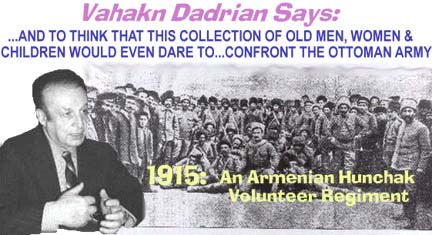
off-guard will vouch for genuine armies, while Vahakn Dadrian will insist there was no civil war and tug
at our heartstrings with melodramatic statements such as:
"Where is going to come the logistics? Where is going
to come the weaponry? Where is going to come the command and control system of this
terror-stricken population whose main concern was how to survive the war?"
Lastly, [4] Armenians in large numbers died of disease. Naturally, they will always
be added to the toll of genocide victims, or as genocide scholars such as Rudy Rummel like to tell us, must be
considered among the "murdered."
|
| Edward
Margar Dashtoyan, born in 1907, Shatakh, Kajet village (link) |
In 1915, during the self-defense of Van our folk fought, but when the Russians withdrew,
we were compelled to deport. The whole surrounding was burned, destroyed and full of
corpses.
Father, mother, my uncles, aunts, my grandfather, grandma — we all departed together and
reached Igdir, crossed the Arax River and settled in Ashtarak, where an epidemic of typhus
had spread and nearly all my family was exterminated. Only me and my mother remained
alive, and we came to Yerevan, to my grandpa's cousin Mourad Dashtoyan's house. There, my
mother also died. They entrusted me to the Polygon orphanage in Alexandrapol (now:
Gyumri).
When people travelling freely of their own accord die of disease, that cannot be
considered an example of "extermination." We don't know if this wording is the
choice of the translators. All of this often nonsensical "Armenian Oral History"
must be taken with a grain of salt, possibly distorted either at the editing stage, or
directly with the source. (Do all Armenians believe, in lieu of irrefutable historical
facts, that what happened at Van must be an example of "self-defense"? Or are
the "oral historians" saying such deliberate falsehoods hoping to
demonstrate their "patriotism"?)
|
Sahak Mirzo Bazian, born in
1913, Shatakh, Djnouk village (link)
|
(Is this guy on the Turkish payroll? It must be read totally
for sure; PRICELESS!)
The guards, seeing that they got no results in recruiting askyars, went out of the
village, surrounded it and remained there. That didn't help either. The villagers
neither came out of the wells, nor returned from the fields. And so, seeing that
their three days' plunder, recruiting and surrounding the village gave no results,
and losing hope about the arrival of the main forces, the eighty-person vanguard
group decided to leave Djnouk and go to Hinents, collect the taxes and askyars, then
go to the villages of Kaghpi, Vank and Sak. Everywhere, under the pretext of
collecting taxes and askyars, they threatened, frightened and plundered. But
everywhere the result was the same. Everywhere they collected the taxes but no
askyars. The Armenians rebelled and didn't go to serve
in the Turkish Army; they didn't want to become Turk askyars.
That was the first step of the indignation and the resistance of the Shatakh people,
which was created spontaneously from the depth of the popular masses. The first test
of popular resistance. They recruited three men from Djnouk, three men from Hinents
and five men from Kaghpi — eleven men altogether. Later all of them ran away from
Sak, when they were surrounded in a house together with the Turks; knowing the
secret passage of that house, they run away and a few Turkish soldiers followed
them.
The second step was the encirclement of the eighty-person guard group in Sak, a
village in the forest, where there were five houses of Armenians and a few houses of
Kurds. Then they captured the group, which was taking the taxes to Tagh. The guards
had impatiently been waiting for the auxiliary soldiers. They stayed in Sak for
three days, but no assistance came. During those three days the Armenians of
Sivtikin village, forming a group of 15-20 armed fighters attacked the kordon (the
guard group of 80 people), snatched their arms and took them to Tagh.
WE LEARN: "The Armenians rebelled."
|
| Tovik Thomas
Baghdassarian, born in 1901, Van, Hayots Dsor, Hndstan village (link) |
(Another Armenian eyewitness who should be getting money from
the Turks.)
The Turks fought against the Armenians for thirty days. The Armenians were
digging trenches. We had no experience, we didn't know what was taking place, but
the children of Van knew a lot. When they brought us from Varag Monastery to
Van, I saw at the Armenian quarters — in Aygestan, the band was playing
"Our Motherland"1 to encourage the fighters. After thirty days, the
Turks began to escape hearing the name of the Russians. As only a few men came
back from Enver pasha's army, Andranik went and occupied Bitlis. The Russians
didn't want to occupy Bitlis. Andranik occupied it with his volunteers.
(Before deportation orders!! And Armenian Volunteers were a
separate group at least to some degree!)
When fighting was over I went to our village. My mother lived with her six sons. I
and my step-brothers joined and brought back from the Kurds the animals they had
stolen away from us. We became owners of two cows and one horse. The peasants of our
village had escaped. Those who had arms and had fought had come and gathered in
the Varag Monastery, which had become the center of the refugees.
The main reason of the Armenian Genocide was that the Armenians wanted to live with
the Turks and Kurds with equal rights, but the Muslim religion wouldn't permit it.
Besides, the most intelligent people of Turkey were the Armenians who had a highly
developed culture; most of the architects, composers and merchants were Armenians.
In order to avoid the Armenians' autonomy, in order not to create a new Bulgaria,
they tried in every way to annihilate the Armenians.
( I thought it was because they wanted a pure Turkish land.)
And to add to Gokalp's excellent point, the main reason for
the "Armenian Genocide" was not because the Armenians were deprived of
rights. The statement of the Armenians' "highly developed culture" itself
proves this (and so does, in a small way, the first paragraph of the next witness,
below); if anything, the generally wealthier Armenians had become the masters of
Ottoman society. No, the one and the only reason for the "Armenian
Genocide" (that's a synonym for relocation, in pro-Armenian-speak) was that
the Armenians rebelled.
This "oral historian" inadvertently is telling us the reasons
concocted by the unscrupulous genocide industry, such as "pan-Turanism" or
"Muslims hating Christians" are all deceitful. The Armenians were
trying to set up an independent state, conducting a massive campaign of ethnic
cleansing in the hopes of achieving it. It was the duty of the Ottoman state, as
it would be the duty of any nation, to protect its territory and people. The way in
which the Ottomans went about doing so was to temporarily move the treacherous
Armenians away, until the danger was over... what Prof. Guenter Lewy correctly
summarized as a "relatively humane" process. If the idea was to
"annihilate" the Armenians, it would have been impossible for the majority of Armenians to have survived.
|
| Manvel
Maroutian, born in 1901, Van, Berdashen village (link) |
Our family was large: five brothers, forty-five people, we lived in a patriarchal way in
peace and harmony. First, the men had their dinner, then the children, then the woman and
then the maid-servants. Until the heroic battle of Vaspourakan, we were happy and
joyful at home.
My father's brothers were — Panos, Martiros, Vahan, who was the mayor, Khosrov was a
merchant, Marouth was the youngest. He and my father used to go to the eighteen
villages and administered them. My father secretly brought arms to Van. Each of the
five brothers had three rooms, which now are equal to fifteen rooms, and we had special
rooms for the servants and the guests.
The American missionaries had a school and a hospital in Aygestan. The German missionaries
had theirs as well. The school director of Kaghakamedj (in-town) was Haykak Kosoyan, who
became later the leader of the Kaghakamedj fighting. He had studied at the Gevorgian
Seminary, had a staunch heart; was a marvelous man. Our teachers were scholars, who had
studied in Europe. There was no beating or thrashing in the classroom, they taught us with
advices and education. There were thirty-thirty five pupils in each class. We studied
English in the Protestant school and French in the others. Once a week a Mullah came,
during those periods we used to sing and dance, then he left and went away. The school had
11 grades. Hambartsoum Yeramian was the director. He was blind, but he recognized each of
us by our voices. He taught us history. The school had a good teaching staff, and, as it
was expensive, only the children of well-to-do families attended it. The Protestant
schools were free of charge. (No freedom of religion!! Ottoman
OPPRESSION in its worst form )
In the past the Armenians were on high posts. The Turks were soldiers, policemen; they
sold fruits on donkeys, while the Armenians were merchants and craftsmen. We used to have
many guests; besides the Armenians we had special rooms to receive Turkish guests. Pashas
and beys came to our houses and we laid abundant tables. (Poor
exploited Armenian folk! Mere slaves they were.)
In Aygestan the American Protestants had their church, hospital, pharmacy, school and very
often they helped the poor.
My grandfather had the St. Vardan Church built near our house, and he wanted to be buried
there. He supplied the government soldiers with food on his own expense. One day when the
pasha came to us, he burned all the bills under the coffee-pot and said, "I burnt,
them all." My grandfather's tombstone was made of marble brought from Italy.
There were many minstrels in Van, who played on chongour (musical instrument) and sang
about Andranik and Serob pashas. (A country is under attack and
these citizens are singing and praising the enemy )
There were American, German orphanages in our town. They kindly treated the patients and
the handicapped; they pitied them.
The boatmen hung heavy iron loads on Vramian's neck and threw him into the sea. After
Vramian's murder we felt that it was deceit and very soon it would burst out, so we began
to arm ourselves. In Kaghakamedj two hundred people had guns. We fought for 25-30 days; it
was a fighting of 'life or death.' The inhabitants of Van fought against the regular
Turkish army, which had 15 thousand soldiers and Kurd rabble, but they resisted. The
teenagers fired cannons; they used tinder to fire them. Each contained ten kilograms of
gunpowder. They removed the tinder, took it away and filled it again. There was a
Frenchman, 'Mon Cher' by name; he was a chemist. He said: "I'll make gun-powder. Tell
only the Armenians. Let everyone collect urine in the house." And he prepared
gun-powder. Then he was killed.
We, the young people, went to meet the volunteers. The first group that arrived was
Nzhdeh's. The son of my mother's brother was in that group. That night Nzhdeh was
our guest.
We reached first the village of Djanik, then Berkri. The volunteer groups were
accompanying us. Whatever someone had was his own; the people were not unanimous any
longer. On the way, near Berkri, the Turks attacked. Some people turned back to Persia.
Many threw themselves into the Bandimahu River. A woman threw herself into the river
together with her seven pretty daughters. A boy had come in contact with a large stone in
the river and was saved. He is now in Germany. We had no cash money with us, but we were
safe and sound.
The Russian intrigue compelled the Armenians to leave their birthplace, monasteries,
graveyards and migrate to Eastern Armenia. Many of them on foot, others on donkeys reached
Orgov, which was the Russian border. Then we arrived to Igdir, where typhus and cholera
broke out and killed hundreds and thousands of people.
And the bulk of these hundreds of thousands of dead Armenians were
added to the "genocide" toll. Isn't it despicable?
Most Armenians died in eastern Anatolia, and not during the "massacres" of the
"deportation," as is popularly believed. The Armenians took a chance; they
conspired with the enemies of their nation. They committed unbelievable crimes. When the
fortunes of war went against them, they accompanied the Russians (and, later, the French)
during their retreats (emanating from rightful fear of retribution from Turks, for what
the Armenians had done to the Turks' families). Those who died in battles became
"massacre" victims. The massive numbers who died of famine and disease became
"genocide" victims. The dishonesty is truly stomach-churning.
|
Smbat Davit Davtian, born in 1905, Van, Narek village (link)
|
In 1916 an order came that everyone should return to his village. (Are you sure it was a genocide) We hadn't gathered the wheat
in 1915; it had grown again. We began reaping the wheat. The houses were burnt, only
the walls had remained. We began covering the roofs of our houses. Once again an
order came to leave our place and go to Eastern Armenia. We came and reached the
Berkri Bridge, which had been reconstructed. We reached Igdir. We had nothing. My
father had an acquaintance there; he went and found him. Then that man's wife and
children came and took us to their house. We lived there till we were deported from
Igdir.
We approached Van and were about to enter the town, the Turks stopped us and started
to look for males. The heroes of Van, who were probably watching with field
glasses, began to fire. Some of the Turks fell, others fled and we were saved
and entered Van. In the town there were also foreign consuls. Mother, who was
leaning against a post, said: "Boys, put your ears here and listen." We
listened and heard voices. It probably was a telegram post. Mother said: "Call
your father from America, let him come."
We were lodged in Van in the school building. Every morning the brass band marched,
playing, in the streets of Van, followed by the children. The self-defense of Van
had already begun. An Armenian told us: 'Children, go and collect the used
bullets so that they can prepare new ones.' We went and collected the bullets and
handed them to the workshop.
The day came when the battle became more intense in Van and Aygestan. The
Vaspourakanis, who had gathered there, defended with unyielding will and
determination Aygestan and the center of Van, Kaghakamedj, where violent combats
took place. Hearing that the Russian army was advancing from Salmast to Van, the
Turks departed panic-stricken. Our heroes attacked and not only they exterminated
the Turks but also acquired a considerable amount of artillery units, bullets, etc.
On the 6th of May the Armenian flag waved over the citadel of Van. The Vaspourakanis
welcomed with great love the Russian soldiers and the Armenian volunteers under the
leadership of General Andranik pasha. When it was merrymaking all over a Russian
officer approached us and took a photo: me, mother and my brother. Then the Russian
revolution began, which compelled the Russian Army to go back to Russia, and with
them many refugees came to Armenia...
Keep in mind the "6th of May" was about a month
before the "genocide" began. Only four days prior, the Ottoman leadership began to consider the
"genocide" (i.e., "relocation") process, since what these
treacherous Armenians were engaged in was nothing short of war. Once again,
since we have the umpteenth "oral historian" using the dishonest phrase
"self-defense," one can only call it defense if one is being attacked. It
was the Armenians doing the attacking.
|
| Siranoush
Simon Toutounjian, born in 1906, Van (link) |
After the 1896 events my father had relations with Paramaz. Aram Manoukian, Arshak Vramian
(Onnik Derdzakian) came to our house. In 1913 the Dashnak House was opened in Van and
its founder was Barounak Kapoutikian, poetess Silva Kapoutikian's father.
On the second floor we had a huge square hall, which held two hundred and fifty people.
When the volunteer groups came, General Nicolaev was our guest for fifteen days, and a
feast was organized in our house. There were armchairs, sofas covered with green velvet in
that room, on the ends of the armchairs there were gilt lions, on the table a pair of
field glasses and an album of the ruins of the town of Ani. Lake Van was visible from one
of our balconies. From the other balcony we could see the Sipan Mountain buried in azure,
to the south started the Taurus Mountains, to the north lay the village of Shahbagh and
Akervetin — the famous Crow Stone of Mher and the flower field, which looked white, from
there the Turks attacked later.
The Dashnak House was near our house. There were also Hnchak and Ramkavar party
members. All those parties were revolutionary, but it would be good if their efforts were
devoted to the same purpose. We should have one party as it had been in Van. Vardges
Sarengyulian and Zohrap were members of the Constantinople Parliament. We had fedayis,
too. Tigran Deroyan was well-known.
The inhabitants of Van were armed. There were four fire-arms in our house, which the men
kept in their pockets. When the war of 1914 broke out, father handed over the arms to the
Turkish government. After the 1909 Adana tragedy, the people of Van thought about arming
themselves. They gathered money and asked Vramian and Davtian for help. They went to
Constantinople; they met Zohrap and Sarengyulian and explained the matter to them.
Until 1915 we had political activists in Van as Vramian, Vahan Papazian, Artak Darbinian,
Paramaz and Ishkhan. The Hnchaks could play a great role had they been able to keep
secrets. In 1914 the Turks found out about the conference organized in Constantsa and they
hanged twenty Hnchak members in the Bayazet square of Constantinople.
Paramaz had come to Van in order to try the effect of the Hnchak influence there, but he
saw that the Dashnaks were numerous in Van and well-organized. The traditions of the
Armenakans were strong. They gave many martyrs as Mkrtich Avetissian and others.
There has been a time when there weren't persecutions against the Armenians in Turkey
and the Armenians' condition was good. The Armenians could live in harmony and peace with
the Turks.
After the Constitution they began recruiting the Armenian men from eighteen to forty-five
years of age. Many Armenians gave fifty gold coins and were freed from the military
service. My brother was getting ready to leave for Paris, and the other brother — for
Switzerland, when the chaos began. The Kurds always were attacked the people coming and
going from the town. The Kurds were plunderers and the Turkish government didn't prevent
them.
Until 1914, the Turks had unofficially intensified the violences, the Armenians were
moderating them diplomatically, but at the same time they were getting armed.
There was a Women's Union in Van. The fedayis came to our house disguised. We used to call
them 'ghachagh' (outlaw). They were supplied with food, so they came and gave accounts.
We, the children, knew that we shouldn't tell anyone anything about them. We knew that the
'ghachaghs' were revolutionaries. I knew many of them personally.
We were also in good relations with the Turk governor Djevdet and Gassim beys. Mother and
I visited them at their houses.
"After the 1909 Adana tragedy, the people of Van thought
about arming themselves." Ironically, the reason for Adana boiled precisely down
to the fact that every Armenian was armed, and began to arrogantly throw their weight
around. We are next told that Van Armenians went to the capital and asked for the help of
parliamentarians Krikor Zohrab and Sarengyulian. I wonder what the response was; if they
were conspiring with the rebels, their subsequent arrests would have been justified.
Genocide lore tells us these two were "murdered" in the "genocide."
It's said in non-genocide sources that Jemal Pasha tried and executed the
perpetrators.
(ADDENDUM, 2-07: Excuse the "Krikor Zohrab" digression!
While Armenian propaganda pins the murder of these two Armenian political leaders on the
Ottoman government, let's look at what is in Wikipedia at the time of this writing. This
online encyclopedia can be a corrupt and unreliable source, since anyone from the public
can contribute; there is a "pro-Armenian Mafia" currently controlling Armenian
matters at Wikipedia, ever vigilant at striking down contributions contrary to the
genocide cause. Yet, even this most Armenian-friendly web site currently has the
following:
 |
|
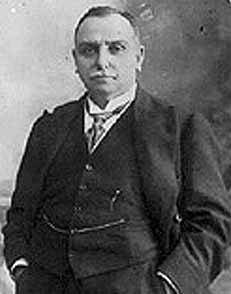
Krikor
(Grigor) Zohrab, circa 1900.
|
“Ordered to appear before a court martial in
Diyarbakir, together with Vartkes Hovhannes Serengülyan (below), both went to Aleppo by
train, escorted by one gendarme, remained in Aleppo for a few weeks, waited the results of
infructuous attempts by the Ottoman governor of the city to have them sent back to the
capital [some sources mention Cemal Pasha himself intervening for their return, but Talat
Pasha insisting on them to sent to the court martial], and then dispatched to Urfa and
remained there for some time in the house of a Turkish deputy friend, taken under police
escort and led to Diyarbakir by car — allegedly accompanied on a voluntary basis by some
notable Urfa Armenians, and with many sources confirming, they were murdered by the
[well-known] band of brigands led by Cherkes Ahmet, Halil and Nazim, at a locality called
Karaköprü or Seytanderesi in the outskirts of Urfa, some time between 15 July and 20
July 1915. The murderers were tried and executed in Damascus by Cemal Pasha in September
1915, and the assassinations became the subject of a 1916 investigation by the Ottoman
Parliament led by Artin Boshgezenian, the deputy for Aleppo.”)
WE LEARN that Armenians were not persecuted, and that there was peaceful co-existence with
Turks. That was the way it had been for centuries. If only these revolutionaries (or,
alternately called "outlaws," even by fellow Armenians) didn't ruin it for the
prosperous Armenians.
Note the last passage; that would be Djevdet, the governor of Van, whom the next "oral historian"
will term by another name Djevdet frequently goes by, "monster." This is the
Ottoman official who has been so demonized in genocide lore, that Peternocchio Balakian
actually had the nerve to reinforce the age-old propaganda (in "The Burning
Tigris"), writing that a favorite pastime of Djevdet was to nail horseshoes on
Armenian feet. You see, Djevet had a pathological hatred of Armenians. He hated them
so much, he received this "oral historian" and his mother at home.
|
Patrick Avetis Saroyan, born
in 1906, Van (link)
|
I was seven years old, when the Turk gendarmes came, threatened us and told us
that we should hand over our fire-arms. They often came and threatened father
and my uncles.
At the kindergarten my teacher was Mrs. Mankassarian, who taught me the alphabet. At
school we were educated with the spirit of patriotism.
In 1914, an eclipse of the sun was observed. The church bells rang. Many people
predicted that there would be war. At the beginning of 1915, in April, the Turk
gendarmes, led by the monster Djevdet, attacked Van. (???????
that is questionable) They had already gathered the young men as if recruit
them, but they had slaughtered them on the way. My uncle Ghevond had managed to
escape from that massacre.
From the third floor of our house my father was watching, lest the Turks should come
down from the fortress towards Kaghakamedj. All of a sudden father saw that the
Turks were getting down the fortress with ropes. Father began to fire, and the Turks
stopped coming down. Everything was for the front. Refugees started to come from
Kharakonis and entered Aygestan.
The Turks used new kinds of cannons, with which they dropped shells on our houses.
They were long and mortar-shaped cannons. The bombs often did not explode, and our
women rendered them harmless very carefully.
On May 5, when we won, the Turks began to flee by boats over the lake. They took
away with them their families, too. The victorious Van people came from Aygestan to
Kaghakamedj with a great musical band and began kissing each other.
Aygestan was at a distance of 4-5 km from Kaghakamedj. Soon the Russian army
approached Van. My father had raised me on his shoulders to see things better.
Finally, the clatter of horses' hoofs was heard. The first who approached Van was
General Andranik, then — Dro, Hamazasp, Gay. Andranik didn't enter Van. After
the battle some people of Van began to plunder the houses of the Turks. My
father didn't participate in it. In those days, holding me by the hand, father took
me to the top of the fortress. In a clearing father saw fifteen eggs. He put them in
his handkerchief and we took them home. Mother laughed at father, saying: "He
went to rob a caravan, but brought only a feather."
Before the fight the Turks had taken away Ishkhan and had killed him by night. I
remember Ishkhan's funeral. He was a great Dashnak activist and had taken part in
the fedayi movement. Ishkhan's coffin was put in St. Vardan Church, a requiem was
held, and his son used to say: "I'll do hop-hop and kill Turks."
 |
|
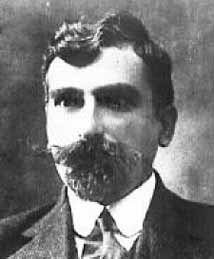
Aram
Manoukian: Pretty scary looking.
|
Then General Nicolaev organized the Van
government which began to function. On 15th of July, General Nicolaev demanded that
the Armenians should migrate, for the Turkish army had received great reinforcements
and was getting ready to attack. The Armenian leaders, Aram Manoukian and others,
refused to migrate and they said to Nicolaev: "We got our victory without
any outer help, and we have a strong will-power to defend our country." But
Nicolaev and Andranik, as leaders, agreed to retreat together with the Russians. A
great commotion started.
The Kurds came down from the mountains to plunder us. We were walking day and
night with blood-stained feet, exhausted, hungry. We reached Orgov. After Bayazet we
ascended a mount and my eyes fell on Ararat. It was the first time I saw the sacred
mountain. I forgot the hardships we had had and our tiredness. I remembered
Raffi's words: "Will there ever come a time when the Armenian flag will float
on top of Ararat."
WE LEARN that Armenian schools were hotbeds of rebellion.
No doubt these policies were directed by Dashnak activists as Ishkhan (a traitor
whom, we are told above, got killed by the Turks), and the cycle of hatred kept
getting fueled.
The Ottomans were engaged in desperate war, and Djevdet was going to spend precious
resources by attacking the Van Armenians for no reason? What an awful propagandist.
If anything, Djevdet had his hands full fending off murderous Armenians. On April
24, the only "deportation" being considered was Djevdet's nerve-wracking evacuation of Muslims, victims of the
Armenians.
|
| Yervand Simon
Shirakian, born in 1907, Van (link) |
In 1914 I began to attend school. But in April 1915 there was no school any more,
because World War I had started, and the Turks had attacked us. All the Armenian
males were being taken to the army, but they didn't draft my father, since he was
supplying the Turks with shoes.
In 1914, when the World War broke out, Eastern Armenia and the Armenians of
Tiflis organized volunteer troops and joined the Russian army. The Turks had sixty
thousand Armenians in their Army. When the Turks learned about it, they took the
Armenian soldiers out of the army, organized working battalions and began to
slaughter them.
When the news reached Van, the people of Van organized a Military Council,
barricaded the town and built defensive positions; in the middle of Van were the
Turkish barracks; the Armenians set fire to it and demolished it.
Beginning from the 6th of April 1915, up to the 4th of May the Armenians were
defending themselves with success. On May 4 the Russian army entered Van, in which
was included also the Armenian army consisting of six thousand soldiers under the
leadership of General Andranik. The Russian authorities elected Aram Manoukian as
the leader of the town of Van. This way we lived till the beginning of July. In the
beginning of July 1915 the Russian authorities ordered the Armenians to migrate.
This eight-year-old kid had actual evidence, then, that the
Turks were slaughtering the Armenians in the Ottoman army. That is amazing. Or is it
possible this "oral historian" was feeling free to add the slippery claims
of genocide lore, as so many other "oral historians"?
WE LEARN that it was the Armenians of the Ottoman Empire, along with some
from Georgia, who filled the ranks of the "volunteers." (Many who
filled the ranks of the Armenians in the Russian Army also came from the Ottoman
Empire, at one point or another, a good number during the outbreak of war.)
If there were some 1.5 million Ottoman-Armenians before the war (2 million and over,
according to pro-Armenians), and there was such mass mobilization that Ambassador
Morgenthau wrote thousands of Turks were dying daily from starvation because few were left to till the fields,
it's remarkable that only a small number of the 18-45 Armenian males were
conscripted. (60,000, we are told here.) If that number is accurate, we can see most
Armenian men succeeded in either running off to the Russians, deserted, and/or
stayed behind and formed guerilla units from behind-the-lines. Up to 100,000,
according to Prof. Justin McCarthy.
|
| Ghazar Ghazar
Gevorgian, born in 1907, Van, Armenian valley, Hndstan village (link) |
The Turkish yenicheri (the yeniceri organization was made
obsolete decades ago) charged children with their bayonets and threw them
five-ten meters away and then they looked and admired their deed. During these
massacre nine members of my grandpa's family fell victim, two remained alive — a sister
and a brother. One of them was eight years old, the other was fourteen. The boy —
Gevorg, became my father, the sister — Voskehat (Kako) — my aunt. So my grandpa fell
victim at the age of forty-five.
I was born in 1907, but my father Gevorg, being a twenty-five-year-old vigorous young
man, became a fedayi to revenge his victim relatives. He fought against the Khan's
(???) group and lost his own life.
During the Russian-Turkish war Djevdet pasha was the viceroy of Van. He kept contacts with
Khalil pasha: in case the latter occupied the Persian Dilman, Tabriz and Khoy, which were
under the Tsarist Russian command, and fulfilled his plan, which was received from
Germany, then Djevdet would condemn all the Armenians living in the province of Van to the
same fate to what the one and a half million Armenians deported to Der-Zor had been
condemned. (An example of polluted testimony. repeating Armenian
orthodox story as if he has seen it)
The Armenian revolutionary parties of the Van province, under the leadership of Aram
Manoukian, Ishkhan, Vramian and Vardan, guessing Djevdet's crafty plans; having
transferred, in advance, the Armenian population of the rural regions of Van, and choosing
the Aygestan district as the main defense center, they began to take strong defensive
measures until the arrival of the Armenian volunteers and the Russian army. Thinking that
Khalil had successfully reached Dilman, Djevdet ordered the Turkish commanders in Van to
begin their atrocities. But the people of Van, together with the villagers of the province
began to counterattack the Turkish army.
When Andranik was about to come, Kako pillaged from the Kurdish villages five hundred
sheep, fifteen cows, four oxen and two horses, thus avenging for the memory of our
victims.
In winter, carts came from Gyogcha and transported us to Upper Adiyaman. Fifteen families
from our village would live there. Each peasant received in his house a family of
refugees. We settled in the house of an old woman, whose son's name was Rouben of Mourad.
She lived with her daughter-in-law, named Glaz. Our landlady's name was Guleh and her
son Rouben was a soldier, serving at the Russian-German front. (?)
In the spring of 1916 we reached our village — Hndstan. We came back home as the swallow
returns to its old nest. Our house was just as we had left it. When we were going to
migrate, Kako had kept many household utensils and agricultural tools in the wells, now we
took them out and began our hard life.
Of course, all the Armenians of the Van province didn't come back, only part of them
returned.
(The other parts clearly describe a country in turmoil and war —
not a genocidal atmosphere; worth reading)
|
Nshan Soukias Abrahamian, born
in 1908, Van, Aldjavaz (Ardske) province, Ziraklu village (link)
|
(This one is interesting; reminds me of the stories that I
heard from my family, sincere and truthful. Shows the horrors of wartime, people
killing others just for mere trousers or some food. Horrible.)
“Killing was a common thing then. They had killed a draftee for a few apricots”
|
| Varazdat
Martiros Harutyunian, born in 1909, Van (link) |
I remember the events of 1915: on April 7 the Armenians rebelled,
which ended with our victory in May 4. The Turks were very fierce. They had imprisoned
many distinguished Armenian intellectuals beforehand. Among them were Arshavir Solakhian
and his friends, whom the Turks had killed all. All the time gun-shots were heard from
Kaghakamedj and Aygestan. The Armenians fought with limited bullets against the
multi-thousand Turkish regular army. Hearing that the Russian forces were arriving, the
Turks ran away.
WE LEARN: "The Armenians rebelled." We also learn the ringleaders of this
rebellion must be designated in innocent terms such as "distinguished Armenian
intellectuals." Note the date, preceding April 24. (June 1 was the actual date
when the relocation policy — sorry, the "genocide" — was implemented.)
Rafael de Nogales' numbers for the Van battle: 12,000 Turks vs. 30,000-35,000 Armenians.
|
Ardsvik
Galoust Terzian, born in 1910, Van (link)
|
Our house was in Khachpoghan Street in Van. It was a two-storeyed building
surrounded with rose bushes. We lived in peace. Our neighbors were the Khandjians,
Ararktsians, Derdzakians.
Before the war my father had escaped from the Turkish army. They had found him
and imprisoned him. He had managed to flee again, and the Turks pursued him, for he
was also a member of the Dashnak Party. While escaping, he had reached our house
and was about to jump over the wall; a Turk had noticed him and fired. So, father
was no more alive.
WE LEARN: Deserters were not "beaten and killed," as
a previous "oral historian" claimed was the fate of those unwilling to be
drafted, nor were their families "burned," as another "oral
historian" stated above. They were imprisoned. This one pushed his luck and was
shot while escaping, a normal course of action in any country.
|
| Vardges Melik
Alexanian, born in 1911, Van (link) |
Together with other children, they sent me, as an
orphan, to the American orphanage in Bayazet. There, they gave us, at times only one
nut a day. Then they transferred us to the Gyumri orphanage, where about forty
thousand orphans lived. They put us in the former military barracks, according to
age. I was in the youngest children's group. There, too, deaths were frequent: the
barracks were not heated, the nourishment was bad, the Americans punished sometimes
very severely: they deprived us of food. We ate our dinner, and the punished child
sat in a corner and looked at us. We often ate cold beans. Scabies and trachoma were
common. They rubbed sulphur all over our body and made us stand in the sun. There
was a school there; the teachers were Armenians. We loved teacher Sahak very much;
he was Soghomon Tarontsi's father. There were no chairs, no tables. One orphan had
to write his calligraphy on the back of the other. I learned in the agricultural
section. We had our classes in the first half of the day and then we did practical
work. They took us to work in the field. In 1928 no more orphanages were left.
(This one is a good description of orphanages. I did not pay
special attention to orphanages. But many say they went to orphanages present in
Ottoman boundaries founded by Americans or Germans. Letting the orphanages work
during genocide would have been “Highly illogical” of course)
Good point, Gokalp. In addition, we are often told of how
cruel the Turks were in the operation of Armenian orphanages. Armenian propaganda
even has made the humanitarian, Halide
Edip, out to be a villain. Here, we get an interesting perspective on how mean
operators from the USA (doubtless missionaries or similar devout Christians) could
be, an "inside scoop" I am coming across for the first time.
|
| Kamsar
Harutyun Khachatrian, born in 1898, Bayazet (link) |
Such events were not rare in Bayazet; tension rose and fell from time to time. They tried
to forget, but when blood was shed, they couldn't stand it. That was the reason why they
were always heedful and vigilant. Everybody kept weapons at home. They tried at least
to have a horse, which they always kept ready to saddle. In case of necessity, one or
several horsemen flew out from each house to render help. It seemed that the ordinary day
was calm. The holidays and particularly the weddings, the open air festivities and
merry-makings were held together — Armenians, Turks, Kurds, but they were always
watchful to the surrounding and the people. They kept guard day and night and were silent.
There were Dashnaks in Bayazet; it was told that there were also revolutionaries; the
elders knew about them, but they didn't allow us to get in touch with them. According to
the traditional custom, the children's respect and obedience towards the elders was
immense and no one tried to disobey. And our elders were very careful and they never left
us alone.
Our birth dates were written on the last sheets of our church Bible. When the exile began,
we all lost our calculations, the more so, as the recruiting to the Turkish army
approached. We tried to avoid it, and no one told his exact age, and thus, everything got
mixed up. I knew that Sirakan was the eldest, then Victor and then me. Mother had told
us that the difference in our ages was two years. Later, when we underwent medical
commission examinations, I became the eldest and Victor — the youngest.
In 1914 the whole town got into a panic, because news came that the Turkish army was
coming to slaughter the Armenians. We locked the doors of the house, kept the keys and
fled to Igdir. (My grandfather told stories such as Armenian bands
wearing army clothes or Kurdish clothing, attacking Armenian villages in order to trigger
uprisings and to start gossips.) Soon people calmed down; the first confusion
subsided and in a few months we returned home. We had rented a house in Igdir and we lived
there as in a summer resort. For the first time we didn't even suffer. We went back;
everything was in its place. We took out the keys, opened the doors and began to live as
before. Nothing was missing in the house. The neighbors received us well, but fear was in
our hearts. I don't remember how much time had passed, when we fled to Igdir again, but
this time it was for a shorter time. We stayed there almost for a month and then came
back. For the third time we hesitated, we didn't want to leave, but the whole town was in
a turmoil, and everybody was moving to the Russian border. It was in the autumn of
1916. When the town became half-empty, we understood that it was unavoidable, we had to go
and we began packing our things. Little time was left. The neighboring Turkish women were
already in our house and each one pointed out what she wanted. In our presence they
divided our property among themselves. We were silent; we were very careful and spoke with
each other in mimics. Our Turk baker woman knew the place of everything and she showed the
others where they were. I couldn't stand any more; I didn't know what to do, I took the
rifle and wanted to kill the woman. Father guessed my intention and held my hand:
"Kamsar, don't shed blood in my house, let it remain clean." He knew what the
consequence would be. If I killed the woman, they would slaughter us all in our house. All
of us got out of the house in silence, with broken hearts. We had put a few rugs and
clothes on the donkey; we didn't care about anything anymore.
The town seemed empty. We were almost the last people to leave. When we were coming out of
the town, I looked back, there were almost no people coming after us. We were running to
catch up with the group of the refugees. We reached them. The Russian soldiers on
horseback were defending us on both sides and at the back. On our way I made friends
with a Russian; he was a very kind boy. While coming out of the house I had not thought
that it was autumn, and the nights were already cold. I understood it on our way, but it
was late; I was cold. My Russian friend guessed it, took off his overcoat and gave it to
me. It was large for my size: the shoulders were falling down, but it was warm. And then,
when they were leaving us, he gave me his horse to ride. The Russian soldiers gradually
fell back. Young boys, teenagers and adult men from among the refugees, who were armed,
came out and occupied the soldiers' places. The throng of the refugees was becoming
denser and denser, since people fleeing from other places were joining us. The crowds of
the people were dragging themselves on the road, crying, mourning, the horror of death in
their heart. Turkish officers were following us from afar. They didn't fire at us, they
were silent, but they didn't leave us alone. All along the way lavash was scattered in
packs. Those escaping before us had taken food with them, but getting tired, they had left
some on the roadside. Whoever got hungry, picked up the bread and ate; even the donkeys
and horses were grazing on lavash. It was distressing to see bread scattered under our
feet.
WE LEARN: Ottoman-Armenians, whose sympathies traitorously ran with
the Entente Powers for the most part, did their best to avoid serving in the army of their
nations, by lying about their ages.
We are told the Turkish Army was coming to slaughter their precious resource, the
Armenians, as early as 1914, just before a horrible struggle where every Ottoman would be
needed. What we're not told is "why."
While the Turkish women were meanly waiting to divide the spoils of this household, it is
interesting that the first time this Armenian family left their home in a panic (in 1914,
to Igdir), and returned months later, nothing was out of place. The neighbors were all
very respectful then.
"Everybody was moving to the Russian border," in the autumn of 1916.
"Everybody" would be the Armenians, and we can see there were plenty of
Armenians who had not been "deported" by the year that Vahakn Dadrian
himself has told us "the
genocide had all but run its course." (If there was a "Final Solution"
in place, why would it have stopped so soon, with the majority of Armenians still alive?)
These Armenians who decided to go off as "refugees" appear to have done so on
their own accord. It doesn't sound like the Turks told them to beat it. Could this have
been Russian-controlled territory (which would explain the sudden appearance of the
Russian soldiers), and the Armenians decided to leave because this was one of the times
the Russians needed to retreat? That was probably the case, as this group appears to have
been completely out of the control of the Turks, who were only tracking them from
"afar." Then again the Turkish vultures looking to gain this family's
possessions make it seem as though the Turks were in control. This "oral
historian" was not clear. (I'm not checking the original pages; simply going with these excerpts Gokalp provided. However, this one I did check, and it still was not clear.)
|
Dsaghik Gevorg Chinimian, born
in 1910, Igdir, Koghb village (link)
|
In 1915 my father Gevorg participated in the Erzroom battle against the Turks.
My mother Tagouhi had remained in Koghb with her three children. When we were being
deported, the Turks fired at us from the mountains. We had nothing whatsoever.
Mother was with her three children. Those who could escape were saved and those who
remained were killed.
Then it was said that the Turks had withdrawn, so we went back to Igdir. We
remained there in winter. Many people died. My uncle's children died of hunger.
The houses were destroyed. The wheat had grown all by itself; we gathered it, ground
it and ate.
In spring we were deported again. Mother had tied her youngest child on her
back, had taken the other by the hand and I had taken mother by the other hand.
WE LEARN: So many Armenian fathers had managed to stay out of
the Ottoman army, only to betray their own country by fighting on the side of its
enemies.
Once again, most deaths occurred from reasons that had nothing to do with
"massacres," in areas away from the control of the Turks. Once again, we
can see Armenians who were dying in large numbers were those from eastern Anatolia,
and not those who had been "deported."
Ironically, we can see that by relocating the Armenian community, even though
the ones who were relocated were also suffering dreadfully (as was everyone else in
the Ottoman nation), the Ottomans likely saved the lives of many more Armenians.
What an "anti-genocide"!
|
| Andranik Aziz
Simonian, born in 1902, Alashkert, Karakillissa (link) |
We lived in comfort and peace. When the First World War broke out, the
Turkish government recruited many young Armenians and those who went never came
back. The government confiscated five hundred sheep and also a great quantity of
cloth, under the pretence of army needs. Meanwhile news were coming that they were
massacring the Armenians in Bitlis, Sassoun and other places and that soon our turn
would also come: they would deport the Armenians of Alashkert and would exile them.
The Armenians of Karakillissa were alarmed. They began to get ready for
self-defense. I remember they were putting sacks of sand in front of the windows and
buying weapons, for they were anticipating the danger every minute.
One day a great number of Cossack cavalry and Armenian volunteers arrived. In the
town the Armenians met them with great enthusiasm, with bread and salt as our
saviors and gave them lodgings in their houses. We also put two rooms at the
disposal of the officers. Thus, some peaceful months passed. One day the Russian
army gave order to retreat and that the Armenians would be deported with them; if
not, they would be slaughtered by the Turks. Being at a loss, the people took the
road of exile. We had four milker cows and one horse. My father loaded the cows with
the necessary items and food, saddled the horse, putting on it the saddle-bag, in
one pocket of which Artavazd squatted, and Nazik's three-year-old son — in the
other. My mother sat on the horse, with seven-month-old Garnik in her lap. I could
walk then, so, holding my grandma by the hand, we set off.
We walked over mounts and through valleys for fifteen days; many people died of
exhaustion and diseases. It happened so that women couldn't carry their children
anymore and left them on the roadside or threw away their possession in order to be
able to walk with less burden. We reached Igdir. Igdir was filled with refugees.
From Igdir the national authorities transported the refugees in vans to Edjmiadsin
and Yerevan. We were taken to Yerevan.
This "oral historian" already begins as a
"professional patriot." Note the nasty statement that Armenians
conscripted into the army never came back, implying they must have been slaughtered.
(We know from Leon Surmelian's account
that a relative in the army visited; for that matter, we got an example from an above account, too.) Confiscation of goods for army needs is
referred to as a "pretense," although the bankrupt empire was hard-up for
food and resources. ("Since the beginning of the war even bread is almost
unobtainable." Leslie Davis)
It's all a prelude for his contention that the Armenians would soon be massacred.
"The Armenians of Karakillissa" were not getting set for
"self-defense," but for resistance in support of Hai Tahd, the
Armenian Cause. This is why when the enemies of their Ottoman nation showed up (the
Russians were no doubt anticipated), they were greeted with cheers and comfort.
It is highly doubtful that when the Russians decided to retreat, they gave the order
to "deport" the Armenians. The Armenians decided to go with the Russians,
for fear of retribution from what the bloodthirsty Armenian troops had done to
innocent Turks.
WE LEARN: If the Russians did order this "deportation," and if Armenians
died in large numbers (from complications of marching; there was no mass
transportation, and Armenians had no choice to march — just like the Armenians who
were "deported" by the Turks), that means the Russians would be equally
guilty of "genocide."
(A contention shared by at least one Armenian historian, Rafael Hambartsumian.)
|
| Arshalouys
Kyuregh Ter-Nazaretian, born in 1905, Babert, Loussonk village (link) |
At night our young men and my uncles took their arms and went away from home. Mother
gave them a supply of provisions. We had one hundred horses; they took them out of the
stables and rode off.
Our youths went and joined Andranik's group in the mountains. We were relieved that the
youth people had gone away from the village.
WE LEARN of yet another example of how the traitorous Armenians
actively served as "belligerents de facto," for "they indignantly refused
to side with Turkey," as Boghos Nubar correctly put
it.
|
Massis Nikoghos Kodjoian, born
in 1910, Babert (link)
|
In April 1915, a week before the Easter, all the well-known people were imprisoned,
among them — my father. The following day mother took some food and we went to the
prison. Father was pale and looked at us with troubled eyes. They inspected us
outside the prison and only then let us in.
Then an instruction came that twenty-four families from Baybourd should be sent to
work on the Berlin-Baghdad railroad in Mesopotamia.
The Dashnaks had urged the people to have arms in every family. Mother took that
weapon by night and threw it into the Jorokh River. Brother sold the cloth of our
shop cheaply to the Turks and bought a horse, so that we might travel in a cart.
WE LEARN: The "intellectual and cultural leaders"
arrested for operating the Armenian Rebellion (these would be the ones urging every
household to possess arms; what they had in mind was not "self-defense"
but "offense" on others' selves) were not all executed at once, as
Armenian propaganda tells us. The father of this family was imprisoned. His family
was allowed to visit him.
In addition, even though the Armenians forced to migrate were no doubt taken bad
advantage of, needing to sell their goods at fire sale prices, here we have a case
where the money received was enough to buy an expensive animal.
|
| Souren Sargsian, born in 1902, Sebastia (link) |
(This one is extremely important since it reveals the details
of the often-told Armenian claim regarding Enver Pasha's appreciation of Armenian
soldiers)
After a training period of two months, the Turkish army passed before our village in
regular lines, with a brass-band. The Turk guests appreciated the Armenian soldiers
telling that they learned well, mastered the technique of weapons soon and that
their commanders praised them. The days passed, the November-December cold weather
and rains caused the soldiers to lose their discipline; many began to escape from
the army, many had come to the village and were hiding in barns or in the caves near
the village; nobody inquired about them.
Thus, 3-4 months passed. In December 1914 news spread that Enver pasha was coming;
the roads should be brought into order about 4 km all along our village. After a few
days Enver's retinue came and stopped at the western end of the village: three
carriages were drawn by four horses each, surrounded by six horsemen in the rear and
six horsemen in the front and taking the lead was Mourad of Sebastia with his group
of 12 horsemen. The peasants surrounded the retinue. I also went especially to see
Enver pasha. The peasants brought salt and bread, as they were instructed by Mourad.
Enver pasha stood up in the carriage, accepted the salt and bread on a tray, thanked
the people with a nod of his head. I saw how Enver pasha took the tray and served
the members of his retinue without exception. In honor of Enver pasha a horserace
was organized on the field road. I was watching how the horsemen were galloping
towards the Alice River. Suddenly the people roared: "Mourad, Mourad's horse
Pegasus won the race." The racing horse-men returned. Mourad approached Enver,
who stood in the carriage, smiled, arranged his moustaches, shook Mourad by the hand
and patted his back. I was standing on a high mound ten steps from Enver pasha and
was staring at him out of curiosity. I remember every thing so well, as if it were
now. The weather was fine. Enver pasha had put on semi-military clothes, he had a
fez on his head; he had long shining boots on his feet; his face was round, broad,
handsome, with regular features; he was a bit taller than average height, a bit
longer moustaches, thick eye-brows and black eyes. Vehib pasha was seated in the
first carriage together with his assistants.
After the horse-race Enver pasha stood up in the carriage and spoke to the people
for ten minutes. I remember his words so well: "The Armenian soldiers are
fighting bravely for their Ottoman Fatherland, for their 'Vatan' (country — in
Turk.) At all the fronts the Armenian doctors and nurses are treating our wounded
soldiers. Most of the Armenian soldiers master the military techniques, for that I'm
very thankful to you. And you, in your turn, work well at the rear to supply our
army with food." When he finished his speech, Mourad approached him on
horseback and shook hands with him. Enver pasha patted Mourad on the back and told
him something in a low voice. The whistle gave the signal and the carriage moved.
Enver pasha disappeared waving his hand.
Thus, days and months passed, nothing exceptional occurred in the village; only our
villagers were filled with enthusiasm to meet the Russian army in Sebastia
(Svaz), but all that was in vain: the Russian army didn't come. Only war prisoners
came. Our people were disappointed with their vain, senseless hopes and feelings.
One day we were playing together with the children in the village center, when
suddenly, from the eastern side, from Kapan, four carriages came swiftly and stopped
in the center of the village on the road. The people rushed forth to find out what
it was. I ran, too. This time again the four carriages were drawn by four horses
each. Mourad's group was standing far from the carriages, silent and sad. The
coachmen were arranging the harnesses of the horses and feeding them. Enver pasha
was returning from Erzroom. He had a very angry appearance; he was looking at the
people with fury and didn't speak to the people next to him.
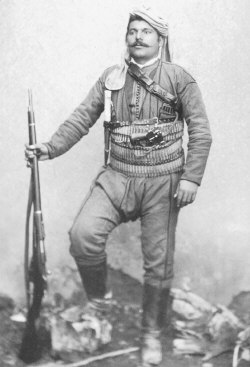 |
|
Murad
of Sebastia |
I passed to the left side of the carriages and,
standing on a mound, was watching Enver pasha on. He was making nervous movements
while sitting in his place. He turned his eyes on the people about and his glance
fell on me. His eyes were filled with hatred. I was horrified by his black eyes. He
wrapped himself in a felt coat and threw a beastlike glance on the standing people.
Enver pasha neither greeted, nor said good-bye to the people, as he had done the
previous time, and left. They stopped at the Seyfe Khan to rest. He called Mourad
and said in an extremely furious manner: "What are your people doing in the
Caucasus, on the Russian side? What did we sign with you in 1908 and 1914 in
Erzroom? You'll pay through your nose for it." Mourad left the group very
offended and sad. He said that Enver had protested about some volunteers. As our
village was on the way from Sebastia to Erzroom, the news reached fast. On his way
to Constantinople, in Sebastia, Enver pasha invited the governors of the six
provinces and gave them instructions about how to massacre the Armenians, to
annihilate all the men by slaughtering them on the spot and to drive the women and
children towards the Taurus Mountains and beyond, to the Arabian deserts, to
annihilate them with famine, thirst and exhaustion. At the end of March 1915 the
governor of Sebastia summoned Mourad. The latter didn't go; he fled to the
mountains, for he knew the governor's intention.
…. The gendarme shouted: "You are old, you've done nothing, but you have
prayed your God that the Russians come and destroy Turkey, that Andranik's sword be
sharp to slaughter the Turks," and he fired. The four old men fell down to
the ground. The Kurds, standing around, began to strike them on the nose, mouth, and
head with clubs till they stopped breathing. The Kurds tied ropes around their necks
and dragged them to the nearby Euphrates River. It was the children's turn. They
brought a child from the first row, the Kurds stabbed him with knives on the back
and the belly till the child stopped breathing and then they dragged him away with
ropes to the river, and thus during 3 or 4 hours. It was the turn of our row. The
Kurds watched standing behind us. They had already killed about 200 children. A
gendarme came up slowly to us and said: "Get away, go!"
Soldiers, gendarmes and Kurds were going and coming, they were getting ready for
something. All of a sudden, a long train came and stood before us. People got off,
and the train went back. They were from Tekerdagh, Rodosto, Edirné, Malkara: the
people of Thrace. The people composed of women, children, old men and girls stood in
astonishment. They had deceived them and brought them saying that they would settle
in a new place. They noticed us from afar and began to move right and left,
screaming and crying for their goods. The gendarmes ran toward them, calmed them
down and made them sit along the railroad. We could see them from our place: they
had their Sunday clothes on; they were white dresses. In the evening they
slaughtered the men and arranged the corpses before the stages. Then they brought
the girls in white clothes. In the darkness of the night, they impaled them all with
the sharp stakes. Our ears became deaf to their and their mothers' screams, cries
and heart-rending clamors. I learned that those people had carried Andranik pasha
on their shoulders, and the girls had sung the song "Like an Eagle,"
dedicated to him and had presented Andranik with bouquets of flowers in the street,
in the presence of Turks. This way they were avenging them.
WE LEARN: The reason for conscripting Armenians into the
Ottoman army had nothing to do with rounding them up and slaughtering them, as
Armenian propaganda tells us. They were equipped and trained, with the expectation
that they would act as loyal Ottomans. While we learn Enver was a nice guy (note the
way he served his entourage with the tray, refreshingly ego-free; "He never
used his official titles," Rafael de Nogales wrote of him), he must have
also been pretty naive, believing in the success of his ill-conceived plans for
Sarikamish, as well as in the loyalty of Ottoman-Armenians.
Once Enver returned with an entirely different disposition, here is how K. S.
Papazian described precisely what
Enver was complaining to Mourad about, expecting the Armenians to live up to their
promises of loyalty in 1907-8 and 1914. Enver had himself to blame for the disaster
at Sarikamish, but the fact is the Armenians played a key role in this defeat. Prof.
Justin McCarthy summed it up:
As World War I threatened and the
Ottoman Army mobilized, Armenians who should have served their country
instead took the side of the Russians. The Ottoman Army reported: "From
Armenians with conscription obligations those in towns and villages East of
the Hopa-Erzurum-Hinis-Van line did not comply with the call to enlist but
have proceeded East to the border to join the organization in Russia."
The effect of this is obvious: If the young Armenian males of the "zone
of desertion" had served in the Army, they would have provided more
than 50,000 troops. If they had served, there might never have been a
Sarikamis defeat.
(Note how the "oral historians" here have largely confirmed
the Ottoman Army report.)
|
Naturally Enver Pasha was livid at this great betrayal. Now note how our
"oral historian" slips into "professional patriotism"
territory. He tells us, "Mourad left the group very offended and
sad," and blamed Enver's fury on "some volunteers"... as
if these were merely a handful. This character was not a loyal Ottoman;
Mourad would go on to fight actively for Hai Tahd in the coming years. How
do we know Mourad wasn't so innocent at this point? We can only speculate, because
our "oral historian" mentions no support for Enver whatsoever,
particularly after his friendly and rousing first visit. What does the "oral
historian" say instead? His fellow villagers were only "filled with
enthusiasm" for the Russian enemy, directed by their "vain, senseless
hopes and feelings."
Naturally, this is all a prelude for "genocide." We're being told Enver
was so angry, that the Armenians would "pay through the nose," and we
can fill in the blanks: the Armenians were all marked for extermination. Our
"professional patriot" tells us, "Enver pasha invited the
governors of the six provinces and gave them instructions about how to massacre
the Armenians." This 13-year-old would have had no idea about these
instructions, and what gives away his nonsense is that his timetable for these
instructions was March. We know that the relocation (i.e., "genocide")
did not go into effect until early June, and we already know about Enver's first
step toward this end, his May 2,
1915 telegram.
Is it possible the massacres our "oral historian" related took place?
The entire village was filled with traitors, as our "oral historian"
admits, and possibly the Turks wanted to make examples of some of them. Yet if the
idea was all-out slaughter, it's very fishy that just when the turn of our
"oral historian" came, the gendarme said: "Get away, go!"
(Why?)
It's tainted testimony and can't be taken at face value, although I do think the
four old men could have been chosen as a warning to the others. The killing of 200
children is poppycock; that level of cruelty would have only served to enrage the
villagers, once the Turks would have left the village. (Such would have been a
guarantee to get the rest up in arms, defeating the whole purpose of expecting
them to get in line.) As far as those girls (who were "impaled," of
course) and others who arrived by train in their Sunday clothes, there are
peculiarities. If they originated from places as far west as Thrace, I don't see
how they (that is, the adults — the women and old men, as identified, in
traditional propaganda-speak) could have "carried Andranik Pasha on their
shoulders," since Antranik was busy with his crimes and betrayals in the
east during this period. (Besides, the four different towns that are listed
couldn't have all had the same "Antranik opportunity.") What's more,
even if these people were marked for slaughter, it would have been ridiculous to
do so before the eyes of the Sebastian villagers. What purpose would that have
served, to "really" turn the people against the state?
Before our "oral historian" got into the traditional propaganda, what he
had to report was extremely valuable. He corroborates that none of the genocide
industry's reasons for extermination are true, such as "pan-Turanism,"
or "Muslims hate Christians." The one and the only reason for the
eventual relocation policy (again, that's the synonym for
"genocide") is that the Armenians were disloyal and rebelled.
ADDENDUM, 07-08: Murad of
Sebastia [Sivas] was praised in a Dashnak publication for his revolutionary role
in 1914; he "sent word everywhere for Armenians not to offer soldier
conscripts to the Turkish army, to avoid military service, and to... fight,
resist, and to die with honor." (Unfortunately, as we are told, he failed to
persuade the Sebastian Armenians to rise in rebellion.) This is from Antranig
Chalabian's Revolutionary Figures, 1994, as related in Guenter Lewy's
"The Armenian Massacres in Ottoman Turkey: A Disputed Genocide."
Chalabian added that during his retreat, Enver told Murad: "Be assured. You
will be punished severely," conforming to the displeasure displayed in the
above account. Of course, the above account made Murad out to be a kind of
innocent scapegoat, while he was actively involved in fighting against his Ottoman
nation, and helped pulled the strings for the treachery of his people. In 1918,
Murad would have a significant hand in the extermination of Erzincan's Muslims.
Tune in here for
a brief round-up of this criminal in some Ottoman military reports.
|
| Arshalouys
Tashjian, born in 1908, Malatia (link) |
In the morning, as day broke, they came and separated us: Armenian Christians — on one
side, Catholics — on the other. They didn't exile the Protestants and the Catholics.
Only us, the Armenian Christians, they decided to drive to exile like sheep. But
because they had seen that father was a shoemaker, they sealed our paper and sent us back
to our village. We came, entered our house and lived.
WE LEARN: Despite what Taner Akcam has told us, the exemption for Protestants and
Catholics was valid. In addition, certain workers were also exempted. This would have been
no way to run a "genocide."
|
Verginé Ruben Nadjarian, born
in 1910, Malatia (link)
|
I remember my father who was ill. The priest
came and said: "Ruben, they want weapons from us, if not, they will kill
me."
Father said: "Go, you become a martyr, but we mustn't hand over the
weapons." He didn't listen. I remember the Turks
took away my father, took away all the men — then they began to plunder.
There was a German orphanage in Igdir. When she was a young girl, mother had stayed
in a German orphanage and so knew German well. She was invited to teach. For all of
us they gave us four buns daily. We ate, but the baby died of hunger, for mother's
milk had gone dry because of the troubles.
A case of "Guns vs. Butter," unrelated
to Economics. If the Armenians didn't get too attached to their guns, in the pursuit
of their mad dreams, they would not have sacrificed as much their butter. Or in this
case, milk.
|
| Grigor
Ekizian, born in 1921, Malatia (link) |
Until 1915, my father was a blacksmith; he made ploughs, ploughshares, and weapons. One
day, the Turks came and searched our house, for the Armenians of Malatia were very
organized: they were always ready. There were one or two weapons in each house.
One day two Turkish officers came and said to father: "Give us your rifles."
For those who had bought guns from father had said where they had bought them from him.
Father said: "I have no guns."
"How is it that you don't have? We know that you have and we know how many you
have."
Father had buried the gun in the garden under a tree; he took them there and showed them
the place. They began digging here and there; they didn't find any gun.
"All the same, you must give you weapon," said the Turks.
They continued digging. Finally they dug out the weapon and took father together with the
weapon. While coming out of the house, in the dark, one of the Turks recognized father and
said to the other: "It's enough we're taking the gun, why take him too? Let's
leave him, let him go."
So they freed father, and he came home.
After a few days, other officers came and took father away. That was the end. They put
handcuffs on father's hands and they bound two men to each other with handcuffs, so that
they might not run away. The Turks knew well how to do such things. Where did they take
them? God knows!
They took them away for a few days. Father, being a craftsman, had a file in his pocket.
He began to file away slowly and loosened the handcuffs and began thinking about their
flight. By daytime it was impossible; they decided to escape by night. The soldiers took
the refugees to an open place for the night and they decided to run away. They came to the
guard and said that they had natural needs. The guard permitted them to go, but they
didn't run away. Was it possible to escape from a serpent? They went again for a second
time and said: "We have natural needs." The Turk guard left them again, but they
didn't dare to run away. They went for a third time and said: "We have needs."
The guard, who was an armed soldier, said: "Ne bok yeyeceksin — yein" (What
shit you're going to eat, go and eat!). They took courage and ran away. After they went a
few meters, they shouted after them: "Kaçdilar — vurun!" (They escaped —
shoot!).
When the massacre of the Armenian was over, father wanted to come to Malatia to his
house. That Turk Hussein's six brothers asked father to stay there; they promised to
arrange for him to marry, for father made ploughs and ploughshares for them. Father didn't
agree.
The Turks said: "Alright, if you don't agree, then go to your house."
Father came to Malatia and heard that they had killed his wife and child on the road of
exile...
He married again (an Armenian) and began to create a new household. I'm my father's
first-born son, Grigor, born in 1921. Then, in 1925, my brother was born. Until 1929, my
father's family had close relations with Hussein and his six brothers, for they had saved
my father's life. Every year they used to bring us a cow, butter, cheese, water-melons
and many other things as presents. Those Turks were very good to us. They loved father so
much that they brought their gold in a purse and gave it to father to keep. When they came
for shopping, they took father with them to help them and keep their accounts: they had
that much trust in father.
In 1929, when we had decided to go from Malatia to Armenia, Hussein came with his six
brothers; they lay down in front of the car, asking father not to go, but father said:
"No, it's my country, I will go."
The Turkish brothers said: "Go, Hovhannes, see that you may not regret it. If it is
good, write to us, we'll come, too."
There are such Turks as well.
In 1960, a man came from Malatia and said that there were one hundred and fifty
families in Malatia and they wanted to come to Armenia. Armenia didn't permit it, saying
that the Turks hadn't allowed them to come. If they were to go to another country, let's
say France or Germany, from there we could have them brought here. But that wasn't an easy
thing. So the Armenians of Malatia, all 150 families, are now scattered all over the world
— America, England, and France. In Malatia, few Armenians are left now.
So, you see, there were good people among the Turks, too. They had kept my father for
six-seven years and then they had kept their relationship ...
Now, aren't there good people among the Azerbaijanis, or in Sumgayit? There are, there
are good people as well.
WE LEARN once again how "armed and ready" the
Armenians were. The Armenian Revolt was truly a nation-wide phenomenon.
Remarkable the Turks were so patient with "Father," if the aim was to
exterminate him. The Armenians are revolting everywhere, and naturally this untrustworthy
community needed to be disarmed. So the Turks go to Father and ask for his guns. Father
lies and says he has none. Father is a blacksmith, so the Turks know he is lying. Finally,
they find the guns. Despite the fact that Father broke the law and lied to the police,
they actually left him behind.
But Father couldn't remain free for long since he was obviously either helping the rebels
or was a rebel himself, and he was arrested, and placed in handcuffs. "The Turks knew well how to do such things,"
our "oral historian" adds, as if knowing how to bind men to prevent them from
escaping was a special ability of Turks. "Was it
possible to escape from a serpent?" we are later asked.
Guess it must have been, if Father was an example.
Father was one of the many returning refugees, and it looks like he was able to reclaim
his house. We are led to believe his wife and child had been murdered, but the cause of
their deaths could well have been famine or disease, as was the case for most.
We also learn a number of the Armenian-Turks of Malatia stuck around until 1960. Armenia
was part of the Soviet Union at the time, and it wasn't a matter of Turkey's not
"permitting" these people from going. It was very difficult for any NATO country
to permit immigration to a nation of the Soviet bloc. If Turkey was so mean and
unreasonable, Turkey would have prevented these Armenian citizens from going to the
Western nations they settled in. And if these Armenians were dying to go to Armenia, what
prevented them from trying in the years ahead? (Could it be that America, England and
France didn't "permit" it, either?) What hypocrisy.
What's interesting is that the Armenian community of Turkey did not just go down to the
60,000-70,000 number in Istanbul we've mostly been told about. There were more to begin
with, and their ranks kept thinning not because Turkey forced them out, but because the
Armenians chose to leave. A point to bear in mind the next time we hear the woeful tale
that the Armenians were forever exiled.
To the credit of this "oral
historian," we are offered positive feelings for the Hussein brothers. "Good
Turks," he called them. If you ask me, with their passionate love, trust and
devotion, they were great, not good.
|
Nvard Petros Ablapoutian, born
in 1903, Urfa (link)
|
In 1900, there was renewed fighting between the Turks and the Armenians. The
Armenians living in the Turkish quarters had fled to the Armenian quarter. The
food supply in the house having been finished, my grandma told Petros to go and
bring food from their house. Father went. The Turks caught him, struck him on the
neck with an axe and ran away. Seeing that her son was late, she went and saw him in
blood. She called the doctor. They stitched the wound, and he recovered. He became a
well-known merchant of donkeys, horses, wool and butter.
In 1915, our family consisted of father, mother, two sons and a daughter. Then I was
born in 1903. We lived a very happy life.
In 1919, the French surrendered. The Turks took them out of town: 400 French
soldiers were taken to Mount Shapaka and killed. They put the head of the general on
a crowbar, brought it to town and showed it to the people. I saw those terrible
events with my own eyes. Fear fell upon the Armenians. One day after the French had
left, they gathered to take down the French flag. The person who had brought the
flag down put an end to his own life.
Father was the chairman of the supply of provisions. It was true, fighting
had stopped, but fear had entered in the hearts of the people. Wherever the
Armenians wanted to open a school, the Turks came and had it closed. I went to
school with the Catholics. There were neither desks, nor tables. They came and
closed it. We went to the orphanage yard. They closed it, too. We went to the yard
of the Armenian Church. Again they came and closed it.
In 1920, our condition improved. Turkish beggars came to our door. Mother
gave them bread, food, clothes.
I used to say: "Give only to Armenians."
"Let them eat, let them put on weight, daughter. I'll give to Armenians as
well. God created all people equal," mother used to say. She was a very
merciful woman; she liked to help the poor.
WE LEARN of yet another "oral" confirmation of how happy and joyous the
Armenians' lives were. The propagandistic "persecution" charge is being
debunked by these "oral historians" time and time again.
In 1919 the French surrendered
and the POWs were killed, we're told. What was the Ottoman fighting force in 1919?
The Ottoman Empire had surrendered in October 1918, and the nation lay prostrate
before the Allies. Ataturk had yet to shape up his nationalistic army at this early
phase. The Turks in this equation do not sound to be an official fighting force.
Three cheers for the humanistic
Armenian mother.
|
| Hovsep
Bshtikian, born in 1903, Zeytoun (link) |
In Zeytoun, my father and uncle were masons; they worked together and lived together with
their families. When the exile began, we were three brothers and two sisters. Our family
was large. The orchards of all our cousins were next to each other. In 1915, they exiled
the inhabitants of Zeytoun first. I was eleven-twelve years old. Our people fought
under the leadership of Norashkharian. For four-five days the fedayees (freedom fighters
— tr.) had been fighting in St. Karassoun Mankants (Holy Martyrs') Monastery. Every
year, on the holiday of Holy Virgin we used to go there for pilgrimage. We ate, drank,
danced, sang, played games; tight-rope walkers came — it was a tradition.
At that place, in 1915, our young men fought. They killed many Turks, but they saw that
they wouldn't be able to win. The Turks had already taken well-known persons to the
military barracks: about three hundred men. Then they took them to Marash, hanged them,
and exiled their families. About one hundred young people, however, had gone to the
mountains to fight. At that time, the Catholicos of Cilicia, Sahak Khabayan, sent a
papal bull, saying: "Don't do such things. Don't rise up in arms. Surrender." He
even came to Zeytoun. We were school-children; they took us to meet him. He preached,
calmed the people down, persuaded them that everything would be alright. He became the
reason that the people of Zeytoun did not fight. Before, the people of Zeytoun had
already fought about sixty times. They had resisted the Turkish government's despotism and
had always won. That was the reason why the Turks feared the people of Zeytoun and didn't
collect any taxes from them. This time they were also ready to resist and die: for
they knew that, in any case, they would die in exile, in the deserts of Der-Zor. I was in
the third form. They came and closed the schools in Marash. They deported us. The Turks
came, gave us donkeys; we loaded them and went to Marash. And from there they exiled
part of the people to the vicinity of Konia and the other — to Der-Zor. They took us to
Konia.
In 1918, when the war ended and the armistice was declared, the Armenians began to go
back to their place. We came from Safa to the station. There we remained two-three days,
and then the train came from Mosul. Turkish soldiers were in the wagons and on the wagons.
They were running away. There was no place in the train, but we got on somehow and came.
The next day we reached Zeytoun. What did we see? They had burned Zeytoun, had turned it
all to ashes, so that the people couldn't come back and live there. Luckily that the fire
hadn't reached our house as it was on the edge of the town, but a Turk was living there.
He was a communication officer. We waited. The man came out and saw our state. It was good
that the man left our house to us. Most of the Armenians, who had remained without
houses, went and lived in the military barracks. In the old days, we had occupied the
barracks from the Turks.
At the St. Karassoun Mankants (Holy Martyrs') Monastery of Zeytoun about 80 young men were
having physical training. Aram bey Cholakian had been with them when the Turks came and
surrounded the monastery. Our boys decided to defend themselves under the leadership of
Aram bey. The Turks began to shoot, then began firing their cannons. The boys of the
monastery responded with fire. They hoped that the youth of Zeytoun would come to help
them and Aram bey was getting ready to attack the enemy with his brave boys. But at night,
the town crier, lantern in hand, came out into the streets of Zeytoun and declared the
order from Catholicos Sahak Khabayan: "By no means should the inhabitants of Zeytoun
fight against the Turks, no one must go to help the youth of the monastery. If not — a
big battle may begin." So the boys of the monastery got no help, although the people
of Zeytoun were ready to go and help the boys. But by night, when they went about with
lanterns and said that it was the order of the Catholicos, the people obeyed and ruined
their own homes...
The Turks began to fire. We were 450-500 people by now. We began the resistance against
the regular army of the Turkish government. We fought for 3-4 days.
As we're informed above, Zeitun has had a long history of rebellious Armenians. (What was this
"despotism" they were fighting if the Turks had practically no contact with
them? The fact that the Turks expected to collect taxes? Rare is the nation that does not
engage in taxing its citizens.) In 1915, it didn't take these Armenians much persuasion to
go on the attack. But the priest must have known something to have persuaded the Zeitunlis
to finally lay down their arms. In contrast to what our "oral historian" is
claiming (certain death in exile), what the priest knew was that there would be no
"extermination" awaiting the Armenians. Indeed, when these Armenians were
finally resettled (how nice of the Turks to have supplied donkeys; in other marches, the
Armenians had to fend for their own). Looks like the priest was right, far as this family
was concerned. Come 1918, they were set to return to their home.
Here the war was over, so where did this "regular army of the Turkish
government" come from? Must have been a remnant of the ragged Ottoman forces. Perhaps
the commander sensed the young men in the Armenian monastery were getting set to engage in
their familiar terror tactics against the defenseless Muslim populace, now that the
occupying Allies were behind the Armenians. "Oral historians" too often lose
points for clarity.
|
Harutyun Alboyadjian, born in
1904, Fendedjak (link)
|
I cried very much, for they had taken Ester, my
little sister from my mother's arms, and now Ovsanna also was gone. When they killed
my parents they took me and other under-age children to Djemal pasha's Turkish
orphanage and turkified us. My surname was '535' and my name was Shukri. My Armenian
friend also became Enver. They circumcised us. There were many others who did not
know Turkish; they did not speak for weeks, with a view to hide their Armenian
origin. If the gendarmes knew about it, they would beat them with 'falakhas' (heavy
club used as an implement of torture). The punishment consisted of twenty, thirty or
fifty strokes on the soles of the feet, or being forced to look directly at the sun
for hours. They made us pray according to the Islamic custom, after which we were
compelled to say three times 'Padishahim çok yasha!' ('Long live my King!'). We
were clothed in the Turkish manner, a white robe and a long black, buttonless coat.
We had a müdür (head-master) and several khojakhanums (women-teachers). Djemal
pasha had ordered that we should be given proper care and attention, since he
appreciated the Armenians' brains and graces and hoped that, in case of victory,
thousands of Turkified Armenian children would, in the coming years, ennoble his
nation and we would become his future support. Towards that aim Djemal pasha had
teachers brought from Constantinople; he had brought doctors, because most of the
orphans fell ill with scurvy and died. I was a very feeble, small child.
One day, Djemal pasha came to the orphanage to see the state of his Armenian boys,
who had become Turks. It was one of the Muslim religious holidays. I don't remember
— it was either Ghurban Bayram or Ramadan. On those days they gave us good food
with meat. Once, when Djemal pasha came, they called me: "'535' — Are you
Shukri?"
I said: "I am."
My friend held me and took me to the guests. Djemal pasha asked me: "My son,
Shukri, what have you made?"
I had a drawer made by hand and a belt. I showed them to him.
He said: "With what instruments are you making them?"
I said: "I have no instruments."
Djemal pasha was astonished. He said with regret: "It's a pity, pay attention
to him; he's a gifted child."
It seemed he wanted to transfer me somewhere else, but the Arab Sheriff came.
As our orphanage was a military orphanage, we had special rules. Each class had to
stand around its table, but there was neither chief, nor corporal or sergeant. All
of us were standing and waiting, and there was no bread on the table. Our Erza bey,
the pharmacist, came. He had the military rank of major, and three Armenian orphans
(Ariph and others) helped him. That doctor of ours came. He was walking between the
tables up and down. He gave the order, 'Sit down.' We all sat down. He continued
going and coming up and down, in deep thought. He came up to our corporal Enver, who
was Armenian but he was circumcised and said: "Oglum Enver, senin ermeni ismin
ne idi? (My son, Enver, what was your Armenian name?)."
"Toros idi, efendim (Toros, effendi)", said the boy saluting.
Then he went to the corporal of the next class: "My son, Djemal, what was your
Armenian name?"
"Vardan idi, efendim (It was Vardan, effendi)."
Then he came to the others. All the corporals were on foot and said their names. One
minute of silence reigned. All of us were waiting...
He said: "Bu günden sora hepiniz de gene ermenisiniz (Beginning from this day
all of you are Armenians again)." And continued in a sorrowful mood: "As
you see there's no one today of our officers; they are absent. Had I wanted, I might
be absent, too. I could go with them, but I decided not to go, not to leave you. It
may so happen that they come in a few minutes, put handcuff on my hands and take me
prisoner. But I remained, I didn't leave you. I beg you don't give trouble to the
Kurds around you. Continue to live in peace as you have done so. If I were not here;
you would not be here either..."
After the glorious victory at the battle of Arara, when Turkey and Germany were
defeated, the Armenian volunteers entered Beirut and, together with the French and
the English, said, 'Vive la France' (Long live France). Then the American Red Cross
took over our orphanage. After 1919, the American Near East Relief cared for the
orphans. There were thirty thousand orphans only in Alexandropol. How many were
there in Greece, in Beirut? They sent food to all of them.
Certainly this kind of "Turkification" was wrong. As
wrong as the Armenianizing of
Turkish orphans was. There were many orphanages, and not all of these Armenians were
"Turkified," of course. (An example to be found in the aforementioned
diary of Sarian.) Can't justify it, but given the rebelliousness and utter
disloyalty of Armenians, I can see how such a boneheaded process could have been
employed as a defensive measure. After the war was over, the ones who implemented
the decision must have been thinking that they wanted these kids to be productive
members of Turkish society... and not the dangerous elements that too many of them
had the potential of becoming. (Note the typical propagandistic excuse given by our
racist "oral historian": the Armenians were such a "master
race," this was the devious way by which the Turks could take advantage of the
Armenians' superior genes. Meanwhile, the great humanitarian care that Jemal Pasha
provided for these Armenians gets lost by the wayside. Not to mention the total lack
of logic: does not Armenian genocide literature instruct us the reason why Armenians
needed to be eliminated was the racial hatred implicit in pan-Turanism? Would Hitler
have converted Jewish orphans into Germans?
Pretty nice of the Turkish Erza Bey to have de-Turkified these boys in one stroke.
And the Turkifiers must have been pretty awful with their Turkifying, because none
of these kids began kicking and screaming, once the idea was to become Armenian
again.
|
| Verginé
Toros Mayikian, born in 1898, Marash (link) |
Marash is my whole family's and my birthplace. My father Toros, who was a teacher, was
also involved with law and national-political activities. He was one of the known
personalities of the town. Often, when a dispute arose between the Armenians and the
Turks, they consulted my father.
We were proud of our little town, where every stone was familiar to us. Marash had about
seventy thousand inhabitants, of which forty thousand were Armenians, the rest were Turks,
Persians, Arabs, Greeks and Assyrians. The Apostolic Armenians had several churches: St.
Sargis, St. Gevorg, St. Karassoun Mankants (Holy Martyrs') Church, and the largest was the
Karasoun Mankants (Holy Martyr's). There were also Catholics and Protestants. We led a
comparatively peaceful life until 1915-1920, when the French authorities were still in
Cilicia. The French and Armenian newspapers always wrote that the French forces would
always remain in Cilicia, because the prestige of France had grown after the First World
War, while that of Turkey, on the contrary, had decreased. But that peace, alas, did not
last long. We gradually felt that the Turks began to hate us. One day, we woke up and
realized that the French had covered the hoofs of their horses and had abandoned Marash
silently. We got up in the morning and were astonished, since nobody knew anything about
it. Even the famous Hakob agha Khrlakian, who supplied the French army with rations free
of charge, had heard nothing from General Dumont concerning their departure. Thus, the
French army was no longer in Marash by September 1920. It seemed that the Turks knew about
it beforehand. At night, we heard gun-shots here and there. It frightened us.
Some Armenians could not have been unaware of this departure, as ultimately some 5,000
accompanied the French from Marash. (For fear of Turkish retribution. Naturally, some
Turks came to hate the Armenians, after the horrible slaughters of Muslims the Armenians
were engaged in.) 2-3,000 Armenians died of famine and disease during this retreat. The
Turks were nowhere, but all of these poor souls would become identified as "genocide
victims."
|
Movses Panossian, born in
1885, Moussa Dagh (link)
|
I am the last participant of the heroic battle of Moussa Dagh and I'm here, alive...
On the 13th of July, 1915 the Turkish government issued an order, telling:
"In seven days all the Armenians must leave." The elders of our seven
villages met in Yoghun-oluk and said: "I was born here, I will die here. I will
not go as a slave to die with tortures under the enemy's order; I will die here,
with a gun in my hand, but I will not become an emigrant." And so we did. We
ascended the mountains. Everyone took whatever he had with him: mattresses, quilts,
pots, pans, animals, and chickens. We took everything to the mountain. The Turkish
soldiers said to us: "You're climbing like asses. Tomorrow you will come down
like asses and will leave."
The world was as mixed up then, as it is now. Before the battle of Moussa Dagh, our
Hnchaks of Khederbek had gone to fight the Turks in Zeytoun with Mr. Aghassi. That
was why when our Moussa Dagh battle began, Mr. Aghassi said: "These are the
seeds I have sown." Until the battle of the mountain, my father used to go to
the training by night, and mother used to say to my grandfather: "Your son goes
to the training by night, comes in the morning, takes the plough and goes to the
fields. He never stays at home."
My grandpa said to his daughter-in-law: "We must always be ready like
that."
So, well organized, we climbed up the mountain. Our two corporals, Sabintsian and
Minas' grandfather (he was a master of silk worms) split us into groups.
He said this, but we didn't believe him, because we had been fighting for more than
forty days, day and night; we were exhausted. Our food and the ammunition were
getting less and less... The Mediterranean Sea was behind us. At night, we lit a
fire for the passing ships to see us and come closer. During the day, Reverend
Andreassian had drawn a Red Cross on a bed-sheet and displayed it on the mountain
slope... A few days passed and finally a ship was seen far out at sea. The
Kerekians' son was a good swimmer; he dived into the sea and swam to the ship. There
was a small metal box hung from his neck, containing a letter written in French.
From the ship, they had been watching with field glasses; they had seen him. They
helped him to get on board the ship. Movses had knelt, crossed his face to make them
understand that he was a Christian, for he couldn't speak French. He had given the
captain the written letter; they had read it, understood that about five thousand
Armenian Christians of Moussa Dagh were waiting for God's salvation. The captain had
asked where they were, where the enemy was, how long they could withstand: "You
resist for 8 more days, let me get permission from my government, either we'll bring
you weapons or come and rescue you." They didn't bring us any weapons, but they
came with warships and rescued us. As Panos' son had said, they lowered ladders
from the ship, and we went up on board the ship. What he had said was always in my
mind, and I never lost hope, and we were rescued...
In 1919, everybody was given the right to go back to his place, and we went to
Moussa Dagh. We saw our houses were burned, destroyed, ruined... We began to
build, to erect, to plant vineyards, trees and grow vegetables. Then we built a
monument on Moussa Dagh to commemorate the ship that had rescued us. There was a
cross on it... We lived comfortably until 1939, when the French and the English
forgot the big promises they had given to the Armenians and presented the sandjak of
Alexandrette to Turkey. Moreover they handed over Moussa Dagh. Eh, what can we do?
Could we live with the Turks? We gathered everything and set off to the Syrian sea
coast — Passit Field. That night it rained. What rain! It poured and
everything was wet... Our people didn't know where to go; there were no trees for
shelter. We started dancing in the rain in order to get warm. We danced the whole
night. In the morning, many people were ill, and died soon after. Then they took us
to Aynjar; it was also an open field. We began to build our new houses, plant new
orchards. We channeled water and, in a few years, we turned it to a paradise. We
grew oranges, lemons ... whatever you could think of was grown there...
This "oral historian" damaged his
credibility by repeating the legendary "cross painted on bed sheet"
malarkey. Here we have a swimmer trying to catch up with a ship "far out in
the sea." Incredible. It's not like that French ship magically appeared. As
Prof Erich Feigl instructs us (see link below): "The truth is that the
entire insurrection of Musa Dagh was well prepared by the Armenians and the
Entente. The aim was to cut the Ottoman Empire into two pieces, separating
Anatolia from Syria and the Suez."
Regardless, the testimony is still valuable, as we can see what was really behind
the "Forty Days of Musa Dagh."
The government decided to temporarily move these Armenians away. That is any
government's right; it's not pretty, but during war, such decisions can be made
and are expected to be obeyed. Because Ottoman-Armenians were disloyal to their
government and were "belligerents de facto," these Musa Dagh
Armenians refused to obey. Instead, they decided to attack the soldiers of their
own government. We can see it's not the Turks who attacked these people. Only
then could the claim of "self-defense" be made.
The "Mr. Aghassi" referred to must have been the leader of the 1895
Zeitun rebellion, the one (elsewhere spelled "Aghasi") who claimed to
kill 20,000 Turks at the expense of only 125 Armenians. If so, it's interesting
this criminal was still alive in 1915 (and presumably back in Zeitun to continue
his dirty work) to have been quoted as saying, "These are the seeds I have
sown." He wasn't bragging about the seeds of "self-defense,"
but of hostile rebellion.
|
| Movses
Balabanian, born in 1891, Moussa Dagh (link) |
I was a farmer, I grew wheat, grapes, and figs. I cultivated silkworms as well. I had four
sons, we lived peacefully with my wife, when on July, 1915, an order came from the Turkish
government that we had to emigrate in seven days. Turkey had entered the war in 1914
and had started to give trouble to the Armenians and to deport them. Our Khederbek Hnchaks
had gone to Zeytoun with Mr. Aghassi to fight against the Turks. That was why when we
began our Moussa Dagh battle, Aghassi said: "These are the seeds I've sown." Finally
it was our turn. Those who had soldiers in the Turkish army wouldn't be deported.
But later, they were also exiled.
When Hurriyet (Liberty) was declared, the Turkish government enlisted Armenians in 1911,
too. From our village, 78 young men went to the army. My brother was among them. The
Dashnaks said to Andranik: "Go, be reconciled with the Turks, now it's Enver and
times have changed. Andranik answered: "I won't go; their hands are bloody."
In 1914, seferberlik (mobilization), started. Whoever they could grab, they took to the
army. Those who could, fled. Turkish officers came and registered all our animals: horses,
cattle, sheep, so that they could gather and take away whenever they needed.
He went. A week passed. He came on Friday, opened the letter and said: "We give you
eight days, sell and buy whatever you can; we're going to exile you."
We held a meeting and decided to ascend the mountain. From Bitias, from Khederbek, we
drove the animals: dogs, cows, donkeys, cattle and climbed the mountain, for the people
knew that the government's hand had a long reach. We took all that we had to the mountain:
pots, pans, provisions, and weapons. We even took grinding-stones: we used to grind wheat
to made bread from the flour. We baked it on tin plates. When we were short of salt, we
brought sea-water and boiled it. The salt remained on the bottom of the pot and we used
it. We badly needed salt for we had many animals. We cut wood, made houses with slanting
roofs and lived there. We had just seven beds. Our settlements were: Damladjek,*
Sovolek,** and Gezeldjek.*** We settled near streams. The enemy started advancing towards
us from three sides: from Shekhourden, the other from Khederbek, and the third from Bitias
(in the direction of Gyarmer Kidayn****). We faced them, with our backs to the sea...
Our warriors were all in all eight hundred people. The rest were children, women,
and old people. We had our headquarters. My revolver was an old, double-barreled system
that used shot. I used to fill it with gunpowder. It was a very old system.
When we arrived in Port-Saïd we sent an application to the French, saying that we
wanted to fight against the Turks, on condition that our Cilicia was given to us.
The French agreed.
One day, French and English doctors came and examined us. Those who were healthy were
enlisted; those who were too old were appointed guards.
We, the youth, were six hundred soldiers. We laid the foundation of the Armenian
Legion. Then, many young Armenians from different parts came and joined us, and we became
twelve thousand Armenians. They took us to Cyprus for training.
One day, we received out orders. We were at Larnaca in Cyprus. Our orders said: "Get
ready; we're going to war against the Turks." We went to the seaport, the ship
arrived, and we boarded it. We parted from Cyprus. Another ship followed us, watching and
guarding our ship against submarines. We landed at Beirut. We rested. Orders came; we
moved towards Jerusalem — Nablous. We walked for eight hours. We halted wherever there
was water. Each of us had thirty-five kilos on his back: blanket, tent, cartridges, and
food. Some time passed. Another order came to go to Cilicia — Adana. We were put on
board a ship. We reached Alexandrette. We were divided: those with automatic weapons
remained in Dyortyol, the others — in Toprakkalé, Djihan. We were taken to Adana as
sentries. Adana had been taken before Cilicia. Wherever we found an Armenian, we recruited
him. There were one 115000 Armenians there. The boys from Zeytoun had defended their
mountains for four years. They had fought the Turks, killed them and had taken their
weapons and money. In Dyortyol, an Armenian soldier had crossed the Gharakilissa River;
the Turks had beaten him. The Armenians then burned the Turkish village. Not a chicken
was left alive between Dyortyol and Alexandrette...
There was a doctor from Kessab, who was a prisoner of the Turks, for he had been
serving in the Turkish army. They were helping us. For instance, there was a Turkish
cannon on top of the Catholic Monastery in Haifa. It was turned towards the Turkish side
and bombarded and killed the Turks. It turned out that the soldier there had been an
Armenian boy and, in order to help us, he had turned the cannon towards the Turks and
killed many of them. Had they allowed us, we, the Armenians could have come to Armenia
then. We would have liberated all our lands. They set us free on 28th of April, 1919. They
brought us to Mersin. On the way, in the train, when we saw Turks, we fired on them.
There was a Chakalian. He said: "Boys, it's shameful; it's a pity, why do you blame
those poor Turkish peasants and kill them? When we go, after us they'll kill the Armenians
who live here..."
A rare Armenian admission regarding mass killings of Turkish villagers.
Andranik answered: "I won't go; their hands are bloody."
Look who's talking.
|
Tonik Gabriel Tonikian, born
in 1898, Moussa Dagh (link)
|
In 1915, when the order of exile came, we left our houses and set out. They made
us walk till the town of Antioch. They separated the men. They wanted to slaughter
us and dump us in the river to drift out at sea. Suddenly an order came:
"Don't massacre; drive them away to remote places." They took us on
foot. We were five children; our father had died. I was the eldest. Mother and
I had to carry the younger ones. The soldiers whipped us. They struck mother on
the face and it swelled badly. No money was left. They took us to Hamma on foot.
We walked three-four days. Along the way, people died in quick succession. Hunger,
thirst and exhaustion: we barely survived the relentless walking.
the war came to an end. France, England, Russia were on one side, the Turks and
Germany — were on the other. The greater part of the Armenians had been
massacred. An order was issued, according to which everyone could go to his
place. We set off and walked back to our country. We reached our villages. There
were even no doors and no windows on the houses. The French had already
entered Cilicia. We started rebuilding our houses and cultivating our land. By and
by our conditions improved. We lived for 20 years on Moussa Dagh under the French
reign. There were no Turks in our villages. The French were protecting us. The
French soldiers used to call us 'Second Brother.'
How did this "oral historian" know of
the original order to slaughter? And the "Don't slaughter" order... was
it so loud that he actually was able to hear it? Or could it have been that there
was neither of these orders, and our "professional patriot" was simply
doing his genocide-proving duty?
We are then told of the causes of death, "hunger, thirst and
exhaustion." The lot "barely survived," yet he survived. And then,
all of a sudden, we get this line: "The greater part of the Armenians had
been massacred." It's a travesty.
|
| |
See also:
Armenian Oral History
|
|