|
|
TABLE OF CONTENTS
1) Introduction
2) Norman Naimark's Review of Guenter Lewy's
Book
3) A Quick Look at Dr. Naimark
4) Holdwater's Notes
5) Taner Akcam Stabs — that is, Takes a Stab —
at Lewy
6) Holdwater's Notes
7) Guenter Lewy Responds
8) Akcam Responds to Lewy
9) Holdwater's Notes
|
|
|
| Introduction |
Guenter Lewy's excellent The Armenian Massacres in Ottoman Turkey: A Disputed Genocide
harbored hopes for those of us who would like to see genuine historians contributing to
what went on in "1915," in order to curtail the omnipresent propaganda and vile
genocide politics reigning supreme today. After all, here was a book — finally — that
went straight down the middle (in reality, the book arguably bent too far backwards for
the Armenians because, I presume, the author wished to minimize the possibility of ad
hominem charges that would be sure to follow), by an established and non-partisan scholar
who observed the rules of scholarship forgotten by too many who call themselves scholars:
consider all sides and not just what one side has to say, observe the facts, nothing but
the facts, and leave emotions out of the analysis.
In many ways, this thoroughly
respectable book served as a breakthrough, and it should have caused shock waves among
those interested in the subject. Naturally, the propagandists in the crowd, such as Taner
Akcam, would go out of their way to put down this book, since this book contains
information and honesty so detrimental to their agenda, but what about the
"neutral" folks?
Oxford
Journals assigned Stanford University's Prof. Norman M. Naimark to pick apart not only
Lewy's book, but Donald Bloxham's exercise in the usual Armenian propaganda (however, with
some admirable attempts at honesty), as well. But what's going to happen when someone who
already has his mind made up, based on the prevalent propaganda, is going to review a book
as Lewy's? Are his eyes going to grow wide and is he going to say, Hot damn! There really
is no evidence for "genocide" here, and I've been hornswoggled? Not a chance, if
the following review serves as an example. Of course, the best thing for a publication to
do with such a "hot potato" topic as this one is to select a genuine historian
who has no feelings either way, but that would be asking too much. What we get is someone
from the genocide crowd, and these people are experts in ignoring or trying to discredit
the true facts, as long as the precious genocide agenda gets served. (At this point, I
have not researched Dr. Naimark's "genocide" background, if any; but you can be
the judge as to whether he had prejudices on this subject matter, before embarking on his
review. (ADDENDUM: a quick subsequent look reveals Dr. Naimark's background is
actually in history, which is all the more heartbreaking.)
The Journal of Genocide Research committed the mortal sin of assigning the
hopelessly partisan Taner Akcam to take apart Lewy and his book, which says a lot more
about the Journal of Genocide Research than it does about Taner Akcam. An
examination of Akcam's review follows, along with a look at the responses of both
gentlemen.
Footnotes by Holdwater.
|
Norman
Naimark's Review of Guenter Lewy's Book
|
Norman M. Naimark
Stanford University
The Great Game of Genocide: Imperialism, Nationalism, and the Destruction of the
Ottoman Armenians, Donald Bloxham (Oxford: Oxford University Press, 2005), xiv +
329 pp., cloth $39.95, pbk $26.95.
The Armenian Massacres in Ottoman Turkey: A Disputed Genocide, Guenter Lewy
(Salt Lake City: The University of Utah Press, 2005), xiii + 370 pp., cloth $24.95.
There are few historical episodes more painful than the Armenian genocide. [1] Many thousands of reliable eyewitnesses of
various nationalities, Turks included, have written detailed descriptions of the
horrors that the Armenians endured—including maiming, torture, starvation,
disease, abduction, rape, mental and physical abuse, and mass execution. [2] There continue to be serious debates about how
many Armenians died, with estimates ranging from 600,000 to 1.5 million. [3] There can be no controversy, however, about the
victims' suffering. [4]
But the pain is not limited to our empathy for the victims and their families. [5] The Turkish government systematically denies the
Armenian genocide [6] and silences Turkish
writers and intellectuals on the subject; Turkish citizens who have discussed the
genocide publicly have been arrested and indicted for "insulting Turkish
dignity." [7] The government's attempts to
keep allied governments from formally recognizing the genocide have negatively
affected Turkish foreign policy. In turn, Turkish policies have prompted equally
misguided attempts in other countries to legislate against denial—such as the
October 12, 2006, bill passed by the French National Assembly making it a crime to
deny that Armenians suffered genocide at the hands of the Turks. [8]
Such ill-advised efforts aside, there can be no question that denial is traumatic
for Armenians. As Donald Bloxham writes in his latest work, The Great Game of
Genocide, "The massive trauma inflicted on the collective consciousness of
the Armenian people is an open wound, continually aggravated by the refusal to
acknowledge its infliction" (p. 234). It is almost impossible for the Armenians
to come to terms with their past as long as the perpetrators' heirs and their
helpmates among Western Ottomanists continue to deny that the genocide took place. [9] Turkish denial has at least three other serious
consequences: it precludes dialogue between Turks and Armenians about their common
past [10]; it limits access to the Ottoman
Turkish archives, making it impossible for researchers to address the many
unanswered empirical questions about 1915 [11];
and it deprives the Turkish people of the opportunity to confront their own past. [12] The Armenian genocide is an "open
wound" not just for the Armenians, but for the Turks as well.
The historiography of the Armenian genocide has been of little help in resolving the
claims and counter-claims by Armenians and Turks. First, the available source base
is much weaker than that for Hitler's war against the Jews. We simply do not have
the kinds of unambiguous documentation of the intentions, plans, and actions of the
Committee of Union and Progress (CUP) government in 1915 that we have of the Nazi
regime's "Final Solution." Second, the historiography of the subject
remains polarized [12a], with some
contributors insisting that genocide was the logical culmination of the Ottoman
Muslim regime's policies towards the Christian Armenians, and others asserting that
the deportation of Armenians to their death [13]
in 1915 was the unfortunate but natural consequence of Armenian disloyalty to the
Turkish state under difficult wartime conditions. Both extremes [14] have their obvious faults, as Guenter Lewy emphasizes in his new
book, The Armenian Massacres in Ottoman Turkey. But it is also true that both
positions have been modified and made more nuanced in recent scholarship—a fact
that Lewy for the most part ignores. [15] In
March 2000, scholars Ronald G. Suny, Fatma Muge Gocek, and Kevork Bardakjian
initiated a series of annual workshops in Armenian-Turkish studies with the intent
of opening a dialogue between Armenian and Turkish scholars. The papers and
publications resulting from the workshops have substantially narrowed the gap
between the Armenian and Turkish exclusivist narratives. [16] Although the use of the term "genocide" for the
massacres in 1915 is still controversial, a great deal of progress has been made in
scholarship on the subject. If the Turkish government were to fully open its
archives and stop interfering in scholarly inquiry [17]
into these events, a sophisticated historical literature would begin to appear
within a short time.
Bloxham's and Lewy's studies must be understood in this historiographical context.
Given the restrictions on access to sources, neither can provide the detailed
narrative and analytical history of the events of 1915 that the field so desperately
needs. Within these limitations, however, the two works are deeply researched and
well written; Bloxham is an especially engaging stylist. [18] Each work is revisionist in its own way, challenging the
traditional "Armenian" story of the 1915 genocide that is represented
above all by Vahakn Dadrian's pioneering scholarship. Lewy seems to have a
particular animus for Dadrian's work, though he cites Dadrian's research to support
his own arguments as frequently as he criticizes it. [19] In an effort to contextualize the events of 1915 in the
international system without depriving them of their meaning for the victims,
Bloxham situates the genocide squarely within the history of the "Eastern
Question." [20] Both authors take the
story of the Armenian genocide up to the present, making serious arguments about the
contemporary relevance of Turkish denial to world affairs. But the similarities end
here.
Some might characterize Lewy's book as an exercise in denial. I would not. Rather, I
would argue that the author engages in a kind of exaggerated empiricism, claiming to
be interested only in the facts and having "no special axe to grind"
unlike "most of those who have written on the subject of the Armenian
massacres" (p. x). In this statement, Lewy appears to overlook the work of
historians of Armenian background, such as Ronald G. Suny [21], who write critically about the Armenian historiography of the
genocide, as well as the growing number of Turkish historians—Taner Akçam, for
example—who are ready to recognize the genocide and are critical of Turkish
denial. While Lewy cites Akçam and especially Suny approvingly, he takes no notice
of their unapologetic use of the term "Armenian genocide." [22] Likewise, he appears to disregard the recent explosion of
comparative historical literature on mass killing that treats the Armenian events of
1915 as an example of genocide (by Isabel Hull, Benjamin Lieberman, Michael Mann,
Manus Midlarsky, Norman Naimark, [23] Samantha
Power, Jacques Semelin, Benjamin Valentino, Eric Weitz, and others). This literature
adds little in the way of new facts or figures to the story of 1915, but it is
important to our understanding of the CUP government's responsibility for genocidal
actions against the Armenians. [24]
Lewy claims repeatedly that he is not interested in the larger question of the
judicial definition of genocide. But the book is nothing if not a systematic attempt
to poke holes in the argument that the mass killing of the Armenians in 1915
constituted genocide. [25] Lewy first
criticizes the "Armenian" argument that a genocide occurred. He then
reviews the "Turkish" argument that the deportations of 1915 were a
consequence of Armenian disloyalty and rebellion and justifiable Turkish fears of
partition. The Armenian losses that resulted were part and parcel of the wartime
situation, according to this argument; many Turks died as well. Here, Lewy
criticizes the absurd official Turkish view that the Armenian deaths were a
consequence of civil war. [26] Finally, he
retells the story of the deportations themselves from his own—supposedly objective[27]—standpoint and demonstrates to his own
satisfaction that there was no premeditation or planning of mass killing on the part
of the Young Turk government. [28] Therefore,
he concludes, the events do not meet the definition of a genocide.
Let me be clear: one can learn a lot from reading this monograph. Lewy has used an
impressively wide range of sources and has an excellent grasp of the available
documentary record. [29] He relates with
sympathy the horrors that Armenians suffered on the forced marches and when the
survivors arrived in Syria and Mesopotamia. However, he puts forward the specious
argument that if one cannot "prove" definitively the involvement of the
CUP triumvirate in the events in the way that one can prove the Nazis' involvement
in the Holocaust, then the events cannot correctly be labeled genocide. [30] He claims, for example, that because the
Young Turks exempted some Armenians in Constantinople, Smyrna, and Aleppo from
deportation, they could not have engaged in genocide. "These exemptions,"
he writes, "are analogous to Adolf Hitler failing to include the Jews of
Berlin, Cologne, and Munich in the Final Solution" (p. 251). That the Young
Turks did not engage in extensive deportations in these cities could not have been,
he insists, the result of an effort to avoid adverse publicity, as so many
historians [31] have argued, since knowledge of
the deportations was widespread. But in fact, there is every indication that
concerted foreign pressure kept certain local Turkish administrations from deporting
Armenians. [32] Moreover, at least some Jews in
Berlin (and elsewhere in Germany) did survive the Holocaust. This in no way
diminishes the argument for use of the term "genocide" in the German case;
neither does the survival of a few Armenian communities undermine its application in
the Armenian case. [33] No historical or
judicial definition of genocide assumes that all members of the targeted group are
killed. [34] The historical cases of genocide
have very different characters and dimensions. For example, the massacre of 8,000
Bosnian Muslims in Srebrenica—a relatively small number in the context of mass
murder—has been labeled genocide by scholars, as well as by the International
Criminal Tribunal for The Former Yugoslavia in The Hague. [35] Finally, if Lewy wishes to maintain his claims to historical
objectivity by using accepted judicial definitions of genocide, then the difficulty
of finding direct evidence for the Young Turks' premeditated planning of mass murder
should not prevent him from concluding that genocide took place. At its core, then,
Lewy's argument is illogical. [36]
-----------------------------------
The rest of Dr. Naimark's review gets into Bloxham's book, not a part of this page's
theme, and has therefore been excluded. Readers who are interested in learning more
about this work are invited to consult Prof. Norman Stone's equally dual review of both Bloxham's and
Lewy's books. Here, we learn Bloxham guided the Edinburgh City Council to recognize
the "genocide," which tells us a great deal as to where Bloxham stands.
Bloxham also goes with the usual propagandistic conclusions, such as a figure of 1.2
million for the Armenian dead. Prof. Stone comments that "We take a tour
round some by now very familiar arguments and sources.," which reveals that
Bloxham relied very much on the usual propaganda (including Dadrian, much as Bloxham
has sometimes criticized Dadrian, to Bloxham's credit. Of note is that Naimark did
not hurl even a variation of the same criticism he leveled against Lewy, that is, "though
he cites Dadrian's research to support his own arguments as frequently as he
criticizes it"; perhaps Bloxham got a free pass here because his criticism
of Dadrian was not as frequent), without caring about conducting original research
as to whether there was a genocide or not. (After criticizing
Bloxham for sometimes offering "inadequate evidence to buttress his
arguments concerning the central planning of the massacres," fellow
genocide-believer Dr. Donald Quataert wrote [in Journal of Interdisciplinary
History, Autumn, 2006] of this book: "Bloxham does not consult Ottoman
archival sources.In fact, he uses few Turkish secondary ones.Thus, his is not an
Ottomanist tract ...[using] Ottoman-language sources in significant measure. His is
always the externalist view,events as seen from the outside by Europeans and
Americans.")
If Bloxham conducted new research, Naimark fills us in on where Bloxham preferred to
concentrate (emphasis Holdwater's):
The argument that the European powers and, eventually, the
United States played an important role in the Armenian tragedy is not a new one. In
his Armenian Atrocities (1915) and especially in his Western Question in
Greece and Turkey (1922), Arnold Toynbee was highly critical of what he saw as
Western contributions to the explosion of national conflict in the Ottoman realm. But
Bloxham has mustered a great deal of fresh evidence from a variety of European
and American archives to capture the dynamic relationship between Great Power
interests in the Ottoman Empire and the growing Armenian nationalist movement.
(What scholar wishing to preserve his integrity would cite an invalid booklet such
as Armenian Atrocities, which was published by England's war propaganda
division, Wellington House, without a disclaimer?)
Naimark goes very easy on his fellow genocide scholar, of course. The one time he is
slightly critical:
Bloxham writes: "It is highly likely, given the repeated
intensification of anti-Armenian policy over the previous decades when outside
attention had been forced onto the Armenian question ... that the Allied threat was
itself responsible for precipitating the general deportation decision" (pp. 85–6).
While judging Great Power policies harshly, Bloxham tries to avoid leaving the
inevitable impression that it was the Entente and not the Turks who were responsible
for the genocide. In my view, he is not always successful.
What a dilemma for a genocide scholar such as Bloxham; he travels down the path of
events leading to the "genocide," and time after time recognizes that if
it were not for imperialist interference and the Europeans' use of the Armenians as
pawns, the Armenians would have never been foolhardy enough to take the traitorous
course they embarked upon (relying on Allied promises, or by living in the fantasy
world that the Allies would give the Armenians the hand-outs they were hoping for),
leading to their tragic fate, and yet Bloxham stops short of the "inevitable
conclusion," because that conclusion would go completely against the dishonest
genocide world's wishing to lay blame on one and only one culprit, in this case,
their favorite Turkish whipping boy. And it sounds like fellow genocide scholar
Naimark bristled at the very suggestion.
After wrongly informing us that a "new, independent Armenia" was formed
after the war had ended (when in fact Armenia came into being in 1918, and the
Ottoman Empire got the
credit for conceiving and recognizing it), Naimark gets offensive with: "...An admission (of genocide by Turkey, in Bloxham's view)
would have undermined the legitimacy of the Turkish Republic because, as Turkish
scholars have pointed out, there was considerable continuity of personnel
between those involved in the Armenian genocide and those who joined the
institutions of Kemalist Turkey." (Emphasis Holdwater's.) It is so
dishonest to refer to Armenian propagandists as Taner Akcam and Fatma Muge Gocek as
"Turkish scholars," as though they would represent the average, objective
Turkish scholar. (But that is exactly part of the value of opportunists such as
Akcam and Gocek, so that genocide scholars can pass them off as typical Turks.) Much
more dishonest is the notion that those who went on to serve in the Turkish Republic
were genocidal criminals. Where is
the proof?
Naimark then wonders "why the murderous legacy of the
Ottoman government in 1915 cannot be decoupled from the legitimacy of the new
Turkish Republic," which is naive at best and disingenuous at worst. The
whole idea of the Armenian genocide propaganda apparatus is to form a link between
Turkey and the empire it overthrew, for a host of reasons everyone already knows
about. (Dr. Dennis Papazian can tell
us about one.)
Finally, Naimark reminds us that "Some Armenians continue
to call for the return of their homeland and urge the United States and Europe to
intercede with the Turks on their behalf." Since the Turks did not go to
war with the Armenians over this land centuries ago, but instead with those who had
already conquered the Armenians (that list is long; the Byzantines serve as the
relevant example), it would be helpful for the responsible scholar who values truth
to remind unwary readers that what "some Armenians" call for would be as
ludicrous as expecting any nation that conquers California to return the state, part
and parcel, to Mexico. (And if Mexico should be a lucky recipient in this insanely
unrealistic scenario, then Mexico would need to give this land, in turn, to American
Indians. None of this takes into account, of course, as to whether Eastern Anatolia
ever comprised the Armenians' "ancient homeland" in the first place.)
|
| Holdwater's Notes |
1. If we want to be honest, there are
countless historical episodes of wartime suffering that are no less painful as the
Armenians' story, and many more real examples of extermination that are incomparably more
painful. (Most poignantly, in the cases of successful campaigns of ethnic cleansing
leading to actual extinction, as with the Australians vs. the Tasmanians, and the Russians
vs. the Ubykh.) For example, the
pro-Armenian crusader, Arnold Toynbee, himself pointed
to around an equal number (500,000) of Kirghiz Turks who suffered much more in the hands
of the Russians, at the same time period as the Armenians. (At least the Armenians were
not "deported," were not subjected to an extermination policy, and the Ottoman
authorities tried to look after the Armenians... much as things went wrong, at times.) So
why doesn't anyone shed tears for the Kirghiz? Perhaps the professor is not even aware of
their existence. This is because the Kirghiz don't have the money, the power, the
influence, and most importantly, perhaps the desire, to make their story known, whereas
the Armenians are completely the reverse. The Armenians and their dishonest genocide
supporters are so successful in wailing, and in putting their money where their wails are,
we get cockeyed comments as this one.
2. Starvation and disease were factors that
affected all Ottomans, serious enough that more Ottoman soldiers died of these factors than through combat. Starvation and
disease cannot count as weapons of "genocide" unless food and medical supplies
are deliberately withheld from victims who are under the total control of their
oppressors. One after the other internal Ottoman documents that were never meant to be
publicized specify precisely the reverse, even if one can't accept the logic that had the
Ottomans utilized such an "extermination-through-starvation" strategy, not a
single Armenian under Ottoman control could have possibly survived. (To review:
genocidists agree one million survived,
some two-thirds of the pre-war population.) But this was not the only irresponsible claim
made by the reviewer; if there are any witnesses for the more violent charges listed, it
is questionable how many of them would be termed "reliable"
(missionaries? Other Western bigots? The Armenians themselves? Even the few
"Turks" mentioned mainly have based their opinions on hearsay, and one must
pause before accepting Turkish testimony tainted through the hands of genocide scholars).
The reason why the British could not find the kind of evidence that mattered for their
planned Malta Tribunal (1919-21) is
because the British concluded (in the case of the U.S. archives that they examined) that
the material boiled down to "personal opinions," which is another way of saying
"hearsay." One does not make rash, serious accusations based on mostly unknown,
third-party sources. Even the few Westerners who firsthand saw evidence of mass murder,
such as U.S. Consul Leslie Davis, could
only speculate on the identity
of the perpetrators. (That is, if lawless tribes of Kurds and Arabs were behind some of
the massacres of Armenians of the convoys, the Ottoman government's role as puppet master
can only be concluded through that annoying necessity known as "evidence." And
evidence does not come about through speculative theories such as the "Special
Organization" popularized by Vahakn Dadrian.)
3. How could any serious scholar not recognize
1.5 million for the incredibly propagandistic figure that it is? Around 1.5 million was
the entire pre-war population, and a 1.5 million
mortality would mean "zero" survivors. Why is the reviewer even mentioning 1.5
million as though it could be valid? Furthermore, the serious low-end of mortality
estimates begin at 200,000 or even less, not 600,000. Prof. Stanford Shaw estimated
200,000, as did the Armenians themselves,
at the end of the war. (Allowing for the Preliminary Peace Conference sub-committee to
conclude, "more than 200,000.") It's no stretch to imagine Prof. Naimark is
deeply partisan, to present this range in the manner that he has. (Even Lord Bryce, of "Blue Book" fame,
offered a range of 500,000-800,000, by war's end, and the Armenian Patriarch himself
did not go over 840,000! If you click on the link, you will discover Armenian
estimates of their dead at well under 100,000.)
4. Every war has suffering. Suffering is not
genocide.
5. Meanwhile, such genocide proponents offer
no empathy toward, or even acknowledgement of, the some 500,000 Muslim and Jewish victims
of the Armenian systematic extermination campaign conducted during and after the war, with
some Russian help. What do we call those who value one human group excessively, and
totally ignore another human group's sufferings?
6. If Prof. Naimark were accused of a terrible
crime based upon no factual evidence, he would be denying it, too.
7. This law does not specifically address the
"genocide." The "genocide" has been freely discussed for years in
public. Taner Akcam has gone on Turkish television in the early 2000s, asking Turks to beg
forgiveness from Armenians, according to an article by one of his partners-in-crime,
Robert Fisk; Akcam's first genocide book was available for sale in Turkey in 1992. The 301
law, which is a foolish law, is an attempt to clamp a lid on the many forces wishing to
destabilize Turkey. There is a good argument that this law is a necessary evil, as only
when a country is stable can a country afford total freedom of speech.
8. At least our reviewer does not praise
countries like France that exercise such censorship of thought, and he scores a point.
However, he has it backward; the reason why this illiberal law became a reality in France
had nothing to do with teaching the "denialist" Turks a lesson (the effect of
the French move will do nothing in having Turkey come around; the only thing that will is
genuine historical truth. For that, one needs actual proof, and not shameless propaganda),
and everything to do with the powerful French-Armenian establishment twisting the arms of
their politicians.
9. We all have our psychological problems. But because someone irrationally persists in
accusing you of a great crime you know you did not commit, and offers no proof that would
stand up in any legitimate courtroom, has nothing to with your needing to agree with your
accuser, simply to help diminish the accuser's psychological problems. And as far as these
"helpmates among Western Ottomanists," what is the reviewer implying? That these
helpmates are somehow profiting from going along with what the reviewer is heavily
implying is a deliberate Turkish lie? If there is such profit, wouldn't there be a great
many more "helpmates" around? And if there is no profit, then why are the
"helpmates" doing what they are doing? Are they masochists? Or is the reason the
obvious one, that they are scholars of principle, and that they must tell the truth?
10. If one party refuses to come to the
table before the other party agrees with what the first party is claiming, what kind of
"dialogue" is that? Turks have no problem with dialogue; Armenians
understandably prefer monologue. This is why, with their great influence, there is
censorship in Western nations, regarding the historical truth of what really happened. In
the USA, school boards as well as media outlets have become intolerant of views other than
the Armenian perspective.
11. That is absolutely untrue, and this man
has just proven himself to be an absolute propaganda-pusher. Even Taner Akcam explained (see near page-bottom), in a
late-2007 interview that appeared in Minnesota Law and Politics Magazine, that
these archives were always open, and now that they are being catalogued, have
become much more user-friendly in recent years. The archives that are not open are
those from Armenia and the A.R.F. outlet in Boston. Why is that?
12. The reviewer keeps diminishing his
credibility by stating yet another falsehood, demonstrating his reliance on nothing but
propaganda. The "genocide" is freely discussed in Turkish newspapers, one can
find all kinds of Armenian propaganda in the nation's bookstores, and even if the Turkish
state was as Stalinistic as the reviewer appears to want to portray, we have what is
called the "Internet," where any Turkish citizen can warp his or her mind with
the same ubiquitous propaganda that has so hopelessly influenced our reviewer.
12a. What is needed to break this
polarization are genuine and neutral historians, honorable enough to leave their
prejudices and emotions aside, and to look at the real facts, and nothing but the facts.
Most have been afraid to tackle this arena, and for good reason. Guenter Lewy has been one of the rare, brave exceptions,
and those who call themselves "historians" should have the courage to support
this lead.
13. Does not Prof. Naimark have a dictionary
on hand? "Deportation" means banishment outside a country's borders. The
Ottoman-Armenians were temporarily resettled within the country's borders. And is
"death" what happened to every resettled Armenian? The fact is, if there were
600,000-700,000 resettled Armenians, as Boghos Nubar estimated (or maybe a little more), they must have formed the bulk of
the survivors. (An Armenian representative told Ambassador Morgenthau in Sept. 1915, for example, that over
500,000 had been resettled until that point, were fairly well-satisfied and had begun to
earn their livings. Arnold Toynbee concurred, figuring 500,000 were up and running in 1916’s
"Treatment of Armenians in the Ottoman Empire.") The fact of the matter
is, the bulk of the Armenians who stayed behind in eastern Anatolia were the ones who
probably got it the worst. Not only in terms of violent death (a good number were
massacred by Muslims, during times the Muslims had the upper hand, mainly for the crimes
the Armenians had perpetrated), but as Richard Hovannisian instructed back in 1967, some
150,000 who had accompanied the Russians in their retreats later died of famine and
disease. This figure forms around one-quarter to one-third of the total of the
Armenians who had lost their lives.
14. Why should the second, or
"Turkish" version be considered an "extreme" when sources hostile to
the Turks confirm it? The reviewer presents the "Armenian disloyalty"
explanation as an "extreme," but why should it be an extreme, when even a
hard-boiled Dashnak as Armen Garo Pasdermadjian confirmed it exactly? The rational and objective evaluator then,
particularly when supported by so many other sources lacking a conflict-of-interest, far
from looking upon this explanation as an "extreme," must accept it as the
truth.
15. Any objective person reading this book
can agree on one thing: Dr. Lewy ignored nothing of substance. See next note.
16. This is a truly dishonest contention.
The mentioned conferences are open only to
the members of the genocide club. Anyone who rejects the Armenian genocide notion cannot
participate. A good number of opportunistic Turks have decided to get in on the powerful
and profitable genocide industry, and it is an extremely false picture to paint such
sell-outs (some who attended may have been naive, but with good intentions) as your
typical "Turkish scholars." These conferences, and the propagandistic papers
that are produced within them (valued so highly by our reviewer, of course), can only be
legitimate if the participants are unafraid to duke it out with real historians and
scholars. (As occurred in a 1990 Turkish
"genocide conference." All significant heavyweights of Armenian propaganda were
invited, only one middleweight showed up.)
17. What propagandistic planet is this man
living in? When has "the Turkish government" interfered with genocide
conferences? (At least, with any hope for success?) The only time I'm aware of is
criticism offered by a government official regarding such a conference to be held in
Turkey, a late-2005 conference that was subsequently held anyway (ironically at the urging
of the government, as co-organizer Fatma Muge Gocek reported)
and not only rejected contra-genocide speakers, but screened their audience members as
well. Does the "Turkish government" have the power to interfere with genocide
conferences held in other countries? (By "scholarly inquiry," perhaps our
reviewer is referring to genocide-accepting Turkish scholars within Turkey being clamped
down upon, but he should then remember two words: Halil Berktay.) It's all very, very
silly and what a shame that people like Dr. Naimark accept this propaganda so
uncritically.
18. Possibly bringing to mind the phrase,
"Style over content." Bloxham gets points (daring to be critical of Vahakn
Dadrian, for example, and also for refusing to accept at least some forgeries as evidence;
for example, in a clash with a Dr. John Fox, within the letters section of History
Today [July 2005], Bloxham called Fox on a forged 1914-15 document that Dadrian had
giddily ballyhooed in 1993. Bloxham also refreshingly gives a nod to the racism of
genocide politics, in his book), but his book is mainly a rehashing of the existing
propaganda.
19. Once again, our reviewer blows his cover
as an objective evaluator. If Dadrian is being criticized, it's about time. Just as one
example, Lewy consulted the German sources Dadrian has relied upon, and thanks to Lewy's
knowledge of German (and by discovering how Dadrian has distorted the translations; see
one example in FN 82), Lewy has exposed Dadrian for the scholarly fraud that he is.
(Disturbingly, our reviewer cannot accept these dents in Dadrian's reputation; he is
looking to put dents in Lewy instead, as with this next point that follows.) As far as the
criticism of Lewy's citing of Dadrian's research to bolster Lewy's own arguments, of
course a scholar is allowed to cite a propagandist's research if the propagandist supports
the scholar's viewpoint, a point that is (as often was the case in Lewy's book, whenever
Lewy cited Dadrian in a "positive" way) contrary to the propagandist's agenda.
In addition, because a propagandist as Dadrian is deceitful does not mean everything that
Dadrian has written cannot be useful.
20. Genocide cannot be discussed as though
the end results took place in a vacuum, the way most dishonest genocide scholars treat the
Armenian matter; of course the history that led to the events must be considered. For
those who do look into the history, the question becomes, how comprehensively is the
history covered? That is, what did Bloxham omit? (The list is endless. In his book, he
grieves over how the Ottomans did not get punished, for example, or as Naimark alluded, "Bloxham
gives great weight to the May 24,
1915, declaration in which the Entente powers insisted that the Ottoman authorities
would be held accountable for atrocities against Christians," and more directly
later, "The Great Powers' ultimately unsuccessful attempt to try the CUP
perpetrators of the Armenian genocide in 1919." Then what was the Malta Tribunal
about? It was nothing but an attempt to punish, an attempt that failed because there
simply was no evidence.)
21. What does "Lewy appears to
overlook" mean? Either one overlooks, or one does not. In the index to Lewy's book,
Suny is referred to almost ten times, which is very healthy for a book that makes use of
such an abundance of sources. And there is no shortage of Armenian "historians"
(this word is in quotation marks because a historian is supposed to take all sides into
account, without bias) in Lewy's book; the "Works cited" segment of the book
runs for twenty-five whole pages, and it is not difficult to pick out all of the
"ians."
22. If Lewy were to ignore the work of
scholars and/or propagandists simply because they use a term Lewy disagrees with, what
would Lewy be left with? His whole objective, of looking at what both sides have to say in
a completely neutral fashion, would be seriously compromised. The fact that Lewy likes
Suny may have more to do with Suny's being at least somewhat reasonable. (And the fact
that Lewy left Akcam alone probably had much to do with Lewy's generosity. In an interview where Lewy singled out Dadrian as
being "in a class by himself," Lewy acknowledged that "Many Armenian
scholars use selective evidence or otherwise distort the historical record" —
and few are more "Armenian" than the "Turkish scholar," Taner Akcam
— so what was Lewy to do? Ignore these propagandists or lazy-thinkers simply because
they have arrived at an unscientific or dishonest conclusion?) That says a lot in a field
that is ruled by such total lack of regard to the truth, as far as the Armenians and their
supporters.
23. A-ha! Looks like Dr. Naimark has made a
mark in "genocide studies" after all. I'm not familiar with half of these names;
so many have hopped aboard the profitable bandwagon, and are continually popping out of
the woodwork. "Thar's gold in them Armenian genocide hills," all right.
24. One does not need a Ph.D. to respect
above all else "facts and figures," particularly regarding such a serious
"genocide" allegation that has yet to be proven. If these listed
"scholars" rely on "Armenian genocide facts" from the solidly
established network of propaganda and don't perform the appropriate research (Dr. Naimark
certainly does not sound as if he made any attempt to research, for example, the Turkish
archives he so criticizes), and instead conduct masturbatory exercises of how genocidal
the Armenian tale was simply through comparison with other episodes that have genocide
characteristics, of what use is their work? Any conflict can be made to look like a
genocide, if one ignores critical information, or subjectively treats irrefutable
occurrences such as the Armenian rebellion as an "extreme" position. And
Samantha Power made this list? How could a serious scholar who has read Power's excuse for history (in the Armenian
chapter of her book) dare to include her name?
25. How can one poke holes in an argument
that has so many holes to begin with, making Swiss cheese look like a steel plate? It is
obvious from part of the book's title —"A Disputed Genocide" — that Lewy set
about doing what a real scholar would do, to take a serious and professional look at all
the silly and propagandistic arguments for the "Armenian genocide." If our
reviewer, now that he has revealed he, too, is a genocide scholar, had the integrity of a
real scholar, he would be forced to admit that what he admiringly characterizes as "Vahakn
Dadrian's pioneering scholarship" and other "genocide evidence" is
dishonest, and built on a house of cards. But no; the emotional genocide scholar is
generally incapable of such integrity, and those as Prof. Naimark feel it their duty to
poke holes in the real truth, any way they can.
26. If Lewy criticized this factor, that can
only demonstrate how incredibly objective he is. (See next footnote.) As far as whether or
not Armenians would have experienced their resettlement (i.e., "genocide") fate
had they remained loyal, we already have Armenian testimony to back it up — for example,
no less than the first prime minister of Armenia, Hovhannes Katchaznouni, said so, in so many
words. If people bristle at the term "civil war," the fact is, the whole of the
Armenian population was against the interests of their Ottoman nation, and had aligned
themselves with their nation's enemy (primary leader Boghos Nubar admitted it). How can this point even be a matter of discussion? It is
simply mind-boggling that so many so-called "scholars," whose duty is to be
objective, are willing to be so misleading. We have all the evidence we need, simply from Armenian oral testimony, and Armenian
books such as "I Ask You, Ladies and
Gentlemen," as to the grass-roots attitude of treachery most Ottoman-Armenians
harbored toward their own country. (Even Naimark's favored author, Bloxham, has written
that British landing parties in Dec. 1914 were "gleefully greeted" by
Armenians; "The Armenian Genocide of 1915-1916," 2003, note 43, pp.
174-6, as noted in Ed Erickson's "Bayonets on Musa Dagh," The Journal of
Strategic Studies, 28:3, 2005.) Whether or not participants were active to the point
of brandishing firearms, the mindset of most Ottoman-Armenians was war with their
country. This is not the "absurd official Turkish view," as Dr. Naimark words
it, but the real history of these events. Here is a brief look at the appropriateness of the term, "civil war."
27. Now why would Dr. Naimark cast doubt on
the integrity of Dr. Lewy by using such a phrase as "supposedly objective"? What
evidence is there that Dr. Lewy is not objective? (As we learned from the previous
footnote, he is more than objective, too many times bending far backwards to be fair to
the Armenian and genocide scholar perspective.) Does anyone believe had Dr. Lewy looked at
the claims and found real evidence supporting the genocide conclusion that he would have
strayed from making such a conclusion himself? Why would he? (Is he supposed to be an
"agent of the Turkish government"? What is the implication being made?) What a
foolish and unfair way for this genocide scholar to have characterized Guenter Lewy.
28. Dr. Naimark himself is allowing himself
to sink deeper and deeper into the propagandist's hole, proving himself to be anything but
"objective." Fellow genocide scholar Henry Huttenbach has correctly written, "There
is no crime without evidence. A genocide cannot be written about in the absence of factual
proof." (The Genocide Forum, 1996.) All right, then, where is the
evidence for the "Armenian genocide"? Guenter Lewy has done a superlative job of
looking at all of the Armenian genocide industry's most significant claims, and
came up with zilch. (Even Professor Richard Hovannisian is reported to have said in
the "Congress on the Problems of World Armenians" held in 1982: "The
Armenian problem could not be proved. The genocide is not valid legally and it is exposed
to prescription.") If there is evidence for the "premeditation or
planning of mass killing" on the part of the Ottomans, that Dr. Naimark mocks Dr.
Lewy for failing to acknowledge, then what is it? If Dr. Naimark cannot point to
such legitimate evidence, then why is he mocking Dr. Lewy?
29. Well, Dr. Naimark almost makes up for
the rest of his unfair near-diatribe with this single line. It certainly helps to show
what a "Shameful Liar" Taner Akcam can be, particularly when Akcam predictably
attempts to discredit Lewy by trying to present Lewy as an amateur (for example, as when
Akcam had the gall to actually write, in his own review [coming up] of Lewy's book: "To
be precise, Lewy’s book seems to be the work of someone who has not mastered the
subject." Akcam also sniffed that it was was "not a work to bother
with.") Not that we needed Dr. Naimark's rare praise of Lewy, as anyone who
analyzes Lewy's book can see what an incredibly comprehensive job Lewy has done.
30. If a crackpot were to accuse Dr. Naimark
of murder without offering concrete evidence, would Dr. Naimark accept the charge? Sounds
like he would, because doing otherwise to him would be a "specious argument."
31. Correction; as so many
"propagandists" have argued. What real historian would fail to accept the stark
logic involved, in this example?
32. Knowledge of the
"deportations" was indeed widespread, and if "the Young Turks did not
engage in extensive deportations" in certain cities for reasons of fear, then this
outlook would have carried over to many more cities. And which "certain local Turkish
administrations" refused the process, affected as they were by "foreign
pressure"? (The more important question is, how could they have gotten around federal
law? It was the CUP government that was choosing the cities [i.e., provinces and sanjaks]
from which Armenians would be transferred, as much as the CUP was not always in control.
If a governor refused to cooperate with such orders, would such a governor have been
allowed to continue in his position?) The only "famous" example I'm aware of is
Liman von Sanders, whom Armenian propaganda likes to credit with saving the Armenians of
Izmir from getting relocated. But as with everything regarding Armenian propaganda, there
is much more than meets the
eye.
33. How many Jews in Germany were still free
and kicking by 1945? (And by "free," the ones still allowed to remain in their
homes were anything but free, their entire rights having been taken away from them,
including the right to work, and even the right to attend movie theaters. Meanwhile, in
March of 1916, Morgenthau was quoted by Vahan Cardashian, in a letter to Lord Bryce, as
stating the Ottoman government's attitude toward Armenians was "passive" and
that the "Armenians were found in good numbers in almost all the interior cities of
Turkey." [The Armenian Review, Winter 1957, p. 107.] These Armenians had
comprised far more than "the survival of a few Armenian communities" as Dr.
Naimark wrongly puts it, since the "genocide had all but run its course" by
Jan.-Feb. 1916, as Vahakn Dadrian has instructed
us. Every one of these Armenians was "free," for all intents and purposes.) This
is an exceptionally absurd parallel, because by 1945 there weren't that many
"free" Jewish Germans left in Germany, and of course there was going to be
some! (There are exceptions to every rule. A cursory check relying on only one source
claims: "In 1933, there were over 500,000 Jews in Germany. Twelve years later,
there were fewer than 50,000 Jews in Germany, and most of them were not of pre-war German
origin." If accurate, we are talking about far less than one-tenth of the
original population.) Meanwhile, propagandists agree there were one million Armenian
survivors, some two-thirds of the original population, which proportionately so exceeds
the number of Jewish survivors in Germany, one would be foolish to even attempt a
comparison. The Armenian Patriarch vouched for 644,900
remaining in what was left of the empire, by 1921. This point is a particularly desperate
means for Dr. Naimark to be in "denial" over the truth.
34. True. But the Final Solution kept
chugging away until the final hours of WWII, as every viewer of Schindler's List
will recall. Yet, the Ottomans' "genocide" (or resettlement policy) was all but
over by early 1916. Why did it come to an end so soon, if the idea was extermination? And
how could hundreds of thousands of Armenians under Ottoman control have survived by war's
end? The dishonesty involved here is jaw-dropping.
35. What Dr. Naimark troublingly omits is
that those very same "scholars" also decreed Bosnia to be a genocide (as, for
one of many examples, Samantha Power; see near-bottom of this page for the "Bosnia"
section), and yet the U.N.'s highest court in the Hague decreed that it was not. Indeed, "numbers don't
matter" as Armenians are quick to remind us when they are forced to explain their
fairy tale figures (although the U.N. Genocide Convention's "in whole or in
part" part means, for the "part" part, that the numbers of the murdered
must be substantial enough to threaten the survival of the group. In other words, if only
one person dies, as the ICTJ's lawyers
have dumbly interpreted genocide rules, that does not count). So what do we consider, in
order to evaluate whether a genocide has taken place? See next footnote.
36. This desperate genocide scholar sure
laid it on thick, did he not? All he succeeded in doing, of course, was demonstrate what
an unreliable partisan he is. (Of course, his entire notion was to make it seem like
Guenter Lewy is clueless.) What Lewy did, contrary to what Naimark misleadingly concludes,
is as logical as one can get. Lewy looked at the evidence without bias. And he analyzed
the evidence without emotion. That was honest, and one can't get any more logical than
that.
The only judicial definition of genocide that matters is the 1948 U.N. Genocide
Convention, as one of the genocide scholars Naimark listed, Eric Weitz, agrees. For one, no political groups are allowed. The
Armenians, unlike the Jewish and Gypsy victims of the Nazis, were not completely innocent;
the Armenians joined their nation's enemies. On that count alone, what happened to the
Armenians cannot be called a genocide. But even more to the point, "intent" must
be demonstrated. As Dr. Ed Erickson wrote in his own review of Lewy's book (MEJ, Spring 2006): "No authentic
documentary evidence exists to prove the culpability of the central government of Turkey
for the massacres of 1915-16." No evidence means no intent, and no genocide... at
least among honest and honorable people. In short, Dr. Naimark clobbers his credibility
and perpetuates racist feelings against an already maligned people when he makes
sanctimonious conclusions such as "premeditated planning of mass murder,"
when there is absolutely no real proof.
(ADDENDUM: It appears, although this is not yet verified, that Dr. Naimark thinks
Chernobyl is a genocide. Chernobyl was a horrible accident, and there was no
"intent" on the part of the Soviet Union to harm anyone, much as the Soviets
were guilty of neglecting their rusty nuclear facility. Accidents can happen regardless of
great maintenance, however, and America's Three Mile Island episode could have easily
turned disastrous, as well. If it did, it would be irrational of anyone to conclude the
USA was guilty of genocide. If Dr. Naimark feels Chernobyl was a genocide, then we have a
better understanding of his standards, and why he may have been quick to criticize Lewy's
work.)
(A reminder to readers who were clicking the footnotes back and
forth: there was more analysis of Naimark's review, regarding Bloxham's book, above.)
|
A
Quick Look at Dr. Naimark
|
Of course, we had to take at least a surface look into the background of Dr.
Naimark, and a web bio describes him as "an expert in modern East European
and Russian History. His current research focuses on Soviet policies and ... on
genocide and ethnic cleansing in the twentieth century." He is a professor
of history at Stanford University, where he earned his degrees. So he is one of
those few genocide scholars who has a background of history, and as so happens with
the corrupting influence of genocide studies, has forgotten the rules of honest history. What
a pity!
He wrote a 2001 book
entitled, "Fires of Hatred: Ethnic Cleansing in Twentieth-Century
Europe," which was reviewed at the American Historical Review (AHR). Naimark earns
points for paying heed to the fate of Chechens and Crimean Turks in the Soviet
Union, not the usual terrain for biased genocide scholars. (Remember the beginning
of Naimark's review, where he declared few genocides were more painful than the
Armenians' experience? Wouldn't either of these have qualified as at least as
painful? Why then is Prof. Naimark giving so much attention to the overexposed
Armenians, when he could venture on a muted crusade for powerless peoples whose
death cries have been seldom heard?) We are not surprised to learn the Armenian
story gets coverage in his book ("the state-coordinated mass slaughter of
Armenians in World War I-era Turkey"), hitting the Turks again with
"the subsequent Greco-Turkish 'population exchange'." ("The 1923
Treaty of Lausanne set a dangerous historical precedent, he [Naimark] contends, by
lending an aura of legality and respectability to the expulsion of nearly 1.5
million Greek Orthodox people from Turkey and over 350,000 Muslims from Greece—a
violent and brutal demographic upheaval that had largely run its course by the time
the treaty was negotiated.") Was Naimark aware the Turks were against this idea, according to Greek
historians? (Armenian and genocide propaganda often presents this episode as yet
another example of Turkish brutality, fulfilling the Turks' wishes of ridding the
nation of its Christian inhabitants.)
An August 02, 2004 article
written by Norman M. Naimark, "Sudan: Bosnia Repeated? How genocides
begin," and appearing in the National Review, impressed me, as it
demonstrated the professor is capable of breaking ranks with the genocide world. For
example, he resists, in this article, of classifying Bosnia as a genocide, inasmuch
as he began the particular passage dangerously ("Bosnia offers another warning,
however, and that is how quickly ethnic cleansing can turn into genocide...");
he only refers to the "Srebrenica" part of Bosnia as genocide, blaming
only the Bosnian Serbs, two-and-a-half years before the U.N. court at the Hague
would arrive at the very same conclusion! That I found remarkable, because everyone
(including myself, at times) used the easy shorthand of "genocide" for
Bosnia, simply because everyone else was calling it a genocide. Here is the part
that was especially impressive:
Some journalists and human-rights organizations want to
label the violence in Sudan as genocide, as a way to jump-start sanctions against
and intervention in Sudan. But Secretary Powell is correct to reject that
interpretation of events. This is not Rwanda, he stated, where genocide did take
place. The aggression in Sudan, like that in Bosnia, does not constitute intentional
mass-murder, but rather the violent expulsion of peoples from their lands. Ethnic
cleansing is bad enough, and this "crime against humanity" requires the
immediate and forceful action of the international community.
The U.S. government subsequently did characterize Darfur as a "genocide,"
but I don't know how much of that had to do with pressure from those using genocide
as a political weapon, and how much had to do with aggression by the Sudanese
government, which subsequently intensified. But the point is, Prof. Naimark is aware
of how dishonest some parties can be, anxious to pin the genocide label regardless
of truthful application to the 1948 U.N. Genocide Convention. (For ostensibly moral
purposes, in order to rescue victims so in need of relief, but so wrong on the other
hand, because these matters are rarely black and white; to prematurely charge an
entity with the worst crime against humanity using only selective facts is an
entirely immoral enterprise.)
Naimark is also to be commended for having written a book on Soviet misbehavior in
Germany ("The Russians in Germany: A History of the Soviet Zone of
Occupation, 1945—1949") which a reviewer indicated made the Nazis
near-saints in comparison with Nazi misbehavior in the Soviet Union. Of course,
German suffering is off the agenda in the genocide world, which usually does not
allow departures from its holy designations of villains and victims. According to
the reviewer, Naimark does not care for such double standards, or as Naimark has put
it, the "pseudoscience of comparative victimology."
So why hasn't Naimark applied this professional caution and open-mindedness with the
Armenian story? And why is he content with embracing such obvious propaganda (given
the conflict-of-interest nature of practically all sources of Armenian genocide
proponents), even when purer information and logic is made available to him, as with
Prof. Lewy's book? And then he actually, as a "historian" sworn, in
effect, to be objective and to restrain his emotions/prejudices, goes so far as to
try and put down an entirely honest and courageous book, a book that should have
served to open his eyes, finally classifying it as "illogical."
|
| Taner Akcam Stabs — that is, Takes a Stab — at Lewy |
The last thing the aptly nicknamed "village idiot" of Genocideland
— Taner Akcam — and his mentor Vahakn Dadrian, as well as Akcam's Dashnak overseers,
needed was Guenter Lewy. Here was a first-rate scholar who had established himself in a
number of diverse areas, a true intellectual, a Holocaust survivor, and a man with no ties
to the "evil" Turks. These propagandistic forces were sitting so prettily,
through sheer muscle and their unscrupulous "end justifies the means" tactics,
their great wealth, their reliance on the apathy and the ineptitude of their Turkish
opponents, their reliance on the great prejudice against Turks in Western society, as well
as their reliance on the unthinking masses who blindly accept whatever they, and their
faithful genocide scholar allies would say, because everyone knows genocide is
"bad."
So something had to be done against such a voice of integrity threatening their flimsy and
hateful propaganda. And here is where their "shock trooper," their carefully
groomed "Turkish scholar," Taner Akcam would come in. Taner Akcam, along with
his huge network of genocide researchers and assistants behind him (the English of any
piece produced by Akcam is being cleaned up by somebody, and one can bet Akcam is not
paying for these services), who can counter and/or try to discredit any pure fact thrown
their way, would make certain to step up to the plate, and try to make mincemeat of
Guenter Lewy. His mission, should he choose to accept it (and if he wants to continue
preserving his comfortable lifestyle, he had better), is to hunt Lewy down, while his
Armenian benefactors are snickering in the background.
|
The Review
|
Journal of Genocide Research
(2007), 9(1), March, 135–163
Book reviews
The Armenian Massacres in Ottoman Turkey: A Disputed Genocide
Guenter Lewy
Salt Lake City, UT: University of Utah Press, 2005
384 pp, $24.95 (hbk)
I should like to confess that upon reading Guenter Lewy’s article, “Revisiting
the Armenian genocide,” 1 the purpose of which was to prepare audiences for his
forthcoming book, I was left with the impression that The Armenian Massacres in
Ottoman Turkey was not a work to bother with. I feel constrained to confess
further that this impression did not change much after I finished reading the
complete text. [37] Even if we put aside Lewy’s
attempt to “excuse” the mass murder in question, and to insist that it is
necessary to assign blame to the Armenians themselves for the mishap that befell
them 2 —an attitude rarely encountered in academia [38]—a more fundamental problem exists. To be precise, Lewy’s
book seems to be the work of someone who has not mastered the subject. [39]
One of Lewy’s core theses is: yes, the Armenians were killed, but it is difficult
to argue that this occurred without any cause. Well, unless one ascribes mass murder
to a condition of insanity, perpetrators always have reasons for their
actions that may be considered “sensible.” [40]
It is therefore natural that the Ottoman authorities felt there were “logical
reasons” for the annihilation of their Armenian citizens. [41] It appears that, for this reason in particular, diplomats
belonging to the Turkish Ministry of Foreign Affairs are distributing this book
freely, as representing “the official Turkish position.” [42] And for this reason, I need to write a lengthy critique in
response. 3 [43]
One of Lewy’s claims is that he is situated outside the parameters of what he
describes as “the Turkish view” and “the Armenian view.” [44] He alleges that his book “subjects the rich historical
evidence available to the test of consistency and (as much as the state of knowledge
allows) attempts to sort out the validity of the rival arguments” (p x). Actually,
one could grant the legitimacy of such an endeavour. A book that does not shy away
from interpreting the opposite views on the events of 1915, exploring the facts and
documents on which these views are grounded, could prove useful, especially to those
new to the subject. Lewy, though, not only fails in his self-assigned task; he
instead pursues a highly pretentious one. [45]
As with his study of the Sinti and the Roma (“Gypsies”) in World War II, 4 his
intent is to show that although events were indeed tragic, they did not constitute a
“real” genocide, as central organization and state-sponsored premeditation were
absent. [46]
Thus, Lewy writes: “The argument that the deportations [of Armenians] in reality
constituted a premeditated program of extermination of the Armenians of Turkey is
difficult to square with many aspects and characteristics of the relocations ...The
fact that large numbers of Armenians died or were killed during the course of the
deportations can give us no reliable knowledge of who is to be held responsible for
these losses of life. The high death toll certainly does not prove in and of itself
the guilt of the Young Turk regime” (pp 251, 54). In fact, he contends, “no
authentic documentary evidence exists to prove the culpability of the central
government of Turkey for the massacre of 1915–6” (p 250). Undoubtedly, there
were deaths, but they resulted from “harsh climate, the long distance to be
traversed on foot, and the arbitrariness of local officials” (p 254). In addition
to starvation and disease, Armenians were “killed by Kurds ...or fanatic Muslims,
who regarded the Armenians as infidels and traitors” (p 256). But a “large
number of Turkish civilians [also] died as a result of severe shortages of food and
epidemics,” and “large numbers of Turkish soldiers ...perished ...these results
surely do not prove that the Ottoman government—ultimately responsible for all of
these conditions—sought and intentionally caused the death of its own civilian
population, of its own soldiers ...” (p 54). “There is a difference,” Lewy
argues, “between ineptness, even ineptness that has tragic and far-reaching
consequences, and the premeditated murder of a people” (p 256). [47]
In order to buttress these assertions, Lewy declares to be untrue, invalid, and
unreliable the documents and related materials produced by those who characterize
the experience of 1915 as genocide or a crime against humanity. 5 Prime among these
“unreliable” documents are those of Naim–Andonian; 6 [48] Lewy contends that Orel and Yuca 7 “have raised enough
questions about [the documents’] genuineness as to make any use of them in a
serious scholarly work unacceptable” (p 73). A second set of documents that Lewy
considers unacceptable are those obtained in connection with the proceedings of the
Istanbul court-martial after the war. The trials were launched for political reasons
and “lacked many basic requirements of due process” (p 78); “throughout the
trials, no witnesses were heard; the verdict of the courts rested entirely on
documents and testimony mentioned or read during the trial proceedings” (p 80).
Moreover, “none of the original documents, sworn testimony, and depositions on
which the courts based their findings and verdicts” is extant (p 80). Accordingly,
Lewy does not hesitate to characterize as “alleged documents” those obtained in
the 1919–20 period (p 250). [49]
A third group of documents that Lewy declares invalid are those implicating the
Special Organization (hereafter, SO) in the Armenian deportations and massacres.
These charges first came to light in the key indictment, by the Turkish Military
Tribunal, of the Ittihadist leadership. But according to Lewy, “there is no
credible evidence other than the assertion of the indictment of the main trial for
the allegation that SO, with large numbers of convicts enrolled in its ranks, took
the lead role in the massacres ...There is no evidence anywhere that ...any ...SO
detachment was diverted to duty involving the Armenian deportation” (pp 84–85).
Lewy consigns to the sword all other conceivable sources that might be used to
demonstrate that the extermination of the Armenians was the result of a deliberately
exterminatory decision of Istanbul’s central authorities, i.e. the government and
the Committee for Union and Progress (CUP). [50]
German documents are indeed important to “help establish the terrible suffering of
the deported Armenians and occurrence of massacres,” but “they do not prove the
responsibility of the central government in Constantinople for these killings” (p
135). The British Blue Book is “based on hearsay” (p 138) and “contains no
evidence proving the responsibility of that government for the massacres that did
occur” (p 139). Missionary reports reflect prejudice and one-sidedness, portrayed
Muslims as “the terrible Turk” and Armenians as “innocent victims” (p 144).
As to “survivor accounts,” they are hardly reliable, since they “do not so
much reproduce reality or reconstruct history as present a version of reality in
tune with the survivor’s personality, perceptions, and experiences” (p 148). As
for consular agents in the field, who “concluded that the high death toll was an
intended outcome of the deportations,” though these officials were “well-informed
...about the horrible events unfolding before their eyes, their insight into the
mindset and the real intention of the Young Turk leadership was necessarily limited
to hunches and speculation” (p 251).
After attempting to demolish these diverse sources [51],
Lewy counters with his own “alternative explanation”: “that the various
decrees issued by the government in Constantinople dealing with the deportation and
its implementation are genuine and were issued in good faith. The Ottoman
Government, I am inclined to believe, wanted to arrange an orderly process but did
not have the means to do so” (pp 252–253).
If there was a well-intentioned government in Istanbul, how is one to explain the
magnitude of Armenian mortality? [52] Lewy
seeks to provide us with a model. One leg concerns “the incompetence and the
inefficiency” of the authorities in Istanbul. Despite their good intentions, they
did not have the tools or the organization to implement such a gigantic undertaking.
It was a “bureaucratic fiasco” (p 253). [53]
A second leg is that local authorities did not listen to Istanbul, and acted on
their own initiative, while “the ability of the central government to influence
the events ...remained limited” (p 208). As a result, “some killings ...[were]
organized by CUP fanatics, who in certain towns formed a kind of shadow government,”
and the central government “had little or no control” over “the arbitrary
actions of the local authorities” (p 231). Local leaders disobeyed the edicts of
the central authorities in part because many of them “were Muslims who had been
forced to flee from the Balkans or Russia and therefore hated all Christians with
great vehemence” (p 231). In places, as at Erzurum and Adana, this led to a “tug
of war ... between the constituted authorities and the CUP radicals” (p 165).
Others responsible for the atrocities that Lewy cannot deny were committed include
Kurds, gendarmes, brigands, volunteers and or irregulars (whose identities he is
unable to pinpoint accurately)—in any case, not people closely identified with the
CUP.
The picture grows clouded, however, when it comes to Syria and Iraq. Since such
categories as “brigands” and “irregulars” were no longer operational, and
only gendarmes and Circassians were left, then the murders in question were
perpetrated by members of these two groups. [54]
As for German reports from Ras-ul-Ain, where the kaymakam (county executive)
had, upon the orders of the central government, organized the killings there, Lewy’s
verdict is as follows: “Whether the massacres had indeed been perpetrated on
command from above, and, if so, on whose command, will probably never be known” (p
210). [55]
Lewy stretches his theory of lack of control so far that for him, the gendarmes
themselves, who were tasked to “protect” the deportee convoys [56] and who were under the jurisdiction of the Interior Ministry,
were beyond the control of the government. [57]
Yet even Halil Mentese, the wartime Ottoman Foreign Minister, conceded that the
anti-Armenian crimes were perpetrated by the gendarmes (p 225). [58] Lewy confirms this, stating that “Turkish gendarmes and Kurds
often cooperated in arranging for massacres and the looting of Armenian convoys”
(p 224). He is unable to explain how contingents attached to the Interior Ministry
could operate beyond the control of that ministry, suggesting only that the
gendarmes “were known to be ignorant, corrupt, and poorly trained” (p 224). [59] The wartime release of convicts from jail,
and their integration into the gendarmerie, aggravated the situation. Lewy maintains
that these “hardened convicts” were the “men who in many towns murdered the
Armenians arrested in the spring of 1915” (p 225). It was the government that
emptied the prisons and released the convicts; it was again the government that
incorporated them into gendarmerie units. Yet as far as Lewy is concerned, the
behaviour of these gendarmes had nothing to do with central government dispositions.
[60]
Another point eagerly pushed by Lewy concerns the systematic liquidation of Armenian
conscripts enlisted for labour battalion work. By declaring, “in most cases we do
not know who was responsible for the killings” (p 229), Lewy— who grants that
the practice occurs—tries to squeak through the implications of the evidence: “many
questions, including the ultimate responsibility for the massacres, remain
unanswered” (p 168). [61]
|
| |
Throughout, for Lewy, the Ottoman Empire is depicted
as an entity along the lines of present-day Afghanistan. Istanbul, the capital, was weak,
almost entirely bereft of influence. Local CUP outfits, like Afghan warlords, functioned
as a shadow government. Regions controlled by these potentates regularly defied the
central authorities. However, Lewy has yet to come up with any document or other evidence [62] that could ground his profound belief in the good
faith of the Ottoman authorities in Istanbul, or demonstrate a conflict between central
and local authorities. Among the many works dealing with twentieth-century Ottoman
history, and among the dozens of books by Turkish and foreign academics exploring the CUP,
one is hard-pressed to find any reference to or indication of such a conflict. [63] On the contrary, there are hundreds of documents,
memoirs, and social-scientific studies attesting that the CUP’s central body exercised
extremely tight control, and maintained its formidable influence not only over its own
organization, but over the government and the government’s central and provincial
organs. On the other hand, there are plenty of memoirs and books written on the personal
problems and factional fights within the Central Committee, and among individuals like
Talaat Pasha and Enver Pasha (members of the CUP leadership triumvirate).[64]
In brief, the most serious problem in Lewy’s book is this: he has failed to apply to his
own thesis the same yardstick, the same criterion, by which he sees fit to dismiss (as “alleged,”
as “hearsay,” or as “hunches”) all the documents and other evidence pertaining to
the key role of the CUP in organizing the deportations and associated massacres. His
assertion of conflict between the centre and local-level authorities is contradicted by
hundreds of documents and testimonies; it is nothing more than hollow speculation. [65]
Lewy’s most serious defect is the chasm between his pretence of competence [66] on the subject, and the actual level of his knowledge. The factual
errors he made in his earlier article, and those in this book, are so substantive as to
reinforce a suspicion that he entirely lacks mastery of the material. Apparently
responding to V. N. Dadrian’s criticisms, Lewy acknowledged errors in his article for Middle
East Quarterly, 8 and corrected them for the book version. The book is, however,
replete with other factual errors. The following, limited examples may illustrate this
point:
1) “Germany missionary Liparit ...stated that Talat was a man ‘who over the last six
years has acquired the reputation of a sincere adherent of Turkish-Armenian friendship’”
(p 65). Lewy seems to be unaware that Liparit was an Armenian activist, not a German
missionary; he later became a member of the Armenian National Council. [67] “In January 1916 the Russians, led by advance guards of Armenian
volunteers, took Diarbekir” (p 118). In fact, Diyarbekir was never occupied by the
Russians. “The Turkish historian Kamuran Gürün” (p 113); “the Turkish historian
Ahmed Emin Yalman” (p 249). Neither of these men was a historian. Kamuran Gürün served
as a diplomat, and Ahmed Emin Yalman was a journalist. [68]
2) “Throughout the trials [of accused perpetrators of the atrocities] no witnesses were
heard; the verdict of the courts rested entirely on documents and testimony mentioned or
read during the trial proceedings” (p 80). This is one of the most important arguments
Lewy advances to call into question the validity of the Istanbul court-martial. But in
reality, witnesses were dispensed with only in the trials of CUP leaders, and the
separately-held trials of cabinet ministers. Witnesses for both prosecution and defence
were allowed and heard in all 54 other trial series. [69]
In many cases, the recourse to witnesses was used as a device to procrastinate and prolong
the trials; in some cases, pro-defendant witness testimony served as grounds for “not
guilty” verdicts. Furthermore, other verdicts incorporated certain portions of witness
testimony, or contained attributions to witnesses. Anyone who undertook to read carefully
the available texts dealing with the cases of Trabzon and Yozgat, and those dealing with
the trials of Responsible Secretaries, is bound to come across such quotations. 9 [70]
3) “None of the testimony, written depositions, and documents put forth by the
prosecution were subjected to cross-examination by the defense, which makes it impossible
to consider these materials conclusive proof” (p 82). Two problems arise here. The first
is that cross-examination was not part of the Ottoman legal system; this is a feature that
extends to the French legal system, on which the Ottoman Penal Code of 1858 was based. It
is curious reasoning to conclude that since, technically, there is no room for
cross-examination, the resulting verdicts, and the tribunals issuing them, must be the
products of a faulty system. Both French and American legal traditions have advantages and
disadvantages. Many criminal-law experts consider the French emphasis on collecting
evidence through pretrial interrogations, and the weighty role that presiding chief judges
play in the French tradition, to be important advantages. It is also relevant to note that
throughout the trials, the courts allowed the defence considerable leeway. Witnesses were
bombarded with questions by the defence counsels, and at times there developed very heated
arguments between witnesses and their lawyers, on the one hand, and defendants and their
lawyers, on the other. In the second place, Lewy’s assertion that the defendants did not
have a chance to inspect and verify the authenticity of documentary evidence in the
possession of the court is a major fallacy. Such evidence, and witness testimony from
interrogations, was indeed offered to the defendants and their counsel for examination and
response. For example, during the second sitting of the Main Trial series, on May 4, 1919,
a document introduced by Colonel Cevad, Istanbul’s wartime Military Governor, was not
only read out by Cevad himself, but was read into the record through the dispensation of
the chief judge, making both acts part of the court transcripts. 10 At the fourth sitting
of the same trial series, on May 8, 1919, Colonel Cevad was shown a number of telegrams
bearing his signature, which he verified. 11 At the fifth sitting, on May 12, 1919, Cevad
verified the authenticity of the telegrams and that of his own signature. A similar
procedure was applied to CUP Secretary-General Midhat Sükrü, who was given a chance to
inspect and verify the telegrams bearing his signature, and declared, “Yes, sir, that’s
right, I remember.” 12 [71]
4) According to Lewy, during the trial proceedings “the defendants denied any connection
between the Special Organization and the central committee of the CUP” (p 86). Yet
during the fifth and sixth sittings of the court-martial, a number of documents were read
into the record that revealed the close links between the Special Organization, the
Central Committee of the CUP, the War Ministry, local party outfits, and units of
volunteers. As usual, the documents were shown to the defendants, who confirmed that they
had issued them. Subsequently, defendants who had originally denied any links between the
CUP, the Special Organization, and the War Ministry admitted to the existence of such
links. At the sixth sitting, for example, Midhat Sükrü was quoted as saying: “As the
S.O. [Special Organization] conveyed to us [the CUP] their need for a special type of
people, we accordingly forwarded their request to our provincial clubs.” 13 [72]
To summarize, Lewy’s work, in my opinion, is an ineptly fashioned product that serves
mainly as a propaganda boon to the Turkish government’s efforts to deny the reality of
the central planning of the annihilation of the Armenian population. For academics, it is
devoid of tangible value. [73]
Taner Akcam
University of Minnesota
Notes and References
1 Guenter Lewy, “Revisiting the Armenian Genocide,” Middle East
Quarterly, Vol 12, No 4, 2005.
2 In the present volume, for example, Lewy writes that “the Armenians can hardly claim
that they suffered for no reason at all” (p 109); “while Armenians were victims, not
all of them were innocent victims” (p 257).
3 This review is a condensed version of a longer essay that will appear elsewhere.
4 Guenter Lewy, The Nazi Persecution of the Gypsies (New York: Oxford University
Press, 2000).
5 These documents, rejected by Lewy, are extensively analysed and explained in my
forthcoming long essay, from which this review is adapted.
6 A series of Ottoman documents published by an Armenian journalist in 1920 in English and
French. Andonian received these documents from an Ottoman officer by the name of Naim Bey.
“Naim–Andonian Documents” is an abbreviation of this publication. For a new edition,
see: Aram Andonian, The Memoirs of Naim Bey: Turkish Official Documents Relating to
Deportation and Massacres of Armenians (Newton Square, PA: Armenian Historical
Research Association, 1965).
7 Sinasi Orel and Su¨reyya Yuca, The Talat Pasha “Telegrams”: Historical Fact or
Armenian Fiction? (Nicosia: K. Rustem and Brother, 1986).
8 For Dadrian’s criticisms and Lewy’s response, see The Middle East Quarterly,
Vol 23, No 1, 2006.
9 Some examples may be adduced here. The formula used in the verdict of the Trabzon trial
was “the credibility of the testimony of the witnesses heard” (Takvim–i Vekayi,
August 6, 1919, no 3616; date of verdict, May 22, 1919). That used in the case of the text
of the Yozgat verdict was “the persuasive character of the testimony of the witness
heard” (Takvim-i Vekayi, August 7, 1919, no 3617; date of verdict, April 8,
1919). The text in the verdict on Responsible Secretaries contains this excerpt: “we
heard the testimony of the defense witness that we had requested; in this connection we
heard the sworn testimony of the witnesses and the statement of the victim” (Takvimi
Vekayi, February 10, 1920, no 3772; date of verdict, January 8, 1920). The text of the
Bayburt verdict reads: “testimony, on the instance of the Court Martial, was delivered
face to face” (Tercümanc Hakikat, August 5, 1920).
10 Takvim–i Vekayi, May 8, 1919, no 3543, May 4, 1919, second sitting.
11 Takvim–i Vekayi, May 15, 1919, no 3549, May 8, 1919, fourth sitting.
12 Takvim–i Vekayi, May 21, 1919, no 3554, May 12, 1919, fifth sitting.
13 Takvim–i Vekayi, May 25, 1919, no 3557, May 14, 1919, sixth sitting.
|
Holdwater's Notes
|
37. It is truly difficult to stomach
the utter gall of Taner Akcam. Here he is, needing to switch to a new career since
his old one became life-threatening (once his fellow Kurdish terrorists came gunning for him), and what a perfect
bedfellow he found in the deep-pocketed Armenian network. The extremist Armenians
hate the Turks, and will do everything to get Westerners to share in the hatred that
binds their diaspora together. Taner Akcam is also allergic to matters Turkish. Each
took their common purpose, and made use of the other for the rewards both would
richly provide. Under the tutelage of his mentor, and by practically copy-pasting
Dadrian's poisonous research, Akcam earned his university degree and has continued
his one-note academic career ever since, nicely compensated by Armenian foundations.
So he is a propagandist through and through, and without any shame, presents himself
as a real scholar, not only the equal of Guenter Lewy, but one who is superior!
38. His rapid-fire assaults would have
spun the head of Machine Gun Kelly. [1] Lewy had no reason to "excuse"
this genocide myth; his purpose was to find the real evidence. There was none. Had
there been, Lewy would have had no reason but to present such evidence. [2] We have
already presented the agreement of powerful Armenians of the period who agreed no
less, such as the terrorist Armen Garo, and Prime Minister Katchaznouni, who added
that it is the national psychology of the Armenians to blame others, but the "terrible
fact," as he put it, was that the mishap that befell the Armenians would
have never happened if the Armenians did not stir things up. [3] Even if
"academia" disagrees with the findings of Dr. Lewy, since when do we go
with the majority's word, if our objective is to find truth? Most of American
society also agreed, at one time not very long ago, that Iraq possessed weapons of
mass destruction. Consent can easily be manufactured by the ones in power and the
ones with an agenda, if only one view of events is controlled and allowed to seep
through.
But what is this "academia" that blindly agrees with the genocidists?
Historian Donald Quataert, in his review ("The Massacres of Ottoman Armenians
and the Writing of Ottoman History") of Bloxham's book that was referenced above, outlines reasons for the "long lapse of serious
Ottomanist scholarship" regarding the Armenians. (No reason is provided,
other than "self-censorship." What was the idea, to protect Turkey and to
cover up Turkish crimes? Why would American graduate students of Ottoman history
from the 1960s have done so? Quataert has mysteriously become pro-genocide, and
let's hope the impression he was trying to convey was not that the Turkish
government was paying off these students. Otherwise, he and the others weren't doing
their historical duty, if they avoided what looked like dark chapters in Turkish
history. He then embarrassingly cites — through Armenian sources — the late 2005
genocide conference in Turkey (Footnote 17), where Turkish
historians are supposed to have "debated" the subject, as though debate in
Turkey had been nonexistent before then, and as though debate could have been
possible in this "fixed" conference where those with contra-genocide views
were barred. In point of fact, real historians in the USA and other Western nations
were getting into the act in the 1970s and 80s, but were quickly frightened away by
unscrupulous genocidists bent on
assassinating their character and reputations. (With the threat of physical attack by Dashnak
thugs rarely far behind, in those frightening years of Armenian terrorism.) Since
propaganda-pushing Armenian and genocide scholars are mostly what is left in the
study of this subject, only those who are full-fledged members of this gang can
describe themselves as "academia," and still keep a straight face.
39. Cue in the far more reliable
opinion, above, of one who at least has a degree in history,
informing us of the reality. Thank you, Prof. Naimark.
40. As Ronald Reagan worded it,
"There he goes again," straying from the main point, in order to distract
and confuse. What the dishonest Armenian propaganda machinery does is present the
"extermination" conclusion as though these events had existed in a vacuum.
That is what Lewy was getting at. We don't need this dopey lecture about
perpetrators' always having a reason; the whole idea is to find out whether the
accused were perpetrators in the first place.
41. "Annihilation" is the
favorite word of Master Vahakn Dadrian. It means "not a trace is left."
Around 1.1 million survived, about two-thirds of the pre-war population. Moreover,
the bulk died from non-murderous reasons, like the bulk of all Ottomans who died
during these years. Not honest.
42. Dr. Lewy will address this horrid
point in his rebuttal, which will follow. What is Akcam implying, that Guenter Lewy
is an "agent of the Turkish government"? Since Lewy came upon his
conclusions independently and objectively, what Akcam is really telling us is that
the anathema of genocidists, “the official Turkish position," must actually
be coming from an honest perspective.
43. Should not the reason, and the
only reason, for this self-described member of "academia" be, what is
the truth?
44. Note how this point is presented,
as "one of Lewy's claims," as though Lewy was trying to put one over on
us. Is there any reason to suspect this claim is false? If not, why would anyone who
is not wily attempt to present Lewy as a potential and secret "agent of the
Turkish government"? (Dadrian had put Lewy in the position of a "committed
partisan," in Dadrian's own
smear effort against Lewy. It appears Dadrian's Turkish protégé must always follow
in the master's footsteps.)
45. If this were a boxing ring, this
chumpion would have been disqualified for such a low blow. (And he would have been
counted out for raising the specter of "denialism," thus further
prejudicing his genocide-sappy audience, with the citing of Lewy's Gypsy book, as
Akcam does with his following point.) Lewy's job is to interpret all views on
the events of 1915, not just one, and to see where the truth lies. By even
mentioning that Lewy's notion was to primarily interpret the "opposite"
(i.e. "Turkish") views, and to imply that this is such a novel idea, Akcam
exposes himself to be the scholarly fraud he is. For it is the duty of a real
scholar to take all relevant information into account, before arriving at a
scientific conclusion, which is exactly what Guenter Lewy has done.
46. It is debatable whether this
should come as news to Taner Akcam, but what he has described is exactly the
"intent" of any honorable and professional scholar, to see if there is
actual evidence to prove something as serious as "state-sponsored
premeditation." Is Akcam telling us that had Lewy found such evidence, Lewy's
"intent" would have been to cover it up? (Putting aside the notion that
Lewy has ignored nothing, and has not covered anything up; in other words, the one
thing Guenter Lewy cannot be accused of is practicing the fine art of
"omission" that those as Taner Akcam and Vahakn Dadrian excel at.) What
reason would Guenter Lewy have to do so? Such dreadful insinuations.
47. And such logic, honesty and
devotion to fact is what separates, ladies and gentlemen, the "man" of a
scholar that Lewy is, and the "boys" that comprise those propagandists and
fools who are part of the genocide world, anxious to latch on to anything,
regardless of how corrupt, in order to buttress their precious agendas.
48. Note how our favorite village
idiot put the word, unreliable, in quotation marks, as if the disgusting Aram Andonian forgeries should actually be
paid serious attention to, in this day and age. The British rejected them for the
Malta Tribunal (1919-21). Even the 1921 Berlin kangaroo court trying Soghoman Tehlirian rejected them. No one, not even the
bulk of Armenian scholars today, would be caught dead pointing to them. Only those
who have hopelessly lost touch with reality, or who are desperate, in the service of
their propagandistic agendas, would dare point to this evil work, and two of the
most notable are Vahakn Dadrian,
and Taner Akcam himself. (The reader
will note that although Mr. Akcam has made it sound like Lewy is off-base here,
since it is only Lewy that "contends" the Andonian matter is rotten and
Akcam does not indicate that Lewy could have a point, Akcam does not follow up with
why Andonian should be reliable, despite going on to furiously address the two other
key components that failed to earn Lewy's respect, the 1919-20 courts and the
Special Organization. As an additional point, we can see through his Footnote 6 that
Akcam flat out writes: "Andonian received these documents from an Ottoman
officer by the name of Naim Bey." Now, since Andonian's work is such an
obvious exercise in fakery — so crude, that in the book itself, the
"narrator" who is supposed to be Naim suddenly adopts Andonian's voice,
alternating off and on — how can any "historian" write a line like that
as though it were a fact, when it is fairly obvious that "Naim Bey" was
none other than Aram Andonian? Akcam himself, in a rare brush with honesty back in
1992, had written: "There are
important grounds for considering these documents fake." )
49. Perhaps, indirectly, this was
Akcam's way of validating Andonian (see previous footnote), since Andonian had
claimed that he had "lost" his precious originals. (He was certainly not
going to be foolish enough to have anyone examine these originals for their
authenticity.) If the 1919-20 Ottoman courts-martial materials are also
"lost" (as Akcam has told us in more places than we can count, as in a recent interview where he was quoted as
saying, "The originals of these documents are not known. We assume that they
have been destroyed after Turkish nationalists took over Istanbul"), and
all that survives are what has appeared in the corrupt newspapers of the corrupt
postwar puppet Ottoman governments, then what real scholar would or could
trust these nonexistent documents? If documents are not to be found, of course they
would be "alleged documents," and only a fool, an amateur or a
propagandist would point to secondhand, "hearsay" sources as trustworthy.
50. And it is about time, since
Armenian propaganda is so full of nonsense and forgeries. (Of the latter, a few examples that Lewy analyzed, something
we all must be grateful for, as I have never encountered any other reliable source
that so comprehensively has done the same.) The question here, however, is if Lewy
put these corrupt claims "to the sword," did Lewy did so frivolously, as
Akcam is making it sound? Or did he do so with class-A scholarship backing up such
conclusions?
51. And every conclusion is the
truth. This is why Armenian propaganda will be in immense peril once the
Turk-prejudiced world proves willing to look at all of this non-evidence with a
serious and objective eye. (Rest assured, that day will come. Those as Akcam know
his dishonest world of genocide is in trouble, and that is why he is taking
Dadrian's lead, putting emphasis on statements of the Ottoman Turks, very often
"hearsay" in their own right. But that is all right, as Akcam knows the
prejudiced Western world will accept whatever Akcam says, without any scrutiny. This
is why Akcam's duty is to try and "demolish" one as Guenter Lewy, because
a non-partisan crackerjack scholar would be listened to — although given the
non-listening of someone as Norman Naimark, even that is in question.)
It must be added that in one of the examples provided, we have the greatest proof of
how far Lewy bent backwards to be fair to the Armenians. The racist missionaries
were the allies of the Armenians, their prayers giving them a God-given license to
vilify the heathen Turks, and (in general) I would not consider missionary testimony
to be reliable at all. Yet Prof. Lewy has made extensive use of missionary
testimony. In a way, he (i.e., one who is trying to go straight down the middle of
both sides) cannot be blamed, as missionaries, besides the consuls, were the only
Westerners around, and these people were the closest thing that came to serving as
"neutral" witnesses, much as the missionaries and bigoted consuls were
anything but neutral.
52. By the same token, then how are we
to explain the magnitude of the Ottoman non-Armenian mortality, the bulk of
whom similarly died of famine and disease? Did the Ottoman government perpetrate a
"genocide" on these Muslims and Jews, as well?
53. Even the missionary Mary Graffam agreed with that assessment,
at least while the events were transpiring: "Most of the higher officials
are at their wits end to stop these abuses and carry out the orders which they have
received, but this is a flood and it carries all before it."
54. Syria and Iraq? Aren't they where
most of the Armenians were transferred to? So let's tackle this point by simple
logic. If the gendarmes (and the "Circassians" who, it sounds, must have
been under the command of the gendarmes, as Akcam presented both in one lump sum)
were under orders to exterminate these hundreds of thousands of transported
Armenians, how many Armenians would have been left? (The rational answer: close to
"zero" Armenians. The reality: most survived, the ones who died dying
mainly from non-murderous reasons.) Secondly, were all the other irregular bands and
lawless chettes absent from these regions, all of a sudden? In other words, is that
true, the only non-Armenians around who could cause harm were the gendarmes and the
Circassians? (It is not as though the Kurds were absent from these regions, for
example; we know even from today's headlines that Kurds comprise a good part of
Iraq.) Let's see now, who were the main residents of Syria and Iraq? Why, that would
be the "Arabs," wouldn't it? Weren't the Arab tribes perhaps second only
to the Kurdish tribes in swooping down on convoys and other helpless folks? (Just as
this movie classic depicted?) And
a good few internal reports (reports we must believe, as they were not meant to be
publicized), indicate these Arab tribes were keeping busy. For example, in Talat's
Sept. 8, 1915 telegram to the Governor of Urfa, the Aleppo governor reported that
about two thousand Armenians ("transferred from Suruc to Aleppo via the route
of Menbic") were attacked by Arabic tribes, and stripped naked. In a
Nov. 3, 1915 telegram to the Diyarbakir governor, Talat instructed the routes be
changed, because "the convoys sent through the said [previously established]
route had to turn back due to attacks by Arabs and the other tribes." (Turkish-Armenian
Conflict Documents, 2007.) These Arab tribes not only made trouble for
Armenians, in Hrant Sarian's diary (see FN 56, below), but Turks and Kurds, too;
Sarian even related a massacre of Turks by the Arabs, near war's end. Lewy provides
the opinions of both U.S. Consul Leslie Davis and Wellington House propagandist
Arnold Toynbee that such chettes/brigands (who were certainly still in operation in
these areas, unlike what Akcam claims) were out for loot (Toynbee), and preyed
"upon all travellers, not just Armenians (Davis)."
If Akcam is referring to Armenians who were murdered after they had reached
their destinations, no honorable party would be able to pinpoint accurately
their identities, because the factual evidence does not exist, and if one
wishes to conjecture the killers were "people closely identified with the
CUP," based on hearsay, one would be welcome. That is, if such a party does
not care about being regarded as an honest scientist, given the absence of the
evidence.
55. The critical sentence that
followed on p. 210, which must have been innocently omitted by Akcam, reads as
follows: "Those perpetrating the killings had an obvious interest in
pleading superior orders." In other words, even if the kaymakam told
Rössler that he was only following orders (and the evidence for this was the German
consul's report to Berlin; did Rössler speak fluent Turkish, or did he have to rely
on interpreters, who were, in most cases, Armenian?), that does not mean the kaymakam
was telling the truth. We have a bunch of other theories outlining this episode, as
two Arab deserters who implicated the Kurdish gendarmes guarding the camp ("the
Kurds, too, were said to have acted on orders from above." You see, ladies
and gentlemen? That is one example of the big difference between an ace scholar as
Lewy vs. a propagandist as Akcam. Lewy does not leave any pertinent information out,
because Lewy does not take sides. By the way, the source for that last point
was what appears to be a British publication — it's a British archival source —
called Arabian Report. The key word is that the Kurds were said to
have so acted, meaning there was no direct confession, meaning it's only hearsay),
as well as a German missionary who felt the "motive for the killings had been
greed." Yet what is Akcam's conclusion after all of this uncertainty? He tells
us flat out that the kaymakam acted "upon the orders of the central
government." Indeed, this is exactly the kind of "proof" that
would satisfy a propagandist eager to confirm a pre-arranged conclusion.
56. Addressing the sarcasm implicit in
the quotation marks surrounding "protect," some gendarmes were dirty
scoundrels, and some were even killers, or at least coordinated killings. Yet,
others dutifully lost their lives in defense of Armenians. The majority was
not a bunch of SS thugs, as Dadrian and Akcam are anxious to portray. When we take a
look at Hrant Sarian's diary, for
example, there is not a word of condemnation of the guards. If anything, we see how
they tried to help Sarian's family, for example, when Sarian's mother got sick.
57. For those who love Holocaust
parallels, let's get real. We are not dealing with the cold precision of German
efficiency. We are dealing with the laid back, "a la Turca" style of the
"Sick Man of Europe."
58. This Mentese reference does not
exist on p. 225, nor in the entire section entitled "The Wartime
Gendarmerie" (pp. 224-226), nor is Mentese listed in the index. Akcam must have
confused this with a source that was probably Mentese's memoirs, and since Akcam has
found him to be such a reliable witness, one wonders why Akcam has ignored the rest
of what Mentese had to say that has contradicted Akcam's thesis.
59. That explains it pretty well,
doesn't it? We might add they were poorly paid, and there were times some did not
even receive their pay in the bankrupt empire. A natural consequence would be
corruption, and a "screw you" attitude toward their "employers."
60. What Akcam fails to explain
(surprise!) is that this "wartime gendarmerie" sub-chapter makes it clear
as to how desperate the Ottomans were for manpower. Even the missionary Henry Riggs
was recruited to give testimony on p. 224: "The Turks were desperately short
of men..." Lewy goes on to explain that "The enlistment of the
convicts did not in fact end the shortage of gendarmes," and he did remind
the reader elsewhere in his book that recruiting convicts was not an unusual
practice in many of the world's armies. (Those who remember the film, "The
Dirty Dozen" may attest to that; the fictional film was inspired by the
USA's WWII usage of convicts, and it is not like the USA was desperate for men.
ADDENDUM: Today's U.S. Military, desperate for recruitment, has issued thousands
of so-called "morality waivers," allowing criminals/"scum" to
enlist for service in Iraq. Many are gang members, America's modern day equivalent
of "chettes" or "brigands.") The Ottoman Empire, already at a
low for men given the wars immediately preceding WWI, was besieged on multiple
fronts by three of the world's strongest powers, who had arranged to divide the lands of the
empire between them. The Ottomans faced a life-or-death ordeal, precisely why the
Armenians' rebellion/disloyalty was a dangerously serious affair.
61. Since when do the "the
implications of the evidence" substitute for the "evidence"?
What is the evidence that the occasional massacres of Armenian labor battalion
soldiers, perpetrated by loose cannons, some of whom actually got executed as
punishment, were "systematic"? In addition, if most Armenian soldiers died
through famine and disease (given their poor working conditions, typhus outbreaks
were frequent), in the same manner that more Ottoman soldiers died of famine and
disease rather than combat, how could any honorable party stoop so low as to use the
term, "systematic liquidation"?
62. It is ironic that Taner Akcam, of
all people, should suddenly stress the importance of a necessary document, or
evidence.
63. The "Afghanistan"
parallel is Akcam's, not (as I recall) Lewy's; I did not at all get the impression
that Lewy conveyed the idea that there was an impotent central government basically
in control of Istanbul (as the current Afghan government is mainly in control of
Kabul), with powerful warlords controlling their own districts — and neither would
any other objective reader. That is an absurd parallel; of course, ultimate control
rested with the CUP. If ever there was a serious conflict between a local official
and the CUP, as something approaching a mutiny, of course the local official would
stand no chance, since the CUP ultimately controlled the military. The idea is that
there was a lot of "Oriental" wiggle room, and if less honorable locals
thought they could get away with something, they would. That is a far cry from
challenging the central government outright, or to call attention to not following
orders faithfully.
64. The report I find readily
believable is from Jemal Pasha's memoirs,
where he wrote in response to Amb. Morgenthau's trying to depict the ones in charge
as (in Jemal's word) "Apaches" that "it would never have occurred
to Enver Pasha, Talaat Bey, and all my colleagues even to use a bitter word to each
other — much less resort to weapons — ...during the period when we were together
in the Ministry."
65. But then there is that annoying internal report from
Ambassador Henry Morgenthau himself, who wrote that in March 1915, the very month
Taner Akcam tells us his "genocide" was decided upon (without offering valid evidence, of course),
central control was so weak, the government was about to collapse. And shades of
those Afghan warlords, Henry reported that "All over Turkey ambitious
chieftains had arisen"! Moreover, the situation was so bad, some Turk "was
believed to be plotting to set up his own government. Arabia had already become
practically an independent nation." If genocidists can't trust Ambassador
Morgenthau, whom can they trust? (Anyone who reads Dr. Lewy's section entitled
"THE POWER OF LOCAL OFFICIALS," pp. 231-2, can determine Lewy's
conclusions are anything but "hollow speculation," given that the
conclusions of these local officials sometimes getting away with disregarding
central orders are based on diverse sources friendly to Armenians, including the
German Ambassador, a German consul, a U.S. embassy official, and Liman von Sanders.
Lewy winds up by reminding his readers that "The local hotheads did not
always prevail," meaning that if a showdown was forced, the CUP government
held the ultimate cards.)
66. "Pretence of
competence." Mee-OWW! (By the way, did you catch the spelling of
"pretense"? Akcam's English fixer-upper appears to have been schooled in
"British" English.)
67. When Dadrian tried to
"get" Lewy with this Liparit point in his Jihad Watch smear effort
(see FN 44), my response was: "sometimes even the best of us slips up.
Slip-ups like Dr. Liparit Nasariantz not being 'a German missionary but an Armenian
political activist' are not wholly unimportant, but really approaches nit-picking
territory." Let's be fair, here. Dr. Guenter Lewy had a billion details to
keep track of, and he was almost certainly working entirely on his lonesome. It's
not as though he had the tremendous genocide support network that Taner Akcam has.
It's actually rather offensive for Akcam to try and present himself as such a
superior scholar by pointing to this triviality, when we all know that if Akcam were
left to his own devices, he would have had no idea who "Liparit" was... to
say the least. (Another point to ponder: at the least, if Dadrian is correct, this
was an honest error, with no misleading intent. Very unlike, for example, Andrew
Goldberg and Peter Balakian's PBS Armenian propaganda show [guest starring Taner
Akcam], where Auguste Bernau was explained as a simple "traveling businessman," when in
reality he was hardly a disinterested party who just happened to be in the vicinity;
instead, his mission was to help the Armenians.)
68. With the implication that Yalman
would have been historically unworthy, it looks like Akcam has inadvertently
instructed us to ignore the constant genocide ramblings of his nutty journalist pal,
Robert "Tsk-Tsk" Fisk,
as Fisk is certainly no historian either. Anyone who has read Kamuran Gürün's
excellent book, The Armenian File, knows that Gürün became every inch the
historian; his researching skills were overwhelmingly greater than Akcam's, since
Akcam has most everything handed to him on a platter, and Gürün's sense of fair
play was much in the right place; Gürün even refused to repeat the unflattering
descriptions of Armenians that are found all over the memoirs of traveling
Westerners. Yes, Gürün was a diplomat, and as a good several other Turkish
diplomats, he was forced to become a historian, since no one else in Western nations
would defend the disliked Turks; someone had to go up against the unrelenting
attacks from those whose mission was to give constant black eyes to the Turks, those
like Taner Akcam. Gürün took on this role, and he did a magnificent job. He may
not have earned an Armenian-sponsored Ph.D. in history, and in this regard he was
exactly as Taner Akcam... since Taner Akcam, who calls himself a
"historian," earned an Armenian-sponsored Ph.D. not in history, but in
sociology.
69. If witnesses were dispensed with
in even one of these trials, then we can see the ones behind the trials did
not have their hearts in the right place, and we can see these trials for what they
were — kangaroo courts. Furthermore, if the originals are missing, and all that
has survived are excerpts appearing in the newspapers, almost certainly copied from
what appeared in the government-controlled newspaper(s), how can we be certain that
witnesses for the defense were "allowed," in every single one of the
remaining trials? (See following footnote.)
70. Akcam's "Footnote 9" is
most revealing. What we have here are a few cases where references to defense
witnesses have been made, and what Vahakn Dadrian has done is point to these few
excerpts and speculate that there were defense witnesses in every single one of the
54 other trials. (Stands to reason, doesn't it? All we have are these excerpts that
have survived in the newspapers.) Furthermore, since Akcam's knowledge of Ottoman
is, at best, next-to-nonexistent, what our self-described "historian" is
doing is asking us to take the word of his master, Vahakn Dadrian, as far as the
correct translations; anyone who is aware of Dadrian's slimy tactics would be a fool
to take such translations at face value. (That's what Dadrian was counting on; who
is going to take the trouble to dig up these old newspapers and to double-check the
translations? The sleeping Turks?) In addition, even if Dadrian performed an ethical
job with the translations, what do these excerpts prove if the newspapers were the
organs of the corrupt puppet governments? These postwar governments were rotten to
the core — one even signed the Sèvres Treaty, the death-blow to their very nation
— and their newspapers were going to publish anything the governments told them
to. This is exactly why no legitimate scholar can seriously consider Dadrian and
Akcam's "bread and butter," these 1919-20 trials, if the original court
transcripts have disappeared.
71. Zzzzzzzzz.... oh. (Yawn.) Are you
still there, dear reader? Yes, that was one incredible stretch of Dadrian blather,
wasn't it? Piling on one detail after the other, making you think, by God, Taner
Akcam must be on to something, all right. However, those of us who are still able to
maintain our sanity are fully aware of these Dadrian tricks, attempting to trap us
in those small and prickly bushes, meanwhile neglecting the reality of the rest of
the forest. And what the forest tells us is: [1] The British refused to use any of
the findings of these kangaroo courts for their own planned Malta Tribunal, because
even the British felt these corrupt trials served as a travesty of justice, and [2]
— we can't say this often enough — these were the courts of a puppet government
that was at the helm of a foreign power occupying the puppet government's nation.
This foreign power held a gun to their Turkish lackeys' heads, demanding that
culprits had better be found, or else. No court of a vanquished nation, a nation
that is occupied by the victors looking to serve their own interests, may be deemed
a legal and legitimate court. For a further elaboration, please visit this page.
72. Prof. Lewy has written a powerful
and very comprehensive mini-chapter on "The Role of the Teskilat-i Mahsusa
(Special Organization)," pp. 82-88 (here is an abbreviated version), and this is what Taner
Akcam chose to concentrate on? The entirety of the quote above reads: " The
defendants denied any connection between the Special Organization and the central
committee of the CUP, however, as well as any role of the SO in the Armenian
deportations and massacres.” Isn't that the critical point, whether Vahakn
Dadrian's "Gestapo Fall Guy" served as the exterminating squads? The point
is that there is no evidence demonstrating that the SO had direct business with
Armenians. This point that Akcam has selected to try and trip Lewy up with is
practically irrelevant; of course, technically the CUP was in charge of the SO, but
the point is, the CUP frequently had no idea what the SO was up to, much like the
White House and Congress are usually in the dark regarding CIA activities. It is
revealing that Akcam focused on this bit of nothingness, when Lewy has presented an
abundance of reliable information that turns Dadrian's SO theories on its ear; in
other words, once again, the tactic is not to honestly tackle the big points with
solid counter-evidence, but to see how much discrediting may be achieved through the
itty-bitty points.
73. With this pathetic conclusion that
has no bearing upon reality, our lovable "village idiot" once again
meanders into full-fledged "idiot" territory.
|
| Guenter Lewy Responds |
Journal of Genocide Research (2007), 9(4),
December, 675–709
Letter to the Editors
Guenter Lewy responds to Taner Akcam’s review of The Armenian Massacres in Ottoman
Turkey: A Disputed Genocide (JGR 9:1)
During the course of writing books on various controversial subjects, I have had my share
of critical reviews, yet I have never spent time replying to them. My assumption has been
that readers can be relied upon to sense hostile intent and special pleading, and will
draw their own conclusions after reading the book in question. Taner Akcam’s review of
my book The Armenian Massacres in Ottoman Turkey: A Disputed Genocide, 1 on the
other hand, represents the kind of attack upon my scholarly competence and personal
integrity that should not go unanswered.
According to Akcam, my book is replete with factual errors that “are so substantive as
to reinforce a suspicion that he entirely lacks mastery of the material.” And yet the
instances he cites hardly substantiate this appraisal. For example, as concerns the
findings of the Istanbul courts-martial held after the end of World War I, which allegedly
prove the existence of a centrally planned extermination of the Armenian community—i.e.
genocide—the all-important fact is that none of the documentation of these trials has
survived. Without the original documents, testimony and depositions, we depend upon
reports of the proceedings preserved in selected supplements of the official gazette of
the Ottoman government or on press coverage, and no historian worth his salt will consider
such materials reliable evidence. It is doubtful that the Nuremberg trials would ever have
attained their tremendous significance in documenting the crimes of the Nazi regime if we
had had to rely on a few copies of documents in the trial record or in the press covering
the trials instead on the verdicts being supported by thousands of original German
documents preserved in our archives.
The involvement of the Special Organization in the alleged genocide fares no better. As
the military historian Edward J. Erickson has shown rather conclusively in a recent
article, 2 this special forces outfit was involved in guerrilla warfare as well as in
conventional military operations, but there is no credible evidence that it had any role
in the massacres of Armenians that we know to have taken place.
Akcam states that Turkish diplomats are distributing my book as representing the “official
Turkish position,” and he characterizes it as a “propaganda boon” for the Turkish
government. After encountering this appraisal, readers of Akcam’s review will be
surprised to learn that the book, supposed to be an apologia for the Turks, includes
passages such as the following (I paraphrase as well as quote verbatim):
• Even if Turkish allegations of wholesale disloyalty, treason and revolt were true,
they are “totally insufficient as a justification for what was done [to the Armenians]”
(p 95).
• After citing the assessment of the dissident Turkish historian Selim Deringil that “colossal
crimes were committed against the Armenian people” and “no histor-ian with a
conscience can possibly accept the ‘civil war’ line, which is a travesty of history,”
I add: “I agree with this view” (p 122).
• “The Turkish side, which seeks to dismiss the mass killings as ‘excesses’ or ‘intercommunal
warfare’ and often speaks of ‘so-called massacres’ therefore is distorting the
historical record” (p 252).
If these views had indeed become the “official Turkish position,” one would have to
conclude that the Turks had made amazing progress in overcoming their defensive attitude
toward the tragic events of World War I. Unfortunately, this is not the case.
In the eyes of Akcam and most Armenians, one either accepts the idea that what happened to
the Armenians constitutes genocide or one is on the side of “Turkish denialists.” My
book represents an endeavour to transcend the sterile was-it-genocide-or-not polemics and
concentrates on the far more important task of clarifying what happened, how it happened,
and why it happened. I rely upon documentary evidence collected during extensive research
in the archive of the German Foreign Ministry in Berlin, the Public Record Office in
London, and the National Archives in Washington. Pace Akcam, I also use the reports
of European missionaries who witnessed the horrors of the deportation process. Reviewers
in other professional journals have found this effort to be successful and valuable.
Since Taner Akcam will have the last word in this exchange, he undoubtedly will use the
opportunity to repeat and renew his impetuous charges against my work. I invite readers of
the Journal of Genocide Research to read my book and form their own opinion of who
is right.
Notes and References
1 Guenter Lewy, The Armenian
Massacres in Ottoman Turkey: A Disputed Genocide (Salt Lake City: University of Utah
Press, 2005).
2 Edward J. Erickson, “Armenian massacres: new records undercut old blame,” Middle
East Quarterly, Vol 13, No 3, Summer 2006, http://www.meforum.org article 991.
Guenter Lewy c 2007
University of Massachusetts Amherst
|
Akcam
Responds to Lewy
|
Taner Akcam responds
I regret that Guenter Lewy feels that I attacked his personal integrity, [74] and am ready to apologize if there is any
hint of that in my review. [75] I do insist,
however, on my argument that he is not in command of the subject matter. [76]
One can say generally that he makes a lot of assumptions, and goes through
contortions to explain away the existing evidence. In fact, he does not provide us
with a coherent narrative of the events, but focuses on points of technical detail
of which he is not in command. [77] I will give
here only two examples, related to his letter.
Since we do not possess the original documents, Lewy dismisses the materials from
the supplements of the official gazette of the Ottoman government and the press
coverage as unreliable. It is hard to believe that an historian would dismiss so
easily the official gazette of a government, when it is the main source for the
cabinet decisions, laws, and regulations. [78]
The task of the historian is to uncover and verify information and evidence. Let me
give just one example. One of the main documents is the written testimony of Vehip
Pasa, the Commander-in-Chief of the Ottoman 3rd Army during World War I. Lewy
categorized this as unreliable, because, he says, we have only quoted remarks in
indictments, and without the full text we lose the context of the quoted remarks.
What Lewy appears to be unaware of is that the entire text of Vehip Pasha’s
testimony was published in the daily newspapers of the time (Vakit, March 31,
1919). The same document is available in the archives of the Armenian Patriarchate
of Jerusalem. The text of the Jerusalem copy is identical to that published in the
Turkish newspaper Vakit, just as with the excerpts of the same document
incorporated in the Key Indictment and the Verdict issued by the Turkish Military
Tribunal. In other words, the accuracy of Vehip Pasha’s testimony can be
determined and corroborated through different sources. [79]
The second point is related to the Teskilat-i Mahsusa. Lewy says that “there
is no credible evidence that it had any role in the massacres of Armenians that we
know to have taken place.” He cites military historian Edward J. Erickson as his
evidence. This shows clearly that Lewy (and also Erickson) is not in command of the
subject matter. [80]
First of all, the high officials and responsibles in the Special Organization had
personally testified to the involvement of their organization. Yusuf Riza, in the
seventh sitting, stated: “Regretfully, we have now reached a point where it
becomes evident that under the direct orders of the CUP’s Central Committee, the
Special Organization became instrumental for the commission of all the crimes” (Takvimi
Vekayi, no 3561, May 29, 1919 issue, seventh sitting, May 17, 1919). [81] At the April 5, 1919 sitting of the Trabzon
trial series, Avni Pas[h]a, who was Commandant at the Trabzon province’s Lazistan
area during the deportations, stated that “A band of brigands, known as Cemal Azmi’s
(Trabzon governor-general) volunteers, and involved in deportations and massacres,
were actually S.O. brigands” (Alemdar, April 6, 1919).
Lewy granted in his book that “brigands, irregulars, chettes, volunteers” were
involved in massacre operations, and accordingly discussed them at some length.
However, he maintains that he was unable to pinpoint the individual identities of
the members, and those who organized them. This is another point where Lewy’s lack
of knowledge becomes clear. These terms—brigands, irregulars, etc.—are used in
official Ottoman language for the Special Organization units. At the fourth sitting
of the main trial series, May 8, 1919, for example, the judge posed the following
question: “What was meant by the term c[h]ete you have been using? Is it
appropriate to designate as brigands a detachment that is connected to the War
Ministry and is part of the Army?” In response, Cevad stated that “in the orders
issued by the War Ministry,” these kinds of different labels were used, adding
that some detachments were called volunteers, others were described as brigands
(T.V., no 3549, May 15, 1919; from fourth sitting on May 8, 1919). The terms “brigand,
chettes, volunteers” are used for Special Organization units not only in the
telegrams introduced in different sittings of the tr[ia]ls, but in the ciphered
telegrams sent by the Interior Ministry to the regions. In the Istanbul Prime
Ministerial Archive there are dozens of documents showing that the Interior Ministry
was involved in the organization of S.O. units in different provinces, and that the
terms S.O. and brigands (cete), volunteers, etc., are used synonymously. [82]
These are only some examples among others that I introduced in my lengthy book
review of Lewy, published in the Armenian-Turkish journal AGOS in summer 2006. An
English translation is forthcoming in Genocide Studies and Prevention. The
reader can confirm there, in extensive detail, the factual mistakes that Lewy has
made in his book. My hope is that Lewy is ready to revise his position. [83] To make mistakes is normal in our profession.
To accept that one has made them is a virtue. [84]
Taner Akcam c 2007
University of Minnesota
|
| Holdwater's Notes |
74. Guenter Lewy not only "feels,"
but knows Taner Akcam attacked Lewy's personal integrity, and so would anyone else
lacking an agenda! The entire purpose of Akcam was to present Lewy as a mentally deficient
amateur who had no idea what he was doing, and possibly in the employ of the diabolical
Turks, in order to convince his already genocide-prejudiced readers that they should go
nowhere near such a kindergarten-level book. Akcam was aware that any readers who
entertained some iota of objectivity (as rare as that quality may be, among Journal of
Genocide Research subscribers) would be dazzled by the degree of proficiency,
thoroughness, honesty and utter professionalism of Lewy's product.
75. One is reminded of Peter Balakian's
greasy tactics vs. Justin McCarthy, in PBS's genocide "debate" show (co-starring Taner
Akcam). First, Balakian tried to malign McCarthy's character without evidence, in the
hopes of discrediting McCarthy before the audience. Then, after McCarthy showed his fist,
Peter Balakian innocently said, "Who, me?" (And then proceeded to renew his
vicious attack. Akcam has followed this strategy to a tee, here.) So Akcam is "ready
to apologize if there is any 'hint' of" attack, is that so? What about the
"Pretence of competence" crack from Footnote 66, above? (Followed up by, as Lewy
specified, Akcam's charge of Lewy's lacking mastery of the material "entirely."
Good grief; not just partly, mind you, but entirely! And then, practically every
one of Akcam's criticisms can be negated by sources that would be beyond the reproach of
any honest party, as may be seen above.) In addition, there is more than a
"hint" of Akcam's attempting to steer readers into wondering whether Lewy just
might be in the service of the Turkish government, or that he might entertain partisan
feeling toward Turks, thereby compromising his credibility, as may be seen in Footnotes 42
and 44.
76. Lewy wisely predicted such childish
and/or desperate insistence, and said it best: "I invite readers of the Journal
of Genocide Research to read my book and form their own opinion of who is right."
Any honorable reader who even leafs through Lewy's book can easily see Lewy is spectacularly
"in command of the subject matter." As we saw from what even Akcam's
fellow genocide scholar Naimark wrote, from Footnote 29 above, Lewy "has an
excellent grasp of the available documentary record."
77. As usual, Armenians and their Turkish
lackeys do the crime, and then blame Turks or other truthful parties with the same crime.
Taner Akcam describes here precisely the tactics used by himself and his mentor
Vahakn Dadrian. (For an explosive example, see how Dadrian focused on "points of
technical detail" while unethically ignoring the rest, when he pointed to the "genocide evidence" of Halil Pasha.) In
contrast, Lewy omits nothing. Lewy behaves as a professional scholar, taking all of the
evidence into account, and Lewy never misleads his readers. Akcam blames Lewy of making
"a lot of assumptions," which presumes that Lewy ignores the real evidence, of
which Akcam tells us Lewy has no real idea about. To support the charge, Akcam will go on
to tell us that he will "give only two examples," and let's start by taking a
look at how well he did with his first example, in the following footnote.
78. We should thank Taner Akcam for proving
once again that he is truly the "village idiot" of Genocideland. (Not to
say, in fairness to Akcam, that the rest of Genocideland's inhabitants are much smarter or
more honorable.) Akcam tells us, "It is hard to believe that an historian would
dismiss so easily the official gazette of a government, when it is the main source for the
cabinet decisions, laws, and regulations." Let us say it again: the postwar
Ottoman governments in question, particularly the corrupt administration of Damad Ferid,
held their hats in hand to the enemy. When a nation is vanquished and occupied by the
enemy, the puppet government that results is necessarily beholden to the enemy occupants.
The newspaper editors in turn would be beholden to the ones in charge of such an
illegitimate and illegal government, publishing anything, regardless of the truth. Not to
say that everything published in the newspapers of, for example, Nazi-occupied Vichy
France would be useless, as far as determining history; but anyone who takes whatever such
newspapers published as absolute historical fact would either be a fool or a propagandist,
and anything but a real "historian."
79. This is the first time I am hearing that
there is a complete copy of Vehip Pasha's testimony, and I can't comment much about that
because all we have is the "word" of Vahakn Dadrian, who probably uncovered this
little gem. (Akcam is most fortunate to have his genocide network providing Akcam with
these little details, allowing Akcam to come across as so proficient.) To get to the
bottom of this claim, one would need to examine Vakit, assuming the version of
Vehip's testimony was correctly transcribed, an entirely different matter than being
correctly translated by Dadrian, or those in Dadrian's employ. Here is the way I imagine
the process should have worked: when these trials were held, the court stenographer
prepared a transcript of the spoken words, and then the official newspapers of the
government, such as Takvimi Vekayi, were given access to these government
documents, to do with them what they felt they had to do, or were instructed to do. This
is why only excerpts of these testimonies have survived, because no newspaper was going to
make a record of the trial proceedings from beginning to end, perhaps with rare
exceptions. The other Istanbul dailies, of which I guess Vakit was one, had to rely
on these government documents as well. (I don't know if the government made the trial
transcripts available for all in the media, or whether the other dailies had to get the
information from the official government newspapers.) Regardless of whether the other
dailies got the information prepared by the government, or whether their reporters got it
"live" by attending the trials (in which case we would only rely on the
reporter's notes, not to mention competence), the end result is that we would still be
dealing with corrupt information, because the governments were corrupt, and the courts
were corrupt, and even the newspapers serving as instruments of such corruption could not
be relied upon, whether official or not.
So the first thing one would need to wonder about is how "the Armenian Patriarchate
of Jerusalem" could have gotten a copy of Vehip Pasha's testimony as an entirely
independent source, as Akcam has made it sound. If the only source of this testimony was
the newspapers, then the Armenian Patriarchate of Jerusalem would have also needed to get
this information from the newspapers. Unless the Vehip Pasha testimony came from an
entirely different source. What could that source have been?
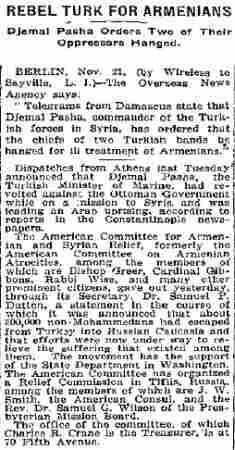 |
|
Even the
Turk-hating New York Times lent
evidence; REBEL TURK FOR ARMENIANS:
Djemal Pasha Orders Two of Their
Oppressors Hanged. (Nov. 22, 1915). Yet
was it only Jemal who deserved the
credit? The New York Times got the
rest of the facts wrong, as usual, claiming
that Jemal had "revolted against the Ottoman
Government," while "leading an Arab-
uprising." Ever-reliable "dispatches from
Athens" were the Times' source. |
In Vehip Pasha's case, his "testimony," as
Akcam puts it, was not really courtroom testimony, but a deposition made while
Vehip Pasha was in British custody at Bekiraga Prison. The same circumstances by which
Halil Pasha had made his statements, at times using the words of his British captors, that
Vahakn Dadrian has made such wonderful use of (link, FT 77 above) as "genocide
evidence." So it is possible the British made Vehip's deposition available to parties
of their choosing, independent of the courtroom prosecutors. We don't know the
circumstances of how Vehip's words came about, how strong-armed he might have possibly
been, whether he was commenting on matters that he knew of firsthand or through
"hearsay" (ADDENDUM: The research of military historian Ed Erickson
demonstrates Vehip was stationed in Gallipoli during 1915, and did not assume command of
the Third Army until 1917, telling us Vehip could not have been a firsthand
witness), and we don't know the full context of what Vehip stated, as all I am familiar
with are the brief Armenian-translated excerpts Dadrian has selected for presentation, to
serve his propagandistic ends. What we do know is that Vehip was acutely aware of the
massive crimes of systematic extermination conducted by Armenians that Dadrian and
Akcam will keep hidden, and we also know Vehip punished Ottoman officers for massacring
Armenian soldiers in the Ottoman army. Now, Vehip did not go off and hang these officers
on his own (no more than, say, General Rommel could have dreamed of executing SS officers
for killing Jews), particularly since Akcam has insisted that the "CUP’s central
body exercised extremely tight control"; new evidence (new to me, anyway)
suggests that the execution of these officers was not the arbitrary decision of Vehip
Pasha, as Dadrian has implied, but most likely was decreed by official military courts
with the approval of Talat Pasha (as we can see
was the likely case involving the execution of two other Ottoman officers who committed
crimes against Armenians, under the jurisdiction of Jemal Pasha). In other words, Talat
Pasha, who was supposed to be behind an extermination policy against Armenians, is on
record for directing the punishment of his own men whom Dadrian and Akcam tell us were
carrying out Talat's "genocide"! (Another incredible note is that, Dadrian, in
his "The Role of the Special Organization," 1993, pp. 68-69, has gone so far as
to describe the officers Jemal is normally credited for executing as "Special
Organization brigands"! For a detailed discussion of Vehip Pasha and his statement,
please turn to this page.)
80. Master Vahakn Dadrian also tried his smearing best to make Erickson come across
as a dope under the influence of the Turks. (Erickson responded to Dadrian here.) There is truly no stopping
the underhanded tactics employed by those such as Dadrian and Akcam. Open-minded readers
may see for themselves if Akcam is talking out of his hat or not, regarding whether Dr.
Erickson is another academic lost soul, by examining the article Dr. Lewy has referenced.
81. Isn't that interesting? Here we have
Yusuf Riza testifying that the Special Organization served as the Armenians' killers "under
the direct orders of the CUP’s Central Committee," and yet we just found out
two footnotes ago that the leader of the CUP, Talat Pasha, had a hand in the execution of
two officers convicted of killing Armenians, officers whom Dadrian identified as
"Special Organization brigands." Something is very wrong with this picture; the
genuine truth-seeker would certainly desire to dig deep beneath what Dadrian/Akcam would
want us to accept on the surface, asking questions such as, who was this Yusuf Riza? Why
was he opining, in the official newspaper of his puppet government, that this conclusion
was so "evident," when the evidence is so scanty or non-existent? What was this
evidence, anyway? The word of frightened men, anxious to protect themselves from the
noose, who were willing to say anything and everything, in full knowledge that they were
trapped in the proceedings of an illegal and illegitimate trial series, so corrupt that
even the British refused to point to their findings, while the British were conducting
their own Malta Tribunal? (ADDENDUM: Time will tell whether the quote attributed to
Yusuf Riza has been presented accurately. Until further notice, readers would be wise to
beware.)
ADDENDUM,
4-08:
AKCAM MADE YUSUF RIZA SAY THE OPPOSITE OF WHAT RIZA SAID!
Interestingly, Akcam provided his Yusuf
Riza "evidence" within his criticism of Lewy's book, inasmuch as Lewy not
only covered Yusuf Riza, but gave Akcam's work itself as the source for denying the
role of the SO with the Armenian massacres! (How good a job did Akcam do in reading
Lewy's book, anyway? Furthermore, how good a job has Akcam done in reading his own
sources?)
Before we get on with Akcam's latest exercise in chicanery, let's provide the
relevant part from Lewy's book, as a reference. (From pages 85-86.)
"The defendants denied any connection between the SO and the central committee
of the CUP, however, as well as any role of the SO in the Armenian deportations and
massacres. [115]
When the presiding judge kept on insisting that the SO had participated in the
massacres, defendant Riza Bey finally expressed his "conjecture" that
locally recruited reinforcements for the gendarmerie, which did not have enough
manpower to carry out the deportations, could also be called "special
organization." However, he insisted that these forces and the units of the SO
were "completely different things. [116] All of the defendants rejected the
idea, repeatedly put forth by the presiding judge, that the SO had two parts, one
functioning under the direction of the Ministry of War and the other under the
central committee f the CUP. I know of no credible evidence that proves their
testimony to have been false."
115. Akcam, "The Proceedings of the Turkish Military
Tribunal," part I, especially 5th and 6th session of the main trial.
116. Ibid., 5th session, pp. 58-59. Riza Bey characterized this scenario as a
"conjecture" during the 7th session, p. 26.
So when Akcam had Riza conclude that "the Special Organization became
instrumental for the commission of all the crimes," Akcam's own evidence
stated otherwise. Isn't that interesting, ladies and gentlemen?
But, wait; there's more..!
We can see from the tone of Lewy's coverage that the judge was in a hurry to pin
blame, making this trial one blatant kangaroo court. We can also sense that Yusuf
Riza does not know a lot and appears to be in a panic. But what did he actually say?
(The translation below is not a labored one):
Riza Bey: (...)My presence at/in the S.O. with Dr Nazim Bey was a service for
the country, Your Excellency. We deemed that there was a war, and all of us should
serve this state, this nation, this homeland as much as we can. Everyone attempted
to do works that they are able to as much as possible. Unfortunately
today the situtation brings [the matters] to such a position where the SO had
become an instrument for the execution of all crimes, under the orders of Central
Committe. I cannot find and give an answer to this, your excellency.
(Turkish text: Doktor Nazim Bey ile Teskilat-i Mahsusa da
bulunusum bir hizmet-i vataniyyedir pasa hazretleri. Biz zannettik ki, harp oluyor,
hepimiz gücümüz yettigi kadar bu devlete, bu millete, bu vatana hizmet edelim.
Herkes elinden geldigi kadar, aklinin erdigi islere tesebbüs etmistir. Simdi bugün
ahval maalesef öyle bir vaziyete getiriyor ki, Teskilat-i Mahsusa merkez-i umuminin
emri altinda bütün cinayetleri icraya vasita olmus. Bendeniz buna cevap bulup
veremeyecegim pasa hazretleri.)
What Riza meant by the "situation" is the political situation of that era
and the courts. This becomes more clear in the answer he gives to the judge two
questions afterwards:
Riza Bey: I take an oath [swear to God], in any form you want, that nobody
from here [istanbul?] intervened. The Central Committee has nothing to do with
these affairs. Please investigate that. Please be certain that there is none.
[i.e., no connection.]
(Turkish text: Ne suretle isterseniz yemin ederim ki, buradan
kimse müdahale etmemistir, merkezi umuminin bu islerle alakasi yoktur. Istirham
ederim, tamik edeniniz. Emin olunuz ki yoktur.)
The person Akcam makes into a confessor actually swears that there
is no relation between these affairs and the CUP's Central Committee.
Afterwards, the man even challenges Vehip Pasha's deposition when the judge refers
to it..!
SOURCE: "Divan-i Harbi Örfi Muhakemati Zabit Ceridesi- Tehcir Yargilamalari
(1919)," Osman Selim Kocahanoglu, page 303, 7th session of the main trial. Thanks
to Hector and his impeccable research.
Holdwater: A relevant "rerun" from a page prepared at the same time as this
addendum:
In a March 8, 2008 published interview in The Armenian
Weekly, [Hilmar] Kaiser faults Akcam — without naming him — for claiming
that an Ottoman official went "to Germany in March 1915 to coordinate the
decision of the Armenian genocide, and [Akcam] gives the source. The
source says exactly the opposite."
This would be in relation to Akcam's absurd hypothesis on the Ottoman government's
convenient "genocide" decision in
March of 1915 that foolish genocide scholars as Robert Manne have accepted at face value. After expressing how
mindlessly "celebrated" these works of pseudo-scholarship have been —
another foolish genocide scholar who has accepted Akcam's "Shameful" book
at face value was Michael Oren — Kaiser points to the "unscholarly" way
in which "Turkish materials have been used" — he must have been
referring to the team of Akcam/Dadrian, since hardly any other pro-Armenian
"scholar" has made use of original Ottoman sources — "because no one is able to check the sources."
|
82. In other words, Taner
Akcam is telling us that anytime we run into the Turkish word "chette" relating
to this period, the word must be taken as synonymous to the Special Organization. Now
we have heard everything, and truly, Taner Akcam has sunk to new lows with this
ridiculous contention. While certainly there may have been some who have used this word to
describe units of the S.O., particularly if it served their purposes, the fact is that
"chette" is a general term which signifies lawless, roving gangs that Arthur
Moss and Florence Gilliam gave an accurate description of when they wrote, "Those
massacres which occur among the Armenians are most often the work of the Kurds, who are
roving bands about as lawless as the mobs in parts of the American South, and about as
out-of-hand politically as the banditti who infest parts of Italy and Spain."
(The Turkish Myth, 1923.) Armenian bands
who hunted down Turks were also called "chettes" much as these criminals had
nothing to do with the S.O. (although, paradoxically, Armenians too have been known
to serve in the S.O.; Lewy commented on p. 85: "The supreme irony of this
situation is rather striking: here is an alleged unit of the SO, the organization that
Dadrian calls the primary instrument in the implementation of the Armenian genocide, that
included Armenians!"), and some Armenians even paid bandit gangs to fight
against the Ottoman Army (ATASE, 41inci Piyade Tumen Tarihcesi, p. 9, as noted in Ed
Erickson's "Bayonets on Musa Dagh.") If "The terms 'brigand, chettes,
volunteers'" were used in "ciphered telegrams sent by the Interior Ministry
to the regions," as Akcam informs us, that does not always mean the CUP was
talking about the Special Organization, not by a long shot! (Leafing through the book,"Turkish-Armenian
Conflict Documents," 2007, for just a few minutes, I found one of what must be
plenty of other examples, an August 29, 1915 telegram by Talat Pasha himself, the first
sentence of which reads: "Alman belgeli bilgilere gore, Bursa Ermeni kacaklarindan
silahli ceteler Yalova ve Izmit bolgesine sarkarak, aralarda Islam koylerine
saldiriyorlar." Here is the translation: "According to the documented
information, the armed gangs of Armenian fugitives are heading to the region of
Yalova and Izmit, and conducting attacks on the Muslim villages located there." One
must also bear in mind that these ciphered telegrams were written in the hieroglyphics of
the Ottoman language, and the translation of words is up to the discretion of the
translator.
Since Taner Akcam reports the word "chette" was used synonymously with the
Special Organization in internal Ottoman documents, let's provide an example of an
internal German document that uses a variation of the Turkish word,
"chette," as related by Guenter Lewy on p. 84: "In this document, dated
August 23, 1915, Stange reports that Armenian villagers, deported from the area north of
Erzurum, 'were murdered, with the acquiescence and even the assistance of the military
escort, by the so-called Tschettes (volunteers), Aschirets (tribesmen) and similar
scum.' Dadrian, in quoting from this document, leaves out the phrase, 'with the
acquiescence.' [In 'The Role of the Special Organization,' p.58.] More importantly,
the term 'Special Organization' does not appear in the Stange report... it is Dadrian, not
Stange, who equates the 'scum' involved in this massacre with released convicts and
enrolls them into the ranks of the SO." (Emphasis Holdwater's.) In other words,
the only reason why the Special Organization is connected with these chettes is because
those as Dadrian and Akcam simply make that connection in at least some of these
cases, thinking that no one is going to check!
What does it say about the scholarly reputation of one such as Norman Naimark, a
"historian" whose duty is to "check" (even Akcam, of all people, has
served to remind those as Naimark of this duty, in Akcam's response to Lewy, above: "The
task of the historian is to uncover and verify information and evidence";
emphasis Holdwater's), and who, after having read Guenter Lewy's book, has learned of the
trickery employed by the tag team of Dadrian and his Turkish copycat Akcam, and still
holds Dadrian/Akcam on a pedestal... while trying to minimize the professional work of a
real scholar like Lewy, by describing his work as "illogical"?
83. In this forthcoming expanded version of
Akcam's smear campaign, the reader can "confirm" at his own peril. Akcam's
purpose is to ignore 98% of the mostly irrefutable information in Lewy's book that clearly
demonstrates there could not have been a state-sponsored plan for extermination, and
instead will concentrate on the little bits and pieces where Akcam can create doubt, as he
has done with this book review and response, Dadrian-style. Akcam can get away with his
antics, because he knows lazy-thinking and/or prejudiced scholars such as Norman Naimark
will not be performing their historical duty, allowing Taner Akcam to get away with being
the scholarly fraud that he is.
84. What is not normal in what Akcam calls
"our profession" is to make deliberate mistakes, by knowingly taking
information out of context, distorting the meaning, or by engaging in purposeful
omissions. And then such a dishonest propagandist must complete the illusion by presenting
himself as an academician of "virtue."
|
|