|
|
|
"...[T]hese records were at the time compiled
for strictly internal use, i.e. for in-house consideration, and were not
intended for public consumption, [so that] one may be reasonably safe in
declaring the evidence obtained thusly as incontestable."
Vahakn Dadrian was not entirely on the mark when he referred to internal
German-government reports as "incontestable" (in his "signal facts" article
from 2003); the people who prepare such reports could, after all, be mistaken
from time to time. However, what is incontestable is that internal reports are
prepared largely with honest intent, and may be generally accepted as
trustworthy.
The TAT site has stressed Western and Armenian sources to turn the genocide
myth on its ear, since these parties were raised with anti-Turkish sentiments,
and had no reason to defend the Turks — very much opposed to the sources
demonstrating a genocide, who had every reason to be untruthful, or conned by
beloved Armenians whispering in their ears. Now, however, it is time for a
change.
It would be absurd to write about a nation's history by exclusively relying
upon what the enemies of a nation had to say. Yet that is exactly how the
"facts" for the "Armenian genocide" have been compiled.
Now we can understand with better clarity why Armenian and genocide scholars
can be such frauds.
Prof. Justin McCarthy exposes the likes of these propagandists:
Why rely on Ottoman archival accounts to write history? Because they are
the sort of solid data that is the basis of all good history. The Ottomans did
not write propaganda for today's media. The reports of Ottoman soldiers and
officials were not political documents or public relations exercises. They
were secret internal reports in which responsible men relayed what they
believed to be true to their government. They might sometimes have been
mistaken, but they were never liars. There is no record of deliberate
deception in Ottoman documents. Compare this to the dismal history of Armenian
Nationalist deceptions: fake statistics on population, fake statements
attributed to Mustafa Kemal, fake telegrams of Talat Pasha, fake reports in a
Blue Book, misuse of court records and, worst of all, no mention of Turks who
were killed by Armenians.
What you will be reading below, time after time after time, clearly
demonstrate Armenian treachery and belligerence, and the Ottomans' attempts to
perform their governmental duty to preserve order. The reports also
demonstrate, far from having it in for the Armenians, that the Ottomans
attempted to safeguard Armenian lives and properties. In short, they
demonstrate that the concept of "genocide" has no basis in reality.
These documents come courtesy of the Turkish "Military
History Documents Magazine," and were compiled into three separate
volumes by the Turkish "Directorate General of Press and
Information," translated into English and French, for distribution on the
world stage (wonder how far that effort got?). The names of these books were "Documents
I" (this page), "Documents on Ottoman Armenians - II"
and "...III," and published in 1982,
1983 and 1986, respectively. The Ottoman originals were also included in these
books, where they may be accessed in the .PDF file version of these books,
made available on the University of Louisville's web site: Vol. 1,
Vol. 2, and Vol. 3.
An average of a quarter-century has passed since these volumes first appeared,
and yet it appears no Turkish person, governmental or civilian, has taken the
trouble to make these very valuable documents available on the Internet. Isn't
that incredible?
What is below has been faithfully reproduced for the most part (for example,
retaining the quaint British spelling), but some errors in English have been
corrected.
|
|
|
| TABLE
OF CONTENTS |
NO:
DATE
OF DOCUMENT
SUBJECT
----------------
1) 9.7.1914
Order of 3rd Army Commander on measures to counter Russian provocations through
Caucasian Armenians.
2) 30.7.1914 Identifications of Armenians serving as
3rd Lt. in the Turkish Army.
3) 6.9.1914 Interior Ministry instruction on Zeytun
gang.
4) 6.9.1914 Letter of Ambassador in Teheran on links
Between Russians and Iranian and Caucasian Armenians.
5) 13.9.1914 Letter of Erzurum Provincial authority
on Armenians provoked by Russians.
6) 8.10.1914 Report by Trabzon Governor on
information related to organizing of Armenian armed raiders by Russian Government
7) 11.10.1914 Report by 3rd Army Command on arming of
Armenians by Russians.
8) 24.10.1914 Report by 2nd Cavalry Division
Commander on Kagizman incidents.
9) 29.11.1914 Coded message from Kazim Bey on Van
rebels
10) 4.12.1914 Report by Gendarmerie Commander Kazim Bey (Ozalp)
on Van Rebellion.
11) 20.12.1914 Proposal by Erzurum Governor Tahsin Bey to
Acting Commander-in-Chief Enver Pasha related to Van rebellion.
12) 21.2.1915 Report by Acting 11th Army Corps Commander
on Armenian military deserters in the Mus region.
13) 28.2.1915 Coded message by 11th Army Corps Command on
assassination of one lieutenant and four Gendarmerie enlisted men by Armenians during the
search of Arak Monastery.
14) 11.3.1915 Instruction on method for securing public
order
15) 15.3.1915 List of Turks murdered by Armenian gangs.
16) 18.3.1915 Coded message from Bronzar Pasha on Zeytun
incidents
17) 19.3.1915 Letter from Van Gendarmerie Division Command
on Armenian attacks on Gendarmerie outposts and men.
18) 24.3.1915 Report on Armenian aggressions on Moslem
villages and on gendarmeries in Van and Bitlis regions.
19) 8.4.1915 Coded message from 4th Army Commander Cemal
Pasha on the link of the Patriarch with Zeytun incidents.
20 7.4.1915 Respond of Acting Supreme Command to the
Armenian Patriarch on justice.
21) 16.4.1915 Letter from Van Gendarmerie Division Command
on measures to counter Armenian attacks on Gendarmerie outposts.
22) 20.4.1915 Report from Van Governor Cevdet Bey on Van
rebellion.
23) 20.4.1915 Coded message from Governor of Van on
expansion of the rebellion.
24)23.10.1918 Report from 9th Army Corps Command on
aggressions and plundering by Armenians in Moslem villages
25) 26.4.1915 Order by the Supreme Command on closing down
Hunchak and Dashnak and similar committees and their branches
26) 2.5.1915 Instruction of the Acting Supreme Command on
rooting out of Armenian rebel sources in Lake Van region
27) 21.5.1915 Coded message from Supreme Command informing
participation of Armenian Gang leader Antranik with his men in the Russian Division of
Chernoroyod.
28). 10.6.1915 Regulation on the administration of assets
and properties of Armenians to be transferred to other locations in view of the war and
the extraordinary political circumstances.
29) 15.6.1915 Report from Acting 10 th Army Corps
Commander Pertev Bey on the clash with Armenians on the old fortress of Karahisar
30) 18,6.1916 Report by Sivas Governor Muammer Bey that
Armenian rebels in Karahisar are put under control.
31) 23.7.1915 5th Army Corps Command letter on
aggressions of Armenians in Moslem villages in Bogazliyan
32) 29.7.1915 4th Army Command Report on the
development of the clash between 400 Armenian rebels in Findicik village of Maras and the
132th Regiment.
33) 18.8.1915 Report from the Communications
Inspectorate on the attacks of Armenian enlisted men of the Urfa Workers Battalion on
Moslem soldiers.
34) 23.8.1915 Coded message from 3 rd Army Command
on Armenian rebels in Karahisar.
35) 24.8.1915 Defence Ministry order on actions to
suppress Armenian aggressions in the Yalova region.
36) 14.9.1915 Coded message from 4th Army Command on
Mount Musa incidents
37) 22.9.1915 French Statement on Mount Musa
incidents
38) 9.10.1915 War telegraph from 4th Army Command on
suppressing Armenian rebellion in Urfa.
39) 15.10.1915 4th Army Command coded message on
confrontation in Urfa
40) 12.4.1916 Report by Military Attache in Bucharest on
Armenian volunteers Organization in the Caucasus.
41) 17.12.1916 Interior Ministry announcement on
migration.
42) 4.10.1917 3rd Army Command report related to Armenian
massacres
43) 18.10.1917 Report on trade by Greek, Armenian and
Jewish traders in Istanbul buying food and gold from German army personnel in Istanbul.
44) 5.12.1917 Cease-fire agreement between the Ottoman and
the Russian armies in the Caucasus front.
45) 22.1.1918 3rd Army Command report on Armenian
cruelties and atrocities in Erzincan.
46) 22.1.1918 Armenian cruelties in Erzincan.
47) 29.1.1918 Letter from Ottoman Caucasian/ Armies
Commander Vehip Pasha to Russian Caucasian Armies Commander-in-Chief General Perjovalski.
48) 30.1.1918 Reports by 1st Caucasian Army. Corps
Commander Kazim Karabekir on Armenian cruelties.
49) 2.2.1918 Cruelties by a 2000 men gang made by
Armenians, Georgians and Greeks in the Polathane region. 2nd Caucasian Army Corps Command
report on details of atrocities.
50) 3.2.1918 Situation in Erzincan and Armenian
atrocities.
51) 6.2.1918 Letter of South Caucasian Assembly Speaker
Kekechkori on peace
52) 6.2.1918 3rd Army Command order on measures to protect
Turks from Armenian cruelties in regions behind withdrawing Russian positions.
53) 6.2.1918 Report of General Odishelidje on searches by
Russian soldiers of Moslem homes in Erzincan under the pretext of a Moslem revolution.
54) 21.2.1918 Reply from General Odishelidje to Vehip
Pasha.
55) 10.2.1918 Views of 3rd Army Command on advancing of
the 1st Caucasian Army Corps towards Erzincan.
56) 10.2.1918 Proposal of the Supreme Command related to
the report of General Odishelidje.
57) 13.2.1918 1st Caucasian Army Corps report on the
entering of the 108th Regiment in Erzincan, against Armenian gangs resistance.
58) 20.2.1918 2nd Caucasian Army Corps Command Report on Georgian
and Armenian committees in Trabzon to deliver their arms. and goods to Turks, and on
murdering of over 200 Moslems by Armenian gang led by Arshak before leaving Bayburt in the
direction of Erzurum.
59) 21.2.1918 3rd Army Command report on liberating
Bayburt and cruelties of Armenian gangs.
60) 23.2.1918 Report on Armenian cruelties in Adilcevaz
and Mamahatun.
61) 23.2.1918 3rd Army Command letter of Sansa passage
incident.
62) 27.2.1918 Report wf General Kazim Karabekir on
Armenian cruelties
63) 2.3,1918 Report of 3rd Army Command on Armenian
cruelties.
64) 13.3.1918 Letter by Istanbul and Izmir deputies
to the International Socialist Conference in Stockholm.
65) 21.3.1918 Report of the 3rd Army Command on the
situation in Erzincan and Erzurum.
66) 25.3.1918 Army Command order on just treatment
to the people during the advance deployment of the 3rd Army.
67) 29.3.1918 Report of Armenian Forces Commander in
Erzurum General Antranik as published in the Caucasian newspaper Kabasluv.
68) 29.3.1918 Message by General Kazim Karabekir to
the Armenian community of Kars.
69) 1.4.1918 Report Stating that number of Turks
murdered by Armenians in Erzurum alone was 2,127 according to corpses recovered.
70) 20.4.1918 Letter of 3rd Army Command ordering equal
and just treatment to everybody with no religious discrimination.
71) 1.5.1918 Cable describing Armenian cruelties and
massacres in the region from Trabzon to Erzincan.
72) 2.5.1918 Cable exposing Armenian cruelties in Erzincan.
73) 3.5.1918 Letter from Caucasian Front Ottoman Armies
Command to the Russian Commander-in-Chief of Caucasian Armies related to leaving to the
mercy of Armenians the people in places, evacuated by Russians
74) 5.5.1918 Document related to marriage of a member of
the Sultan’s family with an Armenian woman named Vartanus.
75) 16.5.1918 Report by Group Commander Brig. General
Sevki to the 3rd Army Command on Armenian cruelties.
76) 23.5.1918 27.5.1918 Turkish translation of the Cable
of author Dr. Stephan Eshnanie on Armenian cruelties.
77) Translation from Russian the memories of Russian Officer
Toverdahleiov, prisoner of war, on Armenian atrocities and cruelties against Turks in
Erzurum and the region, from the beginning of the Russian Revolution until 27.2.1918.
78) 20.6.1918 Letter of General Kazim Karabekir to
Armenian Army Corps Commander Nazarbehov on massacre of Moslem population in the Armenian
Republic by Armenian gangs.
79) 27.6.1918 Letter by Russian Army Corps to the
Independent Armenian Commission in Gumru requesting that the Turkish Command is informed
of the atrocities by Armenian gangs led by Antranik in Nahcivan region.
80) 2.7.1918 Letter by Vehip Pasha to the Armenian
National Assembly Speaker in Batum on cruelties suffered by Turkish people of Baku and
Azerbaidjan.
81) 2.7.1918 Report by Eastern Armies Group Commander Esat
Pasha on murder of 200 Moslems in Islam villages by Armenians.
82) 10.7.1918 Report by Esat Pasha on murder of 7,000
Moslems in Dilman and 1000 Moslems in Rumiye by Armenians, indiscriminately, women,
children, old and alike.
83) 24.7.1918 Letter of Eastern Armies Group Commander
Halil Pasha urging deployment of troops to prevent the annihilation of Moslems by
Armenians in Karabag.
84) 25.8.1918 Report disclosing activities of Armenians
under false names.
85) 28.8.1918 Interior Ministry statement announcing the
results of the investigation by District Governor of Yusufeli on Armenian cruelties.
86) 5.9.1918 Border demarcation according to Batum Peace
Agreement.
87) 3.10.1918 9th Army Corps Command Report on Armenian
attacks on Moslem villages of the Gokcegol region.
88) 24.10.1918 9th Army Command report on cruelties and
massacres by Armenians on Moslem population of Erivan, Karabag and Nahcivan regions.
|
PREFACE
|
Armenian terrorist gangs have been waging a campaign of hatred towards Turkey during
the last ten years, indiscriminately slaughtering and maiming innocent people.
Unfortunately certain countries have attempted to justify and find extenuating
circumstances for these heinous acts of terrorism, which are a blatant violation of
fundamental rights, international law and basic humanity.
The campaign aims at wining the support for these claims of the so-called
"Armenian Genocide" which lacks any historical foundation and originates
only in unjust and biased information arising from lies and slanders. It also seeks
to achieve their demands, which have no logical and legal foundation whatsoever.
Such claims, distorting history and facts, are unfortunately supported by the media
of some countries.
The periodical MILITARY HISTORY DOCUMENTS published by the Military History and
Strategic Studies Department of the Turkish General Staff, devoted its December 1982
(No.81) issue to the First World War years, so much referred to in these baseless
charges and allegations. Documents published in the periodical catalogue Armenian
atrocities and massacres perpetrated on Turkish people in these years. The documents
also very explicitly demonstrate the just and compassionate treatment by the Ottoman
Administration to all citizens, irrespective of their religion, race, sect or any
other consideration.
In presenting the English translation of this publication, which in fact includes
only a selection of the innumerable documents from Turkish War History archives, we
hope that we may enlighten objective readers and researchers alike, and present the
truth for all those who only want to avoid biased assessments.
Necati OZKANER
Director General
of Press and Information
|
| INTRODUCTION |
This book compiles documents from Turkish Military History Archives. The original
facsimile copies of the documents in their Ottoman dialect together with their present day
Turkish transcriptions were first published in the December 1982 (No. 81) issue of the
Turkish Military History Documents Periodical. Now, the English translation of the
documents is being presented for general readers and researchers alike.
The documents herein are concerned with the 1914-1918 period of Turco-Armenian history.
The period in question, coinciding with the First World War, is the most controversial era
of the history of the Ottoman Armenians. Much has been said and much published abroad
about this period. But Turkish documents were very rarely referred to in these
publications. Publications were based in one-sided, biased sources. and in general
reflected twisted and falsified versions of what really happened. It is hoped that the
collection of the documents from Turkish Military History Archives, will shed light on
that controversial period of the history and will also contribute to the work of
researchers.
For a better evaluation of the documents in their true place in history, it will be proper
briefly to summarise the pre-First World War period of the history of the Ottoman Armenian
minority. Until the 1877-1878 Ottoman-Russian War, there never existed any such thing as
an 'Armenian Question". No international treaty, agreement or convention, ever
referred to the term 'Armenian' until that date. The Armenian minority had peacefully
co-existed with the Turkish majority for nearly eight hundred years.
As a matter of fact, the position and living conditions of the Armenians were better than
those of many Turks. While Turks had compulsary military service, Armenians were exempted
from this obligation, and so could devote themselves to trade, agriculture, and
craftsmanship. constantly raising their level of wealth and prosperity. The Turks bore all
the burden of the Ottoman Empire, while the Armenian minority only enjoyed the benefits of
the Empire, and even economically exploited the Moslem Turkish majority.
The 1877-1878 Ottoman-Russian War, initiated a new era in the: history of the Ottoman
Armenian Minority. The Treaty of San Stefano which the Russians dictated to the Ottoman
capital at the end of this war, added a provision envisaging "reforms" for the
Armenians. It was the first time in history that the term 'Armenian' was ever included in
an international treaty. The Berlin Peace Convention of 1878 which later replaced the San
Stefano Treaty, also inserted an article on "reforms" benefiting the Ottoman
Armenians. This provision opened the way for interference in the internal affairs of the
Ottoman Empire by foreign countries, led by Russia and Britain, on behalf of the Armenian
minority. As a consequence. Anatolia became an arena for the power games of the
imperialist states. In this struggle, the Ottoman Armenian minority was exploited as a
tool of international interests.
Feeling and enjoying the support of foreign states behind them, the Ottoman Armenians
began to harbour dissatisfaction with their position. and to demand an autonomous region,
even an independent state in Eastern Anatolia, where they lived only as a very small
minority. When these ambitions were not realised, they adopted revolutionary methods. The
so-called Hunchak and the Dashnak committees founded outside Ottoman territories in 1887
and 1890, chose the Ottoman Armenians as targets for exploitation. At the provocations of
these committees, bloody incidents and rebellions were initiated in Eastern Anatolia from
the 1890's. Influenced by Russian Nihilists, the Hunchak militia utilised propaganda,
agitation and terrorist methods, causing escalating bloodshed in Anatolian territories.
This was followed by their collaboration with the Dashnak committee, waging numerous
rebellions in Anatolia. Hostile feelings against the Moslem Turkish majority was
constantly incited, making peaceful co-existence between the two communities more and more
difficult with every passing day.
It was in such circumstances that the period of the First World War began. The manifesto
of the Hunchak Committee openly stated that "the most favourable time for an overall
rebellion of Ottoman Armenians, is the time when the Ottoman State is at war". The
First World War was therefore the opportune time the Armenian committees had been seeking
for a quarter of a century. On the outbreak of the War, in June 1914. Armenian committees
convened a congress in Erzurum, resolving to continue the struggle against the Ottoman
State.
For Russia, on the other hand. the First World War was also the opportunity she was
awaiting to invade Eastern Anatolia. The Russians resolved to exploit and make use of
Armenians against the Turks as far as was possible. Agreement was reached-between the
Echmiazin Catholicate and the Russian Caucasus Governor General under which Armenians
would provide unconditional support for the Russians. The Catholicate was later received
by the Russian Tsar. In audience, he told the Tsar "the emancipation of the Anatolian
Armenians was only possible through secession from Turkish sovereignty, the establishment
of an autonomous Armenia under the protection of Russia". This was a kind of alliance
between the Russians and the Armenians against Turkey.
The bloody struggle waged by Armenians against Turks from then on can be followed from the
documents in this book. Before the Ottoman Empire entered the First World War, Armenian
gangs armed and equipped in Russia, infiltrated Eastern Anatolia. This was followed by the
arming of Armenians in Eastern Anatolia with Russian weapons. With the declaration of war
by Russia on the Ottoman Empire, both Russian Armenians and Anatolian Armenians moved
against the Turks. Russians disarmed Moslems in places they occupied in Eastern Anatolia,
arming the Armenians with the weapons confiscated from Moslems, paving the way for
aggressions by Armenians on a disarmed and innocent Moslem population.
Armenian gangs perpetrated acts of sabotage, destroyed telephone cables, blew up bridges,
blocked passes, set up ambushes, attacked security stations and small Turkish outposts
behind the Ottoman Army lines on the one hand, and on the other ruthlessly attacked
Turkish villages, slaughtering the Turkish population indiscriminately, women, children,
old and young alike. Innocent people were one by one cruelly bayoneted to death, or killed
with axes and swords, or else shut up in mosques or in schools and then burnt alive.
Widespread Armenian revolts broke out in the regions of Van, Sivas and Maras. The Ottoman
Army, while fighting to prevent the Russian invasion, also had to deal with Armenian gangs
who hit from behind. The Ottoman Government issued a sharp warning to the Armenian
Patriarch in Istanbul and called on him to prevent these Armenian aggressions. But to no
avail. Bloody Armenian aggressions spread to all parts of Eastern Anatolia. The Ottoman
authorities were compelled to take other measures. The Acting Supreme Command of the
Ottoman Empire, in an instruction to the Ministry of Interior dated 2 May 1915, pointed
out the need to remove the Armenian population in certain centres of constant rebellion to
other places close to Russia or in other parts of the Ottoman territory. (Document No. 26
). As an inevitable result of the war and the emergency political conditions, some of the
Armenians in Anatolia were transferred from the war zone to other regions of the Ottoman
Empire.
A detailed Regulation was drawn up on the administration of immovable assets left over by
those Armenians transferred to other places. (Document No. 28). Thus, the Armenian
rebellions and massacres carried out by them could be terminated.
Starting from late 1917, however, Armenians again committed widespread massacres in
Eastern Anatolia. A Cease-fire agreement was concluded in the Ottoman-Caucasus front
between Ottoman and Russian Armies upon the Bolshevik Revolution in Russia. (Document No
44). Russians laid down their arms. The arena was now left to the Armenians in Eastern
Anatolia. Almost every Turkish town and village from Erzincan up to Azerbaidjan suffered
large scale attacks and massacres by Armenians.
The Ottoman Army, liberating Trabzon, Bayburt, Erzincan, Erzururn. Kars and other regions
from the Russians, saw that the cities and their villages had been destroyed and burnt,
people slaughtered, massacred. The massacres conducted by Armenians, which became a black
stain for humanity, shocked and disgusted even the Russian authorities. (Document No. 76).
Almost half of the documents in this book are related to this second wave of Armenian
massacres and cruelties. The inhuman treatment, cruelties, atrocities, massacres by
Armenian gangs perpetrated against innocent Moslem Turkish people, are sufficiently
reflected in these documents. Even today over sixty years later, the terrifying screams of
the victims of these cruelties can be heard.
This book covers only a selection of innumerable documents in the Turkish archives on
Armenian atrocities and massacres. Documents to be published in the near future will be
complementary to this book. By placing these and following documents in their correct
historical context, we are now able to see this important and controversial period in
Turco- Armenian relations in a true and revealing perspective.
We are confident that objective researchers and readers will justly evaluate these
documents. We hope that the book will serve for their enlightenment.
Bilal N. Simsir
Member of The Turkish History Society
|
DOCUMENT NO: 1
|
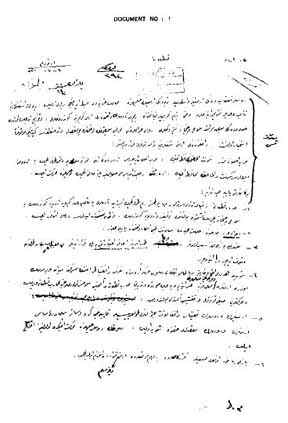 |
|
To
give you an idea of what these things look like;
the above is the original for Document No. 1 |
3rd ARMY
Secret
Erzurum
(6 Sept. 330) 19.9.1914
No: 392 Issued/Date 14
TO ALL UNITS
According to reliable information from the Armenians in the Caucasus, the Russians
have provoked Armenians living in our country, by promises that they will be granted
independence in territories to be annexed from Ottoman land, and that they have
brought many of their own men disguised as Turkish peasants to the Armenian villages
in our country, that they have stored arms and ammunition in many places to be
distributed to Armenians, and moreover, the of Russian General Loris Melikov went to
the Van region for the same purpose. In this context, Armenian leaders in our
country, have decided to pursue the following policy:
To preserve their loyalty in tranquility pending the declaration of war. If war is
to be declared, Armenian soldiers in the Ottoman army will join the enemy with their
arms. If the Ottoman Army advances to preserve loyalty and tranquility, should the
Ottoman Army then retreat, to form armed guerrilla bands to fight against us.
The following measures will be taken:
1. Border units will capture everybody who wants to enter our territories without a
passport and send them to the rear echelons. Anybody who attempts to import arms and
ammunition will be arrested and sent back to the Army. Those who attempt to escape
will be shot.
2. The demands and needs, of the local government apart from war conditions will be
carried out as far as possible.
3. Those who cause panic in units and those who disobey orders to halt and escape
will be executed by officers or on the order of the officers.
4. Vigilance will prevail against any eventuality, particularly, in dangerous times,
in order to avoid any fear and disorder among soldiers, and movements of Armenians
and other non-Moslems will be kept under strict supervision and control, though this
supervision and control should not be made obvious.
5. To enlighten leading personalities of Kurdish and other Moslem communities
against the ill intentions of Russians and Armenians and to convince them that
safety and security; depends on opposing the Russians.
6. Armenians and non-Moslem enlisted men will not be posted to important posts in
headquarters such as clerks and orderlies.
Transmitted No: 391
330 Sept.14
Ibrahim
(1914)
TO PROVINCIAL AUTHORITIES
(The information will be transmitted)
Measures which I consider appropriate follow:
1. Information will be obtained through disguised policemen and. other reliable
persons about the organizations and movements of Armenians and other non-Moslems,
about the locations of the movement, their presence in villages and their
leadership.
2. To establish militia in order to crush any revolt without engaging the army, call
for assistance, from the closest military unit if this is not sufficient.
3. To seize the arms of anybody who does not comply without organizational structure
and send them to courts martial.
4. To maintain the loyalty of Kurdish and other Moslem communities who could be
misled because of ignorance.
DISTRIBUTION
9th Army Corps Erzurum
11th Army Corps Van
11th Acting Army Corps Bitlis
Fortress
2nd Regular Cavalry Division Diyarbakir
1, 2, 3, 4th Reserve Cavalry Divisions Elazig
Van Independent Brigade Trabzon
13th Army Corps (To be transmitted Later)
Van Gendarmerie Command
Communications Zone Command
Trabzon Gendarmerie Regiment
Archive No.4/3671
Cabin No.163
Drawer No. 2
File No. 2918
Section No.797
Contents No. 6
|
| DOCUMENT NO: 2 |
Identifications of non-Moslem cadets graduated from First Senior
Class as Third Lieutenant on 17 July 330 (1 August 1914) :
9th Army Corps, 12th Regiment, 1st Battalion, 2nd Company,
Third Lieutenant Baruter, son of Artin from Trabzon at Eyvasil District Trabzon 1307
(1891)
11th Army Corps, Third Lieutenant Antuvan, son of Fetullah, average height, grey-blue
eyes, well-built, from No: 16, of Sevkulgazel District of Bagdad. Bagdad 1310 (1894)
9th Army Corps, 13th Regiment, 2 Battalion, 2nd Cpmpany Heavy Artillery. Third Lieutenant
Zisis, average height, grey-blue eyes, well -built, son of Samus from No: 384,Kadibayir,
lzmit. Kumkapi- 1308 (1892)
3rd Army Corps, Telegraph Company Mr. Ilia, average height, dark complexion with light
brown hair and grey-blue eyes, son of Merchant Yasep[ar] Kurbanlik District of Balat Balat
- 1309 (1893)
9th Army Corps Cavalry Third Lieutenant Ganbus, son.of Yorgo from Erdek, Eregli origin
Beyoglu - 1309 (1893)
9th Army Corps Cavalry Third Lieutenant Kirkor, average height grey-blue eyes, well-built,
son of Karabet from Yenimahalle of Erzincan. Erzincan - 1309 (1893)
Archive No 1/1920
Cabin No 204
Drawer No 3
File No 4608
Section No 6
Contents No 19-6
|
DOCUMENT NO:3
|
Ministry of Interior
General Directorate of Police
Private: 725
Subject: Retribution of Zeytun Gang
SECRET
TO THE MINISTRY OF DEFENCE
Honourable Minister,
A 40-man gang equipped with prohibited firearms have robbed 21 passengers an hour's
distance out of Zeytun town and have seized over 12.000 kurush of money. The
incident was reported to the villages in the vicinity in an exaggerated way and 30
enlisted men from the region fled from their units in fear that their villages would
also be attacked. There are indications that unless there is pressure on inhabitants
of Zeytun, Moslems will retaliate. With this consideration, it has been decided to
deploy the mobile brigade to. Zeytun; however, as it is evident that not much can be
achieved with this unit comprising over 250 recruits, other measures were deemed
necessary. In this context, in view of the request of the Maras Governor, it has
been considered appropriate to dispatch the 1,160 strong Depot Battalion, stationed
as reserve in the Maras region, considering that security in the region can be
attained by the Gendarmerie without recourse to the above battalion.
Accordingly the General Command of the Syrian Region and the Army Corps Command were
informed of the situation as indicated in the coded message of 17 .August 330
(10.11.1914) that the units taken away from Zeytun because of war requirements must
be replaced. The situation is hereby submitted to your consideration, for
instructions to the Army Corps for necessary measures to maintain the security of
Zeytun and its region. 19.6.330 (2 September 1914)
19 August 330
On Behalf of the Minister of Interior
Under-secretary
Ali Riza
Public Order Section/190
20 August 1330 (3.9.1914)
Archive No 1/131
Cabin No 201-149
Drawer No 14-4
File No 2287
Section No 32/12
Contents No 1-10
|
| DOCUMENT NO: 4 |
No: 440
Decoded message of 24 August 1330 (7 September 1914) from the Supreme Command-in
Istanbul.
According to information from the Ambassador in Teheran, the Russians have issued
arms to the Armenians in Iran and in the Caucasus. The Russian Consul in Tabriz has
promised Armenians to set up an Armenian state and that the strength of Russian
forces around Mako comprises 12,000 infantry, 1,200 cavalry and 124 Artillery guns.
Communications exist between Russians and Armenians in Van. The accuracy of this
information is not definite. Yet Armenian soldiers must be kept under special
conditions and must not be allowed to change their political allegiance.
Archive No 4/3671
Cabin No 160
Drawer No 5
File No 2818
Section No 59
Contents No 2-10
Holdwater: So as early as September 1914,
communications probably were open between Russians and Ottoman-Armenians of Van, in
keeping of their planned "self-defense" of the city during the following
year; the one where the Armenians attacked first, and succeeded in holding the city
for the Russian invaders.
|
| DOCUMENT NO: 5 |
Office of Governor of Erzurum Correspondence Department
No: General 254221
Special 651
To: 3rd Army Command
Dear Sir,
Enclosed please find a copy of the report drawn up by civilian police, specially
dispatched to investigate the condition of inhabitants of Bozveren village of Pasinler
District and of other Armenian villages. The same has been passed on to the District
Governor concerned for action. For your consideration and orders.
31 August 1330 (14 September 1914)
Acting Governor
Cemal
Revenue Officer
No: 414 / 2 September 330
No:
During my stay in Russia, I was told officially and unofficially that the Russian
Government has been placing maximum reliance on Armenians in solving the eastern
provincial problems and in minor problems in the Caucasus, and that the Russian Government
aims to win the support of the Armenians so as to provoke a revolt or upheaval in Eastern
Anatolia any time it chooses, and exploit this in order to interfere in our internal
affairs and use this as a pretext for pressure on our Government.
I have further learnt recently during my stay in Petersburg that the Russians are sparing
no costs in order to win the sympathy and support of Armenians and that this same feeling
of support for Russia is widespread among Armenians on our territories. I am therefore
considering the police reports regarding the position of Armenians in the Pasinler
district very interesting, and I must indicate that a great number of Armenians in the
Eastem provinces share the same feelings.
Info. Copy to 1st Section.
M. Muhtar
Archive No 4/3671
Cabin No 160
Drawer No 5
Rite No 2811
Section No 26
Contents No 24-1
Holdwater: The Russian government gave Ottoman-Armenians the equivalent of $13 million in today's
currency by February 1915, for the initial cost of of arms and preparing the Turkish
Armenians to start riots within the country during the war.
|
DOCUMENT NO: 6
|
No: 19527/1294
Decoded Message of 25 September 1330 (8 October 1914)
From Governor Cemal Azmi of Trabzon.
Copy of coded cable of 22 September 330 (5 October 1914) from
Hopa District according to information from Lazistan Province.
COPY
An 800-man band of raiders comprising Ottoman and Russian Armenians in Russia were
armed by the Russian Government and left Batum the other night for the Artvin
region. They are to be distributed between Artvin and Ardanuc and the number of
these volunteers will be raised to 7,000, in order to disturb security in the
region, upon promises from the Russian Government of independence. They will include
Greeks and Armenians and they will resort to aggressions by Turkish guerillas from
the Iran and Ermiye areas. Their total strength in Batum is 15.000 organized in
three regiments, including No: 264 Kirgolski, No: 154 Revan and No: 66 Siberia
Regiments.
Other information: the Commander of the Batum region has been replaced by a General,
name yet not known. The 750 Kazaks in the Artvin and Ardanuc regions were sent to
the German border and they were replaced by infantrymen from Batum. The number of
Russian soldiers in Lirnan village near Kopmis was raised from 50 to 150 and they
were supplied with 35 more crates of ammunition. The total 1.000.000 strength of
Russian forces on the Ottoman and Iran borders has been reduced to 600.000, after
deploying 400.000 to the German and Austrian fronts.
2nd Section
Document No: 1964-26/27
9 October 1914
To Section 1 for Information
Major
(Signature)
Information Received
11 October 1914
1st Section
Mehmet Tahir
Archive No 4/3671
Cabin No 160
Drawer No 5
File No 2818
Section No 59
Contents No 2-23, 2-24
|
| DOCUMENT NO: 7 |
TO: Command - in - Chief
28.7.330(1.10.1914)
According to information received, the Russians have established guerillas by arming
Russian and Turkish Armenians in the Caucasus and Greeks, and anticipate expanding these
guerilla organizations by sending them into Turkish land. These reports, are gradually
being confirmed, and realised, and Armenian deserters from military units are increasing.
I had submitted the required measures in my letter No: 347 of10/11 September 1330 (23/24
September 1914). Further measures are required for families of deserters and traitors, to
include punishment for villages which shelter and protect the gangs and the dispersing of
such villages. These measures should be announced so that everybody will know about them.
A definite and general decision is absolutely vital.
Signature
Archive No 4/3671
Cabin No 160
Drawer No 5
File No 2811
Section No 26
Contents No 15-1
|
DOCUMENT NO: 8
|
No : 389
Hour : 8
12/13.8.330 (24/25.10.1914)
Decoded message by Abdurrahman Bey, Commander of the Reserve Cavalry Division at
Karakilise of 11/12 October 330 (24/25 October 1914)
1. The strength of Russian forces in Mako is 2,500 cavalry, 700 infantry, about
three batteries of artillery and around 100 transport carts.
2. Surin and Hacik, two Armenians from Bayezit who crossed over from Russia, have
each recruited 2,000 men armed and equipped by Russians. They anticipate proceeding
to Muson via Abbas lake and to Bayezit or Iran via Haraba-macar and Mount Ararat,
each with their two thousand men. Special observers have been dispatched to
investigate the matter and necessary measures have been taken.
First Region:
3. Over 8,000 Armenians, mostly of Ottoman Armenians and army deserters, gathered
around Kagizman, forming some kind of organized guerilla bands, being armed by the
government and supplied with food by the local people, mostly collected from
villages at nights.
4. Among their known leaders are Kosti from Karakilise, Armais from Nefsi Eleskirt
and Apik from Hacli village of Eleskirt.
5. Ten more "Plaston" companies arrived in Kagizman during the last four
days and the forces in Kagizman are estimated at around 15,000.
6. This information is supplied by a reliable Moslem friend of Ottomans from the
people of Kagizman, the Second Regional Command reported.
Not clear
2nd Section 12 October 1914
Archive No 4/3671
Cabin No 160
Drawer No 5
File No 2818
Section No 59
Contents No 2-43,2-44
Document 2784
Date 12-13
Holdwater: A small army — thousands! — of
rebellious Armenians had already formed in eastern Anatolia, one month before the
war had begun. Note they could not have gotten far, if not for the support of local
Ottoman-Armenians. This is the kind of report that led Ottoman officials to relocate
the Armenian community, although it took them over a half year to do so. Other
nations would have booted them elsewhere well before they had proven their
disloyalty, as with the Americans and Canadians vs. their WWII Japanese, and with the Russians and the
British, vs. their WWI Germans
and German men, respectively.
|
| DOCUMENT NO: 9 |
Cable No: 4073
Very important and top priority and urgency
Decoded Message by Mobile Division Commander at Saray
Kazim (Ozalp) of 16 November 330 (29.11.1914)
To: 3rd Army Command
Today the enemy attacked Deyr. The enemy is equipped with artillery and machine
guns. As our defending force in is very small, I think we will have to withdraw
[in?] the direction of Hosab (Guzelsu)
From the confessions of two arrested spies, it is understood that rebellion is
expected in Van and in the province at any time now. I shall proceed in the
direction of Guzelsu, with part of the units in Saray. A difficult position will
arise however, if rebellion starts in the province. Please be advised that the units
built up in Revandiz did not yet deploy.
2nd Section, 16 (29) November 1914
Archive No 4-3671
Cabin No 160
Drawer No 5
File No 2818
Section No 59
Contents No 41
Holdwater: The New York Times was already reporting disturbances in Van,
as soon as war was declared by Russia.
|
| DOCUMENT NO: 10 |
No:950
Decoding of Cable message of 21/22 November. 330 4/5-12.1914.
by Van Mobile, Gendarmerie Division Commander Kazim at Hosab:
An enemy force comprising 4,000 infantry, ,1.000 cavalry, two field and two mountain
artillery guns is in the vicinity of Saray. Reconnaisance units today arrived at Molla
Hasan village between Muslihan and Saray and Ercek. A 500-strong enemy unit supported by
two mountain artillery guns from its forces in Dir occupied Baskale. The remaining part of
the units remained in the vicinity of Dir. Tribe leaders went south without any resistance
against Russians. We are now around Akgol, north of Hasob with a 2,000 strong force which
was deployed from Hosab yesterday. Other units are still at their positions from
yesterday.
The enemy is seizing the weapons from local people in places which it has occupied, using
these weapons, to arm Armenians and form units. There are some Iranian tribes among enemy
units. As we were forced to disarm Armenian enlisted men, due to our losses and deserters,
our forces are limited. The units which moved from Ravandiz have not yet joined our forces
at Somay. Their two mountain guns were returned to Ravandiz, according to information from
Musul.
2nd Section, 22 November 330 (5.12.1914)
Archive No 4-3671
Cabin No 160
Drawer No 5
File No 2818
Section No 59
Contents No 2-55
Holdwater: The Ottomans, short of manpower, were counting on
their Armenian soldiers; this is why Armenian men were drafted and trained, and some had
graduated from military schools, as you have already read in Document No. 2,
above. Armenian propaganda tells us these Armenian soldiers were disarmed because a
"genocide" was underway. Isn't that the most ridiculous and illogical
contention? As we can see from this internal report, they were being disarmed because of
their treachery.
|
DOCUMENT NO: 11
|
Decoding of Message of 7/8 December 33 (7/8 December 1917)
from Mr Tahsin, Governor of Erzurum.
To the Acting Supreme Commander Enver Pasha
There are indications of rebellion among Armenians of Karcikan and Gevas Districts
of Van. Telegraphic cables were destroyed, a corporal was assassinated, the district
governor and his retinue were obliged to use arms, many army deserters were
captured.
Gendarmerie and militia were sent from Bitlis, clashes started. More forces are
needed as the arms of the militia are not sufficient. I have received cables from
Van and from Bitlis on this matter. I have just been in contact by cable with Mr.
Talat. While they indicated that this information should be submitted to your
highest consideration, they also deemed it appropriate to solve the problem by
meetings with Mr. Cevdet and with Mr. Mustafa. Would you approve the deployment of
the unit of Halil Bey which is the furthest advanced, through Bitlis? Or should we
send two mobile gendarmerie units from here? Wounded Esat Bey recovered. Shall we
dispatch him immediately to Gevas with sufficient militia and tribal forces?
Awaiting your orders.
Archive No 1/1
Cabin No 9-101
Drawer No 23-1
File No 4
Section No 23-A
Contents No 5
|
| DOCUMENT NO: 12 |
Ministry of Defence
Department of Correspondence
Coding Section
Coded Message from Elazig to the Ministry of Defence
A group of 40-50 Armenian army deserters with arms at Sironik village 2.5 hours from Mus,
attacked the Gendarmerie Cavalrymen and police who went to the village to capture them.
The clash lasted for two hours. A 200-strong detachment led by Ismail Efendi and, the
Gendarmerie Commander was dispatched to the scene. Nine of those who resisted were killed.
The detachment is still in the village. This is submitted from the Acting Commander of Mus
division.
8 February 330 (21 February 1915)
Acting Commander 11th Army Corps
Hakki
Copy submitted to Headquarters
Same as the former Bitlis incident. Let us keep the same in a separate envelope (file). 9
February 330 (22 February 1915)
Archive No 1/131.
Cabin No 101/149
Drawer No 14-4
File No 2287
Section No 32/12
contents No 6-4
Holdwater: Contemporary Armenian historians such as Hacobian justified Armenian
desertions, for one, by reminding us there were Turkish deserters as well. Yes, but there
was a crucial difference (aside from the fact that Turks who deserted did so mainly as the
war dragged on), as this internal report reminds us: Turks did not desert in order to join
their nation's enemies, and to bear arms against their nation.
|
DOCUMENT NO: 13
|
Ministry of Defence
Department of Correspondence
Coding Section
From Elazig to the Ministry of Defence
(Coded)
Gendarmerie Second Lieutenant Ahmet and four Gendarmerie enlisted men on orders to
search the Arak Monastery in Mus Province on the thirtieth of the current month came
under fire from deserters and were killed. Follow-up operation continues and the
result will be notified subsequently.
15 February 330 (28 February 1915)
Acting Commander 11 th Army Corps
Hakki
Public Order Section 16.12.330 (29.2.1915)
Copy to Headquarters
Archive No 1/131
Cabin No 101/149
Drawer No 14-4
File No 2287
Section No 31/12
Contents No 6-9
|
| DOCUMENT NO: 14 |
Third Army Command
1st Branch
1st Section
Hasankale
26/27.2.330 (11.3.1915)
Province of Bitlis
(Coded)
Reply code 25.2.330 (10.3.1915)
Just as the people are obliged to obey the Government, the Government is also
obliged to be just and to protect the people. What falls on the army is to preserve
public order within the scope of these principles. If the investigation of the
Province proved that Incan Directorate is innocent, there is no need to file the
report.
1st Lieutenant
M. Habib
Background file
Archive No 4/3671
Cabin No 161
Drawer No 1
File No 2820
Section No A. 69
Contents No 2-39
|
| DOCUMENT NO: 15 |
"List of male inhabitants of Mergehu Village murdered or annihilated with the utmost
savagery by local Armenians who joined Armenian gangs strengthening the Russian Forces:
Names Method of Annihilation
---------------------------
Haci Ibrahim, son of Abdi Bullets and bayonet
Abdi, son of Haci Ibrahim Bullets and bayonet
Reso, son of Abdi Beaten and cut into pieces
Sado, son of Omer Beaten and cut into pieces
Aso, son of Reso Beaten and cut into pieces
Kulu, son of Canko Stabbed in the eye with a bayonet
Musa, son of Canko Bayonet in his eye
Emin, son of Molla Hamit Bayonet in his eye
Molla Abdullah, son of Hamit Bayonet in his eye
Ibo, son of Haci Bayonet in his eye
Sado, son of Haci Bayonet in his eye
Abdullah, son of Canko Slaughtered
Ibo, son of Ahmet Abdomen ripped open
Ismail, son of Ibo Burnt in fire
Musto, son of Ozu Bullets
Mahmut, son of Seyyo Slaughtered
Kocak, son of Birro Bullets
Musto, son of Husnu Bullets
Uso, son of Alo Bullets
Maksut, son of Peri Bullets
Haci, son of Peri Bullets
Mehmet, son of Hasanali Bayonet
Ibo, son of Hasanali Bayonet
Abdo, son of Mehmed Bayonet
Molla Suleyman Burnt in oven
Mazgi, son of Abdullah Stabbed in abdomen by bayonet
Sulis, son of Hasan Bullets
Mahmo, son of Mehmet Stabbed with a dagger
Murat, son of Hasan Stabbed with a dagger
Uso, son of Avci Blinded with a bayonet
Lesko, son of Mehmet Stabbed with a dagger
Abdullah, son of Kasim Bullets
Coban Abdullah Bullets
Seymo, son of Mumin Bullets
Muammer, son of Reso Bullets
Paso, son of Merzi Bullets
Gulu, son of Bitor Bullets
Murat, son of Yusuf Bullets and bayonet
Cedo, son of Haci Ibrahim Bullets and bayonet
Faki Mehmet Bullets and bayonet
Silo, son of Abdulcebbar Bullets and bayonet
List of massacred females from the same village:
Kasi, daughter of Huso and wife of Haci Ibrahim Bullets
Fati, daughter of Isa, wife of Aduz Bullets
Zeresan, daughter of Amat, wife of Reso Bayonet
Gullu, daughter of Iyso Cutting off her breasts
Sulnu, daughter of Sulo, Ripping open her abdomen and burning
wife of Ibo her baby in oven
Fatma, daughter of Ibo Slaughtered and burnt in oven
Fidan hatun Burnt in oven
Gulfizar, daughter of Hacihan, wife of Musto Slaughtered
Rahime, daughter of Mehmet, wife of Halil Bullets
Binefs, daughter of Haci Kerim, wife of Suleyman Burnt in oven
Mahiye, daughter of Ali, wife of Sivno Slaughtered
Hati, daughter of Haci, wife of Ahmet Slaughtered
Hacer, daughter of Meho Bullet and bayonet
List of Females of the same village raped and murdered:
Nadire, daughter of Haci, wife of Suvis
Hani, daughter of Kulu, wife of Zerko
Zaliha, daughter of Telli, wife of Silo
Arap, daughter of Sami, wife of Hilo
Wounded males and females of the same village:
Beki, daughter of Hamit, wife of Arno Bullet wound
Hassan, son of Haci Bullet wound
Zeyni, daughter of Abbasa, wife of Canko Bullet wound
Alo, son of Hasan Bayonet wounds in arms and in abdomen
Ebu, daughter of Fatih (virgin) Bullet wound
List of massacred males and females at Istuci village:
Mikail, son of Alo Bullets
Musto, son of Ismail Bullets
Dervis, son of Maksut Bullets
Ali, son of Nimet Bayonet
Esat, son of Kelo Bayonet and bullets
Isa, son of Nebi Bayonet and bullets
Cevher, son of Gani Beaten by rifle butt
Ziro, daughter of Hasan Died from injuries
Hazal, daughter of Ali, wife of Acem Died from injuries
Hamsa, daughter of Huseyin, wife of Huseyin Died from injuries
List of raped women at Istuci village in life:
Sabo, daughter of Maho Virgin
Miri, other daughter of Maho Virgin
Emine, daughter of Meho, wife of Sofi Salih
Sahap, daughter of Ali, wife of Nevruz
Gullu, daughter of Mahi Virgin
List of persons attacked by Armenian gangs:
19 Feb 330 (4 March 1915)
Copied from Original Investigation Book
District Governor
Kemal
Archive No 1/2
Cabin No 113
Drawer No 3
File No 520
Section No 2024
Contents No 11, 11-1, 11-2, 11-3
2nd List
List of persons attacked by Armenian gangs:
Names Kinds of cruelty
Molla Mehmet Efendi, Brother of Professor Molla Yusuf
Subject to ill-treatment only because he dealt in Islamic science. Minor maltreatment.
Taken away. His whereabouts unknown.
Haci Molla Sait at Kavlik
Forced to slaughter his own daughter. His body dismembered when he rejected their orders.
 |
|
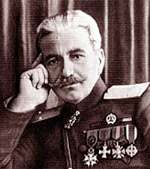
FACE OF A CRIMINAL
Antranik: The Armenian "hero" raped an innocent
Hanim Hatun before very
likely getting her killed. |
Second Lieutenand Isa at Heretil, his friends Omer,
Ali, Mehmet (Shot dead.)
Ahmo, maid of Cindi Aga at Serefhane (Burned in oven together with her baby.)
Fato, wife of Misinha at Yaman Bordo (Slaughtered together with three children.)
Ayse, wife of Mehmet Abdi at Bilecik. (Killed after her arms cut off.)
Hanim Hatun, daughter of Meho at Bilecik (Raped by gang leader named Antranik then
taken away.)
Merchant Mehmet Efendi, brother of Regiment Clerk Mustafa Efendi in Erzurum. (Robbed of
200 Liras. Murdered by bayonet.)
Mosques of Saray and Esedcu turned into stables. Many religious students forced to become
Christians. Following the liberation they all reverted to their faith of Islam.
Nezo Hatun at Perkal
Went mad after watching the murder of the parents of her grandchildren who. refused to eat
the baked flesh of their children at gunpoint
(Certified true copy based on actual investigation.)
2 March 331 (15 March 1915)
District Governor of Mahmudin
Kemal
Archive No 1/2
Cabin No 113
Drawer No 3
File No 520
Section No 2024
Contents No 11, 11-1, 11-2, 11-3
Holdwater: as a personal note, the only indication of
"Documents" put up on the Internet by the apathetic Turks, to my knowledge, was
this section; the one responsible was the infamous "Serdar Argic," in a
long-forgotten Google newsgroup ("soc.culture.turkish," countering that tireless
"professional patriot," David Davidian. This was all the way back in April,
1993.) Serdar Argic appeared to be a one-man army in those days, and it was thanks to his
contribution that the contents of this document already had made it to TAT.
|
DOCUMENT NO: 16
|
Coded Message No: 885 of 5.1.31 (18 March 1915) from General Bronzar on behalf of
the Acting Supreme Commander:
A small gendarmerie detachment was attacked by a 30-strong Armenian gang between
Maras and Zeytun and six gendarmes were killed, while recruits going to Zeytun
escorted by two gendarmerie guards were shut up in a church by the people of Zeytun.
Reasons for severe punishment of the perpetrators are omitted. All units are
instructed by this circular for sufficient strength of such units which will conduct
settlements with Armenian inhabitants.
5 March 331 (18 March 1915)
Signature
Archive No 4/3671
Cabin No 160
Drawer No 5
File No 2818
Section No 59
Contents No 1-12
|
| DOCUMENT NO: 17 |
Branch : 1
Section : 2
Hasankale
6 March 31 (19 March 1915)
TO: MINISTRY OF DEFENCE
Code-Cable
According to the cable of 3/4 March 331 (16/17.3.1915) from the Gendarmerie Division
Command in Van, Armenians at the Sitak district of Van Province attacked the Gendarmerie
and the Gendarmerie posts and have destroyed telegraph cables.
Punishment units were dispatched to the region and the detachment proceeding toward Sitak
was confronted with Armenian gangs and clashes started. The matter is being investigated
in Van province and further results will be submitted. .
Provincial Authority of Van
Code-Cable
According to the coded cable of 3/4 March 331 (16/17.3.1915) of Gendarmerie Command in Van
Armenians in Sitak district attacked Gendarmerie posts and clashes started between the
detachment sent for the case and Armenians. No information has yet been received from your
provincial authority. Report the incident in detail and henceforth report such cases
directly immediately.
Signature
Archive No 4/3671
Cabin No 160
Drawer No 5
File No 2818
Section No 9
Contents No 1-15
|
DOCUMENT NO: 18
|
Draft paper of the Third Ottoman Army
Hasankale
(11 March 31) 24 March 1915
To the office of the Acting-Supreme Commander
Coded
1. A Gendarmerie soldier and a tax collector counting sheep at the lrmiye Village of
Timar District, four hours' walking distance from Van, came under gunfire on 17
March 1915 and a gendarmerie detachment sent from the province overcame the bandits.
2. It was reported from the Province, of Van yesterday that Armenians attacked
several Islamic villages belonging to the. afore-mentioned district on 22 March
1915; that the inhabitants of the villages initially resisted the bandits; the
rebels could not hold out against the militia and Gendarmerie detachments who came
to help the villagers; that the rebels, numbering 1,000 people, retreated from hill
to hill; that this number was exaggerated; and that the bandits were armed with
Russian rifles, small and large calibre rifles, and automatic guns.
3 .The Province of Bitlis demanded the strengthening of the Gendarmerie forces on 21
March,1915 claiming that it was impossible to maintain the security of the province
and .protect the big depots near Bitlis, where Armenians were settled in great
numbers.
4. In view of the danger that these incidents would turn into a general revolt, the
Command of the Van Mobile Gendarmerie Division wrote that measures should be taken
to maintain peace under the condition that the honour of the Government is protected
and not to assign the task of ensuring domestic security to the Division combat
forces before the arrival of the First Mobilization Forces and this was agreed by
Governor Cevdet, who was at Divisional Headquarters.
5. Despite this, it was ordered that three battalions would be formed from the Depot
Conscripts of the 11th Army Corps, currently receiving military training; that they
would be under the command of the provinces of Van, Bitlis, and Elazig, as well as
the completion of the Gendarmerie units constituting the training council at the end
of the training period and the formation of five separate battalions; of Erzurum,
Bitlis and Elazig, Diyarbakir, and Van.
Signature
Commander of the Third Army
Archive No 4/3671
Cabin No 160
Drawer No 5
File No 2818
Section No 59
Contents No 1-27
|
| DOCUMENT NO: 19 |
Office of the Acting Supreme Commander of the Ottoman Army
No: 3108
The coded message coming from Jerusalem to the Office of the Acting Supreme
Commander
Answer: The code dated 8 April 1915 and numbered 5443/194:
1. The Patriarch's account of the events does not truly reflect the facts.
2. The bandits staged an armed attack against a Gendarmerie detachment carrying
ammunition to Zeytun.
3. From the beginning of the incident, my work was intended to prevent even the
slightest harm to the native population and the prohibition of even the most minor
attacks against the bandits by the Muslim population. This aim has been completely
achieved. The Patriarch cannot disprove this achievement.
4. In reality, it is possible not to persecute those who unconditionally surrender
themselves and their weapons provided that they neither took part in any attacks nor
instigated revolt. However, I definitely think that it would not be correct to
announce such a promise for the time being. Both some of the residents of Zeytun and
Maras whose stay in this area may be dangerous and some of those who surrender, must
be moved to Konya. Otherwise, I would have to maintain a considerable force in the
area for merely security reasons even in the case of an enemy concentration.
5. It is definitely not proper for the Patriarch to engage in the Zeytun incident,
even at an advisory level. 10 April 1915
Arrival: 11 April 1915 (27 March 331)
Commander of the Fourth Army
Cemal
Archive No 1/131
Cabin No 101/149
Drawer No 14-4
File No 2287
Section No 32-12
Contents No 1-37
|
| DOCUMENT NO: 20 |
Office of the Acting Supreme Commander of the Ottaman Army
Branch: 1
Private
(26 March 331) 7.4.1915
To His Highness, the Armenian Patriarch
Dear Sir,
 |
|
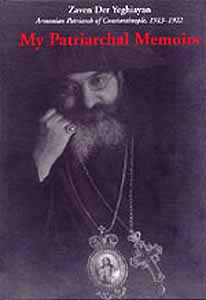
The Patriarch Zaven: His
information
did not conform to the facts.
What a surprise. |
Your detailed explanations and the information you gave
to us do not conform with the existing documents. Nevertheless, the commanders have been
ordered to make investigations into the incidents that you described. I declare here once
again that the Government's policy, as indicated in previous correspondence, is to treat
the people kindly and with absolute justice.
I wholeheartedly trust and attach the utmost value to the friendship and loyalty of the
protected Armenian nation to the Ottoman country. I have not changed my mind about this
for I have always maintained an unswerving and unreserved confidence. However, I am sure
you would also accept as an able person promoted to one of the highest echelons of our
country, that unfortunately there are some stupid people being misled by foreigners. It is
obvious that these people are resorting to brute force for the realization of their
dreams. It is most unfortunate that the Government is sometimes compelled to take harsh
measures to discipline them with the sole objective of protecting Ottoman land. I am
unable to describe the pain we feel when such a compulsion become unavoidable.
It is a fact that unrest can be quelled without assuming grave dimensions, if the leading
figures of the nation heed our advice, deplore foreign provocateurs and make efforts for
the Government investigations to deal only with such persons.
The services and activities of Your Highness are of great value for consolidating
friendship and unity among the citizens and showing them the right path to follow as well
as helping them to come to their senses. I present my best regards to Your Highness with
the firm, belief that the afore-mentioned services will be carried out. Thank you.
Archive No 1/1
Cabin No 101
Drawer No
File No 13
Section No 63
Contents No 4-2, 4-3
|
DOCUMENT N0: 21
|
The coded message received from the Mobile Gendarmerie
Command of Van on 16/17 April 1915 (3/4 April 331)
Armenians from the Sitak District of Van attacked the Gendarmerie troops and
stations and cut the telegraph lines.
Detachments have been sent out in requisite directions: The detachment proceeding in
the direction of Sitak District has confronted the Armenian bands and engaged in
fighting. Presented.
The code is kept at the First Section.
Archive No 4--3671
Cabin No 160
Drawer No 5
File No 2818
Section No 59
Contents No 1-16
|
| DOCUMENT NO: 22 |
Third Army Command
Very urgent
No: Tel-168
The coded message (7 April 331) 20 April 1915, received from
Mr. Cevdet, the Governor of Van
1. The rebels opened fire on the security stations and houses in the vicinity of the
Armenian quarters of the city. Fire was returned and the area defended.
2. As a result of clashes between the bandits near the village of Atalan, considerable
number of rebels were killed by last night and Atalan and Peltensi villages as well as the
Akkilise Monastery, fortified as a stronghold, were burned down and destroyed.
3. Gevas telegraph line. has been repaired and communication resumed.
4. Today, Baskale-HavaSor-Mirmurtal-Resat telegraph line was cut. Repair of this line is
under way.
Archive No 4/3671
Cabin No 163
Drawer No 5
File No 2947
Section No 628
Contents No 3-4
|
DOCUMENT NO: 23
|
Fourth Army Command
No: , Tel-181
7 April 331
The coded message 20 April 1915, received from
Mr. Cevdet, the Governor of Van
Very urgent.
1. The unrest beginning at dawn spread and reached critical dimensions. Neighbouring
provinces are being informed of the situation every day. I have ordered Mr. Tahsin
to regularly provide information to Your Highness.
2. Clashes in Sitak are going on. We have casualties because the Gendarmerie forces
and our officials come under fire in districts and villages without warning.
Officials have been sent from all areas. We expect to save the security stations and
Gendarmerie detachment very shortly.
3. About 400 anarchists from six Armenian villages who ambushed our gendarmerie
detachments in the districts of Havasor and Ercek have been killed. The detachments
are in action. The rebels wanted to stage an attack inside the city today.
Yesterday's observations revealed that there are many armed rebels in the city.
4. I ask for the delivery of a rapid-firing battery along with Gendarmerie battalion
to be sent from Erzincan, if this is possible. Since the revolt must be suppressed
as quickly as possible, in line with the order received, there is great need for
artillery units.
Archive No 4/3671
Cabin No 161
Drawer No 1
File No 2820
Section No A-69
Contents No 3-6
|
| DOCUMENT NO: 24 |
To the Office of the Supreme Commander
of the Ottoman Army
Section No: 3807
From Kars to the Chief of Staff of the
Office of the Supreme Commander
1. All is quiet on the front of the 9th Army.
2- Armenians surrounded the Islamic village of Hosrov in Armenia, 13 kilometers away
from the border on the night of 20/21 October 1918, fought until the night of 21
October 1918, massacred the Muslim population, and pillaged the houses.
3. An Armenian detachment, consisting of about 40 infantry and 3 cavalry, who
departed from the village of Abdikoy at the front of the 36th Division opening fire
on them and whose motives could not be determined, was overcome by return of the
fire.
4. This report numbered 912 was delivered to the telegraph office at 21.00 hours on
23 October 1918 (1334) for submission to the Chief of Staff of the Office of the
Supreme Commander and to the 6th Army Command. 23 October 1918. (23 Oct. 34)
Commander of the 9th Army
Sevki
Submitted to the Second Section
Date 24
Ordered by the Chief of the First Section
Signature
Archive No 1/2
Cabin No 113
Drawer No 3
File No 527
Section No 2056
Contents No 35
|
| DOCUMENT NO: 25 |
Office of the Acting Supreme Commander of the Ottoman Army
Istanbul
26 April 1915 (13 April 1331)
First Section
No:
Top Secret
To the Office of the Undersecretary of the Ministry of National Defence
 |
|
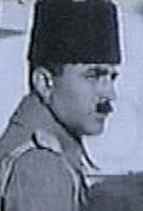
Enver Pasha:
would the
arrest of treacherous
ringleaders constitute
a "genocide" in any
other country? |
Since the Government has decided that the branches of
Hinchak, Dashnak and similar committees both in the capital and provinces will be closed
down immediately; that the documents and papers at these branches will be confiscated
without being destroyed; that the presidents of these committees, their leaders, active
members known by the Government as well as influential and malicious Armenians will be
arrested immediately; that those whose stay in their places of residence is regarded
harmful will be made to stay in more suitable places and measures taken to prevent their
escape; that searches for weapons will be conducted in suspicious places; that the suspect
will be brought before courts martial; cooperation with administrative officials and civil
servants as well as immediate response to their calls for help are hereby demanded as a
priority.
Acting Supreme Commander
Enver
This order has been conveyed to the:
First Army Command
Second Army Command
Third Army Command
Fourth Army Command
Fifth Army Command
Deputy Command of Iraq and Environs
Fourth Army Corps Command
Bosphorus Command
Dardanelles Command
Headquarters in Istanbul
Deputy 12th Army Corps Command in Mousoul
Office of the Undersecretary of the Ministry of National Defence
Army Department
Defence Department
Directorate of Judiciary
Security
Security Section
13 April 31 (26 April 1915)
To be preserved
16 April 31 (29 April 1915)
Archive No 1/131
Cabin No 101/149
Drawer No 14-4
File No 2287
Section No 32-12
Contents No 12-1
|
DOCUMENT NO: 26
|
19 April 1331 (2 May 1915)
Office of The Supreme Commander of the Ottoman Army
First Section
No: 2049 m
To the Ministry of Interior
Top Secret
The Armenians living around Lake Van and particularly at certain places in the
Province of Van are continually trying to stage a revolt. I am of the opinion that
this place of unrest should be cleaned by removing these people from this region.
According to the information received from the Third Army, the Russians drove the
Muslim population who were in wretched condition into our territories away from the
border. Both to achieve the goal indicated above and to retaliate to the Russian
move.
It is necessary either to drive these Armenians into Russian territories or to
disperse the Armenians and their families throughout various places in Anatolia. I
ask the selection of the appropriate proposition and its practice. If you deem it
appropriate, I prefer to drive the families of the rebels and the headquarters of
the revolt away from the borderline and to resettle the Muslim population from
abroad in the places of Armenians.
Ismet
Archive No 1/1
Cabin No 102
Drawer No 1
File No 44
Section No 207
Contents No 2-1, 2-2
Holdwater: This is the decisive May 2 telegram that served as the first
indication of the resettlement decision, or as propagandists will tell us, the
"genocide." The writer is supposed to be Ismail Enver Pasha, and I'm not
sure what's going on with that "Ismet" signature.
|
| DOCUMENT N0: 27 |
The Coded message No: 3166 from Acting Supreme Commander Enver on 21 May 1915 (8 May
331)
It has been reported that the outlaw leader Antranik and his 1,200 volunteers
departed from Selmas and joined a Russian division commanded by the Russian
Commander of of Azerbaijan, Chernoroyod, and that this band later proceeded in the
direction of Baskale; and that the Dashnaks have raised 4,700 rubles in Boston,
United States, for the volunteers and sent this sum to the Armenian Assistance
Association of Caucasia.
Second Section / Date 22
To be written when contact is made with
Mr. Cevdet and the First Mobile Force
Date 22 Sait
Archive No 4/3671
Cabin No 161
Drawer No 1
File No 2820
Section No A (69)
Contents No 4
Holdwater: 4,700 rubles would be a huge fortune in
today's currency. Antranik's volunteer force fluctuated in numbers, of course; a
later document (see Doc. 40 below) would claim 2,000. At times,
Soghoman Tehlirian, the assassin of Talat
Pasha, would be among the fighters.
|
| DOCUMENT NO: 28 |
The Regulations Concerning the Management of the Land and Properties Belonging to
Armenians who Have Been Sent Elsewhere As a Result of the State of War and the
Extraordinary Political Situation.
Article 1 - the management of the land and properties belonging to Armenians who had been
moved elsewhere, will be carried out in compliance with these regulations by specially
formed commissions and assigned officials whose .authorities are indicated in the
following articles:
Article 2 - Following the evacuation of a village or district, all buildings with
furniture and other objects belonging to the Armenians who have been sent elsewhere will
immediately be sealed by the special council or a civil servant appointed by the
administrative commission, and taken under protection.
Article 3 - The type, amount, value, and the name of the owners of the goods taken under
protection will be registered in a detailed way. Later on, these goods will be sent to
convenient storage places such as churches, schools, and, houses. Care will be taken to
catalogue the goods under the names of their owners. Furthermore, the type and amount of
goods, the name of their owners, where they are found and protected will be included in
registration records, the original copy of which will be preserved at the local government
and a ratified copy at the Commission for Abandoned Properties.
Article 4 - The movables whose owners are unknown, will be registered in the name of the
villages where they are found and they will be preserved in the name of the village.
Article 5 - Of movable goods, the ones that can become spoiled and the animals will be
sold at an auction by a council to be appointed by the Commission. The money received as a
result of the sale will be preserved in the name of the owner. If the name of the owner is
not known, the money will be delivered to the financial office for preservation at the
village or district trust where the sold property belongs. A document showing the type,
amount, value and the owner's name of the auctioned goods will be prepared and registered
in a special book, and the bottom of the document will be ratified by the council
conducting the auction. Furthermore, an explanatory record will be arranged, the original
copy of which will be preserved at the local government and a ratified copy at the
Commission for Abandoned Properties.
Article 6 -- Care will be taken to preserve the goods, pictures and holy books found at
the churches in their original places after they are registered and listed. Later on, the
local governments will send these belongings to the places where the population is
resettled.
Article 7 - The type, quantity or number and value of goods and land deserted by the
population will be registered in a book and the lists of abandoned properties and land
will be drawn up for every village and district and they will be delivered to the
administrative c commission.
Article 8- In the case of a crop to be harvested from an abandoned field, it will be sold
at an auction by a council consisting of members appointed by the commission. The money
received as a result of the sale will be preserved at the financial office in the name of
the previous owner. A record will be prepared and its original copy will be preserved at
the local government and a ratified copy given to the administrative commission.
Article 9 - If no one wishes to buy the crop, it can be sold to anyone by underbidding
provided that the payment is made immediately; The money received from such sales or lease
will be delivered to the financial office in the name of the original owner.
Article 10 -Representation documents for using the movable and immovable properties of the
population who had been moved elsewhere are not valid if they are drawn up after the
departure of the original owner.
Article 11 -Migrants will be resettled tn evacuated villages and the existing houses and
the land will be distributed to the migrants through temporary documents by taking into
consideration the capacity of work and demands of the migrant families.
Article 12-The places of origin, settlement date, and resettlement places of the migrants
will be registered in detail on the basis of their birth registers and by the houses they
move into. Furthermore, the houses as well as the type, .amount, and value, of the land
given to them will separately be registered and/the migrants will be given a document
showing the quantity of land and property given to them.
Article 13 -Since the migrants resettled in villages are responsible for protecting and
preserving the houses and the fruit trees in the case of damage, the villagers will
collectively pay for the loss no matter who is responsible. Those who repeat damaging
things will be moved away from the village and. their rights as a migrant will cease to
exist.
Article 14 -Following the resettlement of the migrants, the nomads will be resettled in
the remaining villages in the region and the procedures related to the resettlement of the
nomads will be similar to those applied for the migrants.
Article 15-Care will be taken to resettle the migrants from urban areas to the evacuated
houses in the towns and districts and they will be given enough land in line with their
financial and economic situation in the past as well as their productive power.
Article 16 - Income providing buildings such as shops, inns, factories, and depots as well
as the ones which are not suitable for the resettlement of the migrants and the ones
remaining vacant following the resettlement of all the migrants and the properties and
land falling outside the scope of activities and expertise of the migrants as laid down in
Article 18 may be offered for sale by the administrative commission or councils consisting
of local administrative and financial officials under the supervision of the commission.
Article 17 -A book showing the type, quantity and value of the land distributed to the
migrants as well as their names will be kept as a basis for identity registration.
Article 18 -Vineyards, orchards, olive groves and similar places in towns and villages may
be distributed to those migrants in line with their needs and success. However, they must
prove that they have the necessary experience, knowledge and energy and they must make
immediate payments for these places. After the quantity of land and property distributed
as well as the names of the new owners are registered in a special book, the migrants
enjoying this right will be given a document explaining the situation. The land which is
not distributed to the migrants will be sold by public auction as indicated in Article 16.
Article 19-With the exception of the migrants sent from other provinces with a special
warrant upon orders from the Ministry of Interior or with the permission and approval of
local governments in the provinces, those who arrive in evacuated villages and districts
as migrants and demand resettlement by submitting petitions, must produce official
documents proving that they are migrants, that they have not been sent to any other place
or resettled elsewhere, or that they had to migrate and were sent to these places by a
special order.
Article 20 - The land property that no-one wants to buy, may be leased for a maximum
period of two years provided that the tenant assumes responsibility for the protection and
maintenance and compensation of any sort of damages and pays a pledge.
Article21 -Detailed lists will be prepared in order to show the type, quantity, place,
rent, and the names of the tenants or new owners, of both the sold or leased property and
land by underbidding.
Article 22 -The sum received as a result of the sale will be trusted to the financial
offices in the name of the original owners and it will be paid to the owner according to
the information to be given later.
Article 23 - The Administrative Commissions for Abandoned Properties are responsible for
the conduct of the administration of all the abandoned properties in evacuated villages
and districts in line with the articles of this regulations.
Article 24 - Regarding the administration of the abandoned properties, administrative
commissions will be directly dependent on the Ministry of Interior and they must act
within the confines of the orders issued by the Ministry of Interior. The commissions must
also inform the local governments about their decisions and practices.
Article 25-The applicable decrees of the regulations are subject to permission from the
Ministry of Interior regarding the formation of the councils and commissions which would
administer and protect the abandoned properties. It is up to the administrative
commissions for abandoned properties to appoint civil servants on salary with permission
from the Ministry of Interior and to issue directives within the framework of these
regulations. Copies of the directives thus issued will be given to the provincial
governments.
Article 26 - Even though the commissions and officers for migrants are assigned the task
of sending migrants for resettlement in evacuated places, speeding up and arranging the
process of resettlement at such places, supervising the resettlement activities in
general, as well as making decisions in agreement with local governments and implementing
them are among the tasks of and they fall within the scope of the authorities of the
commissions for abandoned properties.
Article 27 -The commission is obliged to briefly inform the ministry and the provincial
government about its researches, final views, and activities every 15 days.
Article 28-The administration of the properties by the administrative commissions for
abandoned properties will be conducted within the framework of the decrees of these
regulations and the local civil servants will be responsible for correspondence.
Article 29 -The members of the administrative commissions for abandoned properties are
collectively responsible for the administration and protection of such properties and land
in the region as well as for the financial procedures.
Article 30 -The administrative commissions for abandoned properties consist of a specially
assigned chairman and two members, one from the financial and the other from the
administrative offices.
Article 31 -Communications and correspondence are conducted by the chairman himself or by
in the name of the chairman a member elected by the chairman.
Article 32 - If he deems it necessary, the chairman of the commission for abandoned
properties can assign one of the members to search for, supervise, or conduct anything
included in these regulations.
Article 33 -The chairman of the commission of abandoned properties receives one and a half
liras and members one lira each per day from the allocation for the migrants. They can
also receive provision for journey when traveling in the line of duty.
Article 34 -The local governments are entitled to put the decrees of these regulations
into practice in the provinces for which no commission is assigned or sent.
28 May 1331 (June 10, 1915)
Archive No 1/2
Cabin No 109
Drawer No 4
File No 361
Section No 1445
Contents No 1-3
Holdwater: Obviously, the rules above would be misused at
times, depending on the whims and corruption of the local officials. But they prove that
the Ottoman government had its heart in the right place, and this document serves as the
antithesis to "genocide."
|
DOCUMENT NO: 29
|
No: 22910 Tel:
Number: 2147
This telegram must not be delayed
The coded message dated 15 June 1915 from Mr. Pertev,
Acting Commander of the 10th Army Corps in Sivas
1. The Governor has just reported that nearly 500 Armenian bandits occupied the old
castle in Karahisar and had clashes with government forces; that 80 Armenians were
killed during the clashes and a Gendarmerie commander from security forces, a
policeman, and a tax collector were wounded while 10 people from the Muslim
population were either shot to death or wounded; and that the security forces were
burning down all the Armenian houses around the castle.
2. Military preparedness and the measures taken so far have been strengthened in the
face of possible developments.
3. Thirty cavalrymen under the command of Captain Ziya, Commander of the Cavalry
Depot Company, have departed for Susehri to protect the telegraph and telephone
lines.
4. The group of 203 men commanded by Captain Sukru that departed from the Army Corps
Headquarters on 11 June 1915 was ordered to stay in Susehri for the time being until
further notice with the objective of protecting the considerable arsenal stocked in
this city as well as the guns being sent from Erzurum to Istanbul and the
communication command informed the military post commanders that the group of 277
men to be conscripted will proceed on its way after the conscription procedure in
Zara Post and that 19 boxes of weapons presently in Susehri will be delivered to the
first group.
5. Since there are 19 boxes of weapons in Susehri and 160 boxes in Zara, it has been
agreed with the Communication Lines Command that all the boxes will be sent to the
Army Corps with the newly conscripted men for the purposes of facilitating their
transportation and arming the new conscripts in the face of new developments.
6. All of the three roads giving access from the city to the afore-mentioned castle
are blocked by the Gendarmerie forces. We ask the order of the high command even
though we are considering sending to Karahisar the first group of draftees, expected
to be in Susehri until the elimination of the rebels, and to keep it there for a
period of time in order to provide help to the security forces, and keeping the
second group in Susehri after arming the draftees.
First Section
15 June 1915 .
(2 June 1331)
Archive No 4/3671
Cabin No 161
Drawer No 2
File No 2835
Section No 127
Contents No 3-9
|
| DOCUMENT NO: 30 |
No: 23690
Decoding of the telegraph received from Mr. Muammer, the Governor of Sivas, dated
(5/6 June 31) 18/19 June 1915
We have brought Karahisar under control. Nearly 800 Armenians have taken refuge in
the castle. According to estimates, there are about 200 armed rebels in the castle.
There are some women and children with them, too. The castle's access to the town is
blocked and the castle is surrounded. Although the rebels are still resisting at
various spots, their spirit is broken.
An attack on the castle without casualties is impossible as a result of the very
steep cliff around the castle. However, the castle has been isolated. The deployed
regular force will reach tomorrow on time. Results will be informed.
Behic
Archine No 4/3671
Cabin No 161
Drawer No 2
File No 2835
Section No 127
Contents No 3-25
|
| DOCUMENT NO: 31 |
Office of the Acting Supreme Commander of the Ottoman Army
Section
No:5832
The Coded Message from Ankara to the Office of the Acting Supreme Commander
C 33
Secret
District governors and section directors reported that about 300 armed Armenians from the
villages in the vicinity of Bogazliyan attacked and burned down Islamic villages near
Bogazliyan of the Maden District and that some other Armenians also attempted to attack
the Islamic villages in Bogazliyan, killing the Muslim population and pillaging the
villages. This situation has been reported to the 15th Division Command in Kayseri and the
deployment of the entire Gendarmerie Battalion in Yozgat and the necessary number of
Gendarmerie forces from other provinces in the afore-mentioned area in order to put down
the attackers immediately and by harsh measures if necessary without causing any harm to
the population loyal to the government. What will be done and the results will be
communicated. 23 July 1915 (10 July 1331)
Acting-Commander of the 5th
Army Corps
Colonel
Halil Recai
Archive No 1-1
Cabin No 106
Drawer No 1
File No 152
Section No 384 (680)
Contents No 27-2
Date 24.7 Fourth Section
To be preserved
24 July 1915 Lutfu
Holdwater: Doesn't Armenian propaganda tell us all of the
Armenian men were killed by this time? (Peter Balakian, for example, will vouch for their mostly
having been done away with by early 1915.) Yet, not only were Armenian men alive and
kicking, some were committing heinous crimes against defenseless villagers, with the
"Turkish" menfolk away to fight the war.
|
DOCUMENT NO: 32
|
Office of the Acting Supreme Commander of the Ottoman Army
The coded message from Sofer to the Offiice of the Acting Supreme Commander
1. Starting at 03.00 hours today, clashes started between about 400 Armenian bandits
who gathered at the Kandicik village of Maras and fortified the village, and the
132nd Regiment whose mission is to wipe out the bandits. These Armenian bandits have
burned down many houses in Islamic villages in the region and killed or wounded more
than 10 Muslims during the last few days. Gendarmerie casualties include two dead
and three wounded. I am sending a regular battalion and a mountain artillery team to
support the 132nd Regiment. I have assigned Mr, Hakki, the Governor of Adana with
the mission of wiping out the bandits, by commanding the Gendarmerie and regular
forces detached from the provinces of Maras and Adana, and of preventing any
involvement of Muslim people in operations. And I have sent him, to the scene of the
event.
2- A strong reconnaissance unit sent from Aria to the canal came back to Aris on
July 18. The reconnaissance unit swam across the canal and successfully fired the
explosives planted on two different spots on the railway line 2.5 kilometers north
of Kantara. In the meantime, the same unit fired at a small patrol boat on the canal
and the crew had to leave the boat. July 19/20 1915 (19/20 July 1331)
Commander of the Fourth Army
Cemal
Second Section
To be preserved 20.5
Archive No 1-1
Cabin No
Drawer No
File No 13
Section No 63
Contents No 7
|
| DOCUMENT NO: 33 |
No: 6738
The coded message from Aleppo to the General Headquarters
1. It has been reported that Armenians in one of the companies of the Urfa Worker
Battalion killed their Captains as well as some of the Moslem conscripts and wounded other
Moslem soldiers and escaped following an attack with pickaxes and shovels.
2. More than three quarters of the men forming the communication and transportation units,
worker battalions, as well as porter and construction companies are Armenians. Even though
there has not been yet any indication of testing their loyalty, they are probably not
trustworthy. If it is necessary to keep them in such jobs and employ them, the remaining
600 out of 800 rifles which were demanded with the code dated 10 August 1915 with the
objective of protecting the communication units and deterring such incidents, must be sent
immediately. The 200 rifles received so far are not adequate for this job.
3. A big majority of the great number of Armenians working in Intelli and Ayran Tunnels,
company jobs, timbering, and on communication lines are committee members and physically
strong men. For this reason, I ask for the assignment and detachment of some 40 men from
regular forces in the face of probable action by Armenian bandits or by above-mentioned
Armenians. 28 August 1915 (15 August! 331)
Communication Commander
Major General
Veli
Arrival: 16
First, Section
4874
To the Sixth Section
The original copy of this telegraph was submitted to the Sixth Section. The Operations
Section to be informed of further procedure. 24.8
On behalf of the Director
Lutfu
Second copy 1054
Archive No 1-1
Cabin No 108
File No 13
Section No 63
Contents No 8
|
DOCUMENT NO: 34
|
Office of the Acting Supreme Commander of the Ottoman Army
Section Directorate
No 5828
The coded message from Erzurum to the Office of the Acting Supreme Commander of the
Ottoman Army
Answer; 32
1. Since all the remaining Armenian bandits in Karahisar have been punished, only
the Second Giresun Mobile Gendarmerie Battalion has been kept at the afore-mentioned
area with the objective of maintaining local security, and a force of three
battalions formed and sent from the trainees has been transported to Erzurum.
2. Upon reports revealing that over 300 Armenians gathered in a rocky area known as
Kale in Kizilin village, Ulubey county of the District of Ordu with the intention of
staging ambushes, the Gendarmerie forces in the vicinity reached this place and
engaged in clashes. At the end of the clashes, eight bandits have been killed and
the remaining ones punished by the reinforcements that reached the area later on.
3. The 11th Army Corps Command reported that the Christians living in Midyat
revolted and engaged in clashes with Gendarmerie forces as a result of their
attempts to use firearms against the soldiers;
4. A reliable source reported that some Kurds led by Bedirhani Abdurrezzak are
engaged in provocational activities in Sirnak and Pervari in order to incite the
Armenians and the loyal Kurds to a rebellion against the Government and that they
sent messages to Cizre tribes to join them. Upon this, the Mobile Gendarmerie
Battalion in Midyat was sent to Sirnak to pursue Abdurrezzak, according to reports
from the province of Diyarbakir. Furthermore, for the purpose of arming the people
who are loyal to the Government in the face of new developments, 2,000 rifles left
by the 36th Division in Diyarbakir were delivered to the provincial government in
line with a previous demand for about four thousand weapons. 15 July 1331
(28.7.1915)
Commander of the Third Army Corps
Mahmut Kamil
Archive No 1-1
Cabin No
Drawer No
File No 152
Section No 680
Contents No 27, 27-1
|
| DOCUMENT NO: 35 |
Ministry of Defence
Army Department
Army Section
No: M/1950-31-0-1
Istanbul
(11 August 331) 24 August 1915
Very Urgent
To the Central Headquarters
1. It is necessary to send by this evening a 100-men detachment under the command of one
or two capable officers along with the requisite spare ammunition and food sufficient for
three days for the purpose of eliminating the incidents of robbery perpetrated by
Armenians in the Yalova Region.
If this detachment can be formed from the battalion on the other side (Asiatic side),
application should be forwarded to the Haydarpasa Lines Commissioner and it should proceed
to Yalova via Gebze. If the detachment is to be formed at this side (European side),
contact should be established with Docks and Ports Command for crossing the Strait.
2. The Maltepe Communications Post Commander will be responsible for the food supply of
the detachment force. Major Refet, the Commander of the Izmit Gendarmerie Battalion will
command the detachment. Following the termination of the mission, the detachment will
re-join its regiment upon the order of the afore-mentioned major.
3. The hour of departure of the detachment will be reported to the Chief of Staff of the
First Army.
On behalf of the Minister of Defence
Signature
Archive No 5/1920
Cabin No 204
Drawer No 3
File No 4708
Section No 2
Contents No 9-9
|
DOCUMENT NO: 36
|
The coded message from Jerusalem to the Office of the Acting Supreme Commander
No: 7097 DTG
1. The Armenians to be moved away from the district of Antakya gathered at Mount
Musa, north of Suveydiye, and decided to resist. A few of these Armenians took
refuge on enemy warships by escaping by boat. It is possible that the cruisers
"Victor Hugo" and "Henry Fastersine Louis" and three other
unidentified warships took up positions in the Suveydiye region upon these
Armenians' calls. Two regiments from the 41st Division and a mountain artillery team
were sent against the rebels. As a result of the bombardment by warships
"Victor Hugo" and "Henry Fastersine Louis" of the units and
headquarters in and near Kabakli, Kabakli Village was destroyed and casualties
include eight dead from military and civilians, two wounded, and 20 dead animals.
2. The detachment proceeded towards Damlat, the rebels' hide-out at midnight on
August 30, 1915, but no contact took place with the rebels. This reveals that the
Armenians took refuge on enemy warships at night. I am sending General Fahri to the
scene of the events to punish those who permitted the escape of Armenians and caused
unnecessary casualties by not taking care in concealing the headquarters.
3. Other Armenians in Iskenderun and Antakya are speedily being driven away from the
region. 14.9.1915 (1 Sept. 331)
Commander of the Fourth Army and
Secretary of the Navy
Cemal
Second Section 2-7
To be preserved/ 4-7
Archive No 1-1
Cabin No 10
Drawer No
Fiie No 13
Section No 63
Contents No 11
Holdwater: And here we thought those French warships (actually, only one
ship) appeared once the Musa Dagh
Armenians were at the ends of their rope, and hung a bed-sheet declaring
"CHRISTIANS IN NEED"!
|
| DOCUMENT NO: 37 |
Office of the Acting Supreme Commander of the Ottoman Army
French Statement dated 22 September 1915
French cruisers have taken five thousand Armenian refugees, who had been resisting since
the end of July on Mount Musa, north of Antiyuh Port and who recently ran short of
ammunition and food, and transported them to Port Said.
The original document was given to the Second Section on 11-7
To be preserved/ 11-7
Archive No 1-1
Cabin No 10
Drawer No 2
File No 13
Section No 63
Contents No 16
|
DOCUMENT NO: 38
|
To the office of the Acting Supreme Commander in Istanbul
Sent from : Headquarters in Jerusalem
No : 18693
Dale : 26
Hours : 03.35
Urgent. War telegraph, not to be delayed anywhere
The force that I have sent against the Armenian bandits who took shelter in strong
and fortifiable buildings in Urfa and which I have strengthened with a battalion of
regular forces and an artillery team, will start an exemplary punitive operation.
Some of the rebels took refuge in American missionary Leslie's House of the Orphans
near the Armenian quarters. In the face of the importance of Urfa as a city where
many enemy nationals are living, I have sent General Fahri to the city with the
mission of exploring the possibilities of conducting the punitive operation in the
most effective manner. He has reported to me that there are two Britons and two
Frenchmen along with American missionaries in the aforementioned building, that the
Armenians made preparations for defence by building machine gun slits, that he sent
a message to the missionary to get out of the building, and that he attached a
written statement to the gate of the building. In reply to this report, I ordered
him to send written invitations for a meeting with five leading enemy nationals, to
post another statement in public, to prepare records proving that the foreigners are
witnesses to what is going on, to have these records signed by the foreigners, and
then to sign them by himself, the chief of staff, the prosecutor, and another
American if — there is one. General Fahri reported that he called seven persons
but they did not want to sign the records even though they were shown the statement
and the machine gun slits on the building. He also reported that he sent two more
letters to Leslie but this person hung a white cloth on the building on which was
written: We want to get out but they do not allow us to leave the building. It is
possible that the artillery fire directed against the rebels would also cause damage
to this institution. I ask Your Highness to inform the American Ambassador at once
that a possible loss of life of the foreigners in the building could be unavoidable
1 Sept.331 (14.9.1915)
Commander of the Fourth Army
Anmet Cemal
To His Highness, the Supreme Commander
Sir, above are the General's wishes from the Supreme Commander. Your order is asked
for informing the Ministry of Foreign Affairs in order to warn the embassy.
Second Section
17846
Archive No 1-2
Cabin No 113
Drawer No 4
File No 533
Section No 2082
Contents No 2-75, 2-76, 2-77
|
| > DOCUMENT
NO: 39 |
The copy of the second article of the code no: 7664 and dated 3 0ctpber, which was sent by
the Fourth Army Command
2- The confrontation in Urfa ended today with the conquest and destruction of the bandits'
hide-out and the elimination of the rebels. The need for artillery support and the strong
and reinforced refuge of the rebels which was made of stone were the major cause of the
failure to solve this question beforehand.
Casualties from the gendarmerie forces and the people include 20 dead and 50 wounded.
M
10193
Second Section
18139
Archive No 1-2
Cabin No 109
Drawer No 4
File No 361
Section No 1445
Contents No 11-11
|
DOCUMENT NO: 40
|
The copy of the report No: 174 and dated 30 March 1916 from the Military Attache in
Bucharest
File 28 5 8
The Armenian volunteers who are still in Caucasia are organized as follows (From a
report):
Group No:
Commander:
Force:
Region of Operations:
1 Well-known rebel Antranic 2000 Armenian volunteers and two Don Kazak Battalions
Region of Van
2 Rebel Hamarosp 1200 Armenian volunteers and two Don Kazak Battalions Along the
Van- Erzincan War Line
3 Rebel Daro Pastirmadjian
(Officer in Turkish Army and member of the Ottoman Senate). 2000 Armenian volunteers
and five Portkai Kazak Battalions Against Iron on Culfa -Tebrizce Line
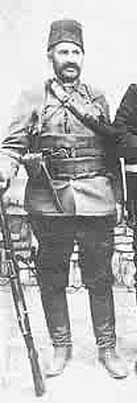 |
|
Keri |
4 Rebel Keri 1000 Armenian volunteers and two
Kazak Battalions Kars
5, . ....Karakin (a former Bulgarian officer) 5000 Armenian volunteers Recently a
Kazak Regiment joined in Caucasian region As reserve force in ....region
6 , Famous rebel Haig Pajise-liantz 2000 Armenian volunteers Engaged in battles in
Erzurum line, now in Kars
Besides these, there are 6000 Armenian volunteers in Tiblis receiving military
training.
The 71st Turkistan Regiment, remaining parts of the 75th and 81st Turkistan
regiments as well as the 38th and 156th Light Artillery regiments returned to
Tibilis from the war zone.
Archive No 1-2
Cabin No 108
File No 318
Section No 1287
Contents No 1-31
|
| DOCUMENT NO: 41 |
To the Office of the Prime Minister
The people who took refuge in interior regions by escaping from the war zone at the end of
the military operations have been sent to new settlement places, resettled, fed, and given
medical aid as well as clothes by our Directorate within the framework of the special
organisation and arrangements given below in detail. The number of such refugees reached
702,900 by the end of October., Even though the people who took refuge and resettled
through their own means without Government assistance are not included in the
above-mentioned figure, they, too, are given financial aid when they request it.
Since the beginning of 1915 when the migration started, those who took refuge in cities
and towns near the war zone such as Giresun, Samsun, Sivas, Elazig, Diyarbakir, and
Mousoul were not kept in small squares or areas to prevent spreading contagious diseases.
The refugees were also sent to places providing better sanitary conditions as well as food
and resettlement possibilities. Transportation vehicles were provided for the women,
children, and the sick to eliminate difficulties during transportation and care was taken
to effect distribution and detachment in an orderly manner. Furthermore, health stations
were set up and the refugees had vaccinations against smallpox, typhoid, typhus, and
cholera.
Their nutritional needs were met during their journey and they were given hot meals in
certain places. The rules and regulations concerning the administrative advice and
practices to be put into effect by administrative directors and migration officials in
connection with such assistance and basic protection principles have been prepared and
submitted to Your Highness as Document No: 1. It has been regarded appropriate to take the
utmost care in implementing these rules and regulations and to inform you briefly of the
general results as follows:
The original residential places of the refugees as well as the regions selected as
resettlement areas have been categorized in four groups with regard to climatic
conditions, food resources, geographical resources and the general condition of
transportation facilities.
"1" The refugees coming from Eastern Erzurum and the Trabzon coast have been
transported to Ordu, Giresun, Unye,. Samsun, Bafra, and Kastamonu via both land and sea.
"2" The refugees corning from Western and Southern Erzurum and Southern Trabzon
have been transported to Ankara and neighbouring regions via the Sivas-Tokat way or to
Kayseri and Nigde via Sivas-Kayseri way.
"3" The refugees coming from the southern and southeastern part of Erzurum have
been transported to Elazig, Malatya, and Maras via Kemah.
"4" The refugees coming from Van and Bitlis have been transported to Diyarbakir
and neighbouring regions, Urfa, Gaziantep, and partially to Adana via the Diyarbakir
route.
Since the transportation, resettlement, and food supplies of the refugees, the protection,
feeding, and care of the widows and the orphans, and the treatment of and medical supply
to the sick as well as the organization and facilities for such needs are provided and
carried out in line with the local characteristics and requirements of every region, it
has been regarded compulsory and appropriate to gather detailed information for every
region separately.
1. The people living in Trabzon and the neighbouring coastal areas have been sent to Ordu,
Giresun, and Samsun in small boats. Although this is the shortest and safest way of
transportation at times of lessening enemy pressure, it could not be carried out as
desired owing to the small number of boats. However, the number of people who took refuge
and received government aid by this way reached twenty thousand. Even though some people
have been transported by land via Karahisar and Sivas, or Niksar, Erbaa, and Amasya, the
inadequate number of transportation vehicles could not bring the state of comfort and
relaxation of the refugees to the desired level. Those coming from Ordu and Giresun by
their own means and resettled in Terme and Carsamba, have been affected by malaria. Since
further stay in this region is considered hazardous, most of them have been sent to Amasya
and Merzifon and the remaining ones to those villages in the area unaffected by malaria
and resettled there. Even though some of the refugees in Samsun have been affected by
malaria, the distribution of quinine has lessened the effects of the disease and there
have been no deaths. Some of the refugees, particularly the villagers, have been sent to
Corum via Kavak, Havza, and Merzifon, and some of them to the Sinop- Kastamonu region via
Bafra. The remaining group of refugees are being sent to the south within the scope of the
possibilities available.
Today, the number of people who took refuge in the region is 79,100. 18,000 of these
people are in Samsun, 18,000 in districts affiliated with Samsun, 4,000 are ready for
transportation in Bafra, another 18,000 people are in Carsamba, 1,600 in Terme, 7,000 in
districts affiliated with Terme, 18,000 in Unye and 5,500 in Fatsa.
Medical examination centres and food stores have been opened in Fatsa, Unye, Terme, and
Carsamba for the medical treatment and feeding of the refugees going to the sub-province
by land. Refugees are given hot meals and vaccinated in these places. Furthermore, the
sick are undergiong medical treatment at special hospitals opened in Samsun, Carsamba, and
Unye. In the meantime, the military communications hospitals set up in Fatsa, Unye, Terme,
and Carsamba are also providing assistance to the refugees in case of need. Moreover, food
stores have been opened at every four hours' walking distance on the roads for meeting the
nutritional needs of the group of refugees traveling from the sub-province to Sinop via
Bafra or those sent to Corum via Kavak-Havza road. An orphans house and a milk centre have
been opened in Samsun and all refugees are given financial aid, adults being paid 30 paras
a day and the children 60 paras. Porridge, boiled and pounded wheat with meat and rice are
distributed once a day to the poor and rice are distributed once a day to the poor and the
physically weak refugees.
2. The refugees coming from Erzurum and its environs to Sivas are taking the Susehri and
Zara-Kochisar route to Sivas. The refugees to be sent to Corum via Tokat have been sent to
Tokat via Susehri-Koyulhisar- Niksar route. Since the refugees coming to Karahisar via
Alucra are to be sent to Kayseri, Refahiye route and Corum..... are transported via
Mesudiye-Resadiye-Niksar route. With the help of the medical examination and food supply
centres as well as health institutions set up by the military, the process of
transportation has taken place in an orderly and continuous way. Particularly the number
of people vaccinated as a precaution against a variety of diseases reached 150.000. Even
though the sub-provinces of Tokat and Amasya of the Province of Sivas are included in the
resettlement regions, since the number of refugees arriving in Sivas exceeded 300,000 and
their food supply and resettlement needs could not be provided to the full at the inner
provinces which constitute the operations area of the Third Army, 144,964 people have been
sent to the directions of Corum, Yozgat, Kayseri, Nigde, Kirsehir and Konya in various
intervals and the remaining refugees were distributed houses for resettlement in the
region within the boundaries of the province of Sivas. So far, a total of 8,637 houses
have been distributed and 2,154 houses previously rented were also given to the refugees
by abolishing rents.
The widows and orphans among the refugees have been resettled in poorhouses and vocational
schools previously established in many places and extended afterwards by the provincial
governments. At such places, the women and the girls are taught carpet weaving, cloth
making, and sewing and the boys are trained as blacksmiths, carpenters, tailors and
similar professions. Our ministry is also giving financial aid to such institutions.. Milk
centres, refugee hospitals and refugee kitchens have been set up in Sivas, Yenihan, Tokat,
Amasya, Merzifon, and Zile, and the distribution of hot meals and meat to the poor and
infirm refugees have been taken under guarantee.
3. Those who took refuge in eastern and southern regions of Erzurum and the western region
of Van are proceeding into the interior regions of the province of Elazig via Kemah or
Divrigi and Kangal, or Patoguzinhan routes. Although the requisite food supply and health
institutions have been hampered by the adverse physical conditions of the roads and the
lack of transportation has been hampered by the adverse physical conditions of the roads
and the lack of transportation vehicles.
Those who arrive in the province of Elazig are being resettled in the central
sub-province, Malatya sub-province, and the districts of Adiyaman and Besni. So far
approximately eighty thousand people have taken refuge in this province. Of all these
refugees, 4,500 people have been resettled in the districts of Adiyaman and Besni of the
central district of Malatya. Some of the remaining refugees have been sent to Diyarbakir,
and the others to Maras and Gaziantep via Malatya. Regarding the food resources and
accommodation facilities, this province is thought appropriate for receiving more
refugees. Therefore, it has been decided to make detachments from Sivas to this province
in case of need. On the road from Malatya to Elazig, beginning from Sivas, food supply
centres have been set up in Deliktas, Ulus, Kangal, Alacahan, Hasan-Celebi, Hekimhan,
Hasanbadrik and in the centres of Malatya-Izoli-Kadikoy and Elazig. Refugees were given
hot meals in these centres. The refugees also went through medical examinations at the
health centres in Kangal and Deliktas and they received medical treatment at the Kangal
Communications Hospital. A hospital, orphans' house, milk centre and refugee kitchens have
been set up in Harput, Elazig, and Malatya.
4. The refugees who arrived in the province of Diyarbakir from the region of Van, Bitlis,
and Mus, used the Palu-Guzinhan-Ergani or Siirt- Lice or Siirt-Silvan routes. Since the
population increase in the province was over 200,000 people, it was decided to send some
of the refugees to Siverek and Urfa affiliates via Siverek and the others to their
pre-determined places of destination either via Mardin, Telermis, and Resulayn route or by
railway with the objective of decreasing the number of people in Diyarbakir, included in
the operations area of the Second Army. Following the establishment of the necessary food
supply and medical centres along the Siverek road the transportation of the refugees by
railway has started. However, upon the orders given by the Second and Fourth Army
commands, it is seen that the refugees to be resettled in the western region of the Taurus
mountains will spend the winter in Urfa and.the detachments to Islahiye by railway have
been discontinued, with ceasing of transportation in Telebyaz Arab, that is Resitpinari,
and detachments resumed towards Urfa. The number of people who took refugee in Diyarbakir
is 16,901 at the central district and 16,162 at.the district of Mardin., So far, 40,000
refugees have been sent to Urfa. The detachment is taking place in orderly groups, the
refugees are fed at the food supply centres set up along the road arid the groups are
vaccinated to prevent contagious diseases.
A hospital and rest houses have been .specially set up for the refugees in Diyarbakir.
Furthermore, about 10,500 children were brought to the kindergartens set up in Diyarbakir,
Mardin, Siverek and Urfa. Detachments to Gaziantep and Maras have not exceeded 15,000
people at present and it is planned to send only 10,000 people to the province of Adana.
However; the necessary arrangements on this route have been made and a refugee station has
been set up in Pozanti as a precaution..
All sorts of administrative means necessary for the accommodation and feeding of the
refugees until they are sent to their resettlement areas have been utiliized.
Administrative Chiefs and Refugee Officials have been assigned with the duty of enforcing
the decisions made in the Capital. A supervisor has been appointed for every region.
However, as a result of the inefficiency of the branches of the Directorate General of
Refugees specially set up for the accommodation of the Muslim population coming from
outside and of the nomadic tribes, local government officials were also assigned to deal
with the problems of the refugees and the employment of officials on a daily wage basis
has begun in the necessary regions. Even though the problems of the refugees gathering
together in operations areas such as Samsun, Sivas-Harput, and Diyarbakir initially until
they are sent to their resettlement regions have been carefully dealt with and they are
given financial aid on a daily basis, their movement and nutritional needs could not be
met at the desired level owing to the difficulties encountered in providing the food
supply and transportation vehicles as well as the climatic conditions and the poor road
conditions. Despite these difficulties, however, a food supply was found at the
Communications Depots of the Second, Third and Fourth Army commands and distributed to the
refugees, furthermore, particularly the health councils of these armies provided much
appreciated assistance in examining and treating the refugees.
The arrangements and facilities regarding transportation, nourishment, and accommodation
are under the responsibility of the General Directorate of Refugees and Tribes of our
Department and the Civil Service Control Boards have been appointed with the task of
supervising the carrying out of these activities. Tackling health problems is being done
through the mediation of special supervisors in harmony with the Ministry of Health. It is
intended to leave the administration of the milk centres set up so far to the provincial
governments. Since the extension of the scope of provincial governments is outside the
authority of our Ministry, we ask the opinion of your highness about handing over the
kindergartens to the Ministry of National Education afterwards.
No one should have the right to claim expertise in administering an exodus of about
800,000 people escaping from the difficulties created by the war, particularly in the face
of the well-known internal situation of the country, climatic conditions and the fact that
the elderly, women and children form the majority of the refugees.
However, establishment of medical examination centres along the roads, vaccination of the
refugees, nourishment of the refugees at times of departure, provision of transportation
vehicles to the elderly and the children, serving hot meals to those people at resting
places during travelling, the partial, meeting of the clothing needs of the refugees,
taking care of the people disturbed by such long journeys, the meeting of the basic needs
of the refugees such as accommodation and nourishment, protection of the sick, the infirm,
widows and the children at special facilities and their resettlement by providing houses
and land have been conducted at a satisfactory level. That is, the question of refugees is
being tackled by the Prime Ministry in an admirable manner in spite of all the
difficulties arising from this situation.
The total amount of money spent for the refugees reached 25 million kurus in the last year
of 331. The amount of money spent by the end of October, of the current year totalled 80
million kurus and approval has been given to spend at least 100 million kurus by the end
of this year in order to meet only the nourishment needs of the refugees.
A schematic sketch of the institutions set up in the resettlement regions where the
refugees have been and are to be transported, such as medical examination centres,
hospitals, kindergartens, and workshops has been presented to the Office of the Prime
Minister as document No: 2.
4 December 1916
Archive No : l .-.2
Cabin No :
Drawer No :
File No : 361
Section No : 1445
Contents No: 15 -- 22, 15 - 23
Holdwater: This document sheds light on the other side of the
coin: the Muslim and other Ottomans who were getting resettled, no less against their will
than the resettled Armenians. They were starving, getting sick, and suffering no less than
the Armenians, yet no one ever spends a breath on them. Why is this? Were they no less
valuable as human beings?
|
DOCUMENT NO: 42
|
Office of the Chief of Staff
of the Third Army Command
Section: 1
Branch: 3
No: 939
Headquarters of the Third Army
4 October 1917
To the Office of the Acting Supreme Commander
Lieutenant Nichola's impressions of the abominable atrocities committed by the
Russians and particularly Armenians against the Muslim population are presented
below. The above-mentioned lieutenant, the Commander of the 12th Company of the
156th Regiment took refuge with the 36th Caucasian Division on 2 September 1917.
The impressions of the above-mentioned document in Russian and in his own
hand-writing are also attached to this document.
"The Muslim population in Elizabethpol, Baku, and Akhaltsikhe was massacred by
the Cossacks as a result of the unrest among the Muslims during the Sarikamis
Operations.
The Armenians among the ranks of the Russian Army are the most loathed and despised
people. These people usually run away during the battles and hide in the villages.
They falsely report that they become sick and shoot themselves to escape from
battles, but they never avoid any opportunity of pillaging. Upon enemy retreat, they
immediately proceed to the front line, pick up anything they can find, and then hide
the rifles, bombs, etc. They indiscriminately rob, both the dead Turkish and Russian
soldiers.
At the beginning of the confrontation, they stole 6 machine guns from a regiment of
the 39th Division in Khorasan and buried them. These machine guns were found after
an investigation and the guilty Armenians were sent for court martial.
Since the Armenians can speak Turkish, they get married to Turkish girls who need
protection in Erzurum under the guise of Caucasian Muslims and then divorce these
poor girls under the pretext of ordinary quarrels.
They usually do not pay for the goods they buy from the people in villages and
cities, particularly from the Muslims. They frequently rape women and girls in rural
areas and villages. Even in secure areas, such as in some quarters at the edge of
Erzurum, they attempted such acts and those who were caught have been punished.
The attitudes and behaviour of the Armenians in villages are utterly inhuman. Since
firewood was expensive in Erzurum, the Armenians destroyed the houses in the
villages and sold the wooden beams of these houses as firewood in the city last
winter. These beams were not taken solely from the deserted houses. The Armenians
usually went to a village, entered a house they liked its look and asked the owner
of the house to give a room for themselves. Or, they would take away the people
living in the houses outside, stay in the house for a few days, then dismantle the
roof, and take the wooden parts to the city by an ox-cart also belonging to the
owner of the house. They would also take pretty Muslim girls or women away with them
telling them, 'Once you were an Armenian.' If these women or girls say that they
were not Armenians, they are beaten and intimidated, poor creatures. When some of
these women had the opportunity to file a complaint to the government, the
administration returned them to their families.
It is sufficient to mention just some of the terrible and shameful crimes committed
only in Erzurum to get an idea about the Armenian atrocities in the villages.
A few people dressed as Muslims climbed the roof of a fairly high building in the
Kars Gate region with a few rifles and a machine gun. From this spot, they opened
fire on the house of the general, who was the Commander of the Erzurum Fortified
Zone. Of course they were caught. Then they spoke like heroes, declaring that they
were Muslims; that they would sacrifice anything for the sake of the religion and
the state; that all Muslims would revolt and destroy the Russians; and that they had
plenty of arms and soldiers to attain their targets. The Russians were scared of
their testimony. Ye Katri-ta Goravisky Polk, who was in Erzurum at that time,
immediately ordered the search of all the houses of the Muslim population. The
Armenians, under the pretext of revealing the hidden arms and pointing out the
houses to be searched, entered the buildings at random and pillaged the whole city.
They have taken anything they found in the houses, such as money, necklaces, belts,
carpets, bracelets, and valuable clothes. They raped a great number .of women. At
the end of the searches, only pencil sharpeners and bread, knives were found, Some
of the Muslims formed a group and went to the Commander after the searches. They
complained about the pillaging and raping. The Commander took some of the goods
seized by the Armenians, and returned them to their owners. Upon the request of the
Turks, those who opened fire at the commander's house were brought face to face with
the Turks. It was then revealed that one of the bandits was an Arrnenian who once
worked as a jeweller in Erzurum. Two Muslims from Erzincan and Trabzon also proved
that the other two bandits were Armenians, too. Upon this, the Russian government
drove away all the Armenians in Erzurum and the Turkish Armenians in the vicinity
from the region. But I do not know what happened to the influential and armed
Armenians.
There were Russian troops in the villages near Erzurum. In one of these villages (as
far as I remember, the name of this village is Kan), the Armenians murdered a
Russian guard at night, cut the. body into pieces, put them in a sack, and asked a
Muslim porter in the morning to carry the sack to the house of the Mayor who was an
influential person and a Muslim. The porter meets two Russian soldiers on his way to
the Mayor's home. The soldiers ask the porter what is inside the sack, The porter
answers that he does not know what is inside and adds that he was paid to carry it
to the Mayor's house. The soldiers ask the porter to open the sack and that they
will buy anything useful for them. The porter does not comply with their wish on the
grounds that the sack does not belong to him. Saying that the porter does not want
to sell anything to them but he would sell the things to the Muslim, the Russian
soldiers bring down the sack and open it. The porter was placed under arrest.
However, it was proved following an investigation that the murderers were Armenians
and they were sent to Court Martial.
Even though the Russians did not want it and did what they could to prevent it, a
great number of pillages and murders took place in Erzurum at the beginning of the
invasion. The atrocities were more horrible and greater in number than can ever be
imagined.
I do not exaggerate if I say that there were only one or two hundred girls who were
not raped. I shall never forget the following incident. The Armenians broke into a
house at a quarter in the south of Erzurum. They tied a young couple to two columns
in the house. Then they inserted a stick into the anus of the couple's one-year-old
son in the middle of the hall. I have personally seen the body of the boy. The
mother of the dead boy went crazy. She was wandering about in Erzurum absolutely
demented. For this reason, her husband did not want her back in the house. However,
the government forced the husband to take his wife home.
I would also like to mention with disgust an abominable sight, a stain on humanity,
that I encountered at the west of Hasankale while my regiment was proceeding into
this town. There was a young Turkish woman, apparently once a very beautiful one,
lying dead on one side of the road. A huge stick had been inserted into her vagina.
We took the corpse and left it at a spot that was invisible from the road.
Such actions of the Armenians are a part of their character, their nature, rather
than anything having to do with hatred. The Armenians are responsible for almost all
the frauds that have taken place in the Russian Army. In the cases of fighting,
robbery, murder, or adultery, the Armenians are always the aggressors. All the
Russians are of this opinion. When a Russian, even a Cossack, is asked to compare
the Turks and the Armenians, they regard the Turks as at least 10 times more
civilized, respectable, and moderate than the Armenians. The Cossacks are sick and
tired of such actions of Armenians and whenever they meet an Armenian they would
immediately kill him if they could be sure they would not be caught. All the Russian
Army, without a single exception, denounce the Armenians with the words, 'Armenians,
go to hell."
More information gathered on this subject will immediately be presented to you.
Husrev.
23 October 1917
No: 9155
With the order of the Commander of the
Third Army Communications Commander
Colonel Muhittin
Delayed as a result of travelling,
Submitted to the Second Section; 24/11/1917
Acting Assistant Section Director
Major Ali Sukru
Archive No 1-2
Cabin No 110
Drawer No 1 (4)
File No 373
Section No 1484 (1032)
Contents No 9, 9-1
Holdwater: Well, that was pretty ironic; the Armenian
antics even made the Cossacks sick!
This document gives us a nice cross-section of all the underhanded tricks of the
Armenians. I like the one where they pretended to be Turkish, married Turkish women,
and after they had their jollies, dispensed with the poor ladies with the old
Islamic divorce decree (where all a man basically had to say was "I divorce
you"). Naturally, one wonders why these poor examples for men would have even
needed to go through so much trouble, when rape was the order of the day.
|
| DOCUMENT NO: 43 |
To the office of the Military Police
My wish,
Recently, some Greek, Jewish, and Armenian tradesmen asked the officials of the German
Army in Istanbul whether they had any foodstuffs, gold, money, shoes/dresses, etc. and
proposed very high prices in return. With the help of the Turkish police, the German
patrols acquired the names of a few such tradesmen in Kadikoy and Moda and reported this
information to us. A Greek named Kooperatif at the British store, a Greek tailor named
Matezakis, and an Armenian wine and Liquor trader named Karabet who works at the Munyakit
Han in Kadikoy are among the tradesmen known for such activities.
In the meantime, a Jew in Beyoglu named Isaac Levi, as indicated in the list attached to
this petition, attempted to trade money with officials from the German Army.
I respectfully ask you to punish these mean tradesmen through legal channels and to
prevent the repetition of such acts:
21-12- 1917
Senior Officer of the German
Military Police
Major
Signature
Archive No 5/1920
Cabin No 204
Drawer No 3
File No 4608
Section No 6
Contents No 13
To the Arbitration Section/ Date 9
Arbitration Section 33
Documents 22936
|
DOCUMENT NO: 44
|
Ceasefire Agreement between the Ottoman and Russian Armies at the Ottoman Caucasus
Front (1)
The following ceasefire agreement has been reached with the desire of halting
fighting between the Ottoman and Russian armies on the Caucasian Front in order to
reach an honourable peace at the earliest opportunity :
Article 1 : The Provisions of this agreement will be made obligatory by both sides
as from 18.12.1333 (5 December 1917) until the conclusion of a final peace
agreement. If any of the parties deems it proper to break this agreement, that party
is obliged to notify the other party 14 days in advance before starting any combat
operation.
Article 2 : As from the moment of this agreement going into effect, both parties
will halt all combat operations at the Ottoman Caucasus front. (x) The parties will
not carry on any operation not only among the opposite units, but also in the region
up to 10,000 meters from the boundary line.
Article 3 : The boundary lines are clearly indicated in the Annex to this Agreement
and are marked on a Sketch. In the region of the 1st Independent Caucasus Army Corps
and the 1st Caucasus Cavalry Corps and of the Ottoman Army front of the opposite
side will be established by Commissions in which both parties will agree.
Article 4 : As from the signing of this agreement, the parties undertake not to
carry on any strategic operation, and not to carry on any extraordinary troop
movements, and particularly to prevent movement of the troops to the Iraqi and
Syrian fronts. Operations contrary to this article will be considered as the
indication of resuming combat operations. Only orders issued until six o'clock on
15.12. 1333 (2 December 1917 18.00 hrs) will be carried and orders issued after the
given hour will be withdrawn. (xx)
Article 5: Both parties reserve the right to replace their units or on the issues of
housing and settlement within their regions behind the separating boundaries,
provided that the strength of forces in divisional regions are not raised
Article 6 : The parties agree not to carry any preparations for attack as long as
this agreement remains valid. The existing positions and shelters, however, may be
restored to their previous conditions.
Rifle and machine-gun firing training ranges will be 5,500 meters to the rear of the
separating boundary, while artillery firing training ranges will be 15,000 meters to
the separating boundary at the minimum. The parties will notify each other in
advance about training firings.
Article 7 : The parties undertake not to despatch any security echelons,
reconnaissance units or reconnaissance teams beyond the separating boundary.
Article 8 : The parties undertake to prevent the passing of soldiers or local
civilians to the no-man's-land between the separating boundaries as long as this
agreement remains valid. All males of the age of military service who cross into
no-man's-land will be considered prisoners. of war. The parties agree, however, to
permit and assist the soldiers of both sides to utilise the water and wood resources
in no-man's-land.
Article 9 : Disputes to arise during the application of this agreement will be
solved by authorised persons to be designated by both parties. At the beginning for
talks on each incident, the parties, through the assistance of the contacting
officials will establish the time and site for the meeting. If possible, the
contacting officials between the army headquarters, will be sent to the
Refahiye-Erzincan highway.
Archive No. 4/1933
Cabin No. :
Drawer -No. :
File No.: 2697
Section No. 284
Contents No. 1-9
(1) From the Black Sea to the Mervane-Carcalan line
(x) Both parties are authorised to use illumination ammunition and projectors
(xx)The given hour will be the time for the first joint session
|
| DOCUMENT NO. 45 |
Coded Message No. 3804 from the 3rd Army to the Supreme Command
A summary of the statement of three persons who were sent from the Kemah Front to Erzincan
a week ago, who have now returned is hereby, submitted :
1. The Headquarters of the 1st Caucasian Army Corps and of the 4th Turkestan Division have
moved on 13.1.34 (26.1.1918) from Erzincan to Erzurum. Some 150 Russian soldiers have
remained in Erzincan to guard certain depots and stores which have not yet been
transferred to Erzurum. Some 1,000 Armenian volunteers old and young, in uniforms or in
civilian [dressed] have been observed in Erzincan. They are led by Murad, one of the
Dashnak leaders.
There are no Georgians among the Armenians in Erzincan. It is not clear whether Armenians
have a regular organization or not. Three mountain artillery guns were seen in the Church
square in Erzincan. The Moslem population is being secretly murdered by Armenians while
plundering and rape cases are widespread. Armenians are also spreading information to the
effect that very soon 20,000 infantry volunteers as well as banknotes printed on behalf of
the Armenian Government will soon reach Erzincan. A former Armenian building, used by
Russian Forces as a hospital, was burnt down by the Russians during their evacuation.
The Russians further started to move their troops from Erzurum to the Caucasus.
2. An Armenian gang raided the Koska Moslem village some three Km.s south-west of Ardase,
burning the houses, plundering their properties and raping women. Inhabitants of Zekginc
Village, 18 Km.s. south-east of Erzincan, suffered similar Armenian raids.
3. Please be advised that I have already written to General Odisalidje, Commander of
Russian Caucasus Army and to General Benzavaliski, Commander-in-Chief of the Russian
Caucasian Armies, to prevent the cruelties underlined in Articles 1 and 2 above and to
punish perpetrators.
22-1.34
Commander 3rd Army
Vehip
Archive No 1/2
Cabin No 113
Drawer No 3
File No 525
Section No 2046
Contents No 6-2, 6-3
|
DOCUMENT NO. 46
|
War Documents File
No.
Decoding
564
100
Refahiye
22.1.34 (22.1.1918)
COPY
To the 3rd Army Command
1. Three enlisted men and two civilians from different units who were taken as
prisoners of war on different dates, have taken shelter in our advanced posts of the
36th Division at Manzuri through the Mezekler River on 20.1.34 (20.1.1918).
These persons set off from Erzincan on 18. 1.34 (18.1.1918) and reached our side
through the Mountain road.
2. From their stories at their interrogation at the 36th Division, the points
explained with our Message No. 56 of 21.1.34 (21.1.1918) regarding Erzincan are
being confirmed.
3. Incidents which they can remember regarding inhuman cruelties by Armenians on the
Moslem people in Erzincan are underlined below :
a) The son of Kara Mehmet and four friends from Zaza's living in Erzincan were
hacked to pieces at the opium poppy mill one night (They cannot remember the date.)
b) Dursun Aga from Karakilise of Erzincan, while loading dung to his cart from a
depot under permission, uncovered three Russian infantry rifles under the dung and
was arrested by Russian patrols charged with stealing rifles.
c) A civilian named Kurt Mehmet Aga was attacked by Armenians in the vicinity of
Demirciler in Erzincan and Armenians also forced a women from the same district to
go with them.
d) Municipality clerk Mehmet Efendi was taken prisoner from Erzincan and taken to an
unknown destination, while his mother, his wife and his four year child were killed
and torn into pieces. Ten days ago, the Cinkeke villages inhabited by ten Kurds were
raided by Armenian volunteers. Armed clashes took place until the evening. Nine
Armenians were killed in the clash.
4. Armenians aiming at winning independence and for maintaining this independence
nowadays are helping the Kurds of Dersim in every way. and try to attribute attacks
by Kurds on them to Turks.
5. Interrogation of the above persons will continue when they reach the Army Corps
Headquarters and important information to be obtained during the interrogation will
be further submitted.
6. This coded message is written under No. 62 from the First Section.
Acting Commanded of the 1st Caucasian Army
Archive No. 4-3671
Cabin No. 82
Drawer No. 5
File No. 2905
Section No. 433
Contents No. 6-21,-22
|
| DOCUMENT NO. 47 |
Ottoman Armies Caucasian Front Command
No.738
Headquarters of the Armies
29.1.34 (29.1.1918)
To General Perjovalski
Commander-in-Chief of the Russian Caucasian Armies
Honourable General,
I am sorry to have the obligation of informing you, with deep regret, how terrible and
painful are the uninterrupted cruelties and abuses by Armenians on the Moslem population
of the Ottoman-land under Russian occupation, as is apparent once again with incidents
recently reported. I am sure this situation is absolutely contrary to the noble feelings
of the Russian Command and of the free Russian Army and that an absolute inevitable
necessity for humanity and civilization prevails and I am also sure beyond any hesitation
and doubt that you cherish the same feelings as your friends:
1. Son of Karamehmet and his four brothers from Zazalar Village now residing in Erzincan
were cruelly hacked to-death by Armenians at the opium poppy mill.
2. Kurt Mehmet Aga in Demirciler of Erzincan was attacked while a Moslem women was
kidnapped by Armenians.
3. Former Municipall clerk of Erzincan Mehmet Efendi was kidnapped by Armenians while his
mother, his wife and his four year old child was brutally murdered and their bodies
dismembered.
4. Armenians attempted to abduct the wife of Veysi, son of Gulbahar from Arus, and Veysi
was murdered as he resisted.
5. Armenians murdered Dursun, son of Saso Huseyin from Mezraa Village at his home.
6. Ismail, son of.Mehmet from Pacenc was murdered by Armenians.
7.On 12 January 334 (12 January 1918) Armenians raided Keleras Village, shooting dead
seven Moslems after tying their hands.
8. On 7 January 1334 (7 January 1918), a group of Armenians in Russian uniforms kidnapped
some 50 men and women from the Ful district on the Black Sea coast, and took them in the
direction of Trabzon. The corpse of Huseyin Cavus from Sahmelek Village four Km.s
southwest of Sarli Pazari, who was among those kidnapped, was later found in the Ful
river.
9. Two Moslems from Kizilagac, seven Km.s south of Sarli Pazari were found dead,
apparently stabbed by bayonets, hands and legs tied.
10. An officer of Greek origin from Kar, provoked a few Armenian and Greek enlisted men,
climbing on the minaret of Ful mosque, firing arms from the minaret; killing four Moslems
who happened to be in the vicinity.
11. Vasil and Kosti from Cemberliogullari, from the village of Erikli of Yurul, now
settled in Gorele in cooperation with Greek and Armenian soldiers, began a massacre
against the Moslem inhabitants of the villages in the area, and unfortunately, Russian
soldiers took part in a number of actions, during which women were subjected to inhuman
and immoral attacks and humiliations.
12. For a month, Greek and Armenian gangs in Russian military uniforms have murdered the
Moslem inhabitants of Nefsi Sarli, Akkilise and Inesil villages west of Sarli Pazari,
plundering their properties and raping them.
13. On 5 January 1334 (5 January 1918) Armenian gangs raided the Islamic village Aralikos
between Filteroglu and Gokeli east of Gorele and the Kirikli village seven and half Km.s
east of Cavuslu, plundering the villages.
14. An Armenian gang of 50 men, raided Ardase district centre, plundering properties and
burning the market street.
The above incidents are based on concrete evidence and documents, and I would like to
point out that I have omitted incidents without clear proof and it is also possible that
there are many incidents of which no information has yet reached us.
I wholeheartedly hope that measures and immediate action will be taken and that these
measures will be urgently implemented. Please accept my deepest respects.
Certified Copy
Husrev
Commander, Caucasian Front
Ottoman Armies
General
Vehip Mehmet
Archive No 4/3671
Cabin No 162
Drawer No 2
File No 2905
Section No 433
Contents No 6-33, 6-34
|
DOCUMENT NO. 48
|
War Documents File
No.
Decoded Message
803
Refahiye 30,1.34 (30.1.1918)
Received 31.1.34 (31.1.1918)
COPY
To the Third Army Command
Urgent
I am hereby presenting the report from 36th Division Command which I received at
23.30 hrs. on 30 January 34 (30 January 1918) on happenings. in Erzincan and
vicinity. With this report and with the statements of eight peasants who arrived in
Kemah today, the conclusion has been reached that Armenians are acting in Erzincan
on their own. In order to avoid violation of the conditions of the armistice
agreement, I did not consider it proper to dispatch troops for help without
consulting your authority. I only permitted issuing arms and some ammunition to
these peasants. I hereby request permission to dispatch a few guerillas disguised as
peasants.
Commander of 1st Caucasian Army
Kazim Karabekir
COPY
Ertkendi Village Moughtar (headman) Feyzi, son of Ismail and Gozeler Village
Moughtar Halil Efendi, son of Mustafa have just arrived in Kemah on horseback. Their
statements follows :
As their previous statements have completely confirmed, Armenians have been carrying
out acts of massacres on the Moslem population in Erzincan for two days. They are
planting bombs at houses which they cannot break into, or burning these houses by
using kerosene. Seven bombs were thrown at the New Mosque today. The number of
Armenians in Erzincan are estimated at no more than 500. Some 2,000 Armenians
gathered at Mamahatun, are fighting against the Turks who cut the Erzincan-Erzurum
road. Artillery gun sounds are heard from the direction of Mamahatun. Armenians
reportedly have two more artillery guns at Harbiye Barracks, apart from their two
guns at Erzincan. Reportedly there are 500 Kurds at Cice passage of Kelek (Poluk)
Village and 700 in Pulumur. Son of Kurd Memis Aga is reportedly positioned at the
Spikur front with 80 men. Apparently only men remained in Erzincan. The fate of the
women and children is unknown. Murad Pasha and his gang want to escape. But the only
escape route is Kemah Passage and Cardakli, for all the other sides are completely
surrounded.
Three branches of service may pass (Infantry, artillery and cavalry) through Kemah
Erzincan road, provided that the bridges are well reserved and protected. Bridges
built by the Russians across the Pratik were destroyed by Armenians three days ago.
If some forces cannot get there at once, it is extremely likely that all bridges and
villages will be destroyed. If we are supported by 60 soldiers, or by 100 rifles and
a sufficient number of soldiers, you will save all villages up to one hour from
Erzincan on the West. All hopes for the women and children rest with the Army. If
the Army does not come to help, they will tear us all into pieces, the population
says. And they swear this is so.
I am favouring giving them 60 rifles and sufficient ammunition. I shall later
collect these arms back. I undertake all the responsibility for the matter. Awaiting
your esteemed orders.
Acting Commander 36th Caucasian Division
Lt. Col. Recep
Certified true copy
Husrev
(Seal)
Archive No. 4/3671
Cabin No. 162
Drawer No 5
File No. 2905
Section No. 433
Contents No. 4-39, 4-40
|
| DOCUMENT NO. 49 |
War Documents File
No.
From Aluora
2.2.34 (2.2.1918)
COPY
To the Third Army Command
375 Special
Confidential
Captain Ibrahim efendi who was dispatched to the enemy area as reported in our Code No. 89
of 13.1.34 (13.1.1918) has written three reports at Duzlu village 3-4 Km.s southeast of
Vakfibekir on 28 and 29.1.34 (1918). One of the reports is related to the surrender to the
Russians of 3rd Lieutenant Sevket (Reserve) from the 5th Caucasian Division, 13th
Regiment, 4th Battalion, who was sent to the enemy side for espionage. Necessary action
will be done when the letter reaches the headquarters. Contents of the other two reports
are briefly as follows :
1. Russians are from time to time using artillery and machine gun fire on Turkish
guerrillas east of Kalederesi river. east of Polathane.
One Russian torpedo boat fired 40 rounds on 27.1.34 (1918) on the people at the region
where the Iskefiye river meets the Black Sea southwest of Cape Yeros. The same Torpedo
boat returned to Trabzon after machine gun fire on the western banks of the same stream.
2. The Greeks have completely withdrawn to Trabzon from Akcaabat district and from the
villages of this district. Many diseases are widespread in Trabzon, people being
vulnerable to many dangers.
While the Greeks of the region are gathered in Trabzon, the Moslem population of the town
has withdrawn to the mountain villages.
3: A 2000-strong gang comprising Georgians, Armenians and Greeks, captured the town of
Polathane on 27.1.34 (1918), erected tents in the region and carried out massacres against
the Moslem inhabitants.
Moslem women were beheaded, faces slashed, and the mutilated bodies of Moslem men and
women were exhibited in a shameless way.
4. On 28/29.134 (1918) Orus village 16 Km. southeast of Polathane was raided by an
Armenian-Greek gang, and the whole Moslem population was massacred.
2nd Caucasian Army Corps Commander
Major General
Sevki
Certified True copy
Archive No 4-3671
Cabin No 163
Drawer No 1
File No 2697
Section No 440
Contents No 11-1, 11-2
|
DOCUMENT NO. 50
|
War Documents File
No.
From Mezraa
3.1.34 (3.1.1918)
3.2.34 (3.2.1918)
COPY
To the 36th Division Command
1. Seven of the 40 enlisted men who succeeded in escaping from Erzincan on 2/3-2-34
(2/3-2 - 1918) arrived in Mezraa, while the rest took shelter in villages south of
Euphrates. Their statements hereby follow :
a. For eight days, Armenians have been forcibly obstructing people from leaving
their homes or going from one village to the other. Day and night they are rounding
up male inhabitants, taking them to unknown destinations, after which nothing
further is heard of them. (Informed, from statements of those who succeeded in
escaping wounded from the massacres around Taskilise ruins). Women and children are
being openly murdered or are being gathered in the Church Square and similar places.
Most inhuman and barbarous acts have been committed against Moslems for eight days.
b. Armenian Forces : The total strength of Armenians in Erzincan and its vicinity is
not over 3,500. (500 cavalry are included in the above figure).
d. Provisions of Armenians : Originally they had food stuff stocked in the fortress
left over from the Russians. Now they are moving these supplies to the Church
Square. Four large stores around the Church Square and almost every house is full of
abundant provisions. Bread is baked in houses and at bakeries near their homes. No
other bakery is operative. (There is definitely a stock of two thousand cans of
kerosene and abundant sugar stored in the Church Square among other provisions).
e. Settlement and positions of Armenians in the city of Erzincan : There are some
100 Armenian families in Erzincan. They live in the Armenian section of the city.
There is always a 100-strong Armenian unit in the Church Square. They are constantly
patrolling the Moslem districts. There are explosives in every house.
2. Hereby are submitted the results of my personal investigations and impressions:
a. The bridges : The bridge at Kizilyazi built by Russians is sound, fit for passage
of infantry and cavalry. The bridge also built by Russians near Alpisti village on
Euphrates, seven Km.s east of the first one is fit for passage of heavy artillery
but has been destroyed by Armenians. (A 13 meter section has been burnt). One
section from the North and one section from the south of the bridge between Zenkan
meadow and Goletasi, 6,5 Km.s east of the above which was built by our army, have
collapsed. Apart from these three bridges, one more bridge was built on the river
Euphrates during the war (East of the Persoan Bridge.).
b. Position for settlement in villages between Kamah Passage and Cardakli : Each of
the following villages may settle the following number of enlisted men :
Kurdish Brasiki (part destroyed) Village : 2,000 men Ekrek (not destroyed) village
and Slike (partly destroyed) : 100 men Suha Village (partly destroyed. There are two
Armenian families) : 100 men Silbisi Village (partly destroyed, uninhabited) : 50
Hah (Partky destroyed, uninhabited) : 200 men Calepli, Upper and Lower (Destroyed,
uninhabited): 200 men Sibyatagi village (destroyed, uninhabited): 100 men Koyne
village (Destroyed, uninhabited) 300 men Lardos Village (not destroyed, inhabited by
80 Kurdish families) : 2500 men.
At Brakisi above, there are 15 Armenian cavalrymen led by Kalos from Pekercili and
at Ekrek there are four local Armenian infantrymen
c. Diseases : There are no indications of epidemics in Erzincan and its vicinity.
d. No food provisions can be supplied from. these villages.
3. Forces to be gathered : I have already enlisted 50 men from the village where I
stay and from the region, but it is not possible to increase this figure under the
present circumstances.
4. A 15-strong unit is needed for Kizilyazi and for Bercin village five Km. east of
Kizilyazi. These will not only increase our strength but will also protect the rear
echelons and the villages.
5. No contact has yet been established with the Left wing: Visual link exists in
daytime with Kurds in right wing.
6. Armenian stand : With the advancing of the Army, they anticipate the annihilation
of the population of the city and to escape in a direction which they consider
appropriate (Sibigür would suit their escape). They anticipate opening the Sansa
Passage which is blocked by tribes and allow the support units in. (The existence of
the support units has been confirmed).
7. Kurdish and Armenian relations : Although the tribes maintain the security of
villages and their inhabitants North of Euphrates, heavy fighting has been going on
with Armenians in Sansa for eight days.
(I consider them as reliable). There are some unarmed 300 tribesmen gathered at
Gozeler, Komrani and villages in the area. (My knowledge is not sufficient about the
feelings and attitude of the Dersim tribes which has not joined the fighting yet).
8. Civilian clothes cannot be obtained here. Enlisted men are wearing their original
clothes.
9. Four horses were just dispatched. Request permission to dispatch fifty rifles and
five thousand rounds of ammunition.
Militia Commander
Ismail Hakki
Archive No. 4/3621
Cabin No. 162
Drawer No. 5
File No. 2905
Section No. 433
Contents No. 6, 6-1, 6-2
|
| DOCUMENT NO. 51> |
War Documents File No.
Army Headquarters
6.2.34 (6:2.1918)
COPY
To the Supreme Command
Very Important and Confidential
In reply to your coded confidential message No. 1347 of 7.1.1918 and annex to our coded
reply of 9.1.1918.
Translation of the Cable of General Liyotnan Odishelidje, Commander of the Russian
Caucasian Army, on orders from the Southern Caucasian Government and signed by Parliament
Speaker Kekochori, is submitted below.
Operations - 829.6,2.1918
COPY
Honourable General,
The Southern Caucasian Government, upon being informed from the cable of Geneal
Odishelidje, of the instructions issued by Acting Supreme Commander H.O. General Enver,
considers it a primary duty to extend its regrets for the delay, caused by reasons beyond
its capacity. As to the proposal of General Enver extended by your esteemed self the
Caucasian Government fully shares the humanitarian wishes of General Enver on the
establishment of peaceful relations desired by both sides.
But Honourable General : The Caucasian Government cannot hide from your esteemed self, its
obligation to unify its moves on the peace treaty with moves of other independent
governments similarly involved in connection with the territorial integrity of the Russian
Republic on terminating the war. The Caucasian Government has already taken necessary
steps in order to learn the views of other governments on the issue. They will inform me
of their views so I will submit it to your esteemed self to be passed on to the Supreme
Command. Of course it will take some time and I hope that it will not be a trouble for you
to wait for some three weeks.
Please accept my deepest respects.
On behalf of the Southern Caucasian Government
Assembly Speaker
Kekechkori
Coded on 7.2.1918
Archive No 4/3671
Cabin No 163
File No 2907
Section No 440
Contents No 12-18
|
DOCUMENT NO. 52
|
War Documents File No.
Army Headquarters
6.2.34 (6.2.1918)
Coded
COPY
TO: 1st Caucasian Army Corps Command
2nd Caucasian Army Corps Command
Communications Zone Inspectorate - Secret Letter
Further to order No: 662 of 29.1.34 (29.1.1918)
1. As almost all Russian units opposite our front have been withdrawn, the
population loyal to us in regions behind the Russian positions are facing an
ever-increasing threat and suppression as well as cruelties and abuses by Armenians
who have decided to systematically annihilate the Moslem population in regions under
their occupation, according to information reaching from various sources. I have
regularly informed the Russian Command of these atrocities and cruelties and I have
gained the impression that the above authority seems to be failing in restoring
order.
2. For these reasons, in regions where the Russian High Command is unable to protect
our population, preparations will be made initially with the following troops, to
act as soon as orders are received to reestablish and strengthen security. Order for
operation has no time limit.
1st Caucasian Army Corps.
a. One infantry regiment from 36th Caucasian Division with all machine guns, the
rifle battalion reinforced with machine guns, a powerful mountain artillery battery,
a cavalry company.
b. 9th Caucasian Division:
2nd Caucasian Army Corps:
a. 5th Caucasian Division (One battalion of this Division moved to Kelkit on
5.2.1918
b. A reinforced infantry regiment from 11th Caucasian Division supported by machine
guns and a mountain platoon.
c. 36th Caucasian Division.
3. Other units of the army corps will be prepared at second echelon in intervals, as
the situation requires. The second echelon troops must therefore be also prepared.
4. Provisions of the Erzincan cease-fire agreement with the Russians remains in
effect and will be absolutely complied with during the advance operation. Any clash
with Russian troops is strictly prohibited. With the withdrawal of Russians only
provisions of the cease-fire agreement regarding the median line are not in effect
and the Russian Command is already notified of this situation.
5. This order has been written to the 1st and 2nd Caucasian Army Corps and to the
Communications Zone Inspectorate.
6.2.19-18 Operations
Commander, 3rd Army
General
Certified true copy
Archive No 4/3671
Cabin No 163
Drawer No 1
File No 2907
Section No 440
Contents No 6-6, 6-7
Holdwater: Let us repeat the critical line from the
beginning: "...cruelties and abuses by Armenians who have decided to systematically
annihilate the Moslem population in regions under their occupation, according to
information reaching from various sources." This is pretty much what real
genocide is about, folks; systematically polishing off an innocent people
because they belong to another "tribe."
|
| DOCUMENT NO: 53 |
War Documents File No:
Translation from Russian
Wireless Message
6.2.34 (6.2.1918)
DTG 3, 15 hrs.
Copy
Honourable General Vehip Mehmet
Commander, Ottoman Caucasian Armies
I deem it a duty to express my regrets for the following deplorable incidents:
Soldiers stationed in Erzincan, on speculations originated by provocateurs alleging that
Moslems would carry out a revolution, have on their own, without orders, resorted to
searches at homes of the Moslem population, and upon the wounding of a soldier by Moslems,
arms were used against Moslems who opposed searching and there were casualties with
unknown numbers on both sides. The intervention of officers stopped bloodshed and
prevented the spreading of the clashes.
I hereby express my deep regret for the incident and have the honour to inform your
esteemed self that I have taken strong measures against those who disturb security and
those who resort to provocations against the Moslem population and that those responsible
will be most severely punished.
Odishelidje
No:15132 January 1918
Received after 2.30 hrs on 6 February 34
by Susehri Telegraphic Centre.
Archive No 4-3671
Cabin No 163
File No 2907
Section No 440
Contents No 12-14
|
>DOCUMENT NO: 54.
|
War File No:
21.2.34 (21.2.1918)
After 5.30 (17.30 hrs.)
Copy
Excellency General Vehip Mehmet
Commander of Caucasian Ottoman Armies
Acknowledge herewith receipt of your cable of 17 February 34 (1918). I have promptly
informed the Commander-in-chief of the contents; I was deeply grieved by the
incidents concerned.
On behalf of the Caucasian Army and myself, I feel obliged to extend my condolences
for the untimely annihilation of innocent Moslems. Please accept my deepest
respects.
8 February 1918
No 15251
Odishelidje
To:
Lt. General Odishelidje
Commander of Russian Caucasian Army
No:1135
Please accept my gratitude and deep respect for the noble feelings expressed by your
esteemed self in your cable No: 15251 of 8 February 1918
Commander Caucasian Front
Turkish Army
Vehib Mehmet
General
Certified true copy
Archive No. 4-3671
Cabin No 163
Drawer No 1
File No 2909
Section No 17 (452)
Contents No 2-80
|
| DOCUMENT NO: 55. |
Telephone Confirmation
Confidential
10.2.34 (10.2.1918)
TO: 1st Caucasian Army Corps Command
Reply 10.2.34 (10.2.1918) Operations -31
1. As the ship from Istanbul, God willing, is inspected in Giresun by the evening of
12.2.34 (12.2.1918) to unload its cargo between 12/13.2.34 (1918), the advance operation
will begin on 13 3 34. (1918) and the situation will be promptly circulated by an order.
2. The Kiranhan outpost is approximately 11 Km.s from llgarcayir, Yaverbey Tackle is 22
Km.s from the outpost and Yalnizbaglar is 8 Km.s from Yaverbey.
As has been informed, deployment from llgarcayir will start by the evening and at least
Yaverbey will be reached. For, because of snow, and difficulty in movement of mounted
units and carts, and as there will be night conditions, it does not seem probable to cover
a 30 km. distance in one night and carry out an efficient operation in a possible assault
the next day with sufficient and efficient forces.
It is therefore requested by Operations Order no 904 of 9.2.34 (1918) that the positions
on slopes opposite the Erzincan Plateau (Eastern entry of Kemah Passage - Yalnizbaglar
Northern Line) by the evening 12.2.34 (1918), in other words in two days, as the
deployment will begin on 11.2.34 (1918). In the first day of the advance, powerful units
with light gear will occupy the positions dominating the Erzincan Plateau, and in this way
arrange the security of the forces.
As movement towards Kemah-Erzincan is more favourable and since. the Kemah passage is
already occupied by the detachments, your views in this regard are requested.
3. Despite, this, however, you have full freedom in the arrangement of the operation. You
can perform the arrangement the way you will consider it p oper. 10.2.1918 Operations.
Nazmi
Dictated to Captain Talat (GS) at 1st Arny Corps, via officers in intermediary telephone
switchboards.
10.2.34 (1918)
22.45 hrs
Captain (GS)
(Signature)
Archive No 4/3671
Cabin No 163
Drawer No 1
File No 2908
Section No 444
Contents No 32/1
|
DOCUMENT NO. 56
|
War File No:
Defence
10.11/2.34 (1918)
Received 11.2.34 (1918)
Copy
Confidential
Requested that you write and inform General Odishelidje, in reply to his message of
regrets in connection with recent incidents, that, unfortunately, the happenings are
not as described to him, as l learnt from the statements of people who escaped from
the unjust treatments and sheltered our forces, and from statements of other
witnesses. Also inform him of the very bad effects of Armenian cruelties on the army
which comprises people of the Turkish land. Also thank him for his feelings and for
the pleasures he anticipated, but keep secret our intentions, until the operation
begins. Further, it will be a far-sighted measure to send the message to General
Odishelidje, not by cable, but in a letter to reach him one day after the beginning
of the operation.
933:10/11.2.34 (1918)
Certified True Copy
Acting Supreme Commander
Enver
Archive No 4/3671
Cabin No 163
Drawer No 1
File No 2909
Section No 452
Contents No 2-2
|
| DOCUMENT NO: 57 |
1,3.2.34 (1918)
To The 3rd Army Command
1. Despite the resistance of Armenian gangs in the Western outskirts of the city, the 2nd
Battalion of the 108th Regiment, entered Erzincan after street-fighting, at.05.30. Clashes
of a minor nature continue in the city.
2. Here is an account of today's developments:
a. A 100-strong detachment made up of 100 enlisted men from the 36th Division, made a
surprise attack on the Armenian gang at Kurdish Birashikin. Two of the Armenian gangs were
killed, the rest escaped. Meanwhile, before escaping they murdered ten people from the
villages whom they kept as prisoners at Birashikin. Two of our men were slightly wounded.
b. Following this, the Operations Detachment of the 36th Division, occupied the slopes
dominating the Erzincan pleteau.
c. Fighting broke out between troops from -the 9 th Division approaching Yalnizbag and
Armenian cavalrymen. One Armenian was killed, the other escaped. Some 80 Armenian cavalry
and 100 infantry were seen at Cukurkaya and Kirklartepesi respectively.
d. In the afternoon, the 2nd Battalion of the 108th Regiment was dispatched towards
Erzincan for reconnaissance. This battalion broke the resistance of some 150 Armenian
gangs firing from around the buildings at 03.00 and as indicated in paragraph one above,
entered Erzincan.
3. No news has yet been heard from troops at West Dersim.
4. Forces occupying Erzincan have been strengthened. On the night of 13/14, the Western
outskirts of Erzincan will be occupied. A strong detachment from the 9th Division, will be
present in Horan for reconnaissance and observation in the Kirklartepesi - Sercebogazi
direction.
5. I can see fire in one location in Erzincan and in two locations in the direction of the
barracks.
6. The Army Corps Headquarters will spend the 13/14 night at Kurdish Birashikin.
7. This report was dictated to the telephone switchboard centre from Birashikin at 07.30
hrs on 13.2.34 to be written to the 3rd Army, 2nd Caucasian Army Corps, 4th Army Corps,
9th Division, 10th Division commands.
Dictated by phone 13.2
1st Caucasian Army Corps
Commander
Colonel
Kazirm Karabekir
Archive No 4/3671
Cabin No 163
Drawer No 1
File No 2908,
Section No 444
Contents No 42,42-1,
|
DOCUMENT NO: 58
|
2nd Army Corps
08.35 Hrs
Sitki/20
Sukru
08.15hrs (before)
2nd Caucasian Army Corps 963
Words 500
To the 3rd Army Command
1. On 19.2.34 0918), Georgian and Russian Committees, addressing the soldiers and
the people, said they were brothers with the Turks, that they would leave their
excess weapons and goods with Turks, to be collected back later. Armenians in
Tarbzon boarded sea-going vessels, with only some 15 Armenians are left packing
their goods, according to information submitted by one of our officers who was
there. No important information was received from the 5th Division and the 11th
Division.
2. The 5th Division will proceed to the Bayburt region today 20.2.34 with one
infantry regiment one artillery platoon and one cavalry company, while the great
part of the Division will remain on the Kasanta-Hardici- Ciresonur-Mansi -Hizirilyas
Irne. This division will cover the area up to . the 1st Army Corps by one battalion
and will maintain links with the 1st Army Corps.
b. The 347th Regiment from the 11th Division, with its main body will remain at
Pirahmet and Teke while one battalion of this regiment will stay at Ardase and
Gumushane, establishing the security and observation with its advanced troops at the
Ovuk Passage - Kazmaci Inn - Azerya Inns - Zigana line.
c. The 37th Division will approach Trabzon as far as possible without engaging in
any clashes with Russians, being ready to enter Trabzon as quickly as possible,
while orders have been issued to expedite negotiations and bargaining with Russians.
d. The Cavalry Regiment made up of the 11th and 20th cavalry companies was organized
at Alucra and was dispatched to advance. The Second Rifle Battalion moved from Cakma
village to Kelkit today.
3. According to information received from the cavalry reconnaissance columns from
the 5th Division after midnight, they entered Bayburt on 19.2.34 (1918) and
submitted the following details. An Armenian gang made up of 100 cavalry and 150
infantry led by Arshak together with their families left Bayburt on 15.2.34 (1918)
and 11.00 hrs, spent the night at Maden Inns, and proceeded towards Erzurum the
following day. These gangs murdered over 200 Moslems before leaving Bayburt and
burnt the corpses. Some provisions are available in Bayburt but there is no
information on the quantity.
4. The weather in the Army Corps region is cloudy and the sea is stormy.
5. This report was delivered to the Alucra Telegraph office to be transmitted to the
3rd Army in Mulkuserif, 1st Army Corps in Erzincan and to the 3rd Army Heaquarters
is Susehri, 20.2.34 (1918) 0.9.15 hrs.
2nd Caucasian Army Corps
Commander
Brig. General
Sevki
Archive No 4/3671
Cabin No 163
Drawer No 5
File No 2947
Section No 634
Contents No : 4-3,4-4
|
| DOCUMENT NO: 59 |
Ottoman Army
Acting Supreme Command
Section
No: B.C.
99
21:2.34 (1918)
Received
From the 3rd Army Command to the Acting Supreme Command Coded Message No: 51
1. In the 4th Army Corps 5th Division Front, the pier of Fikirbuh has been occupied by our
troops.
2. There is no change in the position of the 1st Caucasian Army Corps. No report has yet
been received on the arrival to the Ketur village of the Detachment, which as indicated in
Report No: 50 reached Sansa village.
3. According to information received from the reconnaissance column in Bayburt, an
Armenian gang of 250 infantry and 100 cavalry, left Bayburt and withdrew to Erzurum over
Sandik inns. Before leaving Bayburt, the gang treacherously murdered and burned over 200
people.
4. The 5th Caucasian Division of the 2nd Caucasian Army Corps, occupied Bayburt with a
strong advance column. The attached units of the Division are on Gelengec (453A) Kanta
(53T) line with the main troops at Kanta -Hardis-Sonur-Ugrak line. The advance units of
the 11th Caucasian Division are on the Vavok Mountain, Kazmaca, Ahzarya, Kolat inns,
Zigana line. The 37th Caucasian Division is between the. immediate West of Trabzon and
Polathane.
5. This report was delivered to the Susehri Telegraph office at 20.30 hrs on 20.2.34
(1918) to be transmitted to the Supreme Command, to the Thunderbolt, 6th Army and to the
4th Army Corps Commands.
20.2.34,0918) Checked.
Commander, 3rd Army
Vehip Mehmet
Archive No 1/1
Cabin No 105
Drawer No 1
File No 153
Section No 682
Contents No 45
|
DOCUMENT NO: 60
|
Ottoman Army
Acting Supreme Command
Section
No: 24
Decoding of Message No: 528 from the
3rd Army to the Supreme Command
1. Existence of Armenian gangs reported in Adilcevaz of the 4th Army Corps Front. An
enemy motorboat, after ineffective gunfire off Karmus pier, returned in the
direction of Van. On 2.1.2.34 (1918) the village of Ahlat and the following day
Perhosi Village Southeast of Nazik Lake were occupied. Our reconnaisance column
moving up to Abdal Bayazit Northeast of Nazik Lake; did not meet any enemy. In Mus
plateau Muhacir Til villages (30 La) have been occupied. Reconnaissance columns
moving in the direction of lower Kurti village did not observe any enemy indication
in the directions of Muzu Sufia 46 Darayi 45 L. Snowstorm on this army corps/front.
2. Mamahatun in the 1st Caucasian Army Corps region was occupied by our troops on
22.2.34 (1918); however, a great part was burnt and destroyed. Security troops have
proceeded to the Pelegoz 47 K Cinarkomu Vartik 48 F Pehceric 50 G line. According to
information from peasants in the region, Armenian gangs reinforced by six artillery
guns retreated to the East via Yenikoy 46 G on 21.2.34 (1918). During their
withdrawal they murdered some 300 defenceless Moslems and burnt the corpses.
3. There is no change in the position of the 2nd Caucasian Army Corps.
4. Weather slightly cloudy and warm.
5. This report was delivered to the Susehri Telegraph Office at 20.00 hrs to be
transmitted to the Supreme Command, Thunderbolt Group, and the 4th and 6th Army
commands.
23 February 34 (1918)
Commander, 3rd Army
Vehip
|
| DOCUMENT NO: 61 |
Third Army Command
Chief of Staff
Section 1
Part 1 No : Coded
Army Headquarters
To the Supreme Command
According to a report of the 2nd Army Command of 6.2.34 (1918), a Russian car going past
Sansa was destroyed by the Dersim militia and an officer and an enlisted man in the
automobile were killed, and their documents seized. The documents were translated into
Turkish at the 4th Army Corps Headquarters. Among documents, in a cable dated 5 January 34
(1918) to Colonel Morel signed by First Caucasion Army Chief of Staff Vishinski, it was
stated that the 1st Armenian Snipers Regiment arrived in Erzurum, though, in a weak
condition, urging good relations with the Kurds. Another document confirms Colonel Morelas
Commander of the Erzincan detachment. Copies of the documents will be submitted when reach
the Army Headquarters.
23.2.34 (1918) Operations 1240
3rd Army Commander
General
Vehip Mehmet
Coded 23.2.34 (1918)
M. Kamil
Archive No 4/3671
Cabin No 163
Drawer No 1
File No 2908
Section No 444
Contents No 16-2
|
DOCUMENT NO : 62
|
Erzincan
125/150
27.2.34 (1918)
Hour: 0735 before Hamdi
To the 3rd Army Command
1. The Army Corps front was quiet on the 26 / 27 February 34 (1918) night.
2. Yenilkoy was captured on 26 February 34 (1918) by the Cavalry Company of the 9th
Division.
3. Armenian gangs burnt 20 houses at Yenilkoy, Some provisions are available in the
said place. List of kinds and quantities will be submitted later.
4. As was observed by our detachment Armenian gangs murdered 35 people from Askale
before fleeing.
5. Weather cloudy.
6. This report was delivered to Erzincan Telegraph Center on 27.2.34 (1918) at 0700
hrs. to be transmitted to 3rd Army Caucasian Army Corps Command and 4th Army Corps
Command.
27 February 34 (1918)
Commander 1st Caucasian Army Corps
Kazim Karabekir
Archive No : 4/3671
Cabin No : 163
Drawer No 5
Pile No ; 2948
Section No : 634
Contents No 11 -7
|
| DOCUMENT NO : 63 |
3rd Ottoman Army Command
2.3.34 (1918)
Army Headquarters
Section 1
Part 1
No
Code:
TO: Supreme Command
Thunderbolt Group Command
6th Army Command
4th Army Command
1. No report has yet been received from the 5th Division of the 4th Army Corps front, and
there is no change in the situation in the Mus region.
2. The Armenian gang reported by No. 60 in the 1st Caucasian Army Corps on Tilkitepesi -
Karabiyik Inns - Karagol line were attacked by our advance units on the nights of 28/1 - 2
and 3 - and 3 - 34 (28/2 and 1-2/3-1918), gangs were dispersed and the line was retaken by
our troops.
The Strength of the fighting Armenians was 400 infantry , 100 cavalry. reinforced by two
mountain artillery guns. Before their retreat, Armenian gangs murdered some 30 women,
children and men from the inhabitants of Tazegul. They partly burned the village before
leaving, also burning Oreni village before withdrawing in the Erzurum direction. Cavalry
reconnaissance columns followed them in the direction of Alaca 43 A.
3. A strong reconnaissance company from the 2nd Caucasian Army Corps was dispatched from
Bayburt to Ispir, while troops advancing from the coastal line captured Rize.
Reconnaissance columns proceeded from Rize in the direction of Atina.
There are only one torpedo boat and four ships in the harbour of Trabzon. Almost all of
the Russian soldiers have been transported in the direction of Batum.
4. The weather is clear and cold.
5. This report was delivered to Susehri Telegraphic Office at 20.00 hrs to be transmitted
to the Acting Supreme Command, Thunderbolt Group Command, 4th and 6th Army Commands, 2; 3.
34 (1918)
Operation (61) Husnu Lutfi
Commander, 3rd Army
General
Vehib Mehmet
Coded
2.3.34 (1918)
Archive No : 4/3671
Cabin No 163
Drawer No 6
File No : 2947
Section No : A-629
Contents No . 3-2, 3-3
|
DOCUMENT NO: 64
|
Documentary No.
Section No:
Signature of Draft Secretary
Date of drafting
Clerk No.
Section
Signature of Copying
To Acting Supreme Command
Date of Copying
Subject
Supervised (Signature)
Date of Supervision
To the Stockholm International Socialist Conference
From Beyoglu
According to reports from the Caucasian front, Armenian gangs have been murdering
and inflicting cruelties on innocent people of the region. This verified
information, supported by clear statements of reliable eye-witnesses, was also
confirmed by General Odishelidje, Commander of the Russian Caucasian Army.
Armenians are entering every place evacuated by Russians carrying out murders,
cruelties, rape and all kind of atrocities which cannot be expressed in writing,
murdering all the women, children, aged people who happen to be in the street. These
barbarous murders repeated every day with new methods continue, and the Russian Army
has been urged to intervene to terminate these atrocities. Public opinion is
appalled and horrified. Newspapers are describing the happenings as shocking. We
have decided to inform all our friends urgently about the situation.
Deputy of Istanbul,
Socialist Salah Cimcoz
Deputy of Izmir
Socialist Nesim Mazelyah
Archive No. 1/2
Cabin No. 109
Drawer No. 4
File No 359
Section No. 103 (1435)
Contents-No. 3 --20
|
| DOCUMENT NO : 65 |
Erzurum
21 . 3. 34 ( 1918)
Chief of Staff
of 3rd Army
Coded.
To Acting Supreme Command
Reply : Para. 2 of Code Operation 1156 dated 13/14. 3. 34 (1918)
The Situation in the cities of Erzincan and Erzurum which we have recently taken over is
given below:
These two beautiful cities of our country which are alike in the calamities and
.destruction which they Suffered, have been destroyed, as the specially designed and built
public and private buildings of these cities were deliberately burnt by Armenians apart
from the destruction guttered during the two-year Russian occupation, when the Russian
army was lodged in the buildings Both cities have to be rebuilt as both are in a miserable
condition.
At barracks buildings of Erzincan, the cavalry barracks in Erzurum, the Government
building and Army Corps Headquarters are among those burnt. In short, both cities are
burnt destroyed and trees cut down.
As to the people of these cities :
All people old enough to use weapons were rounded up, taken to the Sarikamis direction for
road-building and were slaughtered. The remaining people were subject to. cruelties and
murder by Armenians following the withdrawal of Russians and were partly annihilated: the
corpses thrown into wells, burnt in houses, mutilated by bayonets, their abdomens ripped
open in slaughterhouses, their lungs and livers torn out, girls and women hung up by their
hair, after all kinds of devilish acts. The few people who were able to survive these
cruelties, worse than those of the "Spanish Inquisition," are in poverty more
dead then alive, horrified, some driven insane, about 1500 in. Erzincan and 30,000 in
Erzurum. The people are hungry and in poverty, for whatever they had has been taken away
from them, their lands left uncultivated.
The people have just been able to exist with some provisions found in stores left over
from the Russians. The villages round Erzincan and Ezurum are in the worst condition. Some
villages on the road have been levelled to the ground, leaving no stone on stone, the
people completely massacred.
Villages far from the Armenian region maintain their existence, but every day groups are
taking shelter with the armed forces because of famine. Let me submit to your information
with deep grief and regret that history has never before witnessed cruelties of such
dimensions. I would like to bring again to your attention, as I have also presented to the
Ministry of Interior, the urgent need of the measures necessary to keep these people
alive. The operation has been going on now for 40 days, and I would like to point out that
the Moslem fighters saved from the Armenian cruelties are now facing the calamity of
famine.
Operation
23 March 34 (1918)
Lutfi
Commander, 3 rd Army
General
Coded
March 34 (1918)
Hakki
Archive No : 4/3671
Cabin No : 163
Drawer No 5
File No 2947
Section No 628
Contents No : 3-1, 3-3
Holdwater: Horrifying, isn't it? Worse than the "Spanish
Inquisition"..! History has rarely seen such inhumanity, save for the stories the
Armenians made up with Turks as perpetrators, which evidently did not take much
imagination.
|
DOCUMENT NO : 67
|
3rd Army Command
1st Section
Code
Army Headquarters
Letter to the 1st Caucasian Army Corps Command
Coded Message to the 2nd Caucasian Army Corps Command
(Coded on 25.3.34 (1918)
The 3rd Army is proceeding over the former border, and has now been entrusted with
another hard but honourable mission which I am confident that this heroic army will
successfully accomplish. In carrying out this mission, I would like to bring to the
attention of my friends that communities with an advanced civilization are settled
in the territories which our army will enter. It is the duty of the character and
humane feelings of the Turks to treat them with protection and justice. The lives,
honour and property of the people will be protected against any aggression while
shrines, schools and libraries will be cleared without any damage or destruction.
The people living here have welcomed us with open arms, waiting for our support and
help. They are Moslems. Another part of the people is ready to cooperate and assist
the side from which they will receive support, protection and affection. They are
the Greeks. The remaining population is Armenians and Georgians. The enmity between
the Turks and Armenians living in Anatolia does not exist in the Caucasus but even
so it is not safe to rely on them.
People in Armenian villages and towns behind army lines will be treated in a way in
keeping with the reputation of the Turkish nation, so long as they do nothing
suspicious. Otherwise, quick action is necessary yet feelings of humanity and the
nobility of these feelings must always be maintained. Officers and men who violate
these principles will be most severely punished.
I expect to derive the utmost benefit from the Greeks living here. There are many
Greek villages in territories extending from Karaurgan to Kars and from Barliz-Oltu
to Ardahan. Information can be received from these villages on the organization of
the Armenians, their strength, number of artillery guns, machine guns and rifles,
and on stores of provisions in the whole region, as well as in Kars and Sarikamis.
Let me repeat once more that the interests and policies of our state require an
attitude completely just and true.
Commander, 3rd Army
General
Archive No : 4/3671
Cabin No : 161
Drawer No 1
File No 2914
Section No 477
Contents No : 67-2, 67-3
|
| DOCUMENT NO : 67 |
3rd Army Command
Army Headquarters
29.3.34 (1918)
Section 1
Group Command
Contents of the report by the Armenian Forces Commander in Erzurum General Antranik
written to the Caucasian Army Commissioner General Odishelidje from Koprukoy on February
27 at 22.0 hrs. upon the fall of Erzurum, and as published in the Caucasian newspaper
Kabasluv, are summarised below:
1. The fleeing of Caucasian Armenian soldiers to their homes, and lack of officers and
organization of Turkey's Armenians, has led to the fall of Erzurum in an unexpectedly
short time. Our 3.000 infantry in Erzurum, rushed to train cars and fled to Sarikamis,
disobeying the orders of their officers. Armenians in Hinis and its vicinity are ordered
to withdraw to Karaurgan and prepare for positions there. The position of our men in
Erzurum and their fleeing to Sankamis gives the impression that defence was not possible.
In the last part of the Report, Antranik says he had informed me by radio message that
peace talks have started in Trabzon and that he had ordered his men to withdraw from the
border, and that he had applied to me expecting that Turkish soldiers would not cross the
border pending the result of the talks, but such an application has not been made to me.
2. In a later issue of the same newspaper, it was reported that General Antranik has
submitted his resignation to the Special British-American Council dealing with the
Armenian Organization in Tiflis.
3.. The papers also refer to the Georgian Army Corps Commander General Gabayev as Georgian
Commander-in-Chief.
4. In its issue of 8.3.34 (1918) the newspaper Kabasluv reports that the 4th Georgian
Regiment has been sent to Kobotesli east to Curuksu, without completing its organization
and arrangements for its provisions to protect the railroad, and that the Regiment
Commander remained in Batum.
29.3.34(1918)
Operation
Nazmi
Commander, 3rd Army
General
Vehip Mehrnet
Archive No : 4/3671
Cabin No . 163
Drawer No : 5
File No . 2948
Section No : 632
Contents No : 6-2, 6-3
|
DOCUMENT NO : 68
|
From Kutek
29.3.34 (1918)
To the Armenian Community of Kars
Gentlemen,
It is the greatest desire of the [Ottoman] Turkish Government that we, with our
children, should live with you in comfort and safety. But do not be misled by the
deceit of cruel Ottoman Armenians who resorted to most brutal torture and cruelties
against the women and children of a nation with whom they lived together for 600
years. Their hands are bloody, their faces are stained. It is not possible to see
the crimes they committed against women, children, old people and not condemn them.
There is no life, dignity or property left in places where they have passed through.
The Turkish Army will absolutely crush them and take the revenge of thousands of
innocent people whom they murdered and burnt. We are well aware that your feelings
of civilisation and humanity are at a level which will condemn these barbarians and
not help them. If you receive us with goodwill, as a Turkish man, I hereby solemnly
promise you a happy life. I am looking forward to your reply before we proceed to
find out those responsible, in order not to make any mistake.
Commander Army Corps
(Signature)
Kazim Karabekir
Archive No : 4/3671
Cabin No : 161
Drawer No 1
File No 2914
Section No 477
Contents No : 52-3
|
| DOCUMENT NO : 69 |
1.4.34 (1918)
To the 4th Army Command
Code.
Reply to code 3/34
Please be advised that from the date of the liberation of Erzurum 12 March 34 (1918) until
20 March 34, in the city of Erzurum alone the corpses of 2,127 Moslem males murdered by
Armenians were found. Searches continue and your command will be further informed about
any others found.
Lutfi
Archive No 4/3671
Cabin No : 163
Drawer No : 5
File No 2947
Section No 628
Contents No : 3-4
|
DOCUMENT NO : 70
|
3rd Army Command
Section 1 No :
Army Headquarters:
20.4.34 (1918)
To The Acting Supreme Command
In its advance operation to liberate her territories occupied by the enemy and and
to protect our cities-in the region known as the "Three Provinces" (Kars,
Ardahan and Artvin) from destruction by the enemy, the Ottoman Army has been
treating the population of the area with no discrimination of kind, religious or
sect protecting the lives, property and dignity of all in accordance with the
principles of the cannon law, doing everything that is possible to secure their
loyalty to the just Ottoman Government.
Upon receiving reliable information on the provocations of Armenian committees such
as Dashnaksagan, creating confusion among the Armenian and Greek population of the
"Three Provinces," forcing them to migrate to inner parts of the country,
leaflets were immediately distributed in the region, assuring the people that the
Ottoman Army would guarantee their lives, properties and dignity with no
discrimination, and that there would be no aggression towards any of them, urging
these people not to be influenced by the provocations of the above Committees.
Accordingly, some of the Armenian and Greek families did not abandon their places,
and remained in their homes. The number of those welcoming the Ottoman Army and
taking shelter under its protection is every day increasing.
Some 1500 Armenians from among the above people remained in Ardahan and were treated
by the Army in the best manner, their security guaranteed, and their food and other
needs met by us. Some of the Greek people who earlier abandoned their homes to
migrate to other parts of the land, returned. All loyal people in the lands to be
liberated will be treated equally.
Submitted to 2nd Section
25.4.34 (1918)
Deputy Chief of Operations
Hulusi
Commander, Third Army
General
Vehip
Archive No 1/2
Cabin No 109
Drawer No 4
File No 359
Section No 1435
Contents No 3-31, 3-32
Holdwater: The irony is that the Turks were so good...
and so humane. How criminal that a segment of the real perpetrators have succeeded,
with their relentless propaganda, in getting an already bigoted world to swallow the
opposite picture.
|
| DOCUMENT NO : 71 |
752/4/5
URGENT TELEGRAPH
To Mr. Seyfi
Chief of Section at General Headquarters in Istanbul
Origin : Erzincan
No : 4626
Words : 100
Received : 1 May 34 (1918)
Location :
Hour : 0900
Signature : (Not clear)
Originated
334 0900
(1 May 34) (1918)
All villages from Trabzon up to Erzincan are piles of debris. A great percentage of. the
villages were burnt to the ground by Armenians during the Russian evacuation. Villagers
are suffering more from the non- Moslem population than the Russians. Cemeteries were
turned into theatres by Russians. Mosques are full of fertilizers, obscene pictures
painted on their walls. Fruit trees on the Trabzon-Erzincan road are cut down, homes
destroyed, hungry women are begging on the roads. Christian villages have been protected.
Erzincan is a scene of tragedy. Wells are full of the corpses of Moslems. Dismembered
bodies, hands, legs, heads are still spread all over the gardens of the homes. The gates
of the most decorated Armenian houses are covered with blood. A great part of the Moslem
population was locked in the houses by Armenians and slaughtered in the entrances. The
city is destroyed.
General Headquarters, Head of 2nd Section
Captain
Ahmet Refik
Archive No 1/2
Cabin No 109
Drawer No 4
File No 359
Section No 1023 (1435)
Contents No 3-36
|
DOCUMENT NO : 72
|
138
General Headquarters
2/5/34 (1918)
TELEGRAPH
To Mr. Seyfi
Director of Second Section
Origin : Erzincan
No : 4703
Words : 200
Received : (Not clear)
Location : (Not clear)
Hour : 12.00
Signature
For two months, the burying of the Moslem dead could not be completed. The total
number of corpses found in wells or ditches is at present 606. These are the poor
people who could not withdraw to Anatolia upon Russian occupation. Many of them were
killed after their hands had been tied by telephone cables. All the corpses
recovered from wells are decayed. Bayonet wounds are observed in the breasts of most
of them. Recovered bodies were brought to the mosque square, those identified by
relatives were delivered to them. The total population of Erzincan now is between
three and four thousand. They are bare-footed, naked, hungry, almost starving.
During our four day stay in Erzincan, journalists could visit the scenes of
cruelties and atrocities for only half an hour. They have also visited the Armenian
church and cemetery. They ignore the corpses. I had photographs taken of the
condition of the heads of the corpses and the burns on them. As former German Consul
in Erzurum Anders accompanies them, but it was not possible to take journalists to
the sites which they ought to look at. They are mostly interested in the markets.
General Headquarters, Head Chief Second
Section Ahmet Refik
(4/5 to be transmitted to Foreign Office)
Archive No 1/2
Cabin No 109
Drawer No 4
File No 359
Section No 1023 (1435)
Contents No 3-37, 3-38
|
| DOCUMENT NO : 73 |
File of War Documents
COPY
To General Perjovalsky, Commander in Chief
of the Russian-Caucasian Army
Dear General,
The withdrawal of the Russian troops from the territories behind the Russian intermediary
front, resulted in the deliverance of the Turkish population of the region into the hands
of the cruel Armenians, and the total disruption of peace and order within the region.
The incidents of murder and inhuman acts committed by the Armenians on various dates have
been increasing day by day and according to the information I have received, the regions
of Erzincan, Ardase, Gumushane, Vakfikebir. and Polathane are now turning into centres of
massacre.
I have learnt with a great sorrow that the city of Erzincan witnessed a great number of
terrifying events on the night of 15-16 January, from the message delivered via telephone,
bearing the signature of Captain Chaplikiri, and which had been sent by the Commander of
the Erzincan Military Units Colonel (GS) Morel to the Russian members of the Refahiye
Armistice Commission. This letter justifies the allegations that the incidents were caused
by the wounding of a soldier by a (so-called Moslem), during the search of a house
believed to contain hidden weapons and the sudden anger aroused among the enlisted men,
resulted in the murder of more than one hundred Moslems (which were innocent people) and
the burning down of a house.
Though the Russian troops are no longer in Erzincan, and though the Armenian renegade
Murat (from Sivas),(who has violated the peace in the provinces of Erzurum, Van and
especially Bitlis, with acts and of brigandry and of slaughter, so has been convicted to
death in his absence by the Ottoman courts) had taken over the administration with his
gang, though Colonel Morel did not have the authority to ban activities of this sort,
though this incident is only the continuation of the series of incidents described earlier
in my letters dated 24.12.33, 22.1.34, 39.1.34, 2.2.34, and numbered 7312, 632, 738,816,
and reflected the Armenian schemes, carefully planned, that plotted the annihilation of
the Ottoman Turkish population through arson, murder, pillage; and rape; and though I
wholeheartedly believe in the goodwill of the High Commanders of the Russian Army, it is
proved and justified that .these acts of anarchy cannot be controlled for unavoidable
reasons. It is also a fact that similar incidents are increasing day by day.
The telegram sent by Colonel Morel to Captain Chaplikin carried the following sentence.
"I am obliged to adopt some punitive measures by burning down the villages of those
who support Kurdish brigand gangs, who are continuously attacking the soldiers, transport
vehicles and stores situated on the road between Erzurum and Erzincan." This
effectively silences the complaints against the measures implemented by the necessity of
the military circumstances.
Since the burning of the villages does not comply with the military circumstances, and as
I have explained before, though I hold the belief that these acts of arson were mainly
committed by the Armenians and were intended to be seen as unpremeditated acts, I
personally am convinced that in a period of a strong reapproachment between the Ottomans
and the Russians, at a time of an establishment of a mutual confidence between the two
nations. Such acts of murder and pillage, committed by the Armenian renegades, might be
rumoured to be the work of the Russian soldiers, and this damaging and undesirable
situation might result in the dissolution of the existing confidence and positive
relations between the two countries. Thus, I kindly beg his Excellency, to justify my
conviction that the allegations concerning this mistaken belief must be avoided through
the implementation of all necessary measures.
The telegram which I have received from the Turkish and Russian members of the joint
Armistice Commission in Kelkit indicates that the Commanders of the Army Corps and troops
left Kelkit on 4.2.1918 and that their presence had been more grievous than the oppression
and mistreatment suffered by the Islamic population from the Armenians; it also emphasizes
that as no Russian soldiers are left in Kelkit, the Commission members have requested the
conveyance of some Ottoman troops for the protection of the goods left in the stores in
and around Kelkit. This request was prepared by the members of the Armistrice Commission
and is signed by the members.
The telegram, sent: by Colonel Morel to Captain Chaplikin. and the above-mentioned
document prepared by the Armistice Commission members have been enclosed in this letter
and it is realised that the territories evacuated by the Russian soldiers must be improved
by the implementation of urgent measures and decisions on behalf of the whole of humanity
and civilisation.
I hereby announce that I am urged to send some troops of the two armies under my command,
solely for the protection of the security of life and property of the Ottoman citizens who
are unfortunately suffering from great oppression and mistreatment, in spite of the
goodwill and sincerity of the Russian Supreme Command Commission, and for the
establishment of order within the zones evacuated by the Russian troops. I would like to
emphasize that my decision must not be interpreted as an act of enmity or hostility
towards the Russian Army, and that I have given strict orders to my commanders concerning
the avoidance of clash of any sort with the troops of the Russian Army and to act with
full friendship and sincerity whenever encountered by Russian soldiers.
On this occasion, I would like to explain, in the words of a soldier, that all the
articles of the Erzincan Agreement save those that have lost their validity, upon the
withdrawal of the Russian troops, are considered as valid, and I would like to emphasize
once more, that this operation is regarded as a necessity ,based upon wholly civilized and
humane sentiments and that it carries no other aims than what I have just explained. With
my deepest respect, esteemed General.
Commander of the Ottoman Armies of the Caucasian Front
General
Mehmet Vehip
Archive No 4/3671
Cabin No 163
Drawer No 3
File No 2927
Section No 535
Contents No 27, 27-1
|
DOCUMENT NO : 74
|
Istanbul
General Directorate of Police
Second Section
Special 2183
To Istanbul Chief of Military Police
Sir,
In reply to your letter No. 2259 of 30 April 334 (30. 4 .1919):
Miss Vartanush in relation with Mr Saadeddin from the Sultan's family, by her own
will and desire accepted Islam and was married to the afore-mentioned person. They
have two sons, the first one year old and the second just born.
5 May 334 (5 May 1918)
On behalf of Chief of Police
Deputy (Signature)
Letter to the Ministry for mediation to secure decision from the Sultan's Family
Council, as it was not considered appropriate for somebody from the Sultan's Family
to marry a woman involved in prostitution. 14 May 334 (14 May 1918)
Archive No : 5/1922
Cabin No : 204
Drawer No : 3
File No . 4609
Section No 9
Contents No : 5
|
| DOCUMENT NO: 75 |
Ottoman Army
Acting Supreme Command
Section
No
To the Third Army Command
(Copy)
In reply to Letter Operations 1031 of 13 May 34 (1918) :
1. Following the occupation by Armenians after the Russian evacuation, Armenians have
burned and destroyed all Moslem villages and massacred the people. This horrible deed, was
not committed only West of Border 93 (The border at the time of 1877-1878 Ottoman-Russian
War) but also East of the border in Erivan, Gumru, Kars, Kagizman, Sankamis and partly in
Ardahan and Ahilek in all the villages. The massacres are confirmed by documentary proof
and evidence.
2. In order to carry out a detailed report of the cruelties and massacres by Armenians,
investigations have to be carried out in all villages and regions so that all incidents
are verified. Military troops in operations do not generally have the time and opportunity
for such an investigation in detail and they have had no opportunity to investigate the
massacres outside the operation areas.
3. Part of the incidents and occurrences investigated by military troops in the
operation-regions are outlined below:
a. On 29 april 34 (1918), 3000 Moslems sent to Ahilek from Gumru on 500 carts, were
completely massacred by Armenians.
b. Villages of Zarudsad (Arpacay) district and of Melik were burnt and inhabitants were
massacred.
c. Again early in April, 67 villages of Suragil district were razed to the ground.
d. An Armenian force, 1000 strong, equipped with machine guns and two artillery guns in
Kulp and vicinity, destroyed all villages in Kulp and Erivan region, East of Kagizman.
e. On 1 May 34 (1918), a 100-strong Armenian cavalry gang murdered over 60 women, children
and men in Sibes, Tepe, Duzkent and region. On 25 April 34 (1918) 570 Moslems from Subusan
village East of Kars were massacred by axes and knives and the corpses burnt. In Magisto
and Alaca villages, over 100 women, children and men were murdered with the same
brutality. All the inhabitants of Tekneli, Haci Halil, Kalul, Harabe, Dagor, Milanli,
Ketak, Alaca and llham village were massacred by Armenians.
f. On 1 May 34 (1918) the inhabitants of Dangal, Acarca, Mulabi, Morcahit, Badigna, Havur,
Koros villages around Ahilkeiek were massacred by Armenians and the villages burnt.
Villages around Samran Northeast of Erivan and around Boguylu North of Kinefski over
Arpacay were burnt and the inhabitants massacred. Many of our soldiers were prisoners of
war at Kars and many in Gumru were bayoneted to death by Armenians in the presence of
other Turkish soldiers.
g. In short, the majority of the Moslem villages of Kars, Sarikamis Erivan, Ahilkelek, and
Kagizman have been destroyed by Armenians.
h. The above are only a small part of the crimes of Armenians in the region. But these can
be viewed as examples of the overall scene. Further investigations are being conducted as
far as possible. Other details will be submitted when available.
16.5.34 (1918)
Group Commander
Brig. Gen.
Sevki
Archive No 1 - 65
Cabin No : 149
Drawer No: 4
File No : 1847
Section No : 61 (89)
Contents No : 7-14, 7-15
|
DOCUMENT NO : 76
|
Lt. Colonel Seyfi
General Headquarters, Second Section.
Istanbul
Batum 8 298 22 1
"Neues Wiener Tagblatt" - Vienna, "Pester Lloyd" "Local
Anzliger" Berlin, "Algemeen Handelsblat" - Amsterdam,
"Vakit" Istanbul. I have been closely following for two weeks the
withdrawal of Russians and Armenians from Turkish territories through Armenia.
Although two months have elapsed since the clearing of the territories of Armenian
gangs, I have been observing the evidence of the cruelties of the Armenians at
almost every step. All the villages from Trabzon to Erzincan and from Erzincan to
Erzurum are destroyed. Corpses of Turks brutally and cruelly slain are everywhere.
According to accounts by those who were able to save their lives by escaping to
mountains, the first horrible and fearful events begun when the Russian forces
evacuated the places which were then taken over by Armenian gangs. The Russians
usually treated the people well, but the people feared the intervention of the
Armenians. Once these places had been taken over by the Armenians, however, the
massacres began. They clearly announced their intention of clearing what they called
the Armenian and Kurdish land from the Turks and thus, solve the nationality
problem. Today I had the opportunity to meet Austrian and German soldiers who had
escaped from Russian prison camps and come from Kars and Alexander Paul (Gumru-
Leninakan).
They have told me how Armenian gangs murdered 360 Turkish prisoners of war in Kars
and Alexanderpolis . Russian officers tried to save the Turks and there were clashes
between Russian officers and Armenian gangs. They, succeeded in saving the lives of
some of the Turkish prisoners in Kars. I am now in Erzurum, and what I see is
terrible. Almost the whole city is destroyed. The smell of the corpses still fills
the air. (Stores left by Russians are now in Turkish hands). Although there are
speculations that Armenian gangs murdered Austrian and German prisoners as well, I
could not get the supporting evidence in this regard, but there is proof of
murdering of Turkish prisoners of war.
Dr. Stephan Eshnanie
This is the translation of the cable from Dr Stephan Eshnanie. The original was
delivered on 23 May 34 (1918) at 01.30 hrs to Cencor Inspectorate to be transmitted
to the addressees upon the orders of the Director.
Signature
(Not clear)
Is it transmitted to the addressee ? Check with original copy. Transmit to Eastern
Department, Special Section, General Directorate of Police and to Acting Supreme
Command
Initials
(Not clear)
Archive No : 1/2
Cabin . No : 109
Drawer -No 3
File No : 346
Section No :. 427 (1385)
Contents No : 3,-52, 3-53
Holdwater: Dr. Eshanie was, in reality, Dr. Stephan Steiner.
|
| DOCUMENT NO: 77 |
Written by Toverdohieyov
REPORT
This document concerns the attitudes of the Armenians towards the Turks living in the city
of Erzurum and the surrounding villages from the date of the beginning of the Russian
Revolution, to the liberation of Erzurum by the Ottoman Army, on February 27, 1918.
Although this report is intended to be a supplement to the history of the Second Artillery
Divison of the Russian Army, it can be considered and treated as a document !h itself.
May 27 1918, Batum
Translated from the Russian by Cavalry Major
Mehmet Hulusi, from Intelligence-Department of Central Headquartes
The enmity between the Turks and Armenians, which has been well known in Russia and Europe
for a long time, was not expected to have manifested itself once again, during the First
World War. It was already acknowledged that the Armenians hated the Turks. Furthermore,
the Armenians had always attempted to present themselves as an oppressed and tortured
community, and had always succeeded in creating the impression of a community, cruelly
oppressed by the Turks, because of the specific character of their racial and religious
enmity towards those people not of their religion.
The Russians, who have had considerable relations with the Armenians, hold a somewhat
different opinion about the Armenians. The Armenians are in fact a despicable community,
without any significant value. These people can only continue their survival by exploiting
others. Moreover, the Russian peasants have their own opinions about the Armenians.
I have frequently heard it said among Russian soldiers that the Armenians are as rough as
bears. The Turks did well in dealing with them and have given them what they have long
deserved. However, the Turks did not do enough!. The Turks should have slaughtered them
completely. Among the Russian troops, the Armenians had always been considered as
inferior. Those people prefer to do anything rather than go to the front to fight. The
attempts at desertion among the Armenians and self-inflicted wounds to avoid going to the
war have justified this opinion. The things I have heard and seen during the two months,
until the liberation of Erzurum by the Turks, have surpassed all the allegations
concerning the vicious, degenerate characteristic of the Armenians. During the Russian
occupation of Erzurum in 1916, no Armenian was permitted to approach the city and its
environs.
While the Commander of the First Army Corps, General Kaltiyin remained in power, troops
including Armenian enlisted men, were not sent to the area. When the security measures
were lifted after the Revolution, the Armenians began to attack Erzurum and its
surroundings. Following the attacks came the plundering of the houses in the city and the
villages and the murder of the owners of these houses. The presence of the Russian
soldiers had prevented the Armenians from killing, so the killing was then committed
secretly.
The Executive Committee of the Revolution, which was established in 1917 by the
amalgamation of the enlisted men in Erzurum, began to search everywhere on the pretext of
collecting weapons. Since these searches were not made in an organized manner, they
quickly degenerated into plundering. Plundering was widely committed by the soldiers, This
plunder was mainly committed by Armenian soldiers who had remained in the rear during the
war.
One day, while passing through the streets on horseback, a group of soldiers including an
Armenian soldier began to drag two old men of seventy years in a certain direction. The
roads were covered with mud, and these people were dragging the two helpless Turks through
the mud and dirt.
I tried to do my best to save those two old men. I told them to treat these helpless
people like human beings. The. Armenian soldier, leading the group approached me with a
whip in his hand and asked: "Are you defending those creatures? The Turks slaughter
us everywhere. They cut us to pieces and you now defend them . Is that so?" The
remaining Armenian soldiers took his side. During those times, the Russian soldiers were
so demoralised that they had acquired the habit of beating and even murdering the
officers. Thus, I was in a very difficult situation. However, when a troop appeared under
the command of an officer, the Armenians quickly disappeared. The troop sent the old Turks
away, without hurting them. Following the withdrawal of the Russian troops, panic became
widespread, for people were afraid that the Armenians who remained in the area, or who
came after the withdrawal of the Russian soldiers, would terrorise the Turkish peasants.
The leading Armenians guaranteed that such a situation would not arise. Furthermore, they
were claiming that an agreement would be signed between the Turks and the Armenians and
they were doing all they could for the drawing up of such an agreement.
During the night, one tended to believe that a period of peace and quiet would be settled.
At first, people almost believed in the guarantee given by the leaders of the Armenian
community. For example, the mosques, which had become virtual barracks for the soldiers,
were evacuated. Furthermore, the mosques were no longer to be used for such purposes. A
(gendarmerie) depot was being established, consisting of Turks and Armenians, and the
Armenians themselves were remanding the establishment of courts for the crimes of murder
and theft.
It was understood later that all these were nothing but tricks and traps. The Turks who
joined the gendarmerie soon. changed their minds and withdrew. The reason was that most of
the Turks who were on night patrol did not return, and no one knew what had happened to
them. The Turks who had been sent outside the city for labor began to disappear also.
Finally, the Court Martial which had been established for the trials of murderers and
plunderers, began to liquidate itself for fear that they themselves would be punished. The
incidents of murder and rape, which had decreased, began to occur more frequently.
Sometime in January and February, a leading Turkish citizen Haci Bekir Efendi from
Erzurum, was killed one night at his home. The Commander-in-Chief (Odiselidge) gave orders
to find murderers within three days. The Commander-in-Chief has bitterly reminded the
Armenian intellectuals that disobedience among the Armenian enlisted men had reached its
highest point, that they had insulted and robbed the people and that half of the Turks
sent outside the city had not returned. He told the Armenian intellectuals that they
should prove their honesty and morality and do what is necessary, and put an end to the
tarnishing of the name of the entire Armenian community if they wanted the region to be
under their control.
Furthermore, he also said that at that period when the First World War had still not yet
reached a decisive point and the agreement envisaging the ceding of the region to the
Armenians had not yet been signed, it was necessary for the Armenians to convince world
public opinion about their strict obedience of the laws and their commitment to the
concept of liberty.
The commanders of the Armenian troops and the representatives of the Armenian community
have emphasized that the violent acts committed by Armenian renegades were in fact
tarnishing the honour of the entire Armenian community, that a group of fugitive Armenians
were attempting to take revenge for the past incidents, but that certain Armenian
intellectuals were strictly opposed to these acts and that they were attempting to
implement certain measures to avoid further violence committed by such outlaws.
A while later, rumours concerning the slaughter of Armenians by Turks in Erzincan began to
spread. We learnt the details of this incident from Commander-in-Chief Odishelidje. They
were as follows:
The killings were organized by the doctors and the employers, and the act of killing was
committed solely by the Armenian renegades. I am unable to give the names of the two
Armenians, since I cannot remember them. More than eight hundred unarmed and defenceless
Turks have been killed in Erzincan. Large holes were dug and the defenceless Turks were
slaughtered like animals next to the holes. Later, the murdered Turks were thrown into the
holes. The Armenian who stood near the hole would say when the hole was filled with the
corpses: "Seventy dead bodies, well, this hole can take ten more". Thus, ten
more Turks would be cut into pieces, thrown into the hole, and when the hole was full, it
would be covered over with soil.
The Armenian responsible for the act of murdering would frequently fill a house with
eighty Turks, and cut their heads off one by one. Following the Erzincan massacre, the
Armenians began to withdraw towards Erzurum. A Russian officer, who wanted to protect the
transport line from the attacks of the Kurds, had once attempted to get some of the
Armenian troops inside the transport line. However, since the Armenians did not like the
idea of entering an organized war, they attempted to burn the houses of the Russian
officers while the officers were sleeping. The Russian officers extinguished the fire with
great difficulty and most of their properties were lost in the fire. The Armenian
renegades among those who withdrew to Erzurum from Erzincan raided the Moslem villages on
the road, and destroyed the entire population, together with the villages.
During the transportation of the cannons, ammunition and the carriages that were outside
the war area, certain people were hired among the unarmed Kurdish population to conduct
the horse carriages. While the travellers were passing through Erzurum, the Armenians took
advantage of the time when the Russian soldiers were in their dwellings and began to kill
the Kurds they had hired. When the Russian soldiers heard the cries of the dying Kurds,
they attempted to help them. However, the Armenians threatened the Russian soldiers by
vowing that they would have the same fate if they intervened, and thus prevented them from
acting. All these terrifying acts of slaughter were committed with hatred and loathing.
Lieutenant Medivani from the Russian Army described an incident that he witnessed in
Erzurum as follows: An Armenian had shot a Kurd. The Kurd fell down but did not die. The
Armenian attempted to force the stick in his hand, into the mouth of the dying Kurd.
However, since the Kurd had firmly closed his jaws in his agony, the Armenian failed in
his attempt. Having seen this, the Armenian ripped open the abdomen of the Kurd,
disemboweled him, and finally killed him by stamping him with the iron heel of his boot.
Odishelidje himself told us that all the Turks who could not escape from the village of
Ilica were killed. Their heads had been cut off by axes. He also told us that he had seen
thousands of murdered children. Lieutenant Colo!nel Gryaznov, who passed through the
village of Ilica, three weeks after the massacre, told the following:
There were thousands of dead bodies hacked to pieces, on the roads. Every Armenian who
happened to pass through these roads, cursed and spat on the corpses. In the courtyard of
a mosque which was about 25x30 metre square, dead bodies were piled to a height of 140
centimetres. Among these corpses were men and women of every age, children and old people.
The women's bodies had obvious marks of rape. The genitals of many girls were filled with
gun-powder.
A few educated Armenian girls, who worked as telephone operators for the Armenian troops,
were called by Lieutenant Colonel Gryaznov to the courtyard of the mosque and he bitterly
told them to be proud of what the Armenians had done. To the lieutenant colonel's
disgusted amazement, the Armenian girls started to laugh and giggle, instead of being
horrified. The lieutenant colonel had severely reprimanded the girls for their indecent
behaviour. When he told the girls that the Armenians, including their women, were
generally more licentious than even the wildest animals, and that their indecent and
shameful laughter was the most obvious evidence ot their inhumanity and barbarity, before
a scene that appalled even veteran soldiers, the Armenian girls finally remembered their
sense of shame and claimed they had laughed because they were nervous.
An. Armenian contractor at the Alaca Communication zone command narrated the following
incident which took place on February 20:
The Armenians had nailed a Turkish woman to the wall. They had cut out the woman's heart
and placed the heart on top of her head. The great massacre in Erzurum began on February
7. According to the present rumours, the enlisted men of the artillery division caught and
stripped 270 people. Then they took these people into the bath to satisfy their lusts. 100
people among this group were able to save their lives as the result of my decisive
attempts. The others, the Armenians claimed, were released when they learnt that I
understood what was going on. Among those who organized this treacherous act was the envoy
to the Armenian officers, Karagodaviev. Today, some Turks were murdered on the streets.
On February 12, some Armenians have shot more than ten innocent Moslems. The Russian
soldiers who attempted to save these people were threatened with death. Meanwhile I
imprisoned an Armenian for murdering an innocent Turk. The Commander-in-Chief sent orders
for the establishment of a court martial. According to the old laws, those who have
committed murder must be executed.
When an Armenian officer told an Armenian murderer that he would be hanged for his crime,
the killer shouted furiously: "How dare you hang an Armenian for killing a
Turk?" In Erzurum, the Armenians burned down the Turkish market. On February 17, I
heard that the entire population of Tepekoy village, situated within the artillery area,
had been totally annihilated. On the same day when Antranik entered Erzurum, I reported
the massacre to him, and asked him to track down the perpetrators of this horrible act.
However no result was achieved.
At the club of the artillery officers, Antranik promised in front of everyone that
discipline would be established. However, this promise was never fully kept. When Antranik
and Doctor Zaverliev were sent by the Caucasian government to Erzurum to restore
discipline within the region, the turbulence in the city somewhat decreased. In the
villages whose inhabitants had been massacred, there was a natural silence. When the Turks
proceeded towards Ilica, the arrests of the Turkish population by the Armenians began once
again. Especially on 25 and 26 February, the number of arrests were considerable. On the
night of 26/27 February, the Armenians deceived the Russians, perpetrated a massacre and
escaped for fear of the Turkish soldiers. Later, it was understood that this massacre had
been based upon a method organized and planned in a circular. The population had been
herded in a certain place and then killed one by one. The number of murders committed on
that night reached three thousand. It was the Armenians who bragged to about the details
of the massacre. The Armenians fighting against the Turkish soldiers were so few in number
and so cowardly that they could not even withstand the Turkish soldiers who consisted of
only five hundred people and two cannons, for one night, and ran away. The leading
Armenians of the community could have prevented this massacre. However, the Armenian
intellectuals had shared the same ideas with the renegades in this massacre, just as in
all the others. The lower classes within the Armenian community have always obeyed the
orders of the leading Armenian figures and commanders. All the officers of my troops were
Russians. However, all the enlisted men were Armenians, though they always obeyed our
orders, although we had no Russian soldiers to oppose them, in case any rebellion
occurred. Those Armenian enlisted men never attempted any murder. Even on the night of the
massacre, although only one Russian officer was on guard at the barracks where the
transportation vehicles were kept, none of the Turks in charge of the horses were
murdered. It should be emphasized that there were only about 40 unarmed Turks in charge of
the horses, whereas the surrounding Armenian artillerymen ran into hundreds.
I do not like to give the impression that all Armenian intellectuals were accessories to
these murders, No, for there were people who opposed the Armenians for such actions, since
they understood that it would yield no result. However, such people were only a minority.
Furthermore, such people were considered as traitors to the Armenian cause. Some have
seemingly opposed the Armenian murders but have supported the massacres secretly. Some, on
the other hand, preferred to remain silent. There were certain others, who, when accused
by the Russians of infamy, would say the following: "You are Russians. You can never
understand the Armenian cause." The Armenians had a conscience. They would commit
massacres and then would flee in fear of the Turkish soldiers.
Human conscience is created without a flaw, just like a precious jewel. It has to remain
flawless. The Armenians answered all the claims of infamy and rebukes for the murderings
of Turks as follows: "Did not the Turks do the same thing to destroy the Armenians?
Our deeds are nothing but the revenge for what took place in the past."
The incidents that occurred only recently clearly manifest the real nature of the Armenian
ideology. Nothing which is already done can be undone. The Armenians have sowed the seeds
of havoc, but they have forgotten that they will ultimately reap the whirlwind."
April 16.1918, Erzurum
Acting Commander of Erzurum and
Deveboynu regions and Commander of
the Second Erzurum Artillery Regiment Prisoner of War,
Lieutenant Colonel Toverdodleyov.
Archive No 1-2
Cabin No 10
Drawer No 4
File No 410
Section No 1578
Contents No 1-12, 1-18
Holdwater: The above is actually the report of Lt.-Col. Twerdokhleboff. Another
translation appeared in the memoirs of Jemal Pasha. More on the Russian officer.
|
DOCUMENT NO; 78
|
Wireless
No: 37
Gumru
20.6.34 (1918)
To His Excellency General Nazarbekov,
Commander of Armenian Army Corps at Kinakiri
It has been learnt from the statements of reliable people escaping from the Erivan
region that the Moslem population living under the jurisdiction of the Government of
the Armenian Republic are not yet free, and that many are still being killed by
Armenian gangs, and their properties plundered.
As peace has been concluded and as the Armenian Republic has clearly indicated in
Article 5 of the Agreement that it will absolutely prevent the establishment and
arming of gangs in its territories, it is requested that gangs committing crimes
against Moslems be disarmed and those responsible punished. With respect.
Chairman of Ottoman Negotiation
Commission and Commander of Army Corps
Kazim Karabekir
Archive No 1/2
Cabin No 15- 110
Drawer No 11-4
File No 401
Section No 1578
Contents No 2
|
| DOCUMENT NO : 79 |
30 June 1918
45
To His Honour the Chairman of the Turkish Commission
Kazim Karabekir
A copy of the wireless message sent to me on June 27 by General Nazarbekov, but which did
not reach me is submitted hereby.
Chairman of the Commission
Brig. Gen.
Trakopov
Secretary : Bektashev
Archive No 1/2
Cabin No : 15/110
Drawer No : 11 - 4
File No- 401 '
Section No 1578
Contents, No : 3 - 1
No 1008
27 June 1918
To the Chairman of the Independent Armenian Commission in Gumru
Please inform the Turkish Commander that Antranik and his entire detachments, which did
not obey my orders and which have been dismissed from the Army Corps, are indeed carrying
out very cruel actions on the people in the Nahdjuvan region.
Naturally the Turkish Commander knows that the Culfa Railroad area south of Kamerli has
been long since under the control of Moslem guerillas. I intended to disperse them but I
failed. I myself and the Government are doing everything possible to disperse the Armenian
and Islamic gangs terrorising the people. I have already informed Turkish Army Corps
Commander Kazim Karabekir of the situation. I wish for the same measures to be taken by
them in the border region. Please also inform the Turkish Commander of the clash between
Armenian, Turkish and Tartar detachments near Kobalsara and Eymanshalo villages. The
clashes possibly started by a mistake. I also request to be informed of the time and
location as well as the size of troops and purpose of the movement, in order to prevent
the recurrence of similar incidents. I can assure you that such incidents will not then
recur.
Commander Army Corps
Nazarbekov
Archive No 1/2
Cabin No: 15/110
Drawer No : 11 -4
File No 401
Section No 1578
Contents No : 3 - 1
|
DOCUMENT NO : 80
|
Eastern Armies Group Command No:
To be translated into French 110
From the Group Headquarters 2.7.34 ( 1918)
To the Chairman of the Armenian National Assembly in Batum
Article 11 of the Peace Treaty envisages the evacuation of Baku by Armenians and the
transfer of Armenian troops in Baku to the territories of the Armenian Republic.
Captain Husameddin, Mr Arzomanoy and their escort who were sent to Baku for the
implementation of this provision of the Treaty, were reportedly unable to enter Baku
and were forced to return to Tiflis. These Armenian forces, in cooperation with the
Bolsheviks, continue to fight against our troops, burning the villages in the
Azerbaidjan Republic, murdering Islamic people. It is requested that other measures
are taken to separate Armenian forces from the Bolsheviks as laid down by the Peace
Treaty and transfer them to the Armenian Republic at the earliest opportunity, and
effective measures taken to save Moslem people from the destructive assaults of the
Armenians.
Translated 3.7.34 (1918)
Acting Commander Eastern Armies Group
General
Vehip
Archive No 4/6520
Cabin No 170
Drawer No 2
File No 3188
Section No 50
Contents No 2-31
|
| DOCUMENT NO : 81 |
Ottoman Army
Acting Supreme Command
Section No:
Coded message No : 2271 received by the Supreme Command.
From Batum
To the Thunderbolt Armies Group Command
1. The daily report of the 6th Army has not yet been received.
2. Armenians had murdered some 200 Moslems in the villages around Culfa on the 9th Army
Front up to 20.6.34 (1918), and an Armenian force of 2.000 infantry men and 600 cavalry
men, surrounded the town of Orduabad on the Aras river 70 km.s, southeast of Nahcivan,
according to a document received from the people of that village.
3. This report No: 6 was delivered to the Batum Telegraph Office at 23.30 hours on 2 July
334 (1918) to be transmitted to the Acting Supreme Command on to the Thunderbolt Armies
Group Command.
2 July 1334 (1918)
Commander Eastern Armies Group ,
Esat
Checked: 7/3 3/5.7.34 (1918)
Archive No 1/2
Cabin No 113
Drawer No 4
File No 528
Section No 1050 (2063)
Contents No 1 -14
|
DOCUMENT NO : 82
|
Ottoman Army
Acting Supreme Command
Section
No:
Coded Message No : 722 received by the Acting
Supreme Command From 3rd Army Command
1. The 6th Army Front was all quiet during the day.
2. 9th Army: A. No important incident was reported in the 4th Army Corps Front on
5.7.34 (1918). Information received from nine Russian officers and two Turkish
prisoners of war enlisted men who sailed from Rumiye to the eastern coast on Lake
Rumiye on a raft is summarised below:
One of the nine Russian Army officers is chief of Staff of Rumiye forces, a Colonel.
Anitar fortress ... (decoding not clear). The .Rumiye forces is made of 6-7 thousand
Armenians and Nasturi, equipped by six Schneider artillery guns, nine machine guns
and 13 automatic rifles. There are two regular battalions in the forces one
300-strong and the other 700-strong. The remaining forces are made up of gangs and
irregulars. There are a total of 206 Russian officers and enlisted men in Rumiye.
Rifle ammunition is abundant but artillery ammunition limited.
According to statements by Russian officers, Armenian Nasturies brutally and cruelly
murdered some 7,000 Moslem women, children and old people in Dilman and sone 3000 in
Rumiye.
Armenian officers are going everywhere, calling on Armenians to take up arms The
Armenians will continue the war against Turks, expenses to be financed by the
British, they said.
B. A 30-40 strong Armenian detachment in an effort to advance in the 223 Regimental
Region of the First Caucasian Army Corps Front on 6 July 1334 (1918) were repulsed
with casualties.
On 2 July 34 (1918) the 2nd Caucasion Division was ordered to push back Armenian
gangs in the Serdarabad Region, through the Aras Valley in the direction, of
Sadaraka.
This Report No : 311 was submitted to the 3rd Army Command.
Further, it was delivered to the Baturn Telegraph Office at 08.00 hrs on 8 July 34
(1918) to be transmitted to the Acting Supreme Command and to the Thunderbolt Armies
Group Command.
Eastern Armies Group
Acting Commander
Esat
10.7.34 (1918)
Archive No 1/2
Cabin No 113
Drawer No 528
File No 1050 (2069)
Contents No 1-15, 1-16
|
| DOCUMENT NO: 83 |
Ottoman Army Acting Supreme Command
Section :
No :
Confidential
Coded Message No: 763 from Gumru to Chief of Staff of the Supreme Command
In a cable I received from the Caucasian Islamic Army Command, it is stated that in recent
days Armenians have murdered over 100 Moslems in Karabag and blocked the way for 300,000
Moslems in the region, murdering women and children of Moslems who want to return thus
necessitating a joint operation from Azerbaidjan to the Southwest and from Nahcivan Region
to the Northeast for the protection of the Moslems population.
As the problem of the Armenia-Azerbaidjan boundary is not yet solved, it is certain that
Armenians will annihilate the total Moslem population of Karabag in order to claim the
extension of their boundaries. Therefore, dispatching of forces to Karabag is imperative
in order to protect the lives of the Moslem population. Although it is not possible to
carry out such an operation with sufficient forces before a solution is found to the Baku
problem, it will be proper if the 9th Army dispatches one regiment for the protection of
the lives of the Moslem population for the time being. Militia to be dispatched under the
protection of regular forces from the Islamic Army may also be effective in the Karabag
region.
Pending for your orders. 24 August 34 (1918)
To Mr Seyfi
Eastern Armies Group Commander
Halil
Archive No : 1/2
Cabin No : 113
Drawer No 3
File N0° : 527 :
Section > :No : 7.1,5 (2056)
Contents ..No : 10
Holdwater: Interesting that the Turks were considering
sending their army to protect the Azeris, a move that politically would have been too
dangerous in 1992. Then, too, the
Armenians massacred Karabakh residents and affected the lives of over double the 300,000
spoken of here.
|
DOCUMENT NO : 84
|
Martial Law Military Court
Temporary investigation Board
To the Chief of Military Police
Persons affiliated to Armenian committees are carrying on their activities under
false names. This has been observed many times, even on the territory currently
under our surveillance. There are those who carry their activities under three
aliases, and those known by a different name in each place.
The name "Suren" was not seen in the attached list of identifications. But
the name'"Sihak Efendi," son of Agop, underlined in red, bears the noted
indications. As he is from Van, with a big mole on his nose, it is very likely that
he is the person being sought under the name "Suren." His neat appearance,
gentle and polite behaviour, are other well-known noted characteristics. These
qualities also support the indication that he is the son of a wealthy family.
It is therefore requested that his address and photograph is sent from the War
College from the period when he was a cadet. Registrations of the Army Corps and the
11th Cavalry Regiment must also be screened.
Chairman of Temporary Investigation Board
Major
(Signature)
The identification with two lines is possibly the brother of the same person.
Archive No 5/1920
Cabin No 204
Drawer No 3
File No 4608
Section No 6
Contents No 19-2
|
| DOCUMENT NO: 85 |
Ministry of Defence
Department of Public Order
No 16077
Copy of the Letter No : 97 dated 28 August 34 From the
Ministry of Interior to the Ministry of Defence
An investigation and survey carried by the District Governor of Yusufeli regarding the
cruel and brutal acts by Armenians towards the Islamic population resulted in the
following information: Vahan from Sedins district of Hodicor Village, accompanied by his
gang of 30 armed men, have cruelly murdered 36 people from Yusufeli, and 150 people from
Ispir. Later, in clashes with the people of the region, 40 people were killed and 15
wounded. After raping many women from Demnurkot, Vasis, Netmah, Tuhki and other villages
in the region he and his gang have fled to Batum and according to a letter received from
the Erzurum Provincial authority today, they are still there. It is requested that 20
copies of his photograph should be sent and measures taken to capture him. Please notify
us of the result
Certified true copy
23 September 34 (1918)
Archive No 4 - 6520
Cabin No 170
Drawer No 2
File No 3190
Section No 64
Contents No 3-24
|
DOCUMENT NO : 86
|
No: 120
1/889
Date: 5.9.1918
To His Honour General Halil,
Commander of Eastern Armies Group
Honourable Sir,
The evacuation of Armenian territories by the Ottoman forces, has also been approved
by Your Excellency.
Your Chief of Staff, also expressed the desire that the Armenian Government should
establish a borderline project in accordance with the Peace Agreement concluded in
Batum.
In order to comply with this desire, the establishing of a border line from the
summit of Alagoz Mountain running up to the northeast of Gumru was also agreed upon
by the Gumru Joint Ottoman-Armenian Commission, but as no detailed information could
be obtained from the Ottoman delegates, a decision was taken on the basis of an
estimate. Accordingly, we have the honour of sending Lt. Col, General Vekilov and
Lt. Markarsantisyantiz to Gumru to present you a sketch of border demarcation with
minor corrections, running from the summit of Alagoz to Karakislali village.
As it will be observed by your kind attention, the demarcation project complies with
the two articles of the Batum Agreement.
Relying on your promise, so kindly made, I take the courage to ask the withdrawal of
the Ottoman troops from the borderline at the earliest possible opportunity. Please
inform the Armenian Government of the evacuation so that we can replace the
withdrawing Turkish troops.
Please accept my deepest respects Your Excellency.
On Behalf of Foreign Minister
Under-Secretary
Archive No 4/6520
Cabin No
Drawer No
File No 3119
Section No 69
Contents No 1
|
| DOCUMENT NO: 87 |
Eastern Armies Group Command
No:
Gumru
3.10.34 (1918)
Copy
To the Eastern Armies Group Command
The Moslem population withdrawing near Cermanos, 65 Km. north of Sahbahti, in the Gokcegol
region, following attacks from Armenians, comprises of 500 families. They gave the
following information:
Bapon, the new Gokcegol Region Commander of the Armenian Government, carried out a
surprise attack on Kizilharabe village south of Gokcegol with a 1000 strong infantry unit
reinforced by four machine guns and two artillery guns, and after a one and half day clash
inhabitants of the village escaped, their goods and provisions plundered by Armenians. An
urgent solution is required, particularly for the needs of these people.
9th Army Commander
Brig. General
Sevki
Political and Military Representation in Erivan
A copy of the report from the 9th Army Command is herewith submitted. Such applications
are following one another every day. Representation is requested in the Armenian
Government for establishing relief among Moslem people and for. return of their properties
and goods.
Commander, Eastern Armies Group
General
Archive No 4/6520
Cabin No 170
Drawer No 2
File No 3191
Section No 69
Contents No 1-13
|
DOCUMENT NO: 88
|
Ottoman Army Acting Supreme Command
Section: No: 3871
From Kars to Chief of Staff of Supreme Command
Attention: Mr. Seyfi
25 Date
To be referred to the Foreign Ministry
Confidential
1. Coded message order No: 2613 of 23.10.34 (1918) from the Prime Ministry was
received.
2. There are no soldiers from the 9th Army in the Karabag region. The Army has no
information on the Baku battles and the happenings there.
3. Since the conclusion of the Batum Agreement until now, in other words for 4-5
months, Armenians in Erivan, Karabag and Nahcivan, Georgians and Germans joining
them in Burcali and Kiza region have been committing all kinds of cruelties on the
Moslem population. Particularly in Erivan and Karabag, the Armenians have
annihilated the Moslem population by massacres, plunders and by forcing them to
leave. Up-to-date, thousands of Moslem families, have been forced to flee for their
lives in starvation to the Kars region. Those who could not flee or migrate were
annihilated. Files, documents and reports on this matter have been from time to time
submitted to the Supreme Command.
4. The Gang Leader named Antranik, who has directed the Armenian policy of cruelty
and brutality, has so far shed the blood of hundreds of thousands of people. Also
destroyed CDNI (this part of code could not be deciphered) houses, still continuing
the same destruction in Karabag. 2. The forces dispatched by the Islamic Army to
Karabag is to attempt to prevent these atrocities. As a matter of fact, peace and
order, even of a temporary nature, has begun in the region with the fleeing of
Antranik and his gang, upon the arrival of these forces from the Arezbaidjan
direction. These are the facts.
Claims to the contrary are just lies resorted to for political reasons
9th Army Commander
Sevki
Operations 5224
24.10.34 (1918)
Archive No 1/2
Cabin No 113
Drawer No 3
File No 527
Section No 732 (2057)
Contents No 26-7, 26-8
Holdwater: Yes, this is when the Armenians committed
their other little "genocide" in Armenia that the Jewish Times
found (in 1990) perhaps analogous to the
Holocaust. In August 1918, probably for the only time in history, the Armenian
government admitted its
responsibility for the taking of some half-million lives. And look which Armenian
"hero" gets the credit in the above report: "... Antranik, who has
directed the Armenian policy of cruelty and brutality, has so far shed the blood of
hundreds of thousands of people." However, the part about Georgians and...
Germans?... taking part in the fray, if accurate, is troubling.
|
| |
See also:
Documents On Ottoman-Armenians, Volume II
Documents On Ottoman-Armenians, Volume III
Armenians
in Ottoman Documents (1915-1920)
|
|