|
|
Below is a marvelous excerpt from E. Uras'
"The Armenians in history and the Armenian question", pp. 763-771,
relating the takeover of the Ottoman Bank on August 26, 1896 by Armenian
Dashnak terrorists. Aside from wearing the mantle of the "first Christian
nation on earth," Armenians have contributed to civilization another
first that is rarely credited; as Prof. Erich Feigl put it:
A model had been created for all future terrorist
raids, complete with hostage-taking, forced publication of a list of demands,
and permission for the terrorists to leave the country — plus all the P. R.
that accompanies an action of this type.
Followed by an American
newspaper account of the event, and then Kamuran Gurun sheds more light in The Armenian File. There is also a following section:
"Conspiracy Theory: "The Turkish government
knew all about it"!
|
|
|
| |
After the Kumkapi demonstrations assassination attempts continued to
be made by the revolutionists against wealthy Armenians who refused to contribute money to
the cause.
The lawyer Hatchik Efendi, Dadjat Vartabet and Der Sukias, a priest in the Kumkapl
cathedral were all murdered. Hatchnik was killed by a fifteen year old Armenian boy by the
name of Armenak. Mampre Vartabet and Migirditch Tutundjief, who were both suspected of
giving information to the Ministry of Gendarmerie, the police officer Markar, Hadji Dikran,
the candle-maker Omnik, the wealthy citizen Karagozian and Undjuian Apik were all murdered
in the open street. Vart Badrikian arrived in Istanbul from Russia as Hunchak
representative and was arrested on arrival on suspicion of having carried out various
assassination attempts but, being a Russian subject, he was handed over to the Embassy.
Ohandjanian, another Russian Armenian, came to Turkey as representative in his place.
The Dashnaktsutiun representative in Istanbul was a Caucasian by the name of Melik
Yusufian.
In 1896 Shant (Thunderbolt), another secret revolutionary society, was founded in
Istanbul, as was as a second revolutionary committee called Kurban (Sacrifice). 37
The Hunchak and Dashnaktsutiun comrnittees got together with the Shant and Kurban
committees and, after long discussions decided to carry out a raid on the Ottoman Bank and
to stir up trouble in the
districts of the city inhabited by Armenians.
The following plan was drawn up by the revolutionary committees:
1.- Rooms were to be rented in various parts of Beyoglu, beginning from Agacami, on both
sides of the bridge, in the Armenian Central School in Galata, Tepebasl, Galatasaray and
around Tunel.
2 .- Groups of eight to ten revolutionaries would lie in wait in these rooms. At the
appointed time they would rain down bombs on the people below and occupy important points.
3.- Six revolutionaries carrying bombs would attack Nasim Pasha, the Minister of
Gendarmerie.
4.-Trenches would be dug in the main streets in Beyoglu. Ox-carts would be brought in
laden with stones and sacks of sand made to resemble household goods being transported by
migrant families. The oxen would then be removed and the carts used as barricades.
5.-The most important part of the plan was the seizure and dynamiting of the Ottoman Bank.
Apart from all this, the necessary keys were to be obtained to allow them access to
certain important places. It was also decided that a hundred rifles should be brought from
the revolutionary committee's centre in Bulgaria.
Preparations were carried out in Uskudar, Samatya and Haskoy. Bombs were ordered from two
brothers by the name of Serkis and Mikayel in Uskudar at 15 kurush for large bombs and 10
kurush for small ones.
Tests were carried out on the bombs at Kaglthane. They were transported from Uskudar to
KabataJs, and thence by ox-cart to Beyoglu. There were 753 bombs in all, twelve of them
weighing as much as 25 kg, all bearing the initials of the Dashnaktsutiun Revolutionary
Comrnittee. There were also 800 of the best quality American revolvers.
The revolutionists gathered at the end of July 1896 in the house of an Armenian woman,
Mlle. Uskuk, in Karnavola St. in Beyoglu. This meeting was attended by the leaders of the
Shant, Samatya (Kurban) and Dashnaktsutiun groups. The operation was organized by three
Russian Armenians, Varto, Mar and Boris, who had been given full powers and authority. The
operation to be carried out in Samatya was entrusted to the Kurban Revolutionary
Committee, and they were given 200 bombs. The Uskudar region was entrusted to the Uskudar
Dashnaktsutiun leader Avo, while Haskoy was left to Hrach. A few days after the
discussions Armen Garo arrived from Athens. 38 The bombs were taken by Ohannes to the
British school at Galata.
The raid on the Ottoman Bank was regarded as of great importance by the revolutionists,
who hoped that it would bring great advantages to the Armenians.
|
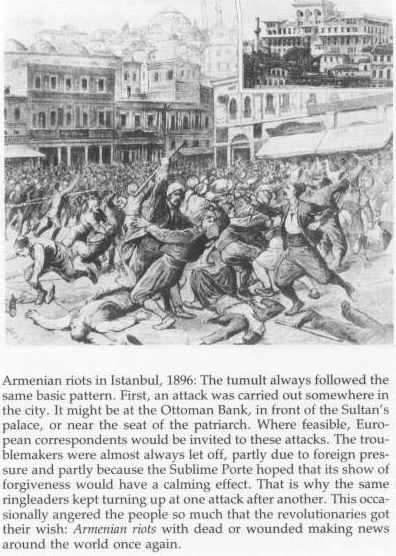
Caption by Erich Feigl, "The
Myth of Terror."
|
The following account of the incident is given by
Hrach (Haik Tiryakian), who himself took part in it: 39
"The comrades gathered at five past six on the morning of August 14. Six people
were enough to begin the raid. We embraced them and bade them farewell. Khosrev and
Papken led the six heroes away. We ourselves left the house with sacks of bombs on
our shoulders and revolvers in our hands. On approaching the bank we heard the bombs
thrown by the comrades who had preceded us, together with the sound of rifle fire.
We began to run in great excitement. The streets were already in a state of turmoil.
People were running here and there in terror and panic. We reached the Ottoman Bank
and rushed inside. Three of our colleagues were on duty in front of the lower door.
We found that one of our party had been wounded.
|
|
|
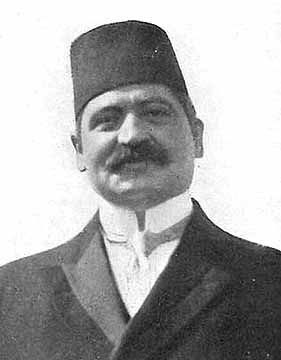
Talat
Pasha
|
While our comrades were busy firing outside,
those within the building were holding up the bank personnel, all of them pale and
trembling. I shouted to them that they had nothing to fear as long as they took no
action. They thought we were bank robbers. They felt relieved, but on hearing the
bombs they again lost their composure. After the bombing had continued for several
hours they realized that we were carrying out an operation against the government.
In the heat of the fray I began to make my way up to
the upper floor together with five comrades. My aim was to go up on to the roof and
signal the success of our operation to a colleague who was waiting at some distance.
This colleague, on learning of our success, was to present letters putting forward
demands to the representatives of the six Powers. My first task was to take out my
handkerchief and wave it. After waving it for a little I bound it to the chimney as
a sign of our success. A few minutes later I saw Margo, one of our comrades, at his
appointed
place at the top of a high house. On seeing me he rushed out in joy. I looked down
on to the road from the side of the building. There were lots of civilian and
military vehicles. I threw a medium-sized bomb. Screams were heard. People rushed
here and here. They began to pick up the dead and the wounded, and bring fresh
soldiers to take their place. Another bomb, and more screams and panic. The bombs
had quite incredible results. They did not kill instantly but tore the victim's
flesh and made them writhe in pain and agony. The large bombs made a sound like a
cannon and produced panic and consternation. I could hear the continual explosion of
bombs and the firing of revolvers.
A number of people were watching us from the windows and balconies of buildings far
and near. I had enough dynamite with me to blow up the whole bank. I remembered my
comrades, and tried to hear what was going on. There was no sound from below. Were
they dead? I was terribly worried. I wept. Only a few hours before they had all been
alive. I went up to a window. Suddenly I heard them calling me. They were our
comrades. They had been looking for me. I went down. Garo and I went into the
manager's office. The Head Secretary of the government was there. I wrote down our
conditions.
1.- Guarantee of peace and security throughout the whole country.
2.-An undertaking on the part of the government that our demand will be satisfied.
3.-That all those who had participated in the operation should be allowed to go free
and not be subject to prosecution.
4.- That if our conditions were not satisfied we will blow up the bank and ourselves
with it.
There were seventeen of us left fighting. Three had died and six were wounded. There
were a few bombs left. Some of us started filling these. Others took up positions at
the sides of the windows and fired on anyone approaching the doors. The comrades
were in good spirits. They said they were ready to fight to the death. Someone from
our side hung out a white flag as a sign that we wanted to parley. I told the
comrades not to throw bombs. Two of the bank personnel were sent out for
discussions.
After five o'clock, I began to write down the names of those who were still alive. I
shall never forget that tragic moment. Darkness had fallen and lights were being
lit. We had continued the attack for four hours, and for nine hours now we had been
on the defensive. We had had very great losses. We had also inflicted considerable
losses on the enemy. The wounded lay howling on the ground. The pain and agony they
felt must have been frightful. The soldiers gradually withdrew from in front of the
bank and took up stations rather further away. All their weapons were trained on the
windows of the building we were occupying. The cretins were waiting for us to be
foolish enough to put our heads out of the windows. We stayed in the bank for
thirteen hours. About a hundred and fifty of the personnel - most of them European -
were trembling like mice in front of us. They dared not take a step without
permission. They were terrified out of their wits by the revolvers and bombs we were
carrying around. Some of them told us that they had stayed for four or five hours in
dark holes. Thirty or forty people in this situation were too terrified to come out.
Twenty or thirty clerks had stayed shut up for six or seven hours in a dirty little
room. The sound of our whistles made their blood run cold."
At the the very beginning of the operation the Dashnaktsution Revolutionary
Committee had sent the following manifesto to the Powers:[40]
[...]
|
| |
We repeat! We shall avoid no
sacrifice in order to achieve our aims . We accept no responsibility whatever for the
consequences.
We deeply regret the losses that both foreigners and the local people may suffer in these
disorders. We deeply deprecate this calamity. But for the desperate, mourning has no
meaning.
We shall die. We know that. But until we gain our rights as human beings, the spirit of
revolt that has worked into the marrow of our bones will continue to threaten the throne
of the sultans as long as a single Armenian remains alive."
The bank was occupied on the morning of 14 August and hostilities continued the whole day.
Auboyneau, the manager of the bank, and his interpreter entered into negotiations with the
rebels and received permission to present the Armenian demands to the Palae. Having asked
permission from the officer in command by lowering a letter on a string from the window,
Auboyneau and his secretary climbed out of one of the lower story windows. The
General-Director of the Bank, Sir Edgar Vincent, went to the Palace accompanied by
Maximoff, the head Dragoman in the Russian Embassy. Sultan Hamid asked Maximoff to find a
solution that would prevent a catastrophe. They returned to the bank at night. The
discussions proceeded as follows: 41
"Maximoff: I remained in the embassy until evening. The manifesto sent by your
central committee had not yet arrived. Of the conditions you put forward most have been
put into effect.
1. Measures have been taken to ensure law and order in the country.
2.The attack against yourself and your colleagues has in effect ceased.
3. Your colleagues have been guaranteed safe conduct out of the country.
As for the third condition put forward by your Istanbul Centre, I am not in a position to
make any statement on this matter. I cannot discuss diplomatic matters here. We are doing
everything
we can to persuade the Sultan to allow himself to perceive the needs of the country. We
were doing this before in any case. We shall continue in our efforts. You took action, and
you have displayed great heroism. This is sufficient to draw attention once again to your
demands. But if you persist, you will lose your case. Instead of friendship and respect,
you will be confronted with hatred and hostility. You say you that otherwise you will blow
up the bank. What will you gain by this? The death of 157 innocent
people will bring the hostility, enmity and detestation of the whole of Europe on your
heads."
The discussion lasted fifteen minutes. We opposed the idea of surrender. It was necessary
to wait. We could wait, we had taken up defensive positions. Garo entered the discussion.
Armen Garo (Karakin Pastirmadjian — We have made clear our demands. We shall wait till
tomorrow evening. By that time your five colleagues will have received our documents and
will have given their reply.
Maximoff — We beg you to leave the building. We can discuss the matter in greater detail
on the yacht. Time is precious. If you wait until tomorrow you may bring about a massacre
tonight. I managed only with the greatest difficulty to get this consent from the Sultan.
Tomorrow everything may change. You will then be faced with a very heavy responsibility.
Do not be the cause of further massacres. There is no need for written promises and
undertakings. We ourselves can give you such a document. But this can never be a reliable
guarantee. A promise extracted with a knife at the throat has no legal validity. Although
giving you our promise we insist that the weapon you are using is not a reliable one. I
understand your situation. But you will arouse the hostility of all Europe. You have begun
well. See that you also end well. Give a little more thought to the matter and consider
the fate of your whole nation.
Garo was opposed to the idea of surrender. But he was worried that
we might be the cause of a massacre."
After protracted discussions the revolutionists finally agreed to leave the building. They
had said that if they met with attack they would kill Maximoff. They walked down to the
shore together with Maximoff between two lines of soldiers with bayonets. There they
embarked on Sir Edgar Vincent's yacht. They were then taken to the Gironde, a ship
belonging to the Messagerie Maritime, and sent off to Marseilles.
Thus, as in the case of the Zeitun revolt, the rebels were able to leave the country
freely under foreign protection.
The Armenians and their supporters in Europe of course added this affair to the list of
"massacres perpetrated against the Armenians."
The Hrach account is from pp. 160-3 of Dashnak historian M.
Varandian's “History of the Dashnaktsutiun,” 1932.
|
Another Reliable Armenian Reports a Massacre!
|
Ovanize, the Armenian who had actually reported the massacre to us (before it had
started), again arrived in a state or terror and said, "The police escorted by
the village watchman are making the round of Candilli houses and marking the doors
of those known to be inhabited by Armenians with the sign of the Cross." He
begged for refuge, which he was given in our cellar; but we little knew that this
cowardly fellow and one of our neighbours were two members of the Secret Society who
had failed to appear with the rest of the gang. No wonder he had been so well
acquainted with the events as they occurred; and knowing that a search was to be
made for the two defaulting members of the Henchate, who lived in Candilli, be
imperilled our lives by his own misdoings.
Dorina Lady Neave, "ROMANCE OF
THE BOSPHORUS" 1949
|
|
An American
Newspaper Account of the Takeover
|
From The Evening Bulletin, Aug. 28, 1896
MANY SLAIN
Armenian Rioters in Constantinople Shed Much Blood
EXACT NUMBER OF VICTIMS UNKNOWN
The Ottoman Bank Looted — Bombs Are Exploded — Gendarmes Beheaded — Four Ladies
Among the Killed — Mob Leaders Surrender.
Constantinople, Aug. 28.—The riots which Wednesday caused so much excitement throughout
Constantinople are apparently at an end. The leaders of the mob which attacked the
officers of the Ottoman bank surrendered and will be expelled from Turkey.
It is known that a great many persons have been killed, but it is impossible to ascertain
the exact number owing to the prevalent excitement and the desire on the part of the
Armenians, as well as the Turkish authorities to keep the identity of the killed and
wounded secret. The Armenian patriarch has excommunicated all Armenians concerned in this
latest uprising.
The official account of the troubles attributes the riots to an organized effort on the
part of the central committee of the Armenian revolutionists to stir up a revolution.
The invaders, as if by a preconcerted arrangement. suddenly entered the great hall of the
Ottoman bank armed with revolvers. daggers and dynamite bombs. Forming in small groups,
they were accosted by the officer of the guards who demanded from them a statement of
their business with the bank.
Without stopping to reply they blew out his brains and then killed and beheaded the
gendarmes, throwing heads of the dead men out into the streets. During the resultant
confusion, they closed the doors of the bank and hurled a number of bombs into the street.
Four Turkish women who were driving along in a carriage were blown to pieces by the
explosion of one of the dynamite bombs. Two of the French employes of the bank, while
descending from a window by means of a rope were wounded by one of the explosions. They
narrowly escaped with their lives by reason of the timely intervention of the imperial
troops. The rioters captured a hotel in the city of Constantinople and bombs and shots and
missiles fairly rained upon the heads of the passersby, wounding many persons. Many
similar events are reported from various portions of the city.
---------------------------------
|
The
Raid on the Ottoman Bank
|
The following is from Kamuran
Gurun's The Armenian File (1985), pp. 157-9.
The organizers of the raid were three Armenians named Varto, Mar, and Boris, who had
come from Caucasia. Karekin Pasdermadjian, who used the nickname Armen Garo, who
later was elected deputy to the National Assembly from Erzurum during the 1908
Constitutional Government and fought against Turkey in Caucasia with his band during
the First World War, came from Athens to join them.
Before the Armenian revolutionaries had surrendered and had been sent to Marseilles,
they had stayed on the yacht of Sir Edgar Vincent, the president of the Ottoman
bank. The president's secretary, too, had stayed with them. The revolutionaries had
told secretary F. A. Baker of the plans they had prepared. Below, we summarized the
secretary's report on the subject.
The events of the 20th were schemed and planned out some three
months ago by the Foreign Committees, and the chiefs of the various bands only came
to Constantinople some three weeks back. The attack on the bank was one part of
their programme, as they told me that the following points and places had been
singled out for their demonstrations: the Sublime Porte, the Armenian Patriarchate,
that part of Stamboul sloping down towards Makri-keui (today Bakirkeuy, the Ottoman
Bank (occupation), the Credit Lyonnais Bank (occupation), the Vaivoda police-station
(bomb attacks), the Galata Serai police station (bomb attack), the Aia Triada Greek
Church (bomb attack).
The bombs were made by them here, they had obtained their dynamite here. The Bank
was attacked at 1, and at the same time a raid was made on the Vaivoda
police-station in order to prevent assistance being sent to the Bank by the latter.
They gave me the following reasons for having singled out the Imperial Ottoman Bank
and Credit Lyonnais for occupation. As these establishments contain people of so
many nationalities, all the Powers would be ready to assist in obtaining their
demands from the Turks, in order to save the lives of their subjects; that the Bank
was the easiest building to resist a siege and to defend; that being the most
prominent building in the town, more attention would be attracted to their attempts
to bring the Armenian cause before the lower classes, and thus instil more ardour in
their weaker brethren.
They used bombs because, they said, they were more destructive, and caused more
consternation, owing to the novelty of the thing.
The assailants were all Turkish subjects, and, with the exception of the three
chiefs, of the `hamal' porter class.
One of the chiefs was killed. Two of the chiefs were not Armenians from
Constantinople, but from Van, and of superior education, knowing Russian, French,
Turkish, and Greek.
The third had evidently lived a long time here, and knew the
place well. They were all most determined men, and repeatedly told me that they
would not give themselves up, but were most anxious as to how far their ultimatum to
the Turks would be successful. For free pardon they did not care, except inasmuch as
if not obtaining the reforms they asked for they would be alive for a new attempt,
which they declared would be more terrible than anything known yet.
Their hatred of the Turks was beyond all description. They declared that they would
return here, through Macedonia, and were confident of success in their next
demonstration. They were anxious to know whether their fellow men had done much
damage with their bombs, whether many soldiers had been killed, and whether the
soldiers had been firing on the Armenians. They also told me that it had been their
intention to kill all the Turks in the employ of the Bank before blowing the latter
up but that they had not time to do so, as things finished sooner than they
expected. (107)
(...)
The demands of the revolutionares were: (109)
- the appointment of a European as Chief Superintendent of police, chosen by the six
powers;
- the appointment of the governors of provinces, and sanjaks, and the head officials
of districts, by the Chief Superintendent of police, with the Sultan's approval;
- the militia, the gendarmerie and the police to be recruited from the local people,
and to be under the command of a European officer;
- a judiciary reform consistent with the European system to be instituted;
- absolute freedom of religion, education, and the press;
- the allocation of three-quarters of the country's income to local needs;
- the annulment of tax debts;
- a tax exemption for five years, and the next five-year tax to be assigned for the
damage done in the recent disorders;
- the immediate return of embezzled properties;
- the emigrants to be allowed to return freely;
- an amnesty for Armenians sentenced for political reasons;
- a temporary commission to be formed with representatives of the European
countries, which would supervise the implementation of the above demands.
In the end, the General Director of the Bank, Sir Edgar Vincent, went to the Palace
with Maximoff, the head dragoman of the Russian Embassy, and obtained authority to
solve the problem. It was guaranteed that they would leave the country freely. 17
people left the Bank with Maximoff, and went to Sir Edgar's yacht. From there, they
set out for Marseilles on the French ship Gironde.
The occupation of the Bank was thus concluded. However, the bombs thrown and the
bullets fired on that day by Armenians on the police and the people aroused the
Muslim community of Istanbul. The disorders in Istanbul lasted for a few days. This
was not only an attack by Muslims on Armenians. The Armenians, too, continued their
attacks.
The British Embassy in its telegram dated 30 August, wrote that `In Istanbul and
Bosphorus, tranquillity was totally established as of last night and today. However,
this evening, around 6 p.m. some Armenians threw a bomb in Galata near the Ottoman
Bank and the soldiers replied to this by opening fire. . . It cannot be denied that
this constant bomb throwing by Armenians has seriously provoked the Turks.'
Likewise, the British Embassy informed its Ministry that the Armenians had thrown
yet another bomb on 3 September.(110)
According to Western sources, the number of Armenians killed as a result of this
incident was between 4,000 and 6,000. A document concerning this subject has not yet
been found in the Ottoman archives. However, in our opinion, the figure 6,000 is
exaggerated. In the case of the Babiali demonstration, too, the disorders continued
for a few days, but the number of dead did not exceed 172. To be able to reach the
figure 4,000--6,000, the incident had to last for weeks. Moreover, it is written in
all the sources that the Muslims fought with sticks and knives, and it is hardly
possible to kill so many people with these means. We have nowhere encountered the
number of Muslims killed. But according to the British document,120 soldiers of the
Grand Vizier were killed, and there were approximately 25 wounded. (111) Again in
the same document it is stated that about 300 Muslims were arrested because of the
incidents, and that the preventive measures taken by the Government were
satisfactory.
A special court was established for this incident, and the Muslims and the Armenians
who were arrested were tried in this court.
107. F. O. 424/188, No. 174, enclosure 4.
109. Nalbandian (1963), pp. 176-7.
110. F. O. 424/188, Nos. 149 and 169.
111. F.O. 424/188, No. 190, enclosure 1.
Prof. Erich Feigl, from "A Myth of
Terror," added: "...it was now possible to dream up tales of
'4000-6000 Armenians killed in the rioting;. Not the least bit of evidence could be
found to support these figures in the secret report of the British Embassy (F. O.
424/188, Nos. 149 and 169). But what difference did that make?"
|
Conspiracy
Theory:
"The Turkish government knew all about it"! |
"Dr. George Washburn, a famous missionary, goes even so far
as to say in a book of his, that Abdul Hamid was aware of the plans of the Dashnags, and
let them enter the bank in order to discredit the Armenian revolution and use it as a
pretext for a massacre."
So wrote K. S. Papazian, in his Patriotism Perverted, 1934, p. 20. Washburn's
contribution to history was provided in a footnote:
" . . . . it is certain that the Turkish government knew all about it many davs
before, even to the exact time when the bank was to be entered, and the Minister of Police
had made elaborate arrangements not to arrest these men or prevent the attack on the bank,
but to facilitate it and make it the occasion of a maesacre of the Armenian population of
the city''. (Dr. George Washborn, "Fifty years in Constantinople", page
246). *
In order to consider this conspiracy theory, several points need to be borne in mind:
1) The sultan was aware that whenever an Armenian got a nosebleed in the far corners of
the empire, the "massacre" would be reported to hostile consuls, giving the
powers the excuse to intervene. The last thing the sultan must have wished for was to
encourage was a massacre, particularly in Istanbul, where many foreigners lived.
2) The sultan knew he was damned, if he did or if he didn't. (Perhaps that is why one of
his nicknames was "Abdul the Damned.") He was well aware that an incident of
this type would have not served to "discredit the Armenian revolution,"
as Papazian worded it, but would have more likely glamorized the "heroic"
Armenian terrorists in the eyes of Turk-despising Europeans. Such was exactly the
contention of Peter Balakian, who wrote in The Burning Tigris: "...a number of
European newspapers… praised the Armenian activists for their honesty… and their
courage.”
3) The ones behind the massacres of the Armenians after the terrorists had made their
getaway, along with their motivations, are reasonably explained by C. F. Dixon-Johnson, in "The
Armenians," 1916:
"A cry went through the city that the Armenians had risen in revolt and were
massacring the other citizens. Many persons armed themselves with cudgels and, joined by a
cosmopolitan mob from Pera and Galata, many of whom were Greek anxious to pay off old
scores on their hated commercial rivals, wreaked vengeance on the Armenian population. The
soldiers and police took no part in the killing. It is estimated that about 1,000
persons perished, including those killed by the bombs and revolvers of the conspirators.
What happened in London and Liverpool after the sinking of the Lusitania affords an idea
of how the East End people of London, who claim to be far more highly educated... would
have behaved if German desperadoes, after murdering twelve of the sentinels on guard at
the Bank of England, had been allowed to escape free in deference to the representations
of the American and Spanish Ambassadors, especially after the fears and passions of the
mob had been aroused by German aliens shooting and bombing from the roofs of the
houses..."
(Incidentally, elsewhere in his book accounting for the various estimates of the 1890s
Armenian dead, Kamuran Gurun figured "2,000" for the Ottoman Bank takeover, on
p. 161.)
4) Note the missionary gave no source for his information, and
expects readers to simply take his "word" for what he calls"certain."
From Christopher Walker's Armenia: The Survival of a Nation, p. 166-167:
"On board the yacht the 15 (one report gives 17) were interviewed by one of Sir
Edgar's secretaries. It emerged that the Ottoman Bank incident was only one part of a
concerted plan, worked out some three weeks earlier. Demonstrations had been planned in
the centre of the city, and near the Armenian Patriarchate; the Crédit Lyonnais was, like
the Ottoman Bank, to be occupied. Bombs were to be thrown at a nearby police station to
distract the police form the banks. In the diplomatic district of Pera (modern Beyoghlu),
north of the Golden Horn, bomb attacks were to be made on another police station, and the
Aya Triadha Greek church. But three days before the incident the authorities had got wind
of the plan, and parts of it had to be abandoned."
What this tells us is that the Dashnaks, perhaps because one of them got arrested and was
suspected of spilling some beans, were aware that their plans were at risk, forcing the
cancellation of the rest of their terrorism spree. Logic tells us that if they felt the
Ottoman Bank takeover plan was jeopardized, they would have been fools to proceed. (In
other words, why were only "parts" of the plan abandoned? How could the Dashnaks
be certain which parts were at risk?)
On the other hand, how do we know what really went on? All we have to rely on are the
claims of the terrorists themselves, and they could have claimed anything. (Much as their
more complex scheme of destruction is entirely believable.)
Which brings us back to our good missionary. He didn't need any evidence. All he needed
was the say-so of his beloved Armenians — or, if he was really a lost Godly cause, could
have made up his own theories, in order to vilify the heathen Turks he no doubt despised.
What this episode really reinforces is that these are exactly the kinds of baseless
stories that were accepted at face value in the Western press, in this case, because
people knew clergymen were too honorable to divulge nothing but the truth.
(Not incidentally, the missionary Dr. George Washborn came up with a figure of 16,000
massacred Armenians in the next two day, some 10,000 above what normal Armenian
propagandists offer.)
-------------------------------------
Further reading:
Counterpoint to Peter
Balakian's "Ottoman Bank" chapter
Armenian
Appointment in Ottoman Bank, Oct. 1915
|
|