|
|
John Roy Carlson (a.k.a.
Arthur Derounian) and his "Armenian Information Service" provided,
in 1955, a booklet that was (as he put it) a "condensation" of
Katchaznouni's "parting words to Dashnagtzoutiun, given in the form of an
address to the Party congress in 1923."
This is a powerful genocide-disproving
document that has been emptied out of the world libraries by
"professional Armenian patriots." These propagandists have also
tried their best to discredit this work, providing desperate claims ranging
from Katchaznouni's being a "Bolshevik," to even more outright
lying, that Derounian, an Armenian patriot in his own right, purposely altered
the translation (!).
The original in Russia has been found,
and translated scrupulously. The 1955 version has already been featured on
TAT, and now, for the first time, readers can ascertain every word
Katchaznouni provided.
The lines in light green
are the ones from the 1955 "condensed" version. The omitted and
"new" lines are in white.
If readers wish to consult the
appendixes and other commentaries Derounian provided in 1955, please visit the
pre-existing version on
TAT.
This presentation has been preceded by a highly informative analysis; the
author, Mehmet Perincek, studied at Moscow University, has a fluent knowledge
of Russian, and conducted invaluable research within the Russian archives.
Katchaznouni's complete manifesto will follow afterwards.
ADDENDUM, 5-07:
Subsequently having read Esat Uras' The Armenians in History and the
Armenian Question (The English version from 1988; Uras had written the
book in 1953, pre-dating Derounian's 1955 work; there is a "Footnote
2" below telling us the year was 1950, instead of 1953), I was struck by
some discrepancies. Because of my healthy suspicion of Turkish historians, at
first I was concerned of exaggerations, which was disconcerting, since Uras'
credibility has been well established. I then looked closer and realized what
was happening. Uras's translation was from the original Armenian and formed a
purer translation. Derounian's translation was from the original Armenian as
well, but since Derounian admitted his version was "condensed," I am
concluding some of the damaging statements were removed. (For example, Uras's "we
invaded Oltu" line has been excised, weakening
the picture of the Armenians' provocation of their 1920 war with the Turks.
Armenian propoaganda tells us, of course, that Turkey was the aggressor with
this war.) Now, Perincek's version is from the "original Russian,"
as I had written above, but actually the Russian version is one step removed
from the original, translated from the Armenian as it was. (So Perincek's
process was Russian-Turkish-English. Uras's version was
Armenian-Turkish-English. Derounian's was Armenian-English. This does not mean
the "three step" process of the first two would be inaccurate, as we
can see from how close all three versions are, but some nuances may have been
lost.)
(Not every Katchaznouni excerpt Uras has used will be referred to; there were
more. Uras, as Derounian, did not perform "straight through"
translations, as far as the English version provides. The "three
dot" rule indicating that there are stretches in between was not
utilized.)
In any event, the parts Derounian deleted are important to examine, as well as
the other discrepancies. Perincek magnanimously allowed the original Derounian
passages to remain untouched, even though some of the Derounian passages
evidently were not always on the ball. Once again, the Derounian passages
below are in light green. At the
time of this addendum, I will add a few "Uras" notes of interests in
yellow.
|
|
|
| THE DASHNAGTZOUTIUN
HAS NOTHING TO DO ANYMORE |
The Manifesto of Hovhannes Katchaznouni
First Prime Minister of the Independent Armenian Republic
The abridged pamphlet Translated from the Original by Matthew A. Callender
Edited by John Roy Carlson (Arthur A. Derounian)
Published by the Armenian Information Service Suite 7D, 471 Park Ave. New York 22 1955
AND
the omitted sections translated from the Turkish edition, Tasnak Partisi’nin Yapacagi
Birsey Yok, Kaynak Yayinlari, Nov.2006, Istanbul
by
Lale Akalin
2006
|
|
INTRODUCTION TO THE TURKISH EDITION
By Mehmet Perinçek
We have been hearing arguments as to how the archives should be consulted, in
connection with the discussion of the Armenian question. Here is a document from the
Armenian archives. With this report by Hovannes Katchaznouni, we are lifting the
cover of the Armenian archives.
We invite the whole world to study the Russian and the Armenian archives, in order
to bring out the truth. They are very rich in documents: reports by the Armenian
authorities and government members of the time and reports by Armenian commanders
written to their seniors, documents published by reliable Armenian historians like
Borian and Lalaian are all in those archives as official documents.
As the Kaynak Publishing House, we are commencing the publication of the
series, The Lie of ‘Armenian Genocide’ in Armenian Documents, with an
official document, a report by the first prime-minister of the first Armenian
government and the leader of the Dashnagzoutiun. I would like to repeat that this
document you will be reading is not a magazine article or a speech but a report
submitted to the Dashnagzoutiun Convention in Bucharest in 1923. The person who read
this report, Hovannes Katchaznouni may be considered the most important figure in
the Dashnag movement. He was holding a responsible position during the period
1915-1923 in which the events referred to as “the Armenian Genocide” took place.
The present report is actually a summary of the events in that period.
Who is Katchaznouni?
Hovannes Katchaznouni is the first prime-minister of the Armenian state founded in
July 1918. He was in power as the head of government until August 1919, for thirteen
months. He was among the founders of the Dashnagzoutiun Party and one of its top
leaders. He was the prime authority of Armenia and the Dashnagzoutiun Party.
He was born in 1867 in the Akhaltsikhe (Ahıska) region of Georgia. Having
studied architecture, he worked as an architect in Baku. He joined the Dashnag
organization there. He became a member of the Armenian National Council in 1917 and
was the Dashnag representative in the Seym (the Caucasian Parliament) until 1918. He
was on the Armenian committee, conducting the peace talks with the Turks in Trabzon
and Batoum. After the dissolution of the Caucasian State, he became the first
prime-minister of the independent Armenian State in 1918. He held this position
until August 1919. He was arrested after Bolsheviks came to power in Armenia in
1920. He left the country after the counter-revolutionary revolt against the
Bolshevik rule was suppressed in 1921. Years later, he returned to the Soviet
Armenia to work there as an architect until his death in 1938.
Publication of the Report
Katchaznouni voices a self-criticism of the past in this conference report. This
self-criticism is actually a confession. Katchaznouni honestly and sincerely
resolves that the Dashnagzoutiun Party is responsible for the past agonies. He
concludes, at the end of the report, that the Dashnagzoutiun Party should dissolve
itself and leave the political arena. His last words are significant: “Yes, I
propose suicide, the party should commit suicide,” he says.
Katchaznouni publishes his report very urgently, that same year. The title he uses
once more emphasizes his proposal of suicide: “Dashnagzoutiun Has Nothing to do
Anymore”
Katchaznouni omitted some three or four pages concerning his proposals about the
inner organizational issues of the party when he first published this report as a
book. However, he included in the book a letter he wrote to a fellow party member
who had criticized his report in his letter.
The book published in Armenian was translated into Russian four years later and and
an edition of only 2000 copies was published in Tbilisi in 1927 as a significant
warning or lesson. The Russian edition included an introduction in Russian. [1]
The English edition of the book was was published in 1955 with the title The
Armenian Revolutionary Federation (Dashnagsoution) Has Nothing To Do Any More by
the “Armenian Information Service” in New York. However, this was an abridged
edition.
What is interesting but what seems natural when the content of the book is taken
into consideration, is the fact that this historical report by the first Armenian
prime minister was banned in Armenia. It is also a fact that all the copies were
collected from the libraries in Europe by Dashnags. All the copies in all the
languages were collected from European libraries. The book is included in the
catalogues but no copies can be found in the racks.
I discovered a copy of the Russian edition in the Lenin Library in Moscow, during my
research on the Armenian issue. The book was translated into Turkish by Arif
Acaloğlu with utmost care and precision and I would like to extend my thanks to
him here for his worthy contribution.
[1] S. Hanoian, in the Introduction, states that Katchaznouni was “open-hearted”
in his report, despite some criticism concerning his ideas on the Soviet rule.
However, in the Soviet Armenia, there were very grave citicisms on Katchaznouni’s
book. See Marents, “Litso Arsyaskogo Smenohovstva”, Bolşevik
Zakavakazya,No.3-4, 1928, s. 83 vd.
|
| Studies in Turkey |
In the Introduction to the previous editions of this book we indicated that Prof.
Türkkaya Ataöv had informed the reader about the book Katchaznouni published, in his
work in English, in 1985. However, there are earlier references to the book. 34 years
before Prof. Ataöv’s book, Esat Uras; again, a few years before Ataöv, Ambassador
Kamuran Gürün and in the same year, in 1985, Mim Kemal Öke referred to the book. This
means that the book has been known in Turkey for over half a century.
Esat Uras, in his celebrated work Tarihte Ermeniler ve Ermeni Meselesi (Armenians and
the Armenian Question in History), which was published in 1950, made references to
Katchaznouni’s book. [2] So it is clear that Katchaznouni’s book, published in
Armenian in 1923 in Vienna, had been translated into Turkish before 1950, when Uras
published his book.
Quotations from the same manuscript translation were also made by Ambassador Kamuran
Gürün in his work, Ermeni Dosyası (The Armenian File), published in 1983 by
the Turkish History Institute. [3]
The bibliography of the booklet, Dokuz Soru ve Cevapta Ermeni Sorunu (The Armenian
Question in Nine Questions and Answers), which states the “Foreign Politics
Institute” as the publisher, contains a reference to the 1923 edition published by
Katchaznouni himself in Vienna. [4] However, in the bibliography the title of the book
appears not in Armenian but in English. It seems that the publications of this institute
were parallel to those of the Turkish State. Mim Kemal Öke, in his article in a
collection published by Boğaziçi University in 1984, quoted in length from the
English abridged edition published in New York in 1955. [5]
Prof. Türkkaya Ataöv published a ten-page work on Katchaznouni’s book, in 1984, in
English. This work was translated into French, German and Spanish and was published
together in these four languages by the propaganda bureaus of the Turkish State, in 1985.
Ataöv, in this work, which has never been published in Turkish, states that he has got a
type-written copy of the Turkish translation of Katchaznouni’s book in Armenian. It
seems that the manuscript translation referred to by Esat Uras and Kamuran Gürün had
been reduplicated as a type-written copy in the meanwhile. Other researchers might also
have referred to the Turkish or English translations of Katchaznouni’s report before
1984.
The Turkish edition, translated from the Armenian original is kept in the Turkish History
Institute, though we are not certain whether the Foreign Ministry keeps a copy.
It might be considered surprising that this report by Katchaznouni has not received due
attention in Turkey, so far. However, it might also be considered natural, because Turkey
and Turkish researchers have not been able to build their theses on a strong basis; they
have not taken the strong stand of anti-imperialist struggle and the righteousness of the
Turkish War of Independence; and also because neither the academic circles nor the Turkish
Foreign Ministry has understood the importance of this report and therefore it has not
been given due consideration. The Katchaznouni report had not been published in Turkish
before the Kaynak Yayinlari edition and in fact, it has almost been hidden. It has
not even been the subject of any serious research or study so far. Doubtlessly, the
tendency on the part of the Turkish researchers and authorities to keep a certain distance
with the Russian and Armenian archives played an important part in this. They must have
regarded using Russian sources as showing an inclination towards Bolshevism. This is also
another indication showing that the main concern in Turkey was to render the Turkish
theses sympathetic to the Western imperialists. This is the essential point.
The Katchaznouni report was introduced to the Turkish reader by the weekly Aydınlık,
in its issue of October 2, 2005. Aydınlık’s treatment of the subject
mainly consisted of a broad summary and an evaluation of the report.
[2] Esat Uras, Tarihte Ermeniler ve Ermeni Meselesi, 1stanbul 1950, s. 716,
740 vd, 758.
[3] Kamuran Gürün, Ermeni Dosyası, Türk Tarih Kurumu Yayınları, Ankara
1983, s. 196, 234, 274, 304 vd, 308.
[4] Dış Politika Enstitüsü, Dokuz Soru ve Cevapta Ermeni Sorunu, Ankara, Nisan
1983, s. 41.
[5] Prof. Dr. Türkkaya Ataöv, An Armenian Source: Hovhannes Katchaznouni; Une Source
Armenienne Hovhannes Katchaznouni¸ Eine Armenische Quelle: Hovhannes Katchaznouni¸
Fuenta Armenia. Hovhannes Katchaznouni¸; Second Printing, Ankara March 1985.
|
Katchaznouni’s Observations
|
Katchaznouni particularly states that he has come to his conclusions after a grave
thinking process. The conclusions he has reached are not the result of
superficiality or lack of will-power. He knows he will infuriate many. He calls on
the delegates of the Dashnagzoutiun Conference to listen to him patiently, with no
prejudice. As he is determining the boundaries of his report, he explains that he
will examine the period extending from World War I to the Lausanne Conference,
dividing it into certain phases from the point of view of the Armenian question and
will focus on the role Dashnagzoutiun has played in this process.
The first Prime Minister of the Dashnagzoution Government makes the following
observations:
— It was a mistake to establish the volunteer units.
— They were unconditionally allied with Russia.
— They had not taken into consideration the balance of power which was in Turkey’s
favour.
— The decision of the deportation of Armenians was a rightful measure taken by
Turks to serve their purpose.
— Turkey had acted with an instinct of self-defence.
— The British occupation once more aroused the hopes of the Dashnags.
— What they established in Armenia was a Dashnag dictatorship.
— They had acted in pursuit of the imperialist demand,”From Sea to Sea” and
had been provoked with this.
— They massacred the Muslim population.
— The Armenian terrorist acts were directed at winning over the Western public
opinion.
— The fault was not to be found outside the Dashnagzoutiun Party.
— The Dashnagzoutiun Party had nothing else to do but commit suicide.
Yes, all these observartions were made by Katchaznouni, the first Prime Minister of
Armenia and the founder of the Dashnagzoutiun Party.
Katchaznouni considers the essence of the Turkish-Armenian relations during the
period of 1914-23 as a state of war. According to Katchaznouni’s evaluations, this
war was actually between Turkey and the great imperialist powers. Katchaznouni does
not make any evaluations that hold Turkey responsible, for he considers the Dashnags
and their Armenian followers as one side of the war and Turkey as the other side. He
concludes that in the face of Turkish victory, the Dashnagzoutiun Party has nothing
else to do but dissolve itself.
These observations may surprise some people. However, we know that many other
Armenian statesmen and historians have also made the same evaluations. The years
following 1921 were years of deep self-criticism for Armenian intellectuals. They
were finally face to face with realities. Doubtlessly, the Bolshevik rule played an
important part in this new turn to reality. The new stand taken against imperialism
necessarily reminded them of the realities and pulled them towards the
Lenin-Atatürk alliance. For this reason, especially the Armenian and Dashnag
documents belonging to the period following 1921 confirm Katchaznouni’s views. The
Dashnag documents, some of which are found in the Armenian State Archives expose the
lie of “Armenian Genocide” as dramatically as Katchaznouni’s report. The
Dashnag sources themselves disclose how they were used against Turkey by the Tsarist
Russia and Western imperialism; what massacres they were responsible for during the
occupation and how just was the fight the Turkish army waged.
|
| Report Teaches a Lesson |
Katchaznouni’s report is extremely valuable not only because it discloses an
indisputable truth but also because it teaches invaluable lessons even in the
present day world. The present USA strategy bestows special missions on small ethnic
and religious groups in dividing certain countries. The bloody outcomes of these
missions are apparent in the examples of Yugoslavia, Afghanistan and Iraq. What is
more, the world public opinion is aware that new examples will ensue. However, there
is always a final scene in these plots and contrivances. Katchaznouni’s report
provides an opportunity to see the tragedies that fill those last scenes, with all
their sadness. Those who allowed themselves to be pushed against the peoples they
had been living together with, for hundreds, even thousands of years, had not only
their neighbours but their own people pay the price for it, most gravely.
Katchaznouni, like all the other Armenian writers state that the Tsarist Russian
regime, the British and the French imperialism used them and when, finally, they
were left alone, they had nothing else to do but bemoan that they had been betrayed.
Those who can interpret the developments in history can certainly see that the
regrets and the cries which will follow the present historical period will not be in
a different tone.
Other Documents in the Dashnag Archives Confirm Katchaznouni
Katchaznouni’s observations stated in his report are confirmed by other documents
in the Dashnag archives. These Dashnag documents, some of which can be found in the
Armenian archives, expose the “Genocide” lie in the same dramatic way seen in
Katchaznouni’s report. The Dashnag documents themselves show how they were used by
the Tsarist Russia and the Western imperialism against Turkey and what massacres
they were responsible for, during the occupation and how rightful was the fight the
Turkish army waged against all this.
Fight against Turkey in the Tsarist Armies
The imperialist centres accuse the Ottoman state and Mustafa Kemal’s Revolutionary
government with subjecting the Armenians to massacre and genocide during 1915-23.
However, the eight years which comprise the period of the Turkish War of
Independence, are at the same time years of fight for the Dashnag forces, under the
leadership of the Tsarist regime of Russia, the British and the French armies. This
historical fact has been reflected in thousands of Armenian documents. I would like
to give a few examples. The declaration sent by the Armenian National Bureau to Tsar
Nicholas II at the very beginning of World War I shows how deeply attached the
Dashnag leaders feel towards imperialism:
“As the glorious Russian Armies are fighting against Turkey who,
with German support has dared to raise its hand against mighty Russia, on the lands
in its own hegemony, in the snowy Armenian mountains and the vast Alashkert valley,
the Armenians, taking the advice of their forefathers (…) have risen to sacrifice
their lives and their assets to Great Russia and the magnificence of its throne. “The
good news of war with Turkey has aroused enthusiasm among all the Armenian people.
The Armenians from all the countries are in haste to take their place in the
glorious Russian armies and to serve the achievement of the Russian arms with their
blood. We are praying God to be victorious over the enemy. We owe it to our nation
to turn into new Russian arms and to fulfill Russia’s historical duty in the East.
Our hearts are burning with this desire.
“The Russian flag will freely flutter in the Bosphorous and the Dardanelles.
Your will, my magnificent lord, bestow freedom to the peoples under Turkish yoke”.
[6]
[6] Mşak, No. 271, 1914: cited by
ibid p. 89
|
| |
Zaven, the Armenian Bishop in Istanbul had already declared, before the war started, to
the reporter of Mşak, the organ of the Armenian nationalist-liberals, that the
radical solution of the Armenian question would be the unification of all Armenia
(including the Eastern Anatolia of Turkey-M.P.) under Russian sovereignty with which
Armenians’ fate was historically linked. The Bishop stated that “the sooner the
Russians arrive here, the better for us.” [7]
Zavriev, the Head of the International Relations Department of the Dashnagzoutsiun Party,
in the letter he sent to the ambassadors of the Tsarist Russia in London and Paris in
1915, exposes the role played by Armenians in World War I:
“Since the first days of the present war, the Russian Armenians have
been in the expectation of joining the war. This situation gives rise to the hope that the
Armenian question will be taken up at the end of the war, and it will definitely be
solved. For this reason, Armenians cannot hold back from participating in the prospective
events and thus must take their place in the war, most passionately” [8]
Another Dashnag document which supports the content of this letter in the Tsarist Russian
archives is in the personal archives of Borian, a politician and historian. The document
which comprises the speech made by the military representative of the Dashnagzoution Party
in the All Armenia National Congress convened in Tbilisi in February 1915 is significant:
“As is known, the Russian government gave 242 900 rubles at the
beginning of the war to make preparations to arm the Turkish Armenians and to incite
revolts in the country during the war. Our volunteer units need to break the defense line
of the Turkish forces and to unite with the rebels and to create anarchy on the front and
behind the lines and by these means help the Russian armies pass through and capture
Turkish Armenia”. [9]
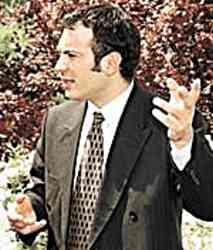 |
| Mehmet Perincek . |
Dashnag publications are full of documents admitting
that they created anarchy on the front and behind the lines and fought as the striking
force of the Russian armies. Orizon, the organ of Dashnagzoutiun reads as follows in its
196th issue of 1912:
“The Turkish state authorities and those in power should know that
from now on, neither a Turk nor the Turkish state has any value for an Armenian
whatsoever. Let them think of other means to protect their existence.” [10]
Again in the 243rd issue of October 31, 1914 of Orizon, it is claimed that the
victory of the Tsarist Russia will also be the victory of Armenians while Armenians are
called to actively participate in the war. [11]
Another organ of the Dashnags, Ayrenik, on September 24, 1914, states the
following, concerning Nikolai Nikolaievich, the Caucasian Governor of Tsarist Russia, who
has just arrived in Tbilisi:
“Yesterday His Excellency the Royal Prince Nikolai Nikolaievich, the
deputy of the Tsar in Caucasia arrived in Tbilisi. We trust that the Royal Prince will put
an end to the existence of the Turkish State forever. With this conviction, we salute the
dear 6th Commander-in-Chief of the Russian army in Caucasia and welcome him”. [12]
[7] Armenian SSR State Central History
Archives (TsGİA Arm. SSR) fond vıpisok, folder 37, sheet 45-46, cited in K.N.
Karamyan, PolojenieZapadnıh Armyan, “ArmyanskiVopros” i Mejdunarodnaya
Diplomatiya V Posledney Çetverti XIX Veka İ Naçale XX Veka, Yerevanski
Gosudarstvennıy Universitet, Yerevan, 1972, p.87 vd.
[8] Mejdunarodnie Otnoşenia V Epohu İmperializma (Dokumenti İz Arhiva
Tsarskogo İ Vremennogo Pravitelstva), seriya III, t. VII, ç.II, Gosudarstvennoe
Sotsialno-Ekonomiçeskoe İzdatelsvo, Moskva-Leningrad, 1935, p. 45
[9] Prof.Dr. Türkkaya Ataöv, An Armenian Source: Hovannes Katchaznouni; Une Source
Armenienne: Hovannes Katchaznouni; Fuenta Armenia: Hovannes Katchaznouni: Second Printing.
Ankara, March 1995
[9] Mşak, No. 271, 1914: cited by ibid p. 89
[9] Armenian SSR State Central History Archives (TsGİA Arm. SSR) fond vıpisok,
folder 37, sheet 45-46, cited in K.N. Karamyan, PolojenieZapadnıh Armyan, “ArmyanskiVopros”
i Mejdunarodnaya Diplomatiya V Posledney Çetverti XIX Veka İ Naçale XX Veka,
Yerevanski Gosudarstvennıy Universitet, Yerevan, 1972, p.87 vd.
[9] Mejdunarodnie Otnoşenia V Epohu İmperializma (Dokumenti İz Arhiva
Tsarskogo İ Vremennogo Pravitelstva), seriya III, t. VII, ç.II, Gosudarstvennoe
Sotsialno-Ekonomiçeskoe İzdatelsvo, Moskva-Leningrad, 1935, p. 45 See B.A. Borian,
Armeniya, Mejdunarodnaya Diplomatiya i SSSR, v.I Gosudarstvennoe İzdatelstvo,
Moskva-Leningrad, 1929, p. 360
[10] Prof.Dr. Türkkaya Ataöv, An Armenian Source: Hovannes Katchaznouni; Une Source
Armenienne: Hovannes Katchaznouni; Fuenta Armenia: Hovannes Katchaznouni: Second Printing.
Ankara, March 1995
[10] Mşak, No. 271, 1914: cited by ibid p. 89
[10] Armenian SSR State Central History Archives (TsGİA Arm. SSR) fond vıpisok,
folder 37, sheet 45-46, cited in K.N. Karamyan, PolojenieZapadnıh Armyan, “ArmyanskiVopros”
i Mejdunarodnaya Diplomatiya V Posledney Çetverti XIX Veka İ Naçale XX Veka,
Yerevanski Gosudarstvennıy Universitet, Yerevan, 1972, p.87 vd.
[10] Mejdunarodnie Otnoşenia V Epohu İmperializma (Dokumenti İz Arhiva
Tsarskogo İ Vremennogo Pravitelstva), seriya III, t. VII, ç.II, Gosudarstvennoe
Sotsialno-Ekonomiçeskoe İzdatelsvo, Moskva-Leningrad, 1935, p. 45 See B.A. Borian,
Armeniya, Mejdunarodnaya Diplomatiya i SSSR, v.I Gosudarstvennoe İzdatelstvo,
Moskva-Leningrad, 1929, p. 360 Orizon, No. 196, 1912 cited in K.N.Karamyan op.cit. p. 81
[11] Orizon, No. 243, October 31, 1914, cited in A.M. Elchibekian, Armenya Nakanune
Velikogo Oktyabrya, İzdatelstvo AN Armyanskoy SSR, Yerevan, 1963, p. 18
[12] Ayrenik, No. 2, Sept.24 1915 cited in Lalaian, “Kontrrevolyutsionnıy ‘Dahnagsutyun’
İ İmperialistiçeskaya Voyna 1914-1918 gg”, Revolyutsionnıy Vostok,
No.2-3, 1936, p. 91
|
|
In the dinner party following the march of the volunteer unit, commanded by Vardan,
on April 15, 1915, in Echmiadzin , the first toast was proposed to glorious Russia
and its heroic army. All Armenian (katoliko/Catholicos),
after having sung ceremonial prayers, declared the gratitude of the Armenian people
to the Russian armies and their readiness to emancipate the Armenian lands from the
hegemony of foreigners, together with Russia. [13]
Similarly, Georg V, the all Armenian (katoliko/Catholicos),
after the occupation of Van, states in the congratulatory telegrams he sent to
Vorontsov, the Caucasian Governor of Russia and to P.I. Oganovsky, the Commander of
the 4th Caucasian Army that he is praying for new victories of the Russian armies
[14]
Hatisian, one of the important leaders of Dashnagsutiun, in his memoirs published in
the 5th issue of Ayrenik in 1933, states that “with the defeat of the Russian
army, all our hopes pinned on this army were exhausted” [15] and declares his
position in World War I.
Fighting Against Turkey in the service of the British and French Armies
Following the collapse of the Tsarist Russia, Dashnags went under the control of the
Western imperialists and fought against Turkey for the regional interests of
Britain, France and USA.
Katchasznouni, as the Prime-Minister of the Dashnag government, on February 1919 ,
in a meeting with General F. Wocker, the commander of the occupational British
forces, stated that he was sure the conditions of Armenians would improve with the
victories of the Allies and with their movement into Caucasia. The report on this
meeting is in the archives of the Interior Ministry of Armenia. [16]
Similarly, another document in the Armenian State Archives relates that the
Armenians in Adana were armed by the French occupational forces under the command of
General Diffe, and were organized in ”revenge units” and fought in French
uniforms. [17]
Obeying British and French imperialism resulted in a commitment in Greek invasion.
The Foreign Minister of the Dashnag Government states, in the telegram he sent to
his representative in Tbilisi:
“The situation on the front is very grave. It is essential that
you see Luck and Corbeille [18] and have them send telegrams to their governments
informing them of how the Turkish troops are advancing and demand that they take all
the necessary precautions(…) See the Greek representative too and demand that he
too send a telegram to his government to inform them of the situation and to ask
them if it is possible for the Greek forces to start an assault and break the
strength of the Turkish forces” [19]
[13] Ararat No. 5, 1915, p.288 vd cited in:
A.O.Arutiunian, Kavkazski Front 1914-1917 gg., İzdatelstvo “Ayastan”,
Yerevan, 1971, p.305
[14] Ararat No. 5, 1915, s. 415 vd cited in: ibid, p.307
[15] Ayrenik, No. 5, 1933, cited in: a.A. Lalaian, “Kontrevolyutsionnaya Rol
Partii Dashnagsoutiun”, İstoriçeskie Zapiski, No.2, 1928, p.83
[16] See Armenian SSR Interior Ministery Central October Revolution Archives (TsAOR
MVD SSRA)f.114, d. 23, y.48 cited in: D. Yenukidze, Krah İmperialistiçeskoy
İnterventsii V Zakavkazye, Gospolizdat Gruzinskoy SSR, Tbilisi, 1954, p. 188
[17] Armenian SSR State History Archives (GİA Arm. SSR) f. 200 d. 132. y. 338
cited in: N.Z.Efendiyeva, Borba Turetskogo Naroda Protiv Frantsuzkih Okkupantov Na
Yege Anatolii (1919-1921) gg.)İzdatelsvo AN Azerbaycanskoy SSR, Baku, 1966, p.
116
[18] The representatives of the Allies in Tbilisi
[19] D.S. Zavriev, K. Noveyşey, İstorii Severo-Vostoçnıh Vilayetov
Turtsii, Tbilisi, 1947, s. 85
|
| Armenian Cruelty in
Dashnag Reports |
The Armenian documents are also full of stories of massacre by the Dashnags under the
command of the Tsarist Russia and Western Imperialism.
In the letter of directive sent by Nikolaev, the commander of the Van military units, to
Aram, who became the Governor of Van following the occupation of the city, on June 22,
1915, the troops are ordered to attack the Kurdish population in the area and ransack the
villages. However, Aram, in his protesting reply states that the directives will not be
carried out but as a warning to the Muslims in the areas not yet occupied, the guilty will
be punished most gravely. [20]
On the other hand, in the urgent report dated November 7, 1918 sent by Lieutenant Colonel
Melik-Shahnazarov, the commander of the Dashnag Bash-Gyarninsk unit, he informs another
Armenian division that they have bombed all the villages in the area, captured 30 Turkish
villages and that they demand permission for an operation to bomb the remaining 29
villages. This Dashnag unit, which gets the permission from the Headquarters lays waste
tens of Azerbeijani villages in the Bash-Gyarninsk region, kills hundreds of people young
and old, consisting of men, women and children and ransacks their belongings. The report
by the Dashnag Lieutenant Colonel is kept in the Armenian State Archives. [21]
The Dashnag report published by the Armenian Soviet historian Lalaian first in the issue
2-3 of the magazine, Revolyutsionnıy Vostok and then in issue 2 of İstoricheskie
Zapisky, the organ of the USSR Academy of Sciences, Institute of History, is
horrifying. The Dashnag officer, in the report he wrote from the Beyazıt-Vaaram
region in 1920, narrates proudly their practices in the area:
“I exterminated the Turkish population in Bashar-Gechar without making
any exceptions. One sometimes feels the bullets shouldn’t be wasted. So, the most
effective way against these dogs is to collect the people who have survived the clashes
and dump them in deep holes and crush them under heavy rocks pressed from above, not to
let them inhabit this world any longer. So I did accordingly. I collected all the women,
men and children and extinguished their lives in the deep holes I dumped them into,
crushing them with rocks.” [22]
[20] D.S. Zavriev, K.Noveisheyİstorii Severo-
Vostochnıh Vilayetov Turtsii, Tbilisi, 1947, p. 85
[21] Armenian State Archives (Gosarhiv Armenii) f. 67, d. 664, y. 1-2 cited in A.A.
Lalaian, op.cit p. 99 vd.
[22] Op.cit p. 101; A. Lalaian, “Kontrevolyuysionnıy ‘Dashnagsutiun’ İ
İmperialisticheskaia Voyna 1914-1918 gg.”, p. 92 vd
|
Dashnag Policy of Plunder
|
The Dashnag units practiced methods of torture of the Middle Ages and plundered the
villages. In this way, they tried to overcome the financial crisis that the Armenian
State was in. In the letter written by a Dashnag official to the head of the Dashnag
government, A. Oganjanian, dated June 21, 1920, the official complains that the
wealth that should be handed over to the Armenian state is being plundered by
Armenians:
“Zanki-Basar was occupied by our troops. This country is so rich
that it can pay our debts many times over. There has been an unconceivable plunder
here. They have collected all the wheat, the barley, the rice, all the samovars, the
carpets, all the money and gold. The Ministry of Finance could only send here
yesterday, two officials, not accompanied by an organized force. A wealth of
gigantic proportions is sliding away from our hands.” [23]
This report by the Dashnag official who wanted the property belonging to Turks
should be collected in the hands of the government is in the Armenian State
Archives. Another important document in this direction is the report sent by the
Armenian Governor of Kars, to the central authority. The Governor, as he is
reporting how the Turkish-Kurdish population is exterminated and their assets
plundered, complains that they are not always successful in collecting all the
wealth in their hands in the occupied villages. The Governor adds that “the region
comprising Turks and Kurds is really like a treasure. But unfortunately we cannot
fully control this place.” [24]
We come across the evidence of another instance of plunder in the 105th issue of
1920 of daily Jogovurd. The writer named G. Muradian recounts from the
Azerbaijani villages of the North bank of Lake Gorchy his impressions of the Dashnag
policy of plunder, with admiration:
“As a result of the work carried out by our government, the
population of these villages have been expelled outside the borders of Armenia. I
have seen abandoned villages with only a few cats and dogs who were meowing or
barking strangely with surprise at the death silence. The population of these
villages have left behind a considerable amount of potatoes, wheat and barley and
seeds. The government can collect from these villages, over two million puds of
wheat and half a million pud of potatoes.” [25]
[23] Gosarhiv Armenii f. 65, d. 116, y. 96 cited in:
A.A. Lalaian, “ Kontrevolyutsionnaya Rol Partii Dashnagzoutiun”, p. 100.
[24] Gosarhiv Armenii f. 67, d. 1769, y. 25, cited in: ibid
[25] Jogovur, No. 105, 1920 cited in op.cit p. 100 vd
|
| Dashnag Torture on Armenian
Peasants |
Dashnag documents also document how Armenian peasants suffered under the
unbelievable torture and cruelty of the Armenian government itself. For example, it
was reflected in the documents how the Dashnag Government Commissar, V. Agamian
punished people and had them shot without trying them or carrying out an
investigation on them, in order to prevent escapes from the army. Agamian gathered
the wives, mothers and sisters of the people charged with deserting the army and
stripped them naked and forced them to duck-walk in the village square. The Dashnag
official then beat the naked women and kept them in water for hours. Agamian, who
later ordered the women to be arrested, raped the young girls and women during the
night. Agamian stayed in office for a long time without ever been punished. The
Dashnag government called him back, only when they learned from a peasant named M.
Azaparetov that the peasants were going to attempt at assassinating Agamian. [26]
A one time member of the Dashnag government, Jagetian, in his article published in
Iran, makes the following statements concerning the Dashnag rule which he was a part
of:
“The government armies, the pseudo-volunteer units (humbas),
plundered the villages around the town of Ichevan (old Delican) and raped the women.
The volunteer execution team put the peasants in such a state that the ‘humbapeta’
(the head of the team), ‘Arch-Mard’ (the bear-man) surrounded the village with
50 volunteers and pulled it down. Almost one thousand Armenian peasants were pushed
to Azerbaijan territory.”
Jagetian says that no official was punished for special treatment of friends and
relatives and adds:
“The Armenian Interior Ministry had become the shelter for all
the criminals. The Minister Krmonian himself embezzled 50 million rubles from the
state treasury one day before he left office.” [27]
Years later, another representative of the Dashnags, the publisher Chalhushian calls
the government police “plunder troops” and tells how it became impossible to
walk unarmed in the centre of the Armenian capital after sunset. [28]
In fact, the system of Armenian volunteer units called “humbapeta” systemized
anarchy and plunder in Armenia and the neighbouring countries. The following song
sung all together is actually a musical confession so far as it reflects the
psychology of the volunteer units: “Come, pull down, pillage, kill and lay your
jacket on your shoulder, walk about freely!” [29]
These circumstances gave rise to a situation where everyone who so wished founded a
volunteer unit and turned these units into criminal organizations. The directive
given out by the “humbapeta” (head of the unit) named Deli-Qazar expresses this
situation very well:
“Announcement to the Armenians of the Yerevan region and the
town of Yerevan: I am going to the front today with the boys. If some people, after
I have left, introduce themselves as Deli-Qazar’s boys and misuse my name as a
blackmailer, they will be punished severely by the nation and the military
authority.” [30]
By 1918, The Dashnag Government had recruited all its citizens below 35 to the army
and had reestablished “volunteer” units for the war to be fought against Turkey.
In their publications, they made announcements threatening those who would go
against this decision with death and proclaimed that “those who were wise” would
not act against them. The issue dated March 1, 1918 of the Dashnag organ, Arev
contains such information. [31] In another document kept in the Armenian State
Archives it is stated that special troops have been dispatched to punish the
villages of Berd, Verhniy, Karmir, Ahbyur and the Shamshadinsk region. [32]
The Dashnag organ, Martik, published in Gumru states that two cannons, one
machine gun and a team of soldiers will be dispatched to the villages of those who
have not participated in the military mobilization and that those who resist will be
bombarded. [33] The Dashnag authority had even formed troops named “Terror Organ”
in order to fight the deserters and posted such announcements on the village walls:
“To all the deserters and the Armenian people: On the night of
March 1, somebody stealing a horse and two others deserting the regiment betrayed
our country and the Armenian people and the three Armenian soldiers were executed by
shooting. All the deserters should report to their troops and do their military
service before it is too late. Otherwise they will be punished in the same way.
Death to the traitors who will give Turks the opportunity of raiding Shiraq (Şirak).
Terror Organ. Gumru, March 2, 1918” [34]
[26] See A. Karinian, “K. Harakteristike Armyianskih
Nationalisticheskih Techeniy”, bolshevik Zakavkatzia, No. 9-10, 1928, p. 70
[27] See A Karinian, “K Harakteristike Armianskih Nationalisticheskih Techeniy”,
Bolshevik Zakavkazia, No. 9-10, 1928. p. 70
[28] See İbid p. 70 vd.
[29] T. Hachikoglian, 10 Let Armyanskoy Strelkovoy Divizii, İzdatelstvo Polit.
Uprav. KKA, Tiflis, 1930, p. 5
[30] İbid, p.5 vd.
[31] Arev, No. 46, March 1, 1918 cited in: A. Lalaian, “Kontrrevolyutsiyonnıy
‘Dashnagsutyutiun’ İ İmperialistcheskaia Voina 1914-1918 gg.”, p.
96.
[32] Armenian SSR Central State Archive (TsGA Arm. SSR) f. 67/199, d. 139, y. 230
cited in: A.M.Elchibekian, Ustanovlenie Sovyetskoy Vlasti V. Armenii,
İzdatelstvo AN Armyanskoy SSR, Yerevan, 1954, p. 76
[33] Martik, No. 2, 1918 cited in: T.P. Agaian, Veliki Oktyahr i Borba Trudyashihsia
Armenii Za Pobedu Sovyekskoy Vlasti, İzdatelstvo AN Aramianskoy SSR, Yerevan,
1962, p. 134
[34] T. Hachikoglian, op.cit., p. 7
|
| |
Jogavurd, one of the organs of the Armenian ruling powers states in its issue of
June 29, 1920 that the Dashnag Government blocked the flow of the river Zhangi (Zangi) and
cut their water supplies to punish the resisting peasants in the region. As a result of
this punishment many people died and the crops were ruined. [35]
Mauses Petros, one of the Dashnag ex-Foreign Ministers, who, like Katchaznouni, makes an
appraisal of the past period in an open letter he wrote to Simeon Vratsian, one of the
Dashnag ex-Prime Ministers and says that the past adventurous attitude of the government
has brought poverty and national conflicts to the country. Petros’ open letter was
published in Zang, the organ of the Hınchaq Party in Tabriz, on September 21, 1921.
[36]
Armenian Peasants Enthusiastically Greeting Turkish Army
The Dashnags acting violently against the Turks and Kurds and massacring them caused
antipathy also among the Armenian people. Moreover, some Armenian documents show the warm
feelings displayed by Armenian peasants towards the Turkish Army. The report written by an
Armenian officer sent from the town of Echimiadzin (Eçimiadzin) to the villages of Gumru,
in search of the Armenian soldiers who had deserted the army is striking. The commander,
on the information he received from the report, reports to the Headquarters, on October
14, 1920, that:
“The Armenians in the Gumru region showed a hostile attitude towards
the Dashnag officer and even attempted to turn him in to the Turks a few times. The people
in many villages seem averse and hostile towards the military. In the villages of Ilhiab
and Kapanak red flags have been put up. (…) My officer has come across a Turkish cavalry
guard accompanied by horsemen from the Selchan (Selçan) Armenians. The Turks were
welcomed with bread and salt. Peasant women cooked dishes in cauldrons. When my officer
asked them who they were cooking the dishes for, they answered: 'Certainly not for you,
they are for the Turks.' “ [37]
The reception by the Armenian people themselves, of the Turkish Army, accused of genocide
today, in this warm manner, gives an idea about how authentic the accusation is.
It is interesting that Dashnags themselves advocated a pro-Turkish stand when the Soviet
rule was established in Armenia, to be able to maintain their existence. Dashnags, who had
displayed hostility towards communism for a long time and had suppressed the progressive
people among Armenians, fighting against imperialism now started to defend alliance with
Turkey as a way out. This fact too disproves the claims that Turkey practiced genocide on
Armenians. In the article published in the Dashnag newspaper, Arach (Araç), on
October 20, 1920, titled “The Question of Armistice and Our Direction”, it is stated
that “if the Armenian people wish to maintain their existence, they are to adopt an
inclination towards Turkey, not Russia”. [38]
This preference is explained also in Ayrenik, [39] the organ of the Armenians in
the USA. Here, they even speak about how they caused wars by making too many demands on
the Ottoman authorities in both the Abdulhamid and the Ittihad Terakki periods and how the
Armenians are responsible for the killings.” [40]
[35] Jogovurd, No.102, June 1920 cited in: A.A. Lalaian,
“Kontrevolyutsionnaya Rol Partii Dashnagsutiun”, p. 102
[36] See Russian State Archive of Socio-Political History (RGASPİ) f. 64, I. 1, d.
208, y. 167-171.
[37] TsGA Arm. SSR f. 68/200, d. 867, y. 278 cited in: A.M. Elchibekian, Velikaya
Okyabrskya Sotsialistiçeskaya Revolyutsiya İ Pobeda Sovyetskoy Vlasti V Armenii,
İzdatestvo A N Armyanskoy SSR, Yerevan, 1957, p. 209
[38] Arach, No. 255 October 20, 1920 cited in: A.A. Lalaian, op.cit. p. 105 and T.P.
Agaian, op.cit. p.31
[39] A. Myasnikov, Armyanskie Politiçeskie Partii Za Rubejom, İzdatelstvo “Sovyetski
Kavkaz”, Tiflis, 1925, p. 19.
[40] T.P. Agaian, op.cit. p. 31
|
The Invaluable Katchaznouni Report and other Armenian Documents
|
There have been endless allusions to “documents” in the discussions concerning
the facts of World War I, from the point of view of Turkish-Armenian relations. It
is as if everybody is in search of a “magic document” to prove or disprove the
“Armenian Genocide”. It is quite absurd to attempt at proving or disproving a
historical fact such as genocide with one or two documents. However, if the public
opinion and the academia are in need of valuable documents, the Katchaznouni Report
is matchless in this respect, for the author is the first prime-minister of Armenia;
not of Turkey. And he encountered the incidents termed as genocide when he was the
prime authority in the Dashnagsutiun Party and the Armenian Government.
He evaluated the events calmly and conscientiously not during but after the war,
after it was over. The person who wrote the report was the leader of one of the
parties at war, in fact, of the party which is claimed to have suffered genocide.
The Prime-Minister of Armenians, who are claimed to have suffered genocide,
evaluates the incidents as events of war and what is more, sincerely admits that
they have been manipulated by the imperialists.
The document in your hands is not in the Turkish archives but in the Russian and
Armenian archives. Who should the imperialists trust if they do not trust the
Armenian Prime Minister, when they are making an appraisal of the claims about the
“Armenian Genocide”? If the Armenian archives do not persuade them, which other
archive will?
The Katchaznouni Report puts an end to the great imperialist lie of “Armenian
Genocide”. What remains is to launch a world-wide campaign of publishing the
Katchaznouni Report and other Armenian documents which expose the facts in Turkish,
English, French, German, Armenian, Russian, Arabic, Chinese, Spanish and other
languages.
Here are the facts from the pen of Katchaznouni, the first Armenian Prime-Minister
and leader of the Dashnagsutiun Party.
It will be appropriate to send a copy of this report to the Committee of
International Relations of the US House of Representatives, to the parliaments of
various USA states, the French National Assembly, the German Federal Parliament, to
the Swedish National Parliament etc. They will learn from the Armenian
Prime-Minister the authenticity of the decisions of “Armenian Genocide” taken by
their parliaments.
Mehmet Perincek
October 11, 2005
Generala Tyuleneva/ Moskova [Moscow]
|
| INTRODUCTION |
However the propagandist may try, historical truth cannot be
subverted forever in a free country. However hard Dashnag propagandists may try to twist
and bury the truth, and glorify the failure of their Independent Armenian Republic, truth
must eventually prevail. Now, for the first time in English, is a deep and incisive
self-study by a competent Dashnag observer.
The author was a pillar of Dashnagtzoutiun. He was the first prime minister of the
Republic. He knew every Party secret before, during and after the founding of the
ill-fated Republic. Few were in a position to know more, nor to express themselves with
greater clarity, logic and foresight than Hovhannes Katchaznouni.
Unlike most Dashnag leaders who were revolutionists, and reared in the early Russian
socialist-revolutionary schools, Katchaznouni was born in Akhaltzkha in the Caucasus, the
son of a revered Armenian priest. He was graduated from the Architectural School of the
University of Moscow. His notable works include the magnificent Cathedral at Baku, among
many others.
This booklet is a condensation of his parting words to Dashnagtzoutiun, given in the form
of an address to the Party congress in 1923 — words which proved remarkably prophetic,
and currently are as true as when they were first spoken.
In reprinting Katchaznouni’s address neither the translator nor the editor are assumed
to agree or disagree with his views.
Katchaznouni’s work is published at this time as a refutation to the grandiose,
exaggerated and even outrageously false claims of the Dashnag leadership today, mouthed by
men who for the most part were mere party functionaries during the days of the Republic,
but through the years have blown up themselves into intellectual giants, saviors of
Armenia, etc.
Katchaznouni’s work is a basic source of Dashnag history, and the Armenian Information
Service considers it a privilege to be able to present, for the first time, the writings
of this Armenian patriot and prophet to an American audience.
JOHN ROY CARLSON
August, 1955 (Arthur A. Derounian)
=======================
A Note from the authors of the Turkish version:
As it is explained in the “Translator’s Note” to the 2006 edition that you are
reading now, the missing parts of this condensed booklet are supplied from the edition in
Turkish which was translated from the Armenian original.
======================
TO THE READER
This is a manifesto which I am preparing to the Convention of foreign branches of the
Armenian Revolutionary Federation convened during this month of April, 1923.
Deeply convinced that all the questions raised here will be subjected to the most serious
consideration of not only the members of the Party but also of every single Armenian, I
thought it was my duty to have this manifesto published and thereby make it public
property.
I am having it printed complete and without any alterations except the final three or four
pages which contain concrete proposals that are reserved to the governing bodies of the
Party.
HOVHANNES KATCHAZNOUNI
Bucharest, July, 1923
|
|
 |
|
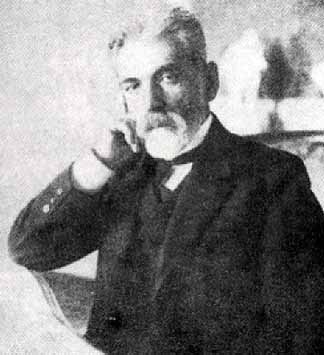
The first man who led the Republic of Armenia. His name is
sometimes spelled "Kachazouni." |
Comrades:
These matters have had my deliberate and serious consideration. I do not know
whether you, too, have arrived at the same conclusions. Allow me to say more: I am
afraid that my final conclusion — those very difficult words which I shall here
state with all singleness of heart — will cause general embarrassment, perhaps
resentment, in the Convention.
I am prepared for that.
I only ask that you believe: a) that it is more difficult for me to write and sign
those words than for you to listen to them from my own lips; b) that those words are
not the result of thoughtless or petty, transient dispositions or hasty resolve. They
are the result of deep-rooted convictions and a clear awareness, for I am capable of
thinking and understanding, considering and determining a stand point.
I beg of you, therefore, that you be patient and approach the
matters with an open mind, unhampered — something which is not easy for men who
have lived a Party life and have thought from a Party angle.
Let me now proceed with my subject.
In order to present my conclusions in proper sequence I feel it is necessary for me
to refresh your memory with the various phases of the Armenian Cause — from the Great War to the Lausanne Conference [42] — and the role played
by the Dashnagtzoutiun during that period. So that I may not abuse your attention, I
shall curtail my speech and present to you a concise yet accurate commentary.
Following 1914, what stages did the Armenian question pass through, what development
did the events show, how did they come about, what sequence did they follow and and
where did they lead to and in the meantime, what did our party do and what will it
have to do in the future?
When I recall the recent past, with these considerations in mind, and when I
distinguish the important points from the secondary and the arbitrary ones, and
arrange them in chronological order, this is the picture that arises:
At the beginning of the Fall of 1914 when Turkey had not yet
entered the war but had already been making preparations, Armenian revolutionary
bands began to be formed in Transcaucasia with great enthusiasm and, especially,
with much uproar. Contrary to the decision taken during their general meeting at
Erzurum only a few weeks before, the A.R.F. had active participation in the
formation of the bands and their future military action against Turkey.
In an undertaking of such gravity, fraught with most serious consequences,
individual agents of the Transcaucasian A.R.F. acted against the will of our
superior authority, against the will of the General Meeting of the Party.
Why?
Because they were also suffering from the syndrome of following the masses, and were
flowing in the direction that the current was taking them.
This example urges us to recall that the A.R.F. in Transcaucasia in the past had
been a follower rather than an originator of movements that had their inception
beyond their control. Thus it was in 1903 (rebellions and demonstrations on the
occasion of the seizure of Church properties); thus it was in the year 1905-1906
(bloody encounters between Tatars and Armenians); and thus it was also during the
first big movements of the laboring classes (1903-1906) when the A.R.F. was being
led at Baku, Tiflis (Tblisi) and Batoum by the policies of foreign socialistic
parties.
The same characteristic line of action appears, as we see a little later, in the
conduct we pursued afterwards generally.
It would be useless to argue today whether our bands of volunteers should have
entered the field or not. Historical events have their irrefutable logic. In the
Fall of 1914 Armenian volunteer bands organized themselves and fought against the
Turks because they could not refrain themselves from organizing and refrain
themselves from fighting. This was an inevitable result of a psychology on which the
Armenian people had nourished itself during an entire generation: that mentality
should have found its expression, and did so.
And it was not the A.R.F. that would stop the movement even if it wished to do so.
It was able to utilize the existing conditions, give effect and issue to the
accumulated desires, hopes and frenzy, organize the ready forces — it had that
much ability and authority. But to go against the current and push forward its own
plan — it was unfit, especially unfit for one particular reason: the A.R.F. is a
people’s mass, strong in instinct but weak in comprehension.
42.
In the Treaty of Lausanne, signed July 24, 1923 between the
Allies and Turkey, reference was no longer made to Armenia or Armenians. Both had
ceased to exist in the eyes of both Turkey and the Allies. Thus the “Armenian
Question” and the question of Armenians was buried in the grave of diplomatic
silence.
|
| |
It is also useless, today, to question who is responsible for the wrongs (if the
issue of responsibily does ever come up). If it had not been Bishop Mesrop, A.
Hatisov, Dr. Zhavriev, S. Arutniov, Dro and Andranic, there would have been others
to do the same things in their place. If the formation of
bands was wrong, the root of that error must be sought much further and more deeply.
At the present time it is important to register only the evidence that we did
participate in that volunteer movement to the largest extent and we did that
contrary to the decision and the will of the General Meeting of the Party.
The Winter of 1914 and the Spring of 1915 were the periods of greatest enthusiasm
and hope for all the Armenians in the Caucasus, including, of course, the
Dashnagtzoutiun. We had no doubt that the war would end with the complete victory of
the Allies; Turkey would be defeated and dismembered, and its Armenian population
would at last be liberated.
We had embraced Russia whole-heartedly without any compunction. Without any positive
basis of fact we believed that the Tzarist government would grant us a more-or-less
broad self-government in the Caucasus and in the Armenian vilayets liberated from
Turkey as a reward for our loyalty, our efforts and assistance.
We had created a dense atmosphere of illusion in our minds. We had implanted our own
desires into the minds of others; we had lost our sense of reality and were carried
away with our dreams. From mouth to mouth, from ear to ear passed mysterious words
purported to have been spoken in the palace of the Viceroy; attention was called to
some kind of a letter by Vorontzov-Dashkov to the Catholicos as an important
document in our hands to use in the presentation of our rights and claims —a
cleverly composed letter with very indefinite sentences and generalities which might
be interpreted in any manner, according to one’s desire.
We overestimated the ability of the Armenian people, its political and military
power, and overestimated the extent and importance of the services our people
rendered to the Russians. And by overestimating our very modest worth and merit we
were naturally exaggerating our hopes and expectations.
The deportations and mass exiles and massacres which took place during the Summer
and Autumn of 1915 were mortal blows to the Armenian Cause. Half of historical
Armenia —“ the same half where the foundations of our independence would be laid
according to the traditions inherited by European diplomacy —“ that half was
denuded of Armenians: the Armenian provinces of Turkey were without Armenians. The
Turks knew what they were doing and have no reason to regret today. It was the most
decisive method of extirpating the Armenian Question from Turkey.
Again, it would be useless to ask today to what extent the participation of
volunteers in the war was a contributory cause of the Armenian calamity. No one can
claim that the savage persecutions would not have taken place if our behavior on
this side of the frontier was different, as not one can claim the contrary, that the
persecutions would have been the same even if we had not shown hostility to the
Turks.
This is a matter about which it is possible to have many different opinions.
The proof is, however — and this is essential —“ that the struggle began
decades ago against which the Turkish government brought about the deportation or
extermination of the Armenian people in Turkey and the desolation of Turkish
Armenia.
This was the terrible fact!
Civilized humanity might very well be shaken with rage in the face of this
unspeakable crime. Statesmen might utter menacing words against criminal Turkey. “Blue”,
“yellow”, “orange” books and papers might be published condemning them.
Divine punishment against the criminals might be invoked in churches by clergymen of
all denominations. The press of all countries might be filled with horrible
descriptions and details and the testimony of eye-witnesses. . . Let them say this
or that, but the work was already done and words would not revive the corpses fallen
in the Arabian deserts, rebuild the ruined hearths, repopulate the country now
become desolate. The Turks knew what they ought to do and did it.
The second half of 1915 and the entire year of 1916 were periods of hopelessness,
desperation and mourning for us. The refugees, all those who had survived the
holocaust, were filling Russian provinces by tens and hundreds of thousands. They
were famished, naked, sick, horrified and desperate floods of humanity, flooding our
villages and cities. They had come to a country which was itself ruined and
famished. They piled upon each other, before our own eyes, on our threshold dying of
famine and sickness. . .
And we were unable to save those precious lives. Angered and terrified, we sought
the culprits and quickly found them: the deceitful politics of the Russian
government. With the politically immature mind peculiar to inconsequential men, we
fell from one extreme to another. Just as unfounded was our faith in the Russian
government yesterday, our condemnation of them today was equally blind and
groundless.
It was claimed that the Russians were intentionally slow to act, showed uncertainty
and provided the grounds and the means for the Turks to slaughter the local
Armenians. It was professed that the reason behind this attitude on the part of the
Russians was to vacate Armenia and later settle the Kossacs there and that Count
Lobanov-Rostovsky’s widely known project “Armenia without Armenians” was in
progress.
It was not only people, but our party and many of our citizens with common sense who
also shared this idea.
We were reluctant to understand that there did not have to be such a project as “Armenia
without Armenians” to explain the Russian stand and that the Russian plans did not
necessarily have to involve such an item as unconditionally taking on the defence of
the Turkish Armenians. Such a plan definitely did not exist. We were only projecting
our own wishes on the Russian government and accusing them of disloyalty.
Our volunteer units were naturally trying to capture Van and Muş without any
waste of time. They headed for these places to save the Armenians. However, Russians
did not only consist of Armenians and they had other intentions. Their sluggishness
and uncertainty to act which we evaluated as disloyalty is explainable by the
customary ineffectiveness of the Russian command ( which was witnessed many times on
other fronts as well) or other general military conditions unknown to us now.
This incident being very much original and interesting, demands to be taken up
individually. By an extraordinary mental aberration, we, a
political party, were forgetting that our Cause was an incidental and trivial phase
for the Russians, so trivial that if necessary, they would trample on our corpses
without a moment’s hesitation.
I am not saying that we did not know the circumstances. Of course we knew and
understood and so we started when it was necessary to explain the situation. Deep
down in our hearts, however, we did not grasp the full meaning of that word-formula;
we forgot what we already knew and we drew such conclusions as though our Cause was
the center of gravity of the Great War, its cause and its purpose. When the Russians
were advancing, we used to say from the depths of our subconscious minds that they
were coming to save us; and when they were withdrawing, we said they are retreating
so that they allow us to be massacred. . .
In both cases we misinterpreted the consequence with the purpose and intention. We
sought proofs of Russian treachery and of course we found them — exactly as we
sought and found proofs of the same Russians— undeniable benevolence six months
before. To complain bitterly about our bad luck and to seek external causes for our
misfortune— that is one of the main aspects of our national psychology from which,
of course, the Dashnagtzoutiun is not free.
|
| |
One might think we found a spiritual consolation in the conviction
that the Russians behaved villainously towards us (later it would be the turn of the
French, the Americans, the British, the Georgians, Bolsheviks — the whole world —to be
so blamed). One might think that, because we were so naive and so lacking in foresight, we
placed ourselves in such a position and considered it a great virtue to let anyone who so
desired to betray us, massacre us and let others massacre us.
In February 1917 the Russian Revolution broke out. New possibilities opened up before us
unexpectedly.
A democratic order was under way in Russia. Extremely important social issues (such as
appropriating the lands into public ownership) were waiting to be solved. We, the
socialists and democrats welcomed this new order with enthusiasm. Also, as a national
political party, we concentrated on the issues of taking over the administrative power
from the central authority and the autonomy of individual regions and peoples.
We set out on a hard work.
The old state mechanism needed to be changed and the local units of the new authority
needed to be set up. The central government which was going through the first phases of
the Revolution did not have the means to look into this question. The local cadres were
wholly entrusted with this issue. Social institutions such as political parties, workers’
unions and national governments were authorized with dealing with the issue (or, rather
they took it upon themselves to deal with it).
The issue of national participation in the government was a particularly complex and
difficult question in Southern Caucasia. National councils among which were Armenian
councils were established in important centers.
The Southern Caucasian Commissariat and Worker, Soldier and Peasant Soviets Southern
Caucasian Center were established. These were two independent establishments of the
central government and were assigned with governing the region until governmental
institutions were set up.
“The Soviets Center” had lost its authority by the end of the year and it left the
political scene. On the other hand, the Southern Caucasian Commissariat gained strength
and turned into the governing power of the whole Southern Caucasia.
As it later proved to be in the Seym and in the Southern Caucasian government, the “Commissariat”
was also a coalition.
This coalition represented the parties in name and form and the nations, in essence. The
main parties were: The Menshevik Fraction, the Social Democrats, the Musavat and the
Armenian Revolutionary Federation Dashnagtzoutiun. These parties in fact represented the
three main nations of the region: the Georgians, the Azerbaijani Tatars [43] and the Armenians.
The Georgian Mensheviks assumed the authoritative position, the leading role in the
Commissariat and later both in the Seym and in the government.
What was the reason?
Here are some reasons:
Firstly, the Commissariat had taken over its authority from the Provisional Government, or
rather the State Duma circles in Petrograd. The Georgian representatives, over a long
period of time, had acquired important positions and influence and had established
contacts, relying on a strong organization which was the Russian Social Democratic Party.
When a “Commissariat” was established in Southern Caucasia, the priority was naturally
given to the Georgians and not to the Armenians and the Tatars who were not conspicuous in
the Duma.
Secondly, there were people more or less experienced in state affairs, among the
Georgians. These people had acquired some habits and experience due to active
participation in the work done in the Duma. Neither we, nor those from the Musavat,
however, had been through such a school and were not prepared. Musavat was new and
Dashnagtzoutiun was in fact only prepared for underground activity. Doubtlessly, the
qualities of the party leaders were also important to a certain extent. The Georgians had
bred a few capable people or social leaders; we had nobody to sit next to them and we used
to sit behind them in the second or third rows.
Another point was that in the times of the old regime, the state affairs were in the hands
of the Georgians. This fact continued after the Revolution, for more people were to be
found among the Georgians, who were capable enough to conduct technical work. Experience
in official service naturally formed a strong basis for the Georgians to gain further
strength in administrative duties. So was the situation from the “Commissariat” to the
affairs relating to the railways and the post and telegraph.
The most important was the following: The Georgians were the best organized people with
the highest social consciousness in Southern Caucasia. On the other hand, there was no
threat against the physical existence of the Georgian people. For these reasons, the
Georgians were stronger than the other peoples.
The geographical location of the Georgian people and the fact that they inhabited the same
area together, that they suffered fewer losses in the War and also that they bred no
mutual antagonism (serious enough to be a threat to their national existence) against
their neighbours made them luckier in being able to be heard, in comparison to the
Armenians and the Azerbaijanis. No matter what, the Georgians could be on better terms
with Turkey and Azerbaijan, compared to the Armenians. What was more, a Georgian
population outside the borders of Georgia, whose lives were under threat did not exist.
However, Armenians had kins living in Azerbaijan and so did Azerbaijanis, living in
Armenia.
The Georgians were living in peace and quiet on their own land; although they did have
certain border problems with their neighbours, these arose from imperialist claims and
could easily be increased or completely solved without putting the present or the future
of Georgia under threat. On the other hand, the relations between Armenians and Turks and
Armenians and Tatars were different. Between them there had been problems going on for
centuries and it was impossible to solve them without major conflicts. Turkey,
unconditionally defeated on the west, was trying to open up a future for itself and
consolidate it on the northeast. And here the Armenians interjected between Erzurum and
Baku and blocked their way.
Insolvable land problems stood between Armenians and Azerbaijanis . The problem was not
occupying one or two towns but having the national population inhabit an unbroken,
continuous geography. This wish was fostered both by the Armenians and the Azerbaijanis.
Armenia could not survive without Şarur-Nakhichevan and the importance of Nakhichevan
for Armenia was different from the significance of Zaqatala, Akhalkalaki and Lori for
Georgia. This was why both Armenia and Azerbaijan were unlucky.
It was perhaps possible for politically mature peoples to find peaceful solutions. However
neither we nor the Azerbaijanis were mature enough; for this reason, the conflict between
the two peoples had mutually become a source of antagonism and distrust.
43.
Tatars: The author here refers to the Azerbaijani Turks. Katchznouni sometimes prefers the
word, “Tatar” is it was sometimes used by the Tsar regime but occasionally uses the
word “Azerbaijanis” to refer to the same people. (LA)
|
|
The Georgians used the Armenian-Turkish and Armenian-Tatar conflicts cleverly (in
other, stronger words, opportunistically), in order to consolidate their privileged
situation. Relying on Turks and Tatars and threatening us with moving the borders in
this or that way, they complicated matters for us and forced us to accept their
conditions. Whenever they needed to ally with us, they started threatening the
Azerbaijanis. This kind of behaviour was politically an absolute blackmail and it
provided a superiority for the Georgians over their neighbours and established their
hegemony over others.
I have digressed a little but in order to make the political situation clear in that
period in Southern Caucasia, it was necessary.
Our party must understand and keep in mind that the party was under the hegemony of
the Georgian Social Democratic Party in the most difficult days, and it acted
abominably.
In September 1917, the Armenian Convention met in Tiflis (Tbilisi). A national board
was established as its executive organ and was named the Central National Council.
This National Council later acted on behalf of the Armenian people of Southern
Caucasia and became the fully authorized representative of the nation.
Dashnagtzoutiun played the leading role both at the Convention and on the board and
the council.
Towards the end of the same year, elections were held in Southern Caucasia for the
members of All Russia Provisional Assembly.
Out of the parties which participated in the election campaigns, the Menshevik
Social Democrats won 12, the Musavat won 10 and the Dashnagtzoutiun won 9 seats. The
number of seats won by the other parties was negligible.
These three parties represented three great peoples who could be listed, according
to their political weight, as the Georgians, the Tatars and the Armenians. These
elections showed that the strongest, or rather the only organized party was
Dashnagtzoutiun.
The All Russia Provisional Assembly. could not meet. The Bolshevik Revolution broke
out in October and was triumphant in Moscow and Petrograd. The Soviet order was
proclaimed and the meeting of the All Russia Provisional Assembly was not permitted,
as this assembly was considered to have bourgeois tendencies.
Southern Caucasia, loyal to the February Revolution did not recognize the Soviet
sovereignty and system
Why?
Because in this corner region the dominant parties preferred a democratic platform
based on a broad mass membership and for this reason would not accept especially a
party dictatorship. On the other hand, they thought that the country was not mature
enough for a fully socialist, let alone a communist regime (besides, the Musavat
Party possessed nothing in the name of socialism). The socialism of the Armenian
Revolutionary Federation Dashnagtzoutiun was only on the surface and had no deep
roots among the masses of people within the party. Among the Georgian Mensheviks, on
the other hand, the nationalistic anti-Russian trend was strong.
Secondly, the Georgian Mensheviks which determined the atmosphere in the political
life of Southern Caucasia, had broken away from the Bolsheviks and were openly
opposing them.
The Mensheviks who were loyal to their party regulations and the general political
line of their party, were pursuing here, exactly the same policy their Russian
comrades were pursuing in Russia. The Musavat which had enthusiastic desires about
capturing Baku and had Panturkist ideals, wanted an immediate separation from
Russia.
The Armenian Revolutionary Federation Dashnagtzoutiun had formed close relations
with the local Bolsheviks and was assisting them, in case the Tatars would capture
Baku. In Tiflis (Tbilisi), on the other hand, they could not close their eyes to the
reality of the Georgians and Tatars and so could not put in practice Bolshevik
policies. They would not have been able to do so even if they had wanted. Anyway,
they had no desire to do so, because the Bolshevik ideology and tactics did not
appeal to them.
Our Party stood in the anti-Bolshevik camp partly due to certain convictions within
the Party and partly because of being under the pressure of outside factors.
I have to remind you here of the neutral and reluctant stand our comrades took in
Baku.
Baku, the industrial city which bore a proletariat of tens of thousands and strong
workers’ organizations offered very favorable conditions for the development of
Bolshevism. That city had been the only region where the Bolsheviks could find a
reliable sanctuary and a sound support in the whole Southern Caucasia since the
first days of the Revolution. Baku did not refuse, in form, the sovereignty of the
Southern Caucasian Commissariat even after the October Revolution. In reality,
however, the power was in the hands of two local organs: the Social Organizations
Soviet and the Workers’ Representatives Soviet.
In the first one, anti-Bolshevik groups, and in the second one the Bolsheviks
dominated. Our Party was represented on both the organs. Inside these organs which
were independent of each other and were of different nature, an open struggle for
domination was going on.
In the first period, the Social Organizations Soviet was stronger (here, the mild
socialists and the liberal bourgeoisie had formed a silent alliance against the
Bolsheviks). The Workers’ Representatives Soviet was gradually gaining strength
and by January 1918 it had gained control over the entire situation.
This Soviet was led by the Bolsheviks. Bolsheviks were not an important force then;
their accomplishments were essentially due to the insecurity prevailing in the other
camp.
Only two parties, Dashnagtzoutiun and Musavat could demonstrate any strength against
the Bolsheviks. However, though these two parties needed to act in alliance if they
wanted to accomplish anything in the struggle against Bolshevism, this was
unimaginable, for there was no mutual trust. Dashnagtzoutiun was aware that its
support for Musavat was required only because of the Bolshevik threat. Musavat had
to erase Dashnagtzoutiun from the political scene, after having eliminated the
Bolsheviks. No doubt, the Bolsheviks would do the same to Dashnagtzoutiun after
having destroyed the Musavat with the help of armed Dashnag troops. For the Armenian
community, the Bolshevik dictatorship was more acceptable in comparison to the
Musavat dictatorship.
The fact that our people got more and more involved in the Bolshevik movement in
Baku and that they provided a kind of sustenance to them is explainable only with
this.
Just as we unintentionally came under the domination of the Georgian Mensheviks in
Tiflis (Tbilisi), we were under the influence of the Bolsheviks in Baku. In both
cases the motivating force was the Turkish-Tatar threat. Bolsheviks wiped out
Musavat in Baku with our support (March 1918); we, on the other hand were able to
protect Baku against the Turkish-Tatar assault with the help of the Russian elements
among the Bolsheviks.
Later, again with our initiative, British forces were invited over from Iran. This
happened in the last moments when the Bolsheviks were getting ready to escape to
Russia and had got on the ships.
If the British had been able to settle down firmly in Baku, the outcome of the
events would probably have been different. However, the few numbers of the British
troops did not promote trust among the people and they got on their ships and went
back to Iran.
|
| |
We were left alone; we did nothing else besides following the British to Iran.
The Azerbaijani government based in Gäncä so far, entered Baku with the Turkish armed
forces and the armed people. The Armenian people were started to be cruelly massacred;
just as the Muslim people were massacred (on a smaller scale) in March during the
Bolshevik-Musavat conflict.
These incidents were happening outside Armenia, in one of the Tatar regions; nevertheless
they were reflected on our political scene and confused the situation and made it more
difficult.
The Tatars continually provoked the Turks against us and speeded up their assault, in
order to be able to enter Baku. With this intention, they were very cunningly speculating
about the March incidents and were putting the blame of the incidents entirely on the
Armenians. The Georgians were displeased with our association with the Bolsheviks; they
had doubts about us, thinking we were seeking for an opportunity to open the doors of
Southern Caucasia to the Russian Bolsheviks. Apart from this, they interpreted having the
British forces over in Baku when the Germans which they were flirting with, were in Tiflis
(Tbilisi) as a betrayal of the Georgian-German-Turkish-Tatar policies.
As a result of the policies we practiced in Baku, our neighbours started to regard us as
independent allies. Our comrades in Baku, on the other hand, thought that they would be
able to protect the rest of Armenia against Turkish assaults by consolidating their
existence in Baku and attracting the Turkish-Tatar forces to the city. They developed
their policies in this direction. I am going back to the chronological sequence of events.
At the end of November 1917 the Russian Army started to get demoralized and the soldiers
started to abandon their troops on the Caucasian front. The front was being destroyed in
astonishing speed.
At the end of January, there was no longer an army. Negligible Armenian troops, with some
soldiers left over from the army, were charged with defending the Erzurum line.
The situation in Southern Caucasia was getting more and more dangerous.
The Bolshevik Revolution and the civil war spreading wider and wider every day, had
definitely torn away the outer regions from Russia.
The Commissariat which acted in the name of the Provisional Government led by Kerensky
lost the ground under their feet after the Government was turned out of office. There was
a need to establish a new power, authorized in the eyes of the public and capable of
conducting governmental affairs independently and with greater authority. Such a power was
established with the Southern Caucasian Seym and its Government.
The Seym was formed out of the Southern Caucasian members of the All Russia Provisional
Assembly (by multiplying this number with three). Thus the Mensheviks (Georgia) had 36,
the Musavat (Azerbaijan) 30 and the Dashnagtzoutiun (Armenia) had 27 seats in the Seym.
The Seym met in Tiflis (Tbilisi), the natural and indisputable capital of Southern
Caucasia.
At the first general congress on 10th February 1918, the executive committee report was
read and the resignation of the Commissariat was accepted. Later, the Seym taking into
consideration the fact that the relations between our region and Russia had been actually
broken and that it was uncertain as to when they would be reestablished, announced the
independence of the Southern Caucasian Democratic Republic and that it was the only
institution which held the executive power in its hands. Within this context, Y.
Gegechkory (Georgian Menshevik) was assigned the task of forming a provisional government
(a cabinet) responsible to the Seym.
This did not mean a separation from Russia; it only reflected the actual situation and was
temporary. Internationally, Southern Caucasia was considered to be an inseparable part of
Russia.
Encouraged by the increasing corruption of the Russian army, Turkish military troops
hastily got organized, got themselves in order and started to capture one after the other,
the regions they had lost. In the meantime, the Turkish Command (Vehip Paşa) started
to initiate a cease-fire and the continuation of the peace talks.
The Seym took a decision to stop the war and sat down for a settlement with the Turks.
The first talks were conducted in Trabzon in March 1918. The Dashnagtzoutiun fraction was
able to add among other Seym demands the demand for self determination of the Armenians in
Turkey within Ottoman borders, as a separate individual point (there were four separate
demands).
However, this demand ( which was very badly formulated and was open to negotiation) was
immediately answered officially and was stated that the self determination of the Turkish
Armenians was an internal matter of Turkey and nobody had the right to interfere with the
internal affairs of Turkey. Thus, they gave us the message that if we ever brought up the
issue of the Turkish Armenians, they would cut off any talks. The Southern Caucasians did
not bring up the issue any more. The reason why they had brought it up was clear; the Seym’s
decision was only a gesture of good will towards the Armenians, and the Seym never had the
intention of insisting on this demand. The Georgians were not inclined to get into
needless trouble (they did not feel the need to); for the Azerbaijanis, on the other hand,
the Turkish interests were more important than the future of the Armenians and even the
Southern Caucasian Republic. The Armenian members of the delegation, were certainly not
able to make the Tatars and the Georgians accept their demands. To be just, it must be
pointed out that even if our allies at that time (the Georgians and the Tatars) had been
able to defend the Armenian demands most sincerely, they would not have been successful.
The balance of power was in Turkey’s favour and therefore there was no reason why Turkey
should give any concessions. This point was clear to us –the Armenian members of the
delegation.
The issue of borders became a hot subject of discussion.
The Turks were convinced that the border between Southern Caucasia and Turkey had been
determined with the Brest Agreement signed by the Bolsheviks. In the same manner, they
stated they had come to Trabzon not to open this agreement to question but to establish
friendly relations with their neighbour, the Southern Caucasian Republic. Southern
Caucasia on the other hand, did not recognize the Brest Agreement and thought it was the
Southern Caucasian peoples who were authorized to decide about land concessions to Turkey.
In other words, the Southern Caucasian delegation did not want to accept that the Soviet
government was legally authorized (on the grounds that this government was not recognized
within Russia itself and on the other hand that according to the slogan of self
determination voiced during the period of the Great War, the real owners of Southern
Caucasia was not the Russian Government, no matter how legitimate it might be, but the
peoples of the region themselves).
It was very difficult to defend this stand not only because it was new and controversial
in international law, but also because the Turkish Army was growing stronger every day and
the Southern Caucasian Army was on the verge of breaking down. In international affairs it
is no secret that the powerful party proves to be right.
Another reason why it was difficult to defend this attitude was because the delegation was
not in unity within itself.
|
|
Because the Georgians were primarily concerned with the issues of Batoum and Ajaria
, in order to be able to secure all this region, they were inclined to leave Kars
and Ardahan to Turks.
However, Armenians needed Kars. We were ready to give Ajaria big concessions in
order to get Kars in return. The Azerbaijanis, on the other hand, as the fourth (or
if Dagestan is taken into consideration, the fifth) republic of the Southern
Caucasian Federation, wanted a Southwestern Muslim Republic to be established in
Ajaria. If not, they thought, Ajaria ought to be attached to Turkey. They did not
want it to be attached to Georgia.
The Azerbaijanis defended completely the same view with the Turks concerning Kars
and Ardahan. They considered Kars and Ardahan Turkish territory and therefore
regarded it quite natural that they should be attached to Turkey.
Turks were very closely informed about our inner conflicts and therefore insisted on
their views.
There was another issue which invoked a big discussion: Turks wanted Southern
Caucasia to be declared independent of Russia and thought that an agreement with us
would only then be possible.
The Southern Caucasian delegates insistently stated that Southern Caucasia was
physically separated from Russia and was in fact independent. Turks, on the other
hand, quite rightly declared that in order for an international agreement to be
signed, a de facto situation was not sufficient and that a legal foundation was
needed and that to bring this about, certain formalities had to be carried out.
These unproductive talks went on for about a month. It was to Turks’ advantage
that the talks went on for so long (otherwise, they would have ended them any
moment). Time was passing, our military force and defense potential was continuously
getting weaker whereas those of the Turks were getting stronger. While we were busy
with holding meetings and with correspondence in Trabzon, the Turkish Army was
advancing without meeting any obstruction. They captured Erzurum at the end of March
and Batoum at the beginning of April.
Nevertheless, the Seym would not admit defeat.
When it was clear that Turks would not make any compromises on anything that was
included in the Brest Agreement, the Seym withdrew its delegation and the Trabzon
talks broke up (this was called “a break”).
Internal discord within the Seym and inside the government of the Federation which
had been going on since the first days was more clearly prominent now.
Turkish success encouraged the Azerbaijanis; their delegation had a better chance to
sit down with the Turks and talk in Trabzon (and they certainly did use it). In the
Seym the Azerbaijanis did not hide that they sided with the Turks. Defending and
developing the Turkish view, they demanded that Southern Caucasia be speedily
separated from Russia, Turkey be given considerable concessions and also the war be
ended, having come to an agreement with Turkey; for they stated that as Muslim
democrats, their religious sentiments prevented them from getting actively involved
in a fight with the Turks.
These words, expressed by a Musavat speaker in the Seym should have been understood
as a possibility that the Southern Caucasian Tatars would fight against us, let
alone fighting on our side, (they had never actually been on our ranks and had never
fought on the Turkish front) if the war with Turkey was continued.
The Georgians hesitated, as if they were the Menshevik fraction of the Seym.
They harboured two trends, two different tendencies (the Russian tendency and the
German-Turkish tendency). Those that were inclined towards Russia did not definitely
want a separation from Russia, but because they evaluated the Brest Agreement as
unacceptable, thought that instead of a peace with such conditions, a war was more
acceptable. The representatives of the second trend were against Russia; They
thought the Russian threat against Georgia was more important than the Turkish
threat. Therefore, they were ready to give very big concessions to Turkey, to be
able to compromise (to speak openly, they were trying to give concessions in the
name of Armenia, to be able to save at least Batoum and the harbour there, if not
the whole Ajaria).
The Armenians (Dashnagtzoutiun fraction in the Seym) did not want to separate from
Russia nor did they have positive expectations from Turkey. The Armenians would
rather stop Turkish attacks with armed force, because they believed that it was
going to be them, rather than anybody else (or perhaps only them) who would suffer
losses and they still hoped they were capable of future military victories.
The Armenian National Assembly met in Alexandropol (Gumru) in April and took up this
issue. Despite the presentation made there, by the author of these lines, it was
agreed that the Brest Agreement should be refused and the war should be continued.
However, this decision could never be put into practice, because we were not in a
position to assert our ideas, we could not even determine our own fate.
The indecision of the Georgians did not last long. The German-Turkish trend was
victorious in the Seym and as a result of this victory, the Seym announced
boisterously on April 22 that Southern Caucasia parted from Russia. On this
occasion, the Georgian and the Tatar leaders made very emotional speeches at the
Seym meeting. The Dashnag fraction supported the proposal of separation but did not
make any speeches.
It was not easy for us to accept this separation, but there was no other way. If we
had opposed, the Southern Caucasian Federation would have broken down; the Georgians
and the Tatars would have agreed to reconcile with the Turks and we would have been
left alone; and we would have been standing against the Turkish Army. Russia
(neither the Bolshevik one nor the anti-Bolshevik one) could not have helped us even
if they had wanted to. We were not only alone, but behind our lines it was also not
secure; for it was clear that the Azerbaijanis and (perhaps the Georgians too in
order to capture Akhalkalaki [Ahılkelek], Lori and Pembek) would come against
us. We needed the Southern Caucasian Confederation more than anybody else and did
not want it to break down. This was why we acted in the same direction as our
neighbours did.
On April 25, Kars fell; and with almost no fighting, for directives were received
from Tiflis (Tbilisi) to surrender the fortress to the Turks. This treacherous
directive had been sent without our knowledge and it aroused great reaction among
our people. That day the fate of the Federation looked very critical.
However, what was done was done. The Kars fortress which was our most strategic area
was now in the hands of the Turks; there was no room for hesitation and neglect. The
Seym accepted the Brest Agreement as the reference and decided to continue the talks
which broke up in Trabzon.
The new phase of the talks started in Batoum on the first days of May (where the
Turks had quite comfortably settled for some time). This time the Turks had a
different approach. The Brest Agreement was no longer satisfactory for them. They
were saying that following the Trabzon talks there was more bloodshed and that this
had to be compensated. They mainly demanded more land compensations from Armenia.
Long and useless talks started again. The Brest Agreement which we did not want to
hear about a few months ago in Trabzon, became our sole wish now. However, it was
impossible to persuade the Turks. They had gripped our throat tightly and did not
want to let go.
|
| |
On May 15, the Turkish troops crossed Arpaçay (Arpatchai) which was the border
according to the Brest agreement, and invaded Alexandropol (Gumru ) in a few hours
and moved towards Karakilise.
The situation was unacceptable.
Tiflis (Tbilisi) which was the capital of Georgia and Southern Caucasia was also
under threat. No further advance was made in the talks going on in Batoum.
The discord in the Seym could not be settled with any compromise. An explosion was
inevitable.
The Georgians were able to see that we were a useless burden on their shoulders and
they could very easily solve their own problems without us. The Azerbaijanis, on the
other hand, had one wish: Joining the Turks to invade Baku right away. Following the
Turkish victory, the Azerbaijanis had no longer any need for the Southern Caucasian
Federation. They did not need the Georgians and they saw the Armenians as their
enemy.
The moment of breaking down had come.
On May 26, the Seym abolished itself and abandoned its rights, taking into
consideration that there were fundamental disagreements concerning war and peace
issues .
On the same day and in the same building, Georgian National Council bombastically
declared the sovereignty of Georgia.
One day later Armenia took the same step.
Now it was Armenia’s turn.
Was it right to declare our sovereignty; did we have the means to establish our own
state and maintain it?
These questions were absurdly unnecessary. We had neither the place nor the time to
organize elections. History had brought us to a certain point. We had to gather
courage and solve this problem, for we did not want to disappear. We had to own our
country, otherwise, we were going to lose it forever. A small hesitation and neglect
would create a situation of res nullius (nobody’s property) and in such a
situation we would become a war booty for our neighbours, the Turks, the Georgians
and the Tatars.
On May 28, late at night, the Central National Council declared Armenia a sovereign
state and itself the highest sovereign organ of this state.
The Council had not received any such authority from the National Board, but
nevertheless they did not hesitate in the face of such a formal obstacle and in the
following years nobody thought of accusing the Council of transgressing their
authority. Everybody was aware that there was no other way.
On May 22-26 the battle of Serdarabat and on May 25-28 the battle of Karakilise were
fought.
The Armenian people had gathered all their strength to defend their existence. No
doubt these fierce battles, the brave resistance that the people (there was no
longer an army) showed (especially around Karakilise) significantly raised our
standing in the eyes of the Turks and provided the opportunity for a settlement.
The Armenian delegates who were now acting on behalf of the Armenian Republic and
who had been authorized by the National Council returned to Batoum and a treaty was
signed on June 4. It was a new phase in the life of the Armenian people; a phase of
the revival of a state organization which had been lost long ago.
On August 1, The Armenian Parliament began to work in Yerevan (Erivan) and the first
government was formed.
The parliament had been formed by tripling the present number of the National
Council members. 6 Muslims, 1 Russian and 1 Yezid member was added to the other
members. The majority belonged to the Armenian Revolutionary Federation
Dashnagtzoutiun. Because our fraction held 18 votes out of the 47 and because we
could not form a bloc with any other fraction, the Parliament had no stable center
and a definite political identity.
The government was not stable either. The cabinet changed four times during the
first 10 months, but the head of the government was always the same person.
The first governments that were formed were all coalitions (the Dashnags, the Cadets
and an independent war Minister). The coalition government was not founded on a
sound basis, because it did not have a safe majority in the parliament (the Cadets
often took a different course from the Dashnags). What was more important was that
there was no common agreement among the parties forming the government, on the basis
of the program. The attitude our party had towards the government was also an
obstacle in this context.
Now I would like to take up a mistake which I find very important and explain it
below.
Armenia was a Democratic Republic. It had the proper organs of
a democratic-parliamentarian government: a legislative body composed of the people’s
representatives and a responsible administration. The Parliament was composed of
representatives from the four existing Parties and minorities with the widest true
democratic principles. The government received its authority from the legislative
body and was responsible to it. This was the form. But the reality was otherwise. In
practice our Party tended to subject to itself, to control, the legislative body and
the government. We did not have the courage, nor the ability to declare an open
dictatorship, but did not wish to remain within parliamentarian limits either and
tried to establish in Armenia the “Ittihad” [44]
system —a party dictatorship disguised as a democracy. An intolerable dualism
resulted from it — on the surface the Parliament and the government; behind the
scenes, invisible, the Party and its organs.
Naturally, these two types of authority which were practiced officially and
unofficially were only obstructing one another. The official rules prevented the
party from acting freely and fast and exposing its own will; the manipulations of
the party also prevented the government from acting with its own initiative. This
factor made it extremely difficult to form coalitions. Actually, the foreign
elements of the coalition government had to practice the policies which had been
decided outside the government, in party offices which did not belong to them and
they had no control over.
Last summer, I prepared a report on this sensitive issue and presented it to the
Party Congress, as I was instructed by the related party organ. My report was read
at the regional meeting which met in Constantinopolis.
44.The
Ittihad (The Committee of Union and Progress) represented the resurgence of the
Young Turk movement in 1909 against the oppressions of Sultan Hamid. It started as a
revolutionary movement friendly to the Dashnags and Dashnag aspirations, but it soon
followed, the established pattern of massacre, bloodshed and rabid Turkish
fanaticism.
|
| |
Here I will suffice with a few lines on this issue.
In November a general peace was declared. Germany and its allies lost the war.
The German troops left Georgia in haste. Turks also receded back into their old territory.
Towards the end of the month, British troops –the troops of our ally— entered Batoum.
We started to entertain new hopes. It appeared as if our situation in Southern Caucasia
would radically change, for the victorious and those which replaced the German troops in
Tiflis (Tbilisi) were our allies. We had fought against a common enemy. We certainly would
attain the privilidge of special friendship of the British, compared to the Georgians who
had flirted with the Germans and to the Azerbaijanis who had openly went over to the
Turkish side.
We were once more wrong. The British saw no difference among us. They acted as if either
they did not know that we had been their ally or had forgotten this. The generosity they
showed towards the Georgians and the Azerbaijanis was unexpected and incomprehensible. We
certainly did not like this attitude of the British and thought they were disloyal. This
was the easiest way of explaining to ourselves an incomprehensible situation. We contented
that they were unfaithful and we were relieved. We did not examine the reasons for this
unfaithfulness.
At the beginning of December, a war between Georgia and Turkey broke out but did not last
long. When the Turks moved from Alexandropol (Gumru) to Pembek and captured Karakilise,
the Georgians took the opportunity and sent troops to the Lori region of Armenia.
Nevertheless, even when Turks receded, the Georgians did not want to vacate Lori. On the
contrary, they took every opportunity to secure their presence there.
They ruthlessly suppressed the resistance of the people of the region. Lori became a
matter of dispute and the gravest border question between Armenians and Georgians.
Georgia broke us off the rest of the world, in order to be able to apply pressure on us
they imprisoned us inside our borders. Even the wheat which was imported into our country
in order to feed our immigrants, was obstructed in Georgia and could not properly reach
its destination.
Georgia invaded Lori and closed the railway. We were surrounded. This was actually a
reason to declare war on Georgia. The revolt of some Armenian villages in Lori and the
severe measures taken by the Georgian government was a direct reason for declaring war. It
was as if the Georgian government was looking for reasons to massacre Armenians.
Probably the provocations of the Russian officers serving in our army also played a part.
The government in Georgia was trying to diminish the Russian factor (which was quite
strong in Tiflis-Tbilisi), curb its influence and nationalize the state apparatus. For
this reason they were dismissing the Russian officials and officers and were expelling
them from Georgia in big groups.
A significant number of Russian officers were serving in our army and these officers had
connections in Tiflis (Tbilisi) (and perhaps also in the volunteer units of the Dennikin
Army). It was probably the same people who provoked our military circles in order to
create the hostile atmosphere needed to start a military operation.
The war lasted only three weeks. On December 31, the British interfered and a settlement
was made. Lori was temporarily declared a neutral zone and a common Armenian-Georgian
authority was established there, under the supervision of the British commissar.
In this way, the war had concluded favorably for us. We had partially achieved our aim
(the railway connection was reestablished with the help of the British). Nevertheless, the
war made us think over many issues. We were a very young state with a history of only 4-5
months and this country which was in need of many things had fought a war. We had been
fighting with a neighbour with whom we had to have the closest relations, for we could
only establish connections with the rest of the world over Georgia.
We were aware of that and sincerely wished to have friendly relations with the Georgians,
but we were not able to accomplish that. The reasons were both the attitude the Georgians
took towards us and our own weakness, political inadequacy and our inaptitude to use the
state apparatus.
Here, I also have to call attention to the continuous fights going on within and outside
our national borders.
We were officially at war with Azerbaijan, because we were actually fighting with them in
Qarabag (Karabağ). There were often clashes in Qazax(Kazak) too. Inside the country,
at certain places like Agapapa (Akbaba), Zot (Zod), Zanki-Bazar(Zengibasar), Vedi-Bazar
(Vedibasar), Sharur-Nakhichevan, (Şarur-Nahçıvan) Zangezour (Zengezur) etc.
many bloody battles were fought with the native Muslim inhabitants.
And also there is no doubt that the attitude of Azerbaijan in this matter was hostile.
Also it is indisputable that the native Muslim inhabitants had been acting against the
Armenian state because they were encouraged by Turkey and Azerbaijan. What is important is
that we had not been able to take the precautions either within our country or outside it,
to secure our stand. We could not establish an acceptable modus vivendi with Azerbaijan.
We were not able to establish order by means of administrative methods, in the Muslim
regions; we were obliged to use arms, send troops, demolish and massacre. We were not
successful even in these; so much so that this failure shook the prestige of the central
authority. In important points such as Vedibasar and Şarur-Nakhichevan we were not
able to establish our authority even with arms; we lost and receded.
On May 28, 1919 on the anniversary of our independence, the Parliament declared Armenia
“united”: in other words, declared that we included the land which would possibly be
saved from Turkish sovereignty into the present Armenian territory. This step was
considered by some Turkish Armenians as usurping their rights, because they found it
extremely dangerous from the point of view of the Armenian question. They made a great
fuss, they protested and the Armenian problem in Turkey was once more brought very heavily
against the Armenian question in Russia. The liberal bourgeoisie inside and outside the
country called this an irresponsible behaviour on the part of Dashnagtzoutiun and started
acting furiously towards the party.
These objections and worries were all ungrounded. The Dashnagtzoutiun had no intention of
usurping their rights or doing any plotting, besides, it was later understood that this
step would not harm the Armenian question in Turkey. The May Declaration had no effect
whatsoever on the Armenian question in Turkey and nobody ever even became aware of it.
|
|
It was later seen that the hopes the people who prepared this declaration cherished
to increase the political significance of Armenia and to facilitate the diplomatic
work done in Europe were in vain. No change had been brought about in the situation,
in the eyes of the European diplomacy. A single declaration of our parliament, this
meager record which had not been supported with the necessary activities could not
have changed the effect of realities. It could have been expected that our national
delegation in Paris would be abolished, but it was not. Even following May 28, two
diplomatic missions in Europe (The Delegation of the Republic and the National
Delegation) continued to function side by side ; they were assigned to advocate the
same issues in the same places to the same people. However, it proved difficult to
compromise the activities of these two organs who were competing for authority. In
this way, our undivided front in Europe was divided. In Armenia, on the other hand,
it became difficult to find an opportunity to have a coalition with liberal elements
and for this reason our party was more isolated.
The psychological demands which led us to announce the Federal Armenia Declaration
are explicable.
The political considerations which led us and which justified the declaration are
also understandable. However, it is a fact that this declaration did not lead to any
favorable results; its unfavorable results (domestic strife and conflicts) are, on
the other hand, very clear.
The Armenian Parliament opened on August 1, 1919. The
elections took place in accordance with the democratic procedure — general, equal,
direct and secret balloting — but it was strange and disheartening that 72 out of
80 members were Dashnaks, with only four members from the other parties. There was
no opposition party to act as a check. We Dashnaks seemed to be victorious but did
not understand that it was not a Parliament but the caricature of a Parliament.
We could not understand that elections proved that our people were not yet ready for
an independent political life. We were not aware that our parliamentary victory was
not actually a victory but a defeat and that by sending 72 members into the
parliament we had lost the ground we trod on, the democratic foundation.
We did not understand that as we assumed authority, at the same time, we were also
assuming all the responsibility. We lacked the necessary provisions and elements. We
could not understand that a strong opposition was needed simply to discipline us and
to prevent us from transgressing the present law and order. We also did not
understand that by carrying our party meetings into the parliament we were actually
bringing the existence of our party to an end.
There was no Parliament; it was an empty form without content.
The problems of state were being discussed and solved behind closed doors, in the
rooms of the Dashnag faction, and then declared from the rostrum of the Parliament.
In reality, there was not even a parliamentary faction, because this latter was
under the very strict supervision of the Dashnag Bureau, and was obliged to carry
out its orders. There was not a government either. This, also, was subject to the
Bureau; it was a kind of executive body for the Bureau in the state. This was the
Bolshevistic system. But what the Bolsheviks were doing openly and consistently, we
were attempting to veil under democratic forms.
On the first days of May 1920 there were Bolshevik demonstrations and attempts at
uprising. These were suppressed without much effort, because they had no basis;
Bolshevism was strange to us. There was also no outside support.
Nevertheless, there was also an interesting situation. A group of young Bolsheviks
(even in Yerevan (Erivan) in front of the eyes of the government) were making noisy
demonstrations and propaganda among the military toops, occupying the train station
in Gumru and capturing an armoured train
This proves that the government was irresponsible, weak and ignorant.
Following the Bolshevik rebellious efforts of May 1920, there
was a “coup d’etat” and the A.R.F. Bureau (the so-called “Bureau Government”)
replaced the Parliament with its own dictatorial rule. By order of the Bureau the
resignation of prime minister A. Khadissian was accepted on May 5, and by order of
the Bureau Dr. H. Ohanchanian was ordered to form a new cabinet; the latter
presented the already-prepared list of ministers in the same meeting in which he was
ordered to form a new cabinet. That was the Bureau itself. Parliament was ordered
indefinitely recessed. The Armenian Parliament had given a dictatorial government to
the Dashnagzoutuin — to the Bureau.
This was against the decision of the 9th General Meeting of the A.R.F. and had many
disadvantages, but it also had the advantage of coming out in the open in its true
form and color.
The Armenian-Turkish war which broke our back began in the Fall of 1920. Would it
have been possible to evade it? Probably not. The crushed Turkey of 1918 had
recovered during the two years. There came forward patriotic, young officers who
formed a new army in Asia Minor. They saw the necessity of attacking in the
Northeast, and also in the Southwest against the Greeks which they could not do
without first crushing their flank on the Armenian front. One cannot say that the
Turks really had such a plan, but it is possible that they did and it was also
probable that the war with us was inevitable.
Despite these hypotheses there remains an irrefutable fact. That
we had not done all that was necessary for us to have done to evade war. We ought to
have used peaceful language with the Turks whether we succeeded or not, and we did
not do it. We did not do it for the simple reason — no less culpable — that we
had no information about the real strength of the Turks and relied on ours. This was
the fundamental error. We were not afraid of war because we thought we would win.
With the carelessness of inexperienced and ignorant men we did not know what forces
Turkey had mustered on our frontiers. When the skirmishes had started the Turks
proposed that we meet and confer. We did not do so and defied them. [*]
I should point out that in the autumn of 1920 we were not a quantitie negligable
in the eyes of Turks. The terrible incidents of the past years were forgotten. Our
people were well rested and our army was well armed with British arms. We had
sufficient ammunition. We were holding a very important fortress called Kars in our
hands. Finally there was the Sèvres Treaty and it was not simply a piece of paper
in those days, it was an important gain against Turks. We were not in a similar
position to what we were in May 1918 in Batoum. We could easily believe we could be
heard, because Turks were considered the defeated party.
We did not make an attempt.
If we had accepted their offer what would they have proposed to us? They would
probably have started from where we had left at Batoum and Brest and then they would
have given further concessions and receded behind the 1814 border lines. They could
possibly have withdrawn further and could have handed over Beyazıt and
Eleşkirt too.
Turks would never have given any further concessions than these in September 1920
and in return, they were going to demand from the Armenian government that they give
up the rights advanced by the Sèvres Treaty.
How would the Armenian government have reacted to this?
They would certainly have refused the offer. The government would never have agreed
to these conditions; they would have preferred fighting.
Not only the Dashnag Bureau-Government but any Armenian government would have acted
in the same way. I am calling attention to this fact. And this quite significantly
alleviates the crime committed by our party. The government could never have
accepted these conditions; because all the political parties and groups, all our
diplomats, all the appointed and voluntary patriots… all would have revolted,
rejected the government and accused it of treason. The Sèvres Treaty had blinded
everyone’s eyes.
We now see that if we had agreed on a settlement with the Turks directly (in spite
of the Sèvres Treaty) we might have gained a lot. But we could not see this at that
point.
* Uras'
translation:
It cannot be denied that we made no effort to avoid
the war. There was a simple but inexcusable reason for this. We had no idea of the
strength of the Turks, and we were too sure of our own strength. This was the main
error. We were not afraid of the war because we were sure that we would win. Just
as, with the insensitivity peculiar to ignorant and inexperienced people, we had no
idea of the strength of the Turks,no defensive measures were taken at the border. On
the contrary, we invaded Oltu, as if we were engaged in a duel. It was as if we
actually wanted war. When confrontations at the border began, the Turks offered
peace negotiations. We haughtily refused. This proved to be a great error. Not only
were we sure of victory, but we believed that reconciliation was impossible...
|
| |
We now see that if we had agreed on a settlement with the Turks directly (in spite of the
Sèvres Treaty) we might have gained a lot. But we could not see this at that point.
All these are possibilities, but they are also the reflections of our thoughts then.
War, on the other hand, was a reality.
It is also a reality, an unforgivable reality that we did not do anything to avoid war but
did just the opposite; we created excuses for it. What is unforgivable is that we had no
idea about the military power of Turkey and neither did we know our own army.
The war resulted in our indisputable defeat. Our army was well fed
and well armed and dressed but it did not fight. The troops were constantly retreating and
deserting their positions; they threw away their arms and dispersed in the villages.
Our army was demoralized during the period of internal strife, the inane destructions and
the pillages that went without punishment. It was demoralized and tired. The system of
roving bands, which was especially encouraged by the Bureau government, was destroying the
unity of the military organization. The instruction of the army, its military spirit, its
organization and discipline, and therefore its power for defense had deteriorated to the
last degree, and that was a surprise to the government: the government and the ministers
of war did not know their own army.[44a]
And then the government made a fatal mistake. Intending to increase the number of troops,
it called under arms additional men who were past middle age and tired, overburdened with
family and financial burdens. They were made to put on the military uniforms in a great
hurry; rifles were put into their hands and instantly sent to the front. These were
ready-made deserters which caused additional defections and demoralization in the ranks of
the army.
When on November 2 [1920] the victorious armies of Karabekir had reached Alexandropol
(Gumru), the Bureau-government presented its resignation. It could not stay in power any
longer; it was beaten, and on account of its defeat it had been discredited.[44b]
Then it became necessary to begin negotiations with the Turks and it became necessary that
those who negotiated should be new faces. After a short indecision, the government of
Simon Vratzian was formed, composed of Dashnags and social revolutionaries. Dashnag
ministers belonged to the “Left” wing of the Party, while he, the prime minister
[Vratzian] was known to be a man of the Russian orientation, and the socialist
revolutionaries had personal ties in the Armenian Bolshevik circles. There was a remote
hope that in the event the Bolsheviks came to power (a fact we were beginning to
understand was inescapable) a government with such a composition would be able to find a
common language with the new comers.
The Turks had already occupied Alexandropol. In the meantime the Armenian Bolsheviks at
the head of the Red troops entered Itchevan and Dilijan. Was there an understanding
between the Bolsheviks and the Turks? In our ranks that conviction was widespread. I
think, however, that it was wrong; in all events there was no positive proof. It is
probable that the Bolshevik agents (or individuals with Bolshevik leanings) were trying to
destroy our Army from the inside, but for that it was not necessary to have an agreement
with the Turks.
The plot of the Bolsheviks was not the reason for our defeat, nor the power of the Turks
(which was not important at that time) but our own ineptness! Of course the Bolsheviks
benefited from our defeat and that was very natural, but it was not essential that they
should have come to an understanding with the Turks for that purpose.
The reason for our defeat was not the treachery of the Bolsheviks or the strength of the
Turks but our weakness. The Bolsheviks certainly made use of our defeat, this was only
natural. They did not need to arrive at a preliminary understanding with the Turks.
It was not difficult to see that the Bolsheviks who had been victorious in Russia and had
settled in Azerbaijan, were obliged to enter Georgia and Armenia too. It was only a matter
of time. They needed to choose a favourable time so that they would not have to spend too
much effort. It was Armenia’s turn now and the Bolsheviks did in December what they had
not been able to do in May.
On December 1 (or November 30) our delegates signed an agreement
with the Turks in Alexandropol [44c] which was not
much different from the cruel treaty of Batoum. On December 1 that same Vratzian
government resigned and relinquished its power to the Bolsheviks.
The Bolsheviks entered Armenia without meeting any resistance. This was the decision of
our Party. There were two reasons for acting this way; first, we could not resist it even
if we wanted to —we were defeated; second, we hoped that the Soviet authorities, backed
by Russia, would be able to introduce some order in the state — a thing which we, all
alone, had failed to do, and it was very plain already that we would not be able to do.
It was our desire to let the Bolsheviks rule the country without any obstruction, to
remain loyal to the new government, to cooperate with their useful work. This decision was
not unanimous. There was irreconcilables who did not expect anything good from the
Bolsheviks; they demanded opposition and fighting, even though the defeat was inevitable.
Small was their number; when the proposal was refused those most in opposition left the
country and fled.
There was also another minority, opposed to the first one: this one wanted to approach the
Bolsheviks as a party matter and form a political block with them. These were segregated
and came to be known as Leftist Dashnags, and made declarations in Bolshevik spirit. They
did not succeed. The Bolsheviks with reason distrusted them, and discarded them.
In the two and a half months until the Februarian revolt, the Bolsheviks governed the
country. The hopes of the optimists did not come true. The political and financial
expectations from Russia were not realized. A regime which could be defined in no other
way than “autocracy and infinite pressure” was established.
Every type of dictatorship essentially means pressure and the reverse is not possible. All
revolutions need to take decisive and extraordinary measures in their struggle, when they
come to power; this is an essential need and is due to the nature of things. However what
the Bolsheviks did in Armenia had one characteristic: they were aimless and arbitrary.
If the Bolsheviks had applied sufficient political tactics in the first phases (which they
later did), they would have guaranteed their presence in Armenia, for there were no
opposing forces in the country. However, the Bolsheviks did not understand this and
started looking for counter-revolutionaries in absurd places and provoked the people
against them.
(These footnotes are from the 1955 version, but were not
included in the Turkish one.)
44a.
For corroboration see Appendix 1.
44b.For the proclamation of Surrender see
Appendix II.
44c. See Appendix III for provisions of the
humiliating Treaty signed by the Dashnags under the tragic and ill-fated Vratzian regime.
|
|
The February revolt is solely their own doing; it was the result of their pressures,
their autocratic behavior and their endless confiscations which used up the last
remains of the economy and deprived the people who already had nothing to eat, of
their last morsels.
Dashnagtzoutiun not only did not take part in the organization of this revolt, it
was also opposed to it.
I know that some Dashnags somehow had some connections with the preparations in some
villages, before the actual revolt. However, it was not the doing of our party but
of individual members. However, after the revolt broke out, our party became active;
it followed the masses and then led an action which it had no part in the
preparations of.
At the end of the revolt, the Bolsheviks were pushed out of central Armenia towards
the peripheral regions (Sharur and Qazax regions). An “Armenian Salvation
Committee” was immediately founded, came to power and led the struggle.
The civil war lasted for 1,5 months.
In our circles, the tendency to explain the defeat of the revolting people by the
supremacy of the Bolshevik forces is commonplace. However, I do not share this view.
Some people really struggled well and were really courageous; but those were not our
people but the Bolsheviks. If our people had fought well, they could have suppressed
the enemy on the Gemerli and Yelenov fronts (anti-Bolshevik Georgia was still
resisting and the Bolsheviks were not able to get any outside help and their own
forces were not numerous). The reason for this bad fighting on our part was not due
to reluctance (if it were, we would not have rebelled and shown the enthusiasm
witnessed in Yerevan in the first days of the revolt); we did not have faith in our
own strength and did not believe in success.
The revolt was a spontaneous and casual action. It broke out at an unexpected
moment, flared and soon died down. I am not trying to say that if the insurgents had
fought well, the Soviet government could have been brought down; no, defeat was
inevitable (especially after the fall of Georgia). We could have slain all the
Bolsheviks in Armenia (it would not have been difficult if the revolt had been more
organized), but behind them was Russia with its Red Army. The Armenian peasants or
the Dashnagtzoutiun Party was not going to resist that. However, what I would like
to point out is that the revolt was destined to be defeated, because it cherished no
faith in victory.
When the Bolsheviks reached Kanakir and occupied Yerevan (Erivan), we left
Yerevan(Erivan) for Dereleğez through Baş-Garni.
A large mass of people who did not know where and why they were going, were also on
the move, along with the insurgents and the party members.
The inevitable defeat was brought about. In the following two or three months, what
happened in Dereleğez and Zengezour was no longer a fight but death throes.
After the fall of Yerevan, it was time to sovietize the mountainous part of Armenia.
Our presence there might even have speeded up the flow of events.
We had thought that by moving into the mountainous Armenia, we would add to the
strength of the native people and increase their capacity to resist. We had not
taken into consideration that a defeated militia who were on retreat could increase
the demoralization and helplessness of frightened masses of people. The native
people did not favour and welcome us. We would rather not be seen by them. On top of
everything, we had to share their last bits of food. We had, unintentionally,
invited confusion to their lives. A firm contradiction arose between the native and
outside Armenian authorities.
The military forces were dissolving day by day. Some of the soldiers who had
accompanied us and who did not like the way they were treated by the native people,
were now thinking about going back home. The groups who consisted of the Turkish
Armenians (both armed and unarmed ones) were trying to reach Aras (Araxe) and then
pass to Iran. The native people now saw that the army was breaking up and there was
disorganization. They started to doubt their own strength.
At the end of the summer, Zangezour which was the last headquarters of the
Democratic Republic, was wiped out.
Armenia was completely sovietized.
In the meanwhile, what had been our diplomatic activity with
the outer world during our liberty as an independent nation — Constantinople,
Europe and America — and what were the results? In the Spring of 1919, the Paris
Delegation of our Republic presented a Memorandum of our demands to the Peace
Conference in Paris jointly with the National Delegation of the Armenians in Turkey.
According to that Memorandum the frontiers of the Armenian State would include:
A. The Caucasian Republic with enlarged territory (the entire district of Yerevan,
the districts of Kars without the northern part of Ardahan, the southern section of
the Tiflis territory, the south-western part of Kantzag);
B. The seven vilayets of Turkish Armenia (Van, Bitlis, Diyarbakır, Harput,
Sivas, Erzurum and Trabzon, excluding only the southern section of Diyarbakır
and the western section of Sivas);
C. The four sanjaks of Cilicia (Maraş, Sis, Djebel-Bereket and Adana with
Alexandretta).
A vast state was being organized and demanded — a great Armenia from the Black Sea
to the Mediterranean, from the mountains of Karabagh to the Arabian Desert. Where
did that imperial, amazing demand emanate from? Neither the government of Armenia
nor the Dashnagtzoutiun had envisaged such a childish and foolish plan. On the
contrary, our Delegation had carried with it from Yerevan very moderate demands,
commensurate with our very modest ability.
|
| |
How did it happen that our Delegation signed the “From Sea
to Sea” demand? It was told that if they did not demand those fascinating
frontiers, the Turkish-Armenians (through their National Delegation) would sever
their Cause from that of the “Republic of Ararat” and will apply to the Powers
accordingly. Our Delegation was also told that America would not accept a mandate
over a small Armenia but would accept one over a "From Sea to Sea"
Armenia. Because it would have been dangerous to proceed with the defense of our
Cause with two separate bodies, each with a contradictory demand, and because the
American mandate was what we wanted, our delegates signed the Memorandum and
presented it to the Powers.
I wish [therefore] to prove once more that our Party has not managed national
affairs, has not had a strong will, has not followed our own program, but it has
been led by others and has allowed the others to lead our Party.
The Paris Memorandum of course thrilled us. A kind of mentality was created
according to which the drawing of frontiers on paper actually gave us those
territories. To doubt it was a treachery. Of course there followed the rude
awakening — the Treaty of Sèvres;[45] the
refusal of the Senate of the United States to accept the mandate; even the frontiers
drawn by President Wilson did not satisfy us. We thought he could have demanded a
larger territory . . . There were the usual complaints that the powers were unfair,
did not appreciate us and did not compensate us according to what we deserved.
However, these narrow borders were an inaccessible and alluring “blue bird” for
us. Turks accepted neither the Wilson solution, nor our objections, nor the Sèvres
Treaty. Instead of vacating Armenian lands, they were heavily arming and
consolidating their positions. The allies on the other hand, showed no intention of
forcing the rebel Ankara to submit. It was the reverse; they had started to flirt
with them. It was as if they did not see that we were unsatisfied and they were busy
straightening their own affairs.
(I often use the words “we” and “our” and do not clarify these pronouns. In
many cases, I do not put any distinction between the party and the masses of people.
Here is another instance of the same psychology, the same narrow scope, the same
political short-sightedness)
The agony of the Armenian Cause began in 1922. At the London
Conference [46] was heard for
the first time the word “Home”. The Treaty of Sèvres was entirely forgotten.
There was no question of an independent Armenian State. Only a doubtful “Home”
in someone else’s home. This was the blow dealt us in March. Things got worse at
Lausanne toward the end of the year. No “Home” was demanded for us. The Turks
politely refused everything. The Great Allies, in a desperate gesture, confessed and
bewailed that they had done everything possible to help the Armenians but could not
do anything.
Then, here came comrade Tchicherin and offered in the name of Soviet Russia to
locate the Armenians of Turkey in Crimea, on the shores of Volga, in Siberia. Thus,
the “State” was reduced to a “Home”, and the “Home” was converted into
colonies in Siberia. The mountain did not even give birth to a mouse. . . This was
the past.
If we are to evaluate the work we did and the results we obtained, we must confess
that we have nothing to boast about from the time we declared the independence of
our Republic. We must admit that our burden to organize a State and lead it was far
beyond our strength.
We have always miscalculated and have always encountered with unpredictable
situations because we have been unable to foresee them. And it is evident, to me at
least, that it was on account of our ineptness, individually, that prevented us from
conducting affairs of state properly. We had been unable to distinguish the State
from the Party and have introduced party mentality into matters of state. We have
not been statesmen.
Let no one take offense from these words which are not spoken with any malice but
are a mere self-estimation. Is it not true that I myself have been among the
incompetents on the front line, your collaborator, equally responsible in our
defeat?
I mentioned “responsibility”...I have had no courage so far to add that we were,
most of the time,not aware of the responsibility we had taken upon us; and also we
were not always sufficiently honest in connection with our duties. I do not have the
courage, because I have worries about whether I can be sufficiently just. Yet, some
people know about it and some day, perhaps some person who is more just than I am
will come up talk about it more justly.
What is the present?
We have a small Republic today between the River Aras(Araxes) and Lake Sevan,
nominally free, but in reality one of the fringe countries of the re-established
sovereign Russian Empire. There is no Turkish-Armenia, neither State nor Home, not
even an international political Question any more, killed and buried at Lausanne.
Generally speaking, the Armenians in the Dispersion are not a political element for
Armenia today.
I can say more: There are no longer any Armenians in the Turkish Armenia and it is
out of the question that one day they will come back. Turks have firmly closed the
doors and a force which will make them open the doors is nowhere to be seen.
Nearly one million Armenians are living outside the borders of the Republic; in
Georgia, Azerbaijan, Northern Caucasia, Iran, Syria, Constantinopolis, Balkans and
even in all the countries of the world.
Only a very small number of Armenians in the Dispersion were able to find themselves
a sanctuary in Armenia. Leaving out the temporary difficulties, the too-narrow
borders of the Republic do not permit massive migration (the issue here is the
possibility of migration of the peasants in Armenian vilayets to Armenia). On the
other hand, the social identity of the Armenians living outside Southern Caucasia
(the petty bourgeoisie who have not had the chance to make a living in their
plundered agricultural country which is dependent on commercial centers) is no less
a problem.
45.
Under Article 88-93, Section VI of this treaty signed
between the Allies and Turkey on August 10, 1920 Armenia was formally recognized by
Turkey and the Allies as a “free and independent” state—a state more of the
mind than of fact—which was promptly deserted by the Allies, rescinded by the
Turks, abused and misgoverned by the Dashnage, and finally put to rout by the
waiting Soviets.
46. As a result, Italy entered the war on
the Allied side, May 23, 1915.
|
| |
The Armenians in the Dispersion are not considered to be one of the elements which are the
founders of the Armenian State. And the longer this process takes, the more alienated they
will feel. [*]
The Armenians in the colonies will perhaps be of some value for some time as an element of
the nation (and this situation is associated with how we maintain our national ties and
raise our national consciousness). Yet, only the part of the Armenian nation which
remained in Armenia and the big pieces living in the neighboring republics of Georgia and
Azerbaijan are only meaningful in connection with being a state founding element.
The Armenian state must depend on them and must consolidate on this basis.
The Armenians in the colonies, at best, can be considered a kind of reserve and assisting
force (on a very modest scale) for an unknown future.
The immediate subject of solicitude for the Armenian political mind
must be the existing Republic, Armenians who live in and around it. I underscore this
sentence vigorously and call it to your special attention, for that will be the starting
point of our future action.
What should the attitude of our Party be, towards this Republic, its regime and
Government? This Republic is not independent; it is a part of Southern Caucasian
Federation or even of Russia. Armenia is actually an autonomous state under the
supervision and control of Moscow. Can this satisfy our Party? Is this our political
ideal?
It certainly is not.
I mentioned earlier that Armenian Revolutionary Federation Dashnagtzoutiun had
involuntarily voted for the separation of Armenia from Russia in the spring of 1918; We
were afraid of separation then, we wanted to stay attached to Russia. Nevertheless, this
does not mean that we disliked independence and that our ideal is being a satellite state.
I definitely believe that Armenian Revolutionary Federation Dashnagtzoutiun, consciously
or unconsciously, has always struggled for the political liberation of the Armenian
people.
The meaning and essence, the historical mission, the power and value of our Party is
concerned with this point. Whatever his tendencies might be, there is not one single
genuine Party member who has not been inspired by the idea of independence or rather, by
the aspiration of independence. Within this context, the scope of our Party is extremely
broad and the number of members is many times more than what has been recorded in the
Party books.
I already explained my views quite broadly in Chakatmart last year, so I do not believe I
have the right to repeat them here now. However, I want to add now, that the present fate
of Armenia cannot be the ideal Dashnagtzoutiun has cherished.
We were the frantic advocates of the idea of federation (we still are) and we know that
Armenia, small as it is, cannot survive in any other way. However, we are for a federation
where the states are federated with their own volition and with equal rights. The present
Russian Federation has not been structured on these grounds.
The Armenian Republic is a Soviet Republic. The Soviet system theoretically envisages a
class dictatorship. However, what is seen in Armenia now is the dictatorship of the
Communist Party.
Can this type of authority satisfy us?
It certainly cannot.[**]
It is true that we have made an unsuccessful attempt at founding our own dictatorship, but
dictatorship (whether of party or class ) is not a religion for us. We, who were poisoned
with political power and inexperienced about governing a country, could not resist the
attraction, but we stumbled. However, we eventually became aware of our mistake and
started looking for ways out; if we had been late, we would have fallen, for not only the
“religion” but the structure of our party was not also suitable for a dictatorship.
Armenia does not possess any class or stratum, party or group which can establish a
dictatorship relying only on its own force. Only an outside power can establish a
dictatorship in our country. It is as if our country has been created for democracy; what
we are deficient in is only political wisdom and the habits of governing a state.
While this great deficiency makes it difficult to establish genuine democratic values, at
the same time it eliminates the grounds for a dictatorship fostered on interior dynamics.
The socioeconomic life in the Soviet Union, and in Armenia for that matter, have been
built on communist principles (or tried to be built).
Do we find such a policy necessary and useful for Armenia?
No, we do not.
All this is not related with how conscious we are about socialism which is our Party’s
banner and how much we have absorbed it. Neither does it depend on how compatible it is
with our party’s structure and its collective ideology.
I am using this negative statement unconditionally but as an old and incorrigible
communist I know from my own world outlook that not only simple communistic principles but
even a socialist order is not suitable for the present day Armenia.
Armenia is not mature enough for socialism and does not possess the minimum reasons which
would call for an attempt in this direction. All the attempts made in this direction are
doomed to fail and especially is a crime committed against Armenian laborers.
I also took up this issue quite broadly in the Chakatmart journal. Since I do not see any
disagreement on this among us, I suffice with these lines.
* Uras' translation:
Nearly a million Armenians live within the Armenian
Republic while more than a million are scattered abroad: in Georgia, Azerbaidjan, Northern
Transcaucasia, Iran, Syria, the Balkans and many other parts of the world. Only a very few
of those outside can find refuge in the Armenian Republic. Its territory is too limited
for the settlement of the refugees from the provinces. Some of those who live abroad
cannot return because of their trades, since they could not make a living in a poor and
rural country such as Armenia. In general the Armenians outside cannot be considered an
integral part of the population of Armenia. As long as the situation remains the same they
must remain Armenia's stepchildren.
(Holdwater note: if this is the way Katchaznouni put it, he was
telling us there were only around two million Armenians in the world.)
** This
section was included in the 1955 version. It was translated there as such:
The Armenian Republic is
a Soviet and the Armenian government today is a Communist dictatura. Is it possible to
come to an agreement with the Bolsheviks? We have tried and have been refused. The fact is
that the Bolsheviks do not wish to recognize our importance.
The next paragraph begins with the same as presented here a little
later: "Let me go a step further..."
|
|
+++++++++++++++++++++++
As I have described above, neither the political situation in Armenia nor its
political system, its domestic socio-economic policies can satisfy us. We want not
the present republic but another one.
Consequently, what should our stand be towards this republic, its regime and
government? The simple and short answer is: We must struggle against it.
However, when complicated issues and affairs are in question, simple and short
answers might be wrong.
Political parties are not institutions where abstract topics are taken up and solved
on a theoretical basis; the raison d’etre of political parties is not
developing theories (it is a secondary work) but action and action performed in
the existing concrete conditions.
When we think in these terms, (which we must, otherwise, we will make grave
mistakes) the answer will be different.
A struggle requires a definite aim and concrete and useful means to reach that aim.
What means do we possess and what use can they bring us ?
If the Soviet system allowed for civil liberties, as the opposition, we would
express ourselves in the press and in public meetings openly; we would criticize the
erroneous policies of the Soviets; we would gather supporters on our side; we would
organize the discontented and resisting elements.
If the Soviet system allowed for political equality, we would participate in the
election campaigns, try to find ourselves posts in the Soviets and try to cause
certain alterations in the laws and regulations.
However, the Soviet authority wishes to accept neither civil liberties nor political
equality. This authority is a party dictatorship (let us call it a class
dictatorship). It is certainly possible to deplore it, to complain or get angry
about it but it will change nothing and the reality will stay the same: we have no
place as the opposition in Armenia.
I am talking about Armenia itself, because I do not think an opposition outside
Armenia will be of any use to us.
It is possible for us to talk and write about any issue we want in the colonies.
What we need is only some paper, a printing-house and some money, and nothing more.
However, what can the public opinion in the Armenian colonies in Romania, or in
Egypt (accepting that such a public opinion can be created) mean for the Soviet
Armenia?
Our voice in the press might be taken secretly to Armenia. In the past, in the
Tsarist regime, we used to take the Droshak and other publications secretly to the
country, and at present, if I am not mistaken, the EsErs are secretly taking the
publications they have published abroad, to Russia. I have no idea about what they
might be hoping for and how successful they will be in this secret propaganda.
However, I am asking this: Taking into consideration our realities and conditions,
could these declarations published secretly and to be read only by a few hundred
people have any significance in the face of numerous publications the Bolsheviks
have been supplying throughout the country?
The most important thing we do not possess and will not possess is slogans which are
understandable for the people and which might excite the masses of people.
Let us take this up later.
Is it possible to make a settlement with the Bolsheviks?
It seems incredible but in the past, we thought this naïve attitude possible and
attempted at organizational cooperation with the Bolsheviks. Yes, it certainly is
incredible because such a suggestion is misunderstanding the essence of Bolshevism.
Bolshevism is monarchic. Those who do not support it (or those who are not
absolutely neutral politically) are against it. It should not be forgotten that
according to the Bolsheviks, we are a party of the petty bourgeoisie which, for me,
is not a mistake (if we take into account not only the party program and the
individual standpoints of the individual party leaders, but the actual structure of
the party and its collective ideology, this definition is not at all unrealistic).
If the Bolsheviks are intolerant towards the Marxists, the Mensheviks and the
socialist revolutionaries, they cannot naturally tolerate the Armenian Revolutionary
Federation Dashnagtzoutiun as well.
Why should the Bolsheviks cooperate with us?
We have always liked to point out and persuade ourselves and others that if the
Bolsheviks do not cooperate with us, they will not be able to govern Armenia.
What is the basis for these threats of ours? Why should the Bolsheviks believe that
we are essential for them?
We have been expelled from Armenia or have been stifled inside the country for two
years. Have the Bolsheviks encountered any obstacle which may threaten their
existence, should we not come to their aid? I know nothing of these obstacles and
tend to think that such obstacles do not exist.
We certainly are worthy people as simple citizens, but which party or government
abandons its political line or cooperates with its adversaries in order to attract a
few hundred people to its side?
Whatever the circumstances, whether we are right or wrong, or whether we have too
much brains or too little, the Bolsheviks are not looking for ways to cooperate with
us and they do not accept this.
There have been attempts in this direction and have received negative answers. A new
attempt will be not only absurd but also degrading.
|
| |
It will be absurd because there are borders which the party cannot pass over, as
regards its political honour.
The remaining possibilities are either secret, clandestine, conspiratory or more
general revolutionary activities, for we have been pursued by the governments of
both the Tsar and the Sultan. Are not we capable of doing in the Soviet Armenia what
we did in the Turkish Armenia, for tens of years?
We certainly are.
We might establish a base in the Iranian Karadağ and send people and arms to
the other side of Aras (Araxe), (just as we did in Salmas once). We might establish
the necessary secret relations and establish armed “humb”s in the Sünik and
Dereleğez mountains just as we did in the Sasun mountains and the Çatak
stream. We might provoke the peasants in some regions difficult to access, to rise
and then we might expel the communists there or destroy them. Later we might create
great commotion even in Yerevan and occupy a state building at least for a few hours
just as we occupied the Ottoman Bank or we might explode any building. We could plan
assassinations and execute them just as we killed the officials of the Tsar and the
Sultan and kill a few Bolsheviks; in the same way, just as we did to Sultan
Abdulhamid, we could plant a bomb under Myasnikov’s or Lukashin’s feet.[*]
We could do all these, I think we could.
However, there is this question: Why? What are our aims and hopes?
When we created a great hubbub in Turkey, we thought we would attract the attention
of the great powers to the Armenian cause and would force them to mediate for us,
but now we know what such mediation is worth and do not need to repeat such
endeavors. If Europe has not been able to help us in Turkey, Russia will never be
able to do it, nor will they wish to do it. As a method of controlling separate
individuals, terror might have been of some use on the Kurdish troublemakers or the
officials of the Tsar. However, we have to admit that the Bolsheviks are of a
different fibre. If there is to be terror on both sides, the Bolsheviks will not be
short of it, on the contrary, they will leave us behind in that respect.
When we use terror on one single person, they will use it on masses.
Are we capable of turning the tendencies among the people into a civil war? This is
very disputable, but possible. If we take a very serious decision and we
persistently strive for it and do not prove very particular about the means, we may
succeed…..
But why?
When the Bolsheviks are strongly in power in Russia and when in our back, there is
Turkey in alliance with the Bolsheviks, is it possible to expel the Bolsheviks from
Armenia?
I think not even one such naïve person who might believe this can be found among
our ranks. If there is a civil war, it is going to result in our defeat. Bolshevism
is not an Armenian regime and the place where it is going to be buried will not be
(does it have to be buried?) Armenia. Armenian Bolshevism is an extension and only a
small part of Russian Bolshevism. As the Red Banner swings in Russia, it will
inevitably swing in Yerevan too. We would have thought otherwise in 1918 but we have
no right to do so now.
However, Bolshevism has resolute adversaries in Russia and other places, at least in
neighboring places like Georgia and Azerbaijan, if not anywhere else. Is it not
natural that we should come together with the other disconcerted people and try to
destroy this communist dictatorship?
Yes, it might be natural. However, the problem is that we should not do it.
The Armenian people have already been so much harmed, exhausted and weakened that
nobody has the right to put them under new tests and demand new sacrifices from
them. What has been done must be considered sufficient. Let us wait for the
anti-Bolshevik Russia to deal with the Bolsheviks themselves. We will not be
involved in it! Armenian people have deserved to rest for a while and heal their
severe wounds. If some people do not want to grant us this right and some people do
not like this stand that we take, let them be.
Let me go a step further to explain my thoughts. I ask myself:
if, by a miracle, the existence of Bolsheviks in Armenia depended on myself, if it
were possible for me to remove them from Armenia in a single second, by the movement
of a single finger of mine, would I make that movement? I answer without hesitation
that I would not. Not only would I not do it, but I would cut off my entire hand so
that even in my dream, by mistake or inadvertently, I might not be able to make that
dangerous movement.
In the present conditions, the Bolsheviks are necessary for Armenia; there is no
other power to replace them; this is the reality.
Since the first days of our State, we have very well known that a country like
Armenia which is so small, poor, plundered and broken apart from the rest of the
world cannot be really independent and self-governing. We have realized that we
needed a support or some outside force, so that we would be able to maintain our own
existence by relying on it, at least in the first phases, until we organized and
gathered our forces. We sought for such a support first in distant America, and
later in Europe. The results are obvious. Two or three years ago, we might have had
some hope, but today there is no hope and insisting on it would be an unforgivable
naïveté. What the distant and uncertain future will bring us is not yet known.
Nevertheless, the visible future is very clear at present: Today there are two
actual forces and we have to take them into consideration: Russia and Turkey. The
circumstances have developed that way and our country is a satellite state of Russia
and is capable of protecting itself more than sufficiently from the attacks of
Turkey. If Russian authority is lifted, Turkish-Tatar authority will substitute it.
Either Russia or Turkey; either the Bolsheviks or the Turkish nationalists; we have
no other choice.
While we are facing such alternatives, we should not entertain any doubts. We will
certainly choose Russia, not Turkey; and the Bolsheviks, not the Turkish
nationalists.
If our alternatives had not been so limited, we would have had many objections to
Russia in general and to the Bolsheviks in particular. Our calamity is our
geographic position which binds us. Armenia needs the Bolsheviks because it needs
Russia.
What will happen tomorrow is unknown (I think what is happening now is also going to
happen tomorrow), but it is Russia that is dominant today.
Today, in order to have friendly relations with Russia, Armenia must be Bolshevik
itself. There is no other way; I at least see it that way.
The words I uttered above, ie “We have no slogans to be able to carry out an
anti-Bolshevik struggle in Armenia” must be appraised within this context.
I am asking the same question in another way, this time about the past.
Was the arrival of the Bolsheviks a calamity for our country?
This is an unexpected question coming from a Dashnag. The Bolsheviks are necessary
in Armenia under the present political conditions and there is not other force that
could take their place. This is the truth. Let us not be carried by narrow political
ideas.
I do not like to repeat that the Soviet regime is not at all suitable for Armenian
reality, I think this view is indisputable.
On the other hand, I know the Bolshevik activities in Armenia quite well and I
remember them; I mean the two and a half months when I was in Armenia (December
1921-February 1922). I know and I remember how many people suffered; it was the
Dashnags who suffered primarily. I myself and many of you were immensely persecuted
and pursued.
I would like to add that we should never forget these grave issues and be cautious
when we are taking a decision; for as the injured party, we are inclined to see only
the negative aspects and exaggerate everything.
* Uras's
translation:
Have we not formerly been persecuted by the Tsars and
the Ottoman Sultans? Could we not do the same in the Armenian Republic as we had
done for years in Turkish Armenia? Of course we can. We can establish a national
home in the Karadag area of Iran (just as we had done in Selmas) and from there we
could smuggle fighters and ammunition across the Araks, we could establish secret
contacts and we could form armed bands. We would be able to incite to rebellion in
the villages in inaccessible spots on the Sunik or Tarlakyazi mountains, on the
Sasun mountains and the hills of the Shataks, and we could overcome the communists
and crush them. We would also be able to hold noisy demonstrations and even occupy
for a few hours an office at Erevan, just as we had once occupied the Ottoman bank.
We could blow up buildings, establish organizations and perpetrate terrorism and
personal murder. We could of course kill a few Bolsheviks just as we had killed the
functionaries of the Sultan and the Tsar. Indeed we could explode bombs in front of
Miyasnukian or Lukashin just as we had done before Sultan Hamid. We could do all
these things, but there is one quesiton left; What would we hope to gain?
(Holdwater: quite a powerful indictment of the
Dashnaks' criminality.)
|
| |
When I remember the conditions we were in in November 1920, I ask myself: “Would not it
have been better if the Bolsheviks had not occupied our country and had left it to its own
fate to be governed by us?” My answer is negative: No, it would not have been better, it
would have been worse.
We were already in those days aware of the irreparable situation and opened all the doors
to the Bolsheviks.
I have already stated above: all our hopes were in vain. We could get neither political
nor material aid from Russia (I am again talking about the first phase). For example, the
Bolsheviks did not defend Armenia against Turkey and approved the Gumru Agreement we had
signed under the threat of vanishing. This is the reality.
If Bolsheviks had not occupied our country and if we had been alone, would the Turks have
abided by the agreement, would they not have gone any further under various pretexts
(which are not difficult to create)? What would we have done in face of these intentions?
We were defeated and weakened and had lost our authority inside and outside the country;
what would we have done ?
We had exhausted all our resources, had come to an impasse as
Government and as Party in the fall of 1920. Had the Bolsheviks delayed their arrival, we,
ourselves, would have asked them to come because we were so weakened and powerless and
there was no other force in the country to replace us.
Look at the consequences of their coming:
We governed our country for two and a half years; it is nearly two and a half years the
Bolsheviks have governed it. We had wars with Georgia, Azerbeijan and Turkey. The
Bolsheviks have had none. We had continual internal fights – Agapapa (Akbaba), Zot
(Zod), Zanki-Bazar (Zengibasar), Vedi-Bazar (Vedibasar), the valleys of Milli (Milin),
Sharour(Şerur) Nakhichevan (Nahcivan), Zangezour (Zengezur). The Bolsheviks have had
no internal fights, except those in connection with the “Februarian” revolt. We had
kept the entire country under arms, in constant fighting, we had kept all working hands on
the battlefields at all time when there was the greatest demand for construction work. The
Bolsheviks have freed the people from that calamity, from that heavy burden.
In our time the people were decimated or exhausted from famine. We destroyed
bread-producing lands like Sharour and Veti (Vedi), cattlelands like Agapapa (Akbaba),
wantonly and without benefit to us. We gave to the armies of Kazim Karabekir (along with
much other wealth) the harvest of 1920 — the only abundant one since the famine years.
Today, I hear Armenia is not hungry any more, is not clamoring for bread, one might say,
and I believe it because the people had time to sow and to reap.
We tried hard to re-establish communication with the outer world but did not succeed. The
Bolsheviks did it. During our time Armenia groped in darkness, all movement and activity
ceased half an hour after sunset because we had no means for providing lighting. The
Bolsheviks brought much kerosene from Baku and saved the country from the slavery of
darkness. Of course these things are not very important you might say, but is it not a
fact that we could not achieve even that little? The Bolsheviks were necessary for Armenia
then and they are necessary for Armenia today.
Nevertheless, the Bolshevik system in its entirety is not acceptable for us. But what can
we do? Perhaps, fight it from without? This might be of some use perhaps, if it is
used to support the war inside, fought overtly or covertly. Otherwise, what would the use
be of a commotion created outside the country?
European cities are full of emigrant malcontents of all kinds who
publish newspapers, write books, call protest meetings, threaten, cure the Bolsheviks. . .
I know of no other “work” that is more futile and miserable than what is being done.
Is it with these thundering words that they will blow off Soviet heads? That is not a
fight nor a struggle but an exposition of a despicable stupidity. The fighters against the
Bolsheviks must fight from within so that the blow may tell; but to hide behind the
frontiers and show one’s fist from a safe distance — it is a gesture which, at all
events, is not worthy of Dashnagtzoutune.
To fight from without, to carry on an anti-Bolshevik propaganda from abroad, when our
words are not heard inside the country, is an inane and indecent thing.
There are people among us who think Dashnagzoutiun should help the regeneration of Armenia
from without by staying in the opposite camp.
How?
|
|
Various commercial and industrial companies should establish manufactories,
factories, irrigation canals etc, in order to import goods into Armenia and to
export raw materials to the external markets.
Leaving aside how competent we are, as a party, in such commercial and industrial
issues or in charity work of providing assistance and protection to the needy, and
how desired our mediation might be in respect to achieving a definite solution, I
have this question to ask: can a political party include such work in its program? I
think not. These are not among the issues a party should deal with. This would not
be the political program of a party, but a repudiation of it.
If Dashnagzoutiun resorts to such ways, if it prefers this direction, it must
declare that it has lost its own raison d’etre.
We must leave trade to traders, industry to industrialists and aid to aid
organizations. Dashnagzoutiun should deal with other work (if there be such work).
Yes, if there be…
As a political party, we cannot cooperate with the Bolsheviks within the country, in
connection with the state work they are doing; similarly, we cannot be in the
position of the official opposition no matter how much we wish it.
We should not be carrying out any clandestine work; we should not destroy the Soviet
state power even if it were possible.
While we feel no urge or wish to fight within the country, fighting only orally from
without and carrying on an anti-Bolshevik propaganda from abroad in the colonies is
an inane and indecent thing.
Helping the economic development of a country from abroad, establishing commercial
and industrial companies, on the other hand, are not what a political party should
do.
What are we to do then?
It is here that I shall say the very grave word, which, I know will embarrass you,
but which must be said at last, and said simply, without concealment or attenuation:
THE ARMENIAN REVOLUTIONARY FEDERATION HAS NOTHING TO DO ANYMORE.
Our Party had done everything it could do and is exhausted. New conditions of
existence present new demands and we are unfit to respond. We must therefore leave
the field to others abler than ourselves.
Is it necessary to repeat again the new conditions? Here they are:
Turkish Armenia does not exist anymore; half the Armenian people have been
massacred, others are dispersed in the four corners of the world, the other half is
homeless and bleeding, in need of long rest and recuperation; the Armenian Republic
is united with Communist Russia as an autonomous state; to separate our State from
Russia we cannot, even if we wish — and we must not wish it, even if we were able
to do so; the Party is beaten and has lost its authority, has been expelled from the
country, cannot return home, while in the colonies it has no work.
This is the situation today.
The Party cannot say “I shall therefore create work for me” no matter what kind
of work. That “therefore” is a mistake of logic. The sentence must be reversed
to : “because I have no work to do I must cease to exist. Work is not for the
existence of the Party, but it is the Party that must exist to do the work, and
where there is no work for the Party, there can be no Party.
When I said the Dashnagtzoutun has nothing to do anymore, I did not express myself
correctly. It has one more final thing to do, a supreme duty to the Armenian Cause
and toward its own past. It must, and by its own decision, with full cognizance,
decisively end its existence.
Yes, I suggest suicide.
There are, sometimes, such situations where an honorouble way out is only suicide.
Our Party is in such a situation now.
We should have done this four or five years ago. When we signed the agreement in
Batoum in June 1918 and when an independent Armenian state was born as a consequence
of this agreement and took its modest place among other states, in the month of
August that year, when we opened the Armenian Parliament which was going to shape
the new state… We should have abolished our Party then, and opened the way for new
political groups. Our historical mission had been completed. This would have been a
very honourable consequence of a long and arduous work of a quarter of a century
with bloody struggles and great sacrifices.
However, we did not understand then, that history was entering a new phase and in
this phase the forces had to realign. We did not understand and did not have the
courage to understand.
It might have been a forgivable behaviour not to understand this four or five years
ago in the midst of revolutionary fever, but the situation is very clear today and
the new demands of life are very assertive.
Failing to understand this reality now means that both of our eyes are blind. If we
do not show determination now, only a fall and an dishorouble end will be waiting
for us. It is with their work that the parties live. If there is no work and in its
place there is only imitation, death is inevitable.
The ARF Dashnagtzoutiun must purge its ranks unconditionally, to be able to save its
life and future; and expel the unreliable, the confused, the tired, those who do not
firmly believe and who are hopeless, the lazy and the indifferent, that is to say,
nine out of ten, perhaps more, of the party members. After this, only the cadres who
have been closely examined, those who are morally strong, those who are firm
believers and who can make every sacrifice and will not be obstructed in any
circumstances will remain and these cadres will have to do underground work. This
will certainly not be a political party. It will be a conspiracy organization.
Our Party can save itself by this means and only by this means, can we revive and
carry the banner.
At what price?
At the price of risking the Armenian political question, and leaving the Armenian
people face to face with new ordeals in the case of a failure. In such a case, the
party leaders should not shrink but resolutely stand against this obstacle.
|
| |
However loyal we might be to the Party ideology, I do not want to believe that there
is even one single person who would consciously like to save the party at such a
price.
The Party is not an aim and anyone who forgets this basic reality, should be
considered a traitor and a dangerous and harmful person. The Armenian people is not
a raw material for the Dashnagtzoutiun. If we are to act — consciously or
unconsciously — like a person who is suffering from party fanaticism, we would be
committing a capital crime.
ARF Dashnagtzoutiun was a tool in the hands of history. When a tool has done its
job, when it is also worn out or when the rest of the process requires a new tool,
the old tool is cast away and it must be cast away. A tool which belongs to the past
can be kept only as a sign of affection and cult, but its place is the national
museum.
In the context of carrying on with the Armenian political question, Dashnagtzoutiun
ise useless from now on and therefore, must depart from the scene.
I am constantly talking about the Armenian political question, and going back to the
same subject, because I cannot separate Dashnagtzoutiun from this question. I can
see the whole existence of our Party within this question. Thus, it is only natural
that I cannot find another stand point to be able to argue in favour of my
convictions and to determine the direction that my thoughts will take, as I am
addressing this Dashnagtzoutiun Congress.
I ask you, would the political liberation of our country,
which has been our aim and work thus far, die with us? It would be extreme
megalomania on our part to think so — not only megalomania but a very naïve
conception of historical facts. It is for the very purpose of assuring our National
Cause, not to do any harm to it, that I propose the dissolution of our Party.
One year ago, although I wrote in Chakatamarta about how harmful the death of ARF
Dashnagtzoutiun would be to the Armenian question, at the same time, I also stated
in the same place, that the actual borders of Dashnagtzoutiun have greatly gone
beyond our Party organizations; our Party is only one aspect of the Armenian cause,
in struggle. The name, Dashnagtzoutiun may very well be lost, forgotten but the
proud spirit which gave birth to Dashnagtzoutiun, the spirit of freedom will never
die and this is the real Dashnagtzoutiun. The Party, that is to say, the present
organization might dissolve but the mission and the work will survive.
It will never die but even gain a new joy of life.
And for this reason alone— in order that it may be guaranteed and that it may
develop further in future— I suggest that the Party commit suicide.
There is one thing that we must understand: The Armenian Bolsheviks who will succeed
us have to take up our work and they have taken it up. They have to do it whether or
not they are aware of it and whether or not they want to do it. They are, just like
us, a tool in the hands of the great master, History. We have done our job,
completed a phase, and now the remainder is up to them.
We have to be thankful to the Bolsheviks. They established the same work on surer
grounds (if not saved it), by overthrowing us. At that critical moment when we were
overpowered by our own work, they took our place.
Our struggle has not died.
Yes, it is true, Armenia, today, is not an independent country, it is just an
autonomous region under the authority of the Russian Federation, but how can we
know?; Perhaps it is the best solution for Armenia today.
The reality has confirmed this: Hastily founding a sovereign state under the present
unfavorable conditions is beyond the powers of the Armenian people. A class which is
politically prepared is needed in order to be able to attain a medium level of
subsistence and to acquire the habits connected with state affairs. Following great
upheavals, massacres and plunder, this class needs a peaceful period to get
organized and to gather force. In the developing conditions, Armenia has to live
this period under Bolshevik banner. Let it be so.
The Dashnagtzoutun cannot assist the Bolsheviks. It is
necessary that it may not be overthrown, and in order that it may not be upset the
Dashnagtzoutiun has only one means — to depart from the scene.
We very often hear that following one single political line will not be sufficient
in order to solve our problem; for caution requires that one tendency should be
accompanied by another parallel tendency. The Armenian Bolsheviks are following the
Russian line; let them follow it, but other possibilities should also be kept in
mind. For example, today, the Russian Bolsheviks are in the same front with the
Turks, but tomorrow this artificial bloc may fall to pieces and we may have to find
a common language with the Turks and the Europeans situated in their back.
Consequently, we may have to maintain relations with the Turks of tomorrow. Although
there is nothing left for Dashnagtzoutiun to do, it must maintain its existence and
its present anti-Bolshevik position at least for this purpose.
I object to neither this possibility nor the existence of a second possibility.
However, I insist on one point: This role is not suitable for ARF Dashnagtzoutiun.
Dashnagtzoutiun is a more unacceptable participator of talks with Turks than with
the Bolsheviks. If one day the need arises to hold talks with the Turks, other
people who have a different understanding, a different psychology and especially, a
different past (or no past) must come to the scene. At this point, Dashnagtzoutiun
cannot be helpful but on the contrary, might constitute an obstacle.
It is claimed that the Bolshevik regime and authority are not eternal. That is to
say, Bolshvism may fall from power more or less unexpectedly, in the short or long
run. Consequently, a reserve force, another organization is needed to substitute
Bolshevism and to take hold of the leadership so that the country may not fall into
anarchy.
|
| |
Dashnagtzoutiun should at least be kept for those days.
At this point, I would like to argue: Even if such a situation arises, I declare and I
insist that the new authority will not be established by Dashnagtzoutiun.
When the present conditions show a considerable change, the Soviet authority which does
not suit the Armenian reality and is alien to it, will leave its place to other political
and social groups; it will consider its own role accomplished and completed. However, the
force that will substitute the Bolsheviks is not Dashnagtzoutiun.
New conditions will bring new demands.
Political (especially revolutionary) parties are not constantly renewed, trying to confirm
to the demands of the day; they arise in certain periods and perform certain duties, using
certain means. A party cannot get rid of its past, no matter how much it desires to. The
past will always hover over the present and will surround it: Memories, habits, relations,
sympathies and antipathies will come to the surface and will insert a kind of anarchy into
the daily work.
New wine is never stored in old barrels, because the barrel will break down and the wine
will flow away.
ARF Dashnagtzoutiun was useful for Armenia and the Armenian cause in the past. In the
future, it will be of no use. Another Dashnagtzoutiun, perhaps a Dashnagtzoutiun of the
Armenian Republic will occupy its place.
There is nothing left for Dashnagtzoutiun to do… Neither today, nor tomorrow nor in the
future. It must end its existence with its own hands. It must do this for the sake of its
own past, to save its own name and honour.
Let us look around: Are we actually living the present? Is this actually a party activity
and party life? Is it not clearly seen that we have already entered a phase of corruption
and the reasons for this corruption is not coincidental and external but internal and
organizational.
The new generation, the youth is not with us (like they were 20-25 years ago). No new
forces full of enthusiasm and faith are joining our ranks, in order to substitute the
weary and the ones who have lost their faith and courage. On the contrary, they are
running away from us, corrupting the party; or only the ones who are useless, indifferent,
unenergetic and unenthusiastic and who have no ability to work, remain; only the ones who
bear the coldness of death in their hearts and who carry a slight irony on their lips
remain with us.
We do not want to see the reality and continue our old habit of bringing monotonous
explanations to events. We say: The bad and the self-interested; the hired and the
nerveless go away; the good and the sincere; the ones who are psychologically and mentally
sane remain with us, as usual. Is this an explanation then? Is this not similar to the
absurd explanations made by the Bolsheviks that the Dashnagtzoutiun is composed of only
the hired people of the bourgeoisie, of bandits, robbers and all types of adventurers?
This is not an explanation; these are the words of either a naïve child or of an
incorrigible demagogue.
And since the Dashnagtzoutune has nothing else to do anymore —
neither at the present time nor in the future, it must end its existence. Our Party has
lost its “raison d’etre”, its reason for existence. This is the bitter truth. Shall
we have the courage to confess the truth and arrive at the proper conclusion?
And the only conclusion is that we must end our existence.
With comradely salutations
HOVHANNES KATCHAZNOUNI
(Once again, if readers wish to consult the
appendixes and other commentaries Derounian provided in 1955, please visit the pre-existing version on TAT.)
|
|